Anti aging Drugs for Dogs Market Size, Share, Forecast Report 2026 to 2035
What is Anti aging Drugs for Dogs Market?
Anti aging Drugs for Dogs Market Size is valued at USD 0.09 Bn in 2025 and is predicted to reach USD 1.78 Bn by the year 2035 at a 34.5 % CAGR during the forecast period for 2026 to 2035.
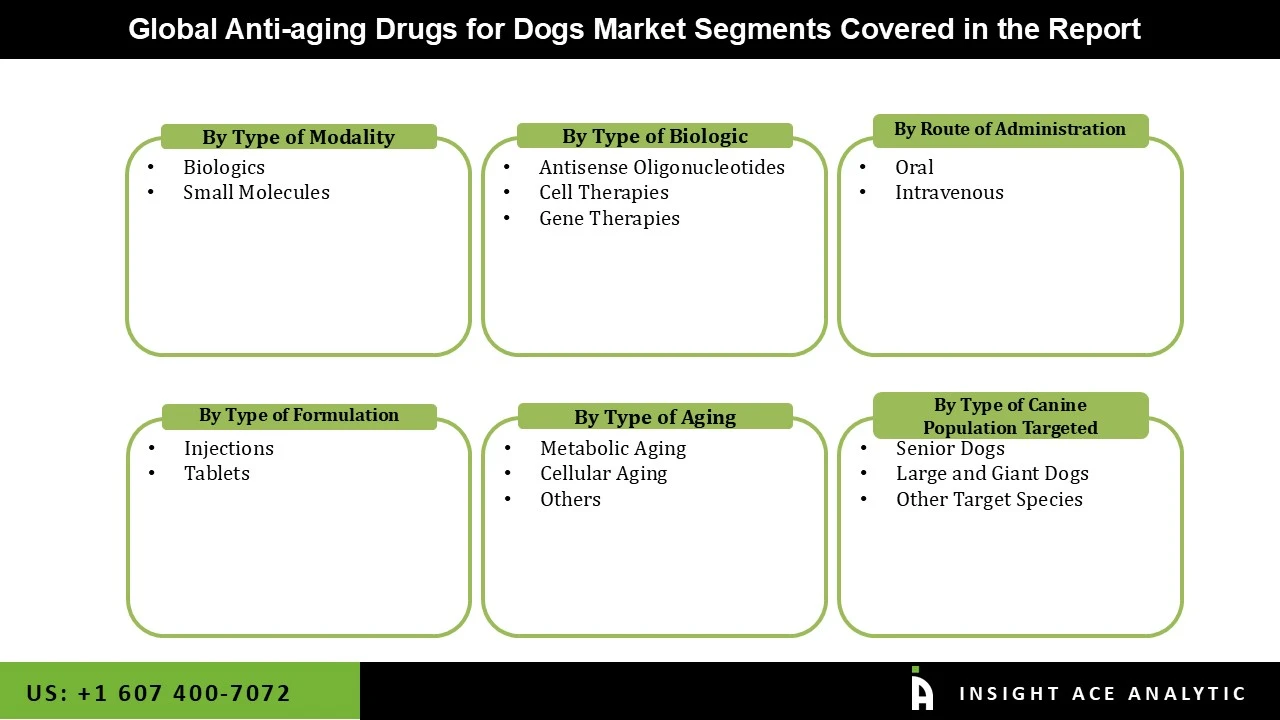
Anti aging Drugs for Dogs Market Size, Share & Trends Analysis Distribution by Type of Modality (Biologics, Small Molecules), By Type of Biologic (Antisense Oligonucleotides, Cell Therapies, Gene Therapies), By Route of Administration (Oral, Intravenous), Type of Formulation (Injections, Tablets), Type of Aging (Metabolic Aging, Cellular Aging, Others) and Segment Forecasts, 2026 to 2035
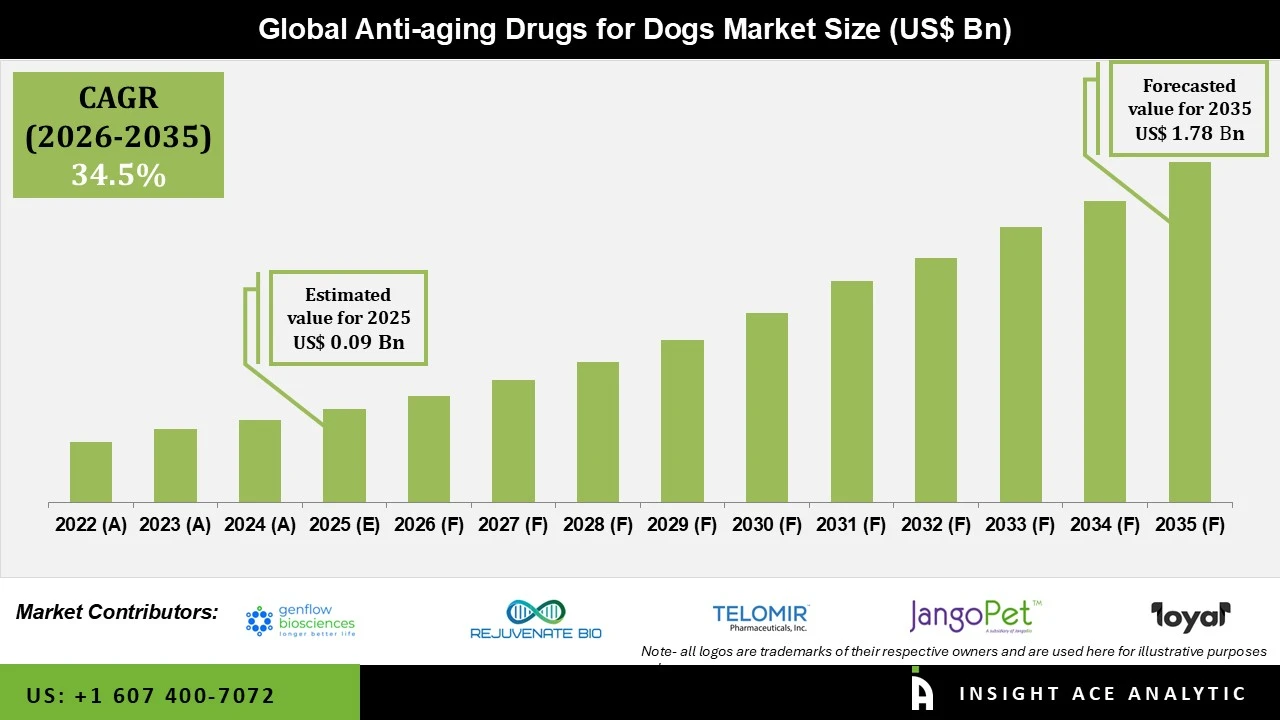
Aging in dogs is a complex biological process. It involves a gradual decline in cellular function, reduced ability to regenerate, and a higher risk of chronic diseases. These diseases include cognitive dysfunction, osteoarthritis, cardiovascular issues, kidney disease, and metabolic disorders. Anti-aging drugs for dogs are therapies designed to target the biological causes of aging instead of just treating one disease. These therapies aim to slow down age-related decline, improve healthspan, and support physical and mental function. They work on pathways linked to cellular aging, inflammation, oxidative stress, mitochondrial function, telomere biology, and gene regulation. This field also embraces new methods like gene therapies and longevity-focused biologics that aim to boost the overall quality of life for aging pets.
The market for anti-aging drugs for dogs is emerging as a distinct part of the veterinary medicine industry. This growth is fueled by ongoing advancements in pet healthcare and longevity science. Biotechnology companies are introducing new therapeutic options, while veterinary research groups and regulatory bodies are exploring fresh strategies to extend healthy lifespans in dogs. The market features increasing clinical studies, partnerships between industry and research institutions, and the creation of innovative drug platforms tailored to age-related issues in pets. As veterinary treatments shift from mere disease management to promoting healthy aging, the anti-aging drugs for dogs market is likely to become more important in the overall companion animal healthcare sector.
Competitive Landscape
Which are the Leading Players in the Anti-aging Drugs for Dogs Market?
• Loyal
• Genflow Bioscience
• Rejuvenate Bio
• Telomir Pharmaceuticals
• Alive
• JangoPet
• Deprenyl Animal Health
Market Dynamics
Driver
Rising Pet Humanization
The increasing humanization of pets drives the anti-aging drugs for dogs market. Dogs are seen as key family members, leading owners to focus on preventive healthcare and long-term wellness along with treating illnesses. This change has resulted in a higher demand for therapies that maintain mobility, cognitive function, and overall vitality as dogs get older. Pet owners are also more open to new veterinary innovations, including longevity-focused drugs and gene therapies, especially when these can extend healthy lifespans instead of just managing age-related diseases. As spending on pet healthcare rises and awareness about healthy aging grows, the demand for anti-aging drugs for dogs is expected to increase significantly. This will encourage more investment and product development in this emerging market.
Restrain/Challenge
Limited Regulatory Pathways and Clinical Validation
One of the main challenges in the anti-aging drugs for dogs market is the limited rules for approving treatments that focus on aging instead of specific diseases. Since aging is not usually seen as a medical condition that can be treated, developers need to show that their drug offers clear clinical benefits, such as delaying the start of age-related diseases or improving overall healthspan. Running long-term clinical trials in companion animals is also complicated, takes a lot of time, and costs a lot of money. It requires a lot of safety and effectiveness data over several years. These scientific and regulatory challenges can extend product development timelines, raise research costs, and postpone commercialization, making it hard for companies to introduce new anti-aging treatments to the veterinary market.
Small Molecules Segment is Expected to Drive the Anti-aging Drugs for Dogs Market
Small molecules are likely to lead the market for anti-aging drugs for dogs. They are in an advanced stage of development, have established regulatory pathways, and are easy to administer. Most of the longevity drug candidates for dogs are small-molecule therapies that can be given orally. This makes them suitable for long-term use and helps pet owners stick to treatment plans. Additionally, small molecules usually have lower manufacturing costs and can be produced at a larger scale compared to biologics, which supports wider commercial use. The presence of leading candidates from companies like Loyal and Telomir Pharmaceuticals highlights the strong growth potential of the small molecules segment during the forecast period.
Gene Therapies Segment is Growing at the Highest Rate in the Anti-aging Drugs for Dogs Market
Gene therapies are expected to grow the most in the anti-aging drugs for dogs market. This is because they target the underlying causes of aging instead of just addressing symptoms. Improvements in gene editing, viral vector technologies, and regenerative medicine are speeding up the creation of new therapies aimed at enhancing healthspan and delaying chronic diseases in older dogs. Increased investment in veterinary biotechnology, more translational research, and a stronger emphasis on precise veterinary medicine are also supporting the swift growth of the gene therapies segment in the coming years.
Why North America Led the Anti-aging Drugs for Dogs Market?
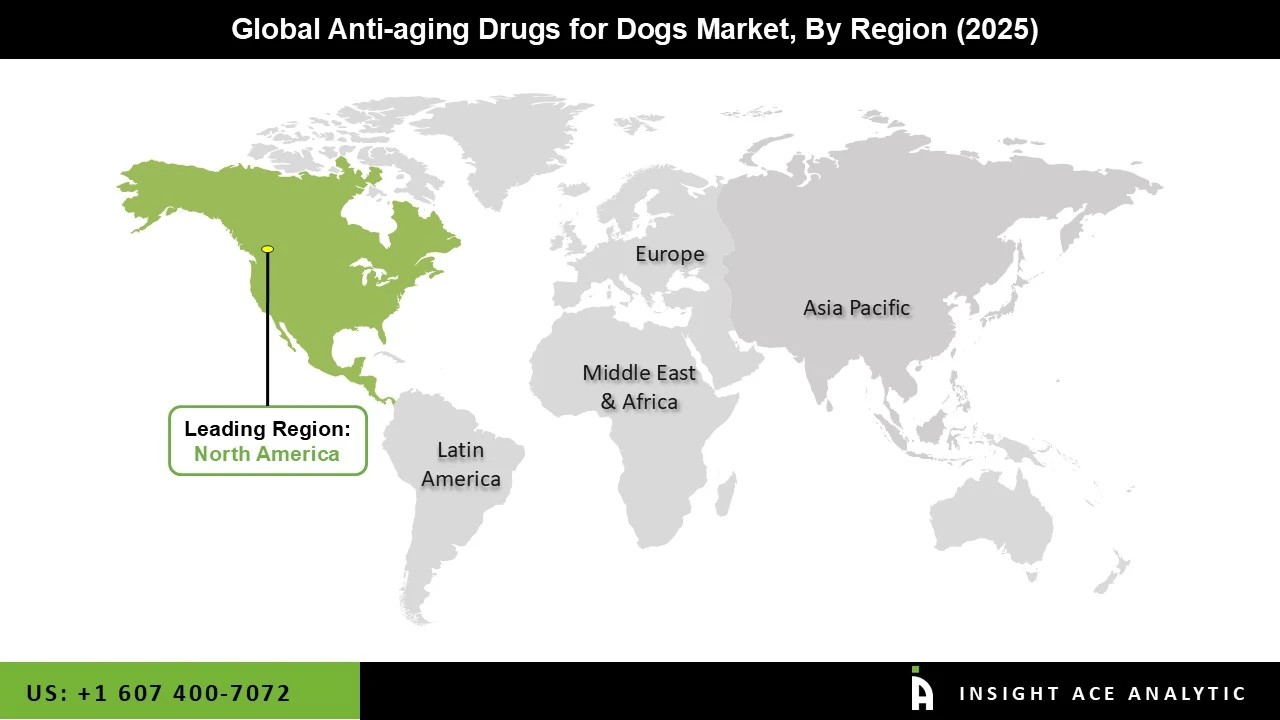
North America is expected to lead the anti-aging drugs for dogs market because of its strong veterinary healthcare system, high levels of pet ownership, and significant spending on pet healthcare. The region has become a center for veterinary biotechnology and longevity research. This is supported by active clinical studies, solid investment in new treatments, and a welcoming regulatory environment for developing veterinary drugs. Additionally, greater awareness of healthy aging in pets and a well-established system for research, marketing, and adopting new veterinary medicines continue to boost North America's position in the market.
Key Development
• In October 2025, Genflow Biosciences announced an update from its GF-1004 Dog Aging proof-of-concept trial, reporting positive safety and efficacy findings for its SIRT6 gene therapy in elderly dogs with age-related decline.
Anti-aging Drugs for Dogs Market Report Scope:
| Report Attribute | Specifications |
| Market size value in 2025 | USD 0.09 Bn |
| Revenue forecast in 2035 | USD 1.78 Bn |
| Growth Rate CAGR | CAGR of 34.5% from 2026 to 2035 |
| Quantitative Units | Representation of revenue in US$ Bn and CAGR from 2026 to 2035 |
| Historic Year | 2022 to 2025 |
| Forecast Year | 2026-2035 |
| Report Coverage | The forecast of revenue, the position of the company, the competitive market structure, growth prospects, and trends |
| Segments Covered | Type of Modality, Type of Biologic, Route of Administration, Type of Formulation, Type of Aging, Type of Canine Population Targeted, and By Region |
| Regional Scope | North America; Europe; Asia Pacific; Latin America; Middle East & Africa |
| Country Scope | U.S.; Canada; U.K.; Germany; China; India; Japan; Brazil; Mexico; The UK; France; Italy; Spain; China; Japan; India; South Korea; Southeast Asia; South Korea; Southeast Asia |
| Competitive Landscape | Loyal, Genflow Bioscience, Rejuvenate Bio, Telomir Pharmaceuticals, Alive, JangoPet, Deprenyl Animal Health |
| Customization Scope | Free customization report with the procurement of the report, Modifications to the regional and segment scope. Geographic competitive landscape. |
| Pricing and Available Payment Methods | Explore pricing alternatives that are customized to your particular study requirements. |
Market Segmentation:
Anti-aging Drugs for Dogs Market by Type of Modality -
• Biologics
• Small Molecules
Anti-aging Drugs for Dogs Market by Type of Biologic -
• Antisense Oligonucleotides
• Cell Therapies
• Gene Therapies
Anti-aging Drugs for Dogs Market by Route of Administration -
• Oral
• Intravenous
Anti-aging Drugs for Dogs Market by Type of Formulation -
• Injections
• Tablets
Anti-aging Drugs for Dogs Market by Type of Aging -
• Metabolic Aging
• Cellular Aging
• Others
Anti-aging Drugs for Dogs Market by Type of Canine Population Targeted -
• Senior Dogs
• Large and Giant Dogs
• Other Target Species
Anti-aging Drugs for Dogs Market by Region-
North America-
• The US
• Canada
• Mexico
Europe-
• Germany
• The UK
• France
• Italy
• Spain
• Rest of Europe
Asia-Pacific-
• China
• Japan
• India
• South Korea
• South East Asia
• Rest of Asia Pacific
Latin America-
• Brazil
• Argentina
• Rest of Latin America
Middle East & Africa-
• GCC Countries
• South Africa
• Rest of Middle East and Africa
Research Design and Approach
This study employed a multi-step, mixed-method research approach that integrates:
- Secondary research
- Primary research
- Data triangulation
- Hybrid top-down and bottom-up modelling
- Forecasting and scenario analysis
This approach ensures a balanced and validated understanding of both macro- and micro-level market factors influencing the market.
Secondary Research
Secondary research for this study involved the collection, review, and analysis of publicly available and paid data sources to build the initial fact base, understand historical market behaviour, identify data gaps, and refine the hypotheses for primary research.
Sources Consulted
Secondary data for the market study was gathered from multiple credible sources, including:
- Government databases, regulatory bodies, and public institutions
- International organizations (WHO, OECD, IMF, World Bank, etc.)
- Commercial and paid databases
- Industry associations, trade publications, and technical journals
- Company annual reports, investor presentations, press releases, and SEC filings
- Academic research papers, patents, and scientific literature
- Previous market research publications and syndicated reports
These sources were used to compile historical data, market volumes/prices, industry trends, technological developments, and competitive insights.

Primary Research
Primary research was conducted to validate secondary data, understand real-time market dynamics, capture price points and adoption trends, and verify the assumptions used in the market modelling.
Stakeholders Interviewed
Primary interviews for this study involved:
- Manufacturers and suppliers in the market value chain
- Distributors, channel partners, and integrators
- End-users / customers (e.g., hospitals, labs, enterprises, consumers, etc., depending on the market)
- Industry experts, technology specialists, consultants, and regulatory professionals
- Senior executives (CEOs, CTOs, VPs, Directors) and product managers
Interview Process
Interviews were conducted via:
- Structured and semi-structured questionnaires
- Telephonic and video interactions
- Email correspondences
- Expert consultation sessions
Primary insights were incorporated into demand modelling, pricing analysis, technology evaluation, and market share estimation.
Data Processing, Normalization, and Validation
All collected data were processed and normalized to ensure consistency and comparability across regions and time frames.
The data validation process included:
- Standardization of units (currency conversions, volume units, inflation adjustments)
- Cross-verification of data points across multiple secondary sources
- Normalization of inconsistent datasets
- Identification and resolution of data gaps
- Outlier detection and removal through algorithmic and manual checks
- Plausibility and coherence checks across segments and geographies
This ensured that the dataset used for modelling was clean, robust, and reliable.
Market Size Estimation and Data Triangulation
Bottom-Up Approach
The bottom-up approach involved aggregating segment-level data, such as:
- Company revenues
- Product-level sales
- Installed base/usage volumes
- Adoption and penetration rates
- Pricing analysis
This method was primarily used when detailed micro-level market data were available.

Top-Down Approach
The top-down approach used macro-level indicators:
- Parent market benchmarks
- Global/regional industry trends
- Economic indicators (GDP, demographics, spending patterns)
- Penetration and usage ratios
This approach was used for segments where granular data were limited or inconsistent.
Hybrid Triangulation Approach
To ensure accuracy, a triangulated hybrid model was used. This included:
- Reconciling top-down and bottom-up estimates
- Cross-checking revenues, volumes, and pricing assumptions
- Incorporating expert insights to validate segment splits and adoption rates
This multi-angle validation yielded the final market size.
Forecasting Framework and Scenario Modelling
Market forecasts were developed using a combination of time-series modelling, adoption curve analysis, and driver-based forecasting tools.
Forecasting Methods
- Time-series modelling
- S-curve and diffusion models (for emerging technologies)
- Driver-based forecasting (GDP, disposable income, adoption rates, regulatory changes)
- Price elasticity models
- Market maturity and lifecycle-based projections
Scenario Analysis
Given inherent uncertainties, three scenarios were constructed:
- Base-Case Scenario: Expected trajectory under current conditions
- Optimistic Scenario: High adoption, favourable regulation, strong economic tailwinds
- Conservative Scenario: Slow adoption, regulatory delays, economic constraints
Sensitivity testing was conducted on key variables, including pricing, demand elasticity, and regional adoption.
Request Customization
Add countries, segments, company profiles, or extend forecast — free 10% customization with purchase.
Customize This Report →Enquire Before Buying
Speak with our analyst team about scope, methodology, pricing, or deliverable formats.
Enquire Now →Frequently Asked Questions
Anti aging Drugs for Dogs Market Size is valued at USD 0.09 Bn in 2025 and is predicted to reach USD 1.78 Bn by the year 2035
Anti aging Drugs for Dogs Market is expected to grow at a 34.5 % CAGR during the forecast period for 2026 to 2035.
Loyal, Genflow Bioscience, Rejuvenate Bio, Telomir Pharmaceuticals, Alive, JangoPet, Deprenyl Animal Health
Anti aging Drugs for Dogs Market is segmented into Type of Modality, Type of Biologic, Route of Administration, Type of Formulation, Type of Aging, Type of Canine Population Targeted, and By Region
North America region is leading the Anti aging Drugs for Dogs Market.