Pet Food E-commerce Market Size, Trend, Revenue Report 2026 to 2035
What is Pet Food E-commerce Market Size?
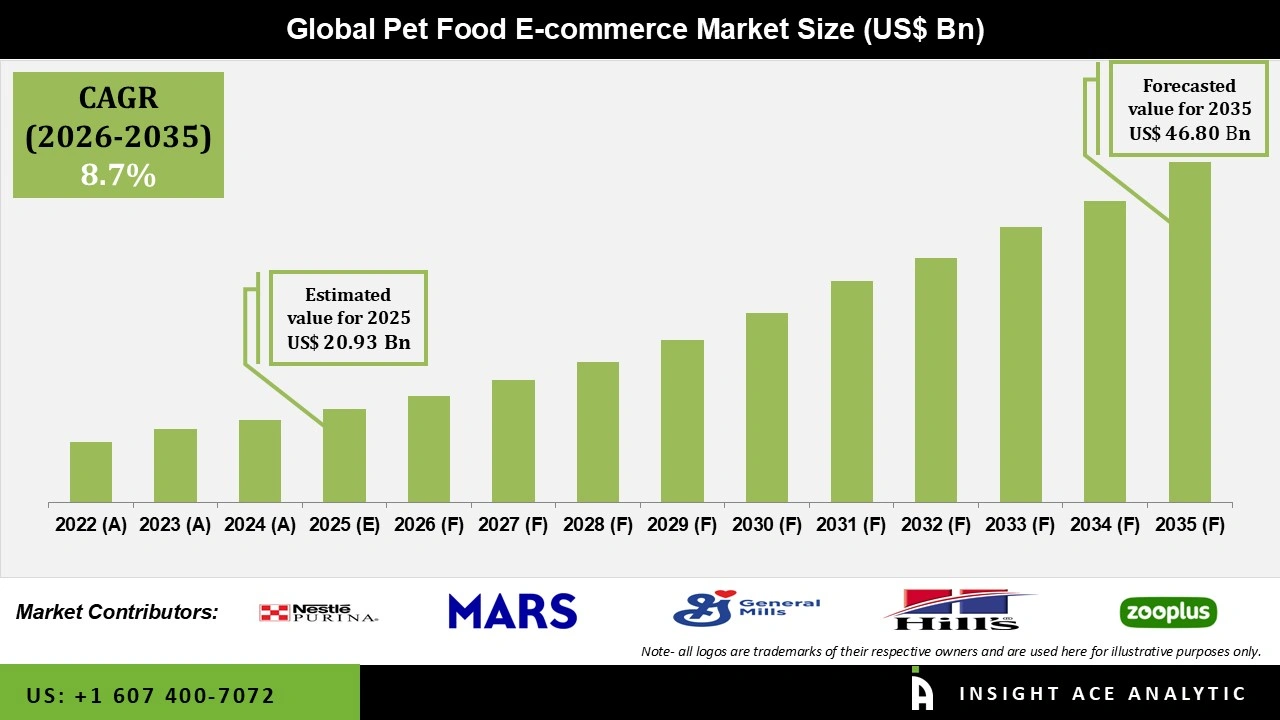
Global Pet Food E-commerce Market Size is valued at USD 20.93 Bn in 2025 and is predicted to reach USD 46.80 Bn by the year 2035 at a 8.7% CAGR during the forecast period for 2026 to 2035.
Pet Food E-commerce Market Size, Share & Trends Analysis Distribution by Pet Type (Dogs (Dry Food, Wet Food, Snacks/Treats), Cats (Dry Food, Wet Food, Snacks/Treats), Others (Dry Food, Wet Food, Snacks/Treats), by Price Range (Economy, Mid-Range, Premium) and Segment Forecasts, 2026 to 2035.
The pet food e-commerce market is now a key part of the global pet care industry, as more people choose to buy pet food online for convenience. Shifts in shopping habits, greater use of the internet and smartphones, and better digital payment options have led many consumers to shop for pet food online instead of in stores. E-commerce gives pet owners more product choices, better prices, home delivery, subscription options, and easy access to premium and speciality brands. As more people own pets in both developed and emerging countries, online pet food sales keep rising. A major reason for the market’s growth is that pet owners are paying more attention to pet health and nutrition. They want high-quality food that fits their pets’ age, breed, size, and health needs. This has led to more demand for premium, grain-free, organic, natural, veterinary-recommended, and functional pet foods. Online shopping makes it easier for people to compare products, read reviews, and pick from a wider range than in most stores. Subscription and automatic delivery services also help customers keep a steady supply of pet food.
Technology is also helping the market grow. Features like AI-powered product suggestions, personalised shopping, mobile apps, loyalty programs, and targeted marketing help e-commerce companies keep customers engaged. Faster delivery, better logistics, and improved inventory management have made online shopping easier. Partnerships between pet food makers, online stores, marketplaces, and direct-to-consumer brands are making more products available and helping companies reach more customers. Social media, influencer marketing, and digital ads are also raising awareness of premium pet foods and encouraging people to buy online. Even though the market is growing fast, there are some challenges. Online retailers face tough competition, pressure to keep prices low, higher delivery and logistics costs, and customers who expect fast shipping. Sellers also have to deal with fake products, worries about product authenticity, and keeping food fresh during shipping. To stay competitive, companies need to keep investing in their digital platforms, cybersecurity, customer service, and supply chain efficiency.
Despite these challenges, the long-term outlook for pet food e-commerce is very positive. More people are owning pets, spending more on their care, and looking for better nutrition. With more internet access and ongoing improvements in digital commerce, the market is set to keep growing. As shoppers keep valuing convenience, personalized experiences, and quality pet food, online sales will become even more important in the global pet food industry.
Competitive Landscape
Which are the Leading Players in the Pet Food E-commerce Market?
- Nestlé Purina
- Mars, Incorporated
- Hill's Pet Nutrition, Inc.
- General Mills Inc.
- Schell & Kampeter, Inc.
- Zooplus SE
- Charoen Pokphand Group
- The J.M. Smucker Company
- Chewy, Inc.
- Petto
Market Dynamics
Driver
Rising Pet Ownership and Growing Preference for Online Pet Food Shopping
The pet food e-commerce market is steadily growing as more people own pets and choose the convenience of shopping online. With busy schedules, better internet access, and widespread smartphone use, many pet owners now buy pet food online instead of going to stores. Online shopping gives them more choices, better prices, home delivery, subscription options, and access to both local and international brands. Pet owners are also paying more attention to their pets’ health and nutrition, which increases demand for premium, natural, organic, grain-free, and breed-specific foods. E-commerce makes it easier to compare products, read reviews, and pick the best food for each pet. Improvements in digital payments, delivery networks, smart product suggestions, and personalised shopping are also helping the market grow. As people spend more on pet care and get used to shopping online, the pet food e-commerce market is likely to keep expanding in the coming years.
Restrain/Challenge
Intense Market Competition and Supply Chain Challenges
A major challenge in the pet food e-commerce market is strong competition among online retailers. Many e-commerce sites, direct brands, supermarkets, and pet stores compete by offering discounts, promotions, and fast delivery, which can lower profit margins. Keeping pet food fresh during storage and shipping, especially for wet and premium products, requires good logistics and inventory management. Higher shipping costs, supply chain issues, and changes in raw material prices can affect product availability and costs. Online retailers also need to deal with concerns about fake products, customer trust, secure payments, and data privacy. To stay competitive, companies must keep investing in technology, delivery systems, customer service, and digital marketing while managing costs and efficiency.
The Dogs Segment is Expected to Drive the Pet Food E-commerce Market
Dogs are expected to account for the largest share of the pet food e-commerce market in the coming years. They are the most popular pets worldwide, which keeps demand high for all types of dog food, from dry and wet food to treats. More pet owners are willing to pay for better nutrition to support their dogs’ health and well-being. Online stores make it easy to find premium and special dog foods that might not be in regular shops. Subscription plans, personalised feeding tips, and home delivery also make online shopping more appealing. As more people own dogs and focus on their pets’ health, the dog segment will likely keep driving growth in the pet food e-commerce market.
The Premium Segment is Expected to Drive the Pet Food E-commerce Market
Premium pet food is expected to be the fastest-growing part of the e-commerce market as more owners choose quality over price. People want pet food with high-quality ingredients, balanced nutrition, natural recipes, and health benefits for their pets. Premium options like grain-free, organic, high-protein, vet-recommended, and breed-specific diets are becoming more popular online. E-commerce makes it easier to find, compare, and buy these premium brands, including some that are not sold in regular stores. As people have more disposable income, treat pets more like family, and learn more about pet nutrition, demand for premium pet food online is likely to keep rising.
Why North America Leads the Pet Food E-commerce Market?
North America leads the pet food e-commerce market because of high pet ownership, strong online shopping systems, and high spending on pet care. In the United States and Canada, many pet owners buy pet food online for convenience, subscriptions, and access to premium brands. The region also has advanced delivery networks, secure payment systems, good internet access, and many top pet food makers and online stores.
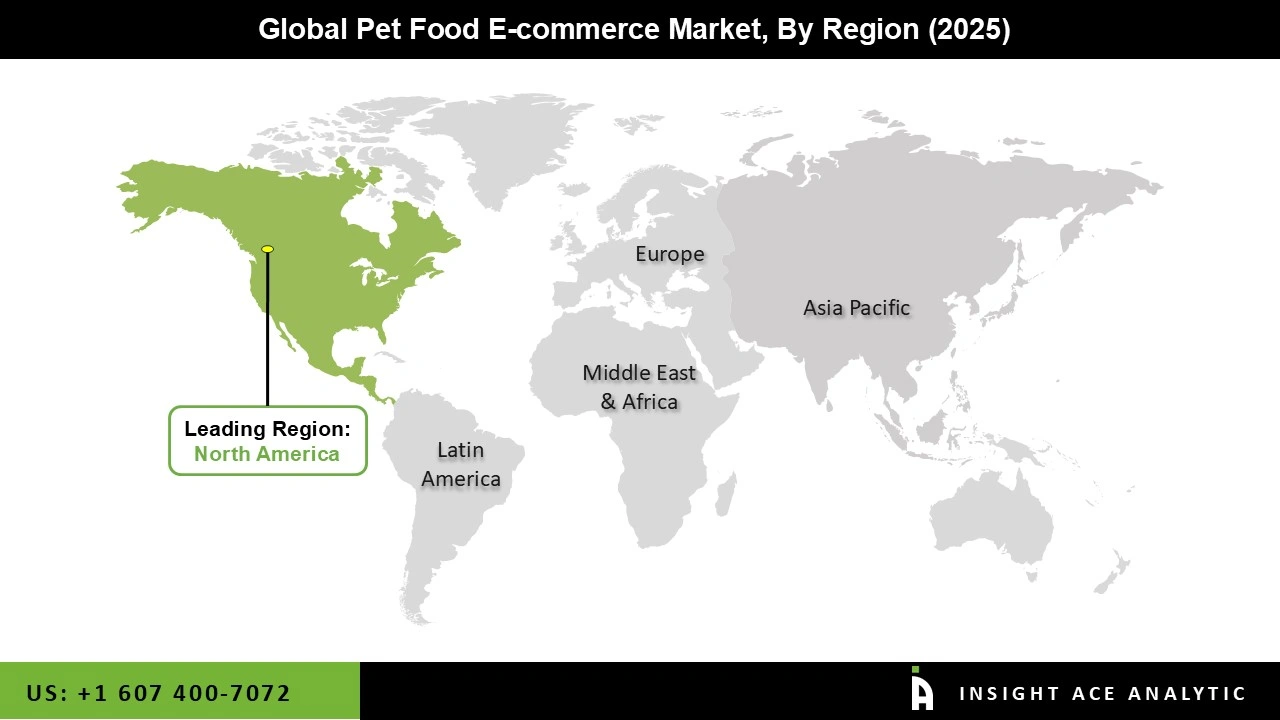
More people are learning about pet nutrition and want premium or special foods, and direct-to-consumer sales are growing. With new digital shopping options, personalised experiences, and more spending on pets, North America is likely to stay ahead in the global pet food e-commerce market.
Key Developments-
• In May 2025, Nestlé Purina expanded its pet care business by strengthening its presence in high-growth markets and increasing investments in premium pet nutrition, supporting the growing demand for online pet food sales and digital retail channels.
• In March 2025, Chewy, Inc. continued enhancing its e-commerce platform by expanding its Autoship subscription program, personalised shopping experience, and digital pharmacy services to improve customer convenience and retention.
Pet Food E-commerce Market Report Scope :
| Report Attribute | Specifications |
| Market size value in 2025 | USD 20.93 Bn |
| Revenue forecast in 2035 | USD 46.80 Bn |
| Growth Rate CAGR | CAGR of 8.7% from 2026 to 2035 |
| Quantitative Units | Representation of revenue in US$ Bn and CAGR from 2026 to 2035 |
| Historic Year | 2022 to 2025 |
| Forecast Year | 2026-2035 |
| Report Coverage | The forecast of revenue, the position of the company, the competitive market structure, growth prospects, and trends |
| Segments Covered | Pet Type, Price Range and By Region |
| Regional Scope | North America; Europe; Asia Pacific; Latin America; Middle East & Africa |
| Country Scope | U.S.; Canada; U.K.; Germany; China; India; Japan; Brazil; Mexico; The UK; France; Italy; Spain; China; Japan; India; South Korea; Southeast Asia; South Korea; Southeast Asia |
| Competitive Landscape | Nestlé Purina, Mars, Incorporated, Hill's Pet Nutrition, Inc., General Mills Inc., Schell & Kampeter, Inc., Zooplus SE, Charoen Pokphand Group, The J.M. Smucker Company, Chewy, Inc., Petto |
| Customization Scope | Free customisation report with the procurement of the report, Modifications to the regional and segment scope. Geographic competitive landscape. |
| Pricing and Available Payment Methods | Explore pricing alternatives that are customized to your particular study requirements. |
Segmentations Pet Food E-commerce Market :
Pet Food E-commerce Market by Pet Type-
- Dogs
- Dry Food
- Wet Food
- Snacks/Treats
- Cats
- Dry Food
- Wet Food
- Snacks/Treats
- Others
- Dry Food
- Wet Food
- Snacks/Treats
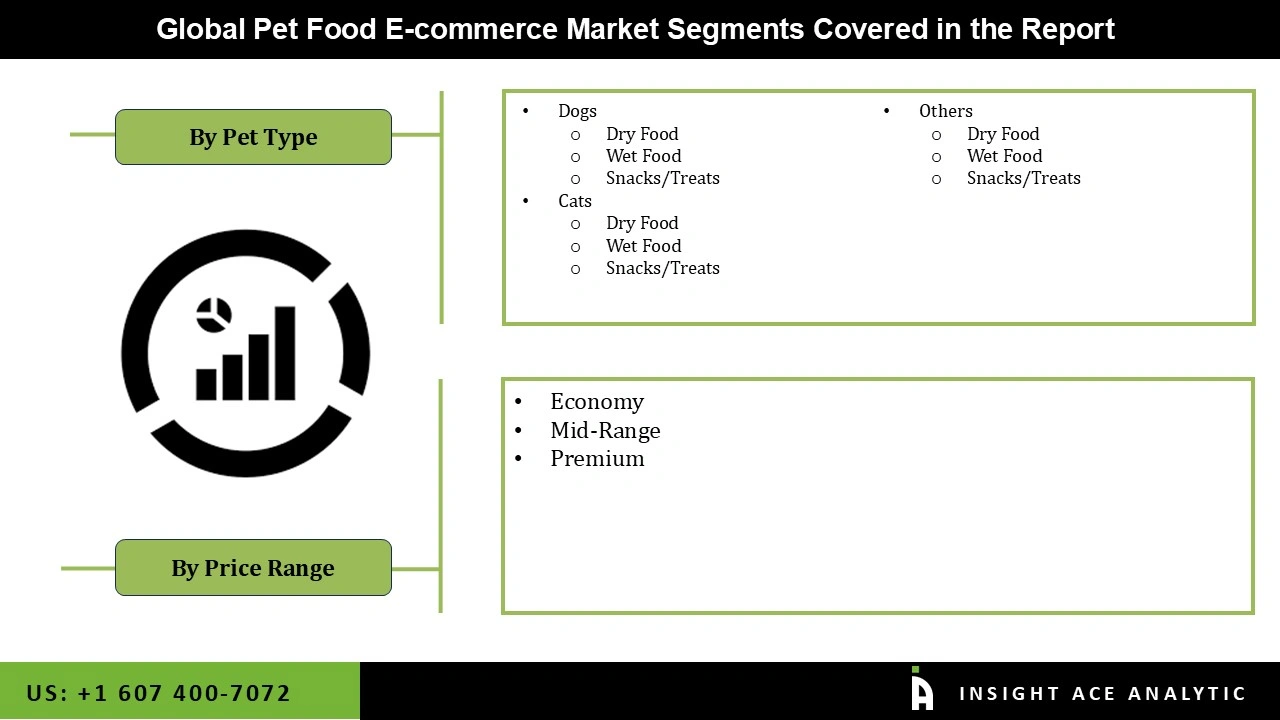
Pet Food E-commerce Market by Price Range-
- Economy
- Mid-Range
- Premium
Pet Food E-commerce Market by Region-
- North America-
- The US
- Canada
- Europe-
- Germany
- The UK
- France
- Italy
- Spain
- Rest of Europe
- Asia-Pacific-
- China
- Japan
- India
- South Korea
- South East Asia
- Rest of Asia Pacific
- Latin America-
- Brazil
- Argentina
- Mexico
- Rest of Latin America
- Middle East and Africa-
- GCC Countries
- South Africa
- Rest of Middle East and Africa
Research Design and Approach
This study employed a multi-step, mixed-method research approach that integrates:
- Secondary research
- Primary research
- Data triangulation
- Hybrid top-down and bottom-up modelling
- Forecasting and scenario analysis
This approach ensures a balanced and validated understanding of both macro- and micro-level market factors influencing the market.
Secondary Research
Secondary research for this study involved the collection, review, and analysis of publicly available and paid data sources to build the initial fact base, understand historical market behaviour, identify data gaps, and refine the hypotheses for primary research.
Sources Consulted
Secondary data for the market study was gathered from multiple credible sources, including:
- Government databases, regulatory bodies, and public institutions
- International organizations (WHO, OECD, IMF, World Bank, etc.)
- Commercial and paid databases
- Industry associations, trade publications, and technical journals
- Company annual reports, investor presentations, press releases, and SEC filings
- Academic research papers, patents, and scientific literature
- Previous market research publications and syndicated reports
These sources were used to compile historical data, market volumes/prices, industry trends, technological developments, and competitive insights.

Primary Research
Primary research was conducted to validate secondary data, understand real-time market dynamics, capture price points and adoption trends, and verify the assumptions used in the market modelling.
Stakeholders Interviewed
Primary interviews for this study involved:
- Manufacturers and suppliers in the market value chain
- Distributors, channel partners, and integrators
- End-users / customers (e.g., hospitals, labs, enterprises, consumers, etc., depending on the market)
- Industry experts, technology specialists, consultants, and regulatory professionals
- Senior executives (CEOs, CTOs, VPs, Directors) and product managers
Interview Process
Interviews were conducted via:
- Structured and semi-structured questionnaires
- Telephonic and video interactions
- Email correspondences
- Expert consultation sessions
Primary insights were incorporated into demand modelling, pricing analysis, technology evaluation, and market share estimation.
Data Processing, Normalization, and Validation
All collected data were processed and normalized to ensure consistency and comparability across regions and time frames.
The data validation process included:
- Standardization of units (currency conversions, volume units, inflation adjustments)
- Cross-verification of data points across multiple secondary sources
- Normalization of inconsistent datasets
- Identification and resolution of data gaps
- Outlier detection and removal through algorithmic and manual checks
- Plausibility and coherence checks across segments and geographies
This ensured that the dataset used for modelling was clean, robust, and reliable.
Market Size Estimation and Data Triangulation
Bottom-Up Approach
The bottom-up approach involved aggregating segment-level data, such as:
- Company revenues
- Product-level sales
- Installed base/usage volumes
- Adoption and penetration rates
- Pricing analysis
This method was primarily used when detailed micro-level market data were available.

Top-Down Approach
The top-down approach used macro-level indicators:
- Parent market benchmarks
- Global/regional industry trends
- Economic indicators (GDP, demographics, spending patterns)
- Penetration and usage ratios
This approach was used for segments where granular data were limited or inconsistent.
Hybrid Triangulation Approach
To ensure accuracy, a triangulated hybrid model was used. This included:
- Reconciling top-down and bottom-up estimates
- Cross-checking revenues, volumes, and pricing assumptions
- Incorporating expert insights to validate segment splits and adoption rates
This multi-angle validation yielded the final market size.
Forecasting Framework and Scenario Modelling
Market forecasts were developed using a combination of time-series modelling, adoption curve analysis, and driver-based forecasting tools.
Forecasting Methods
- Time-series modelling
- S-curve and diffusion models (for emerging technologies)
- Driver-based forecasting (GDP, disposable income, adoption rates, regulatory changes)
- Price elasticity models
- Market maturity and lifecycle-based projections
Scenario Analysis
Given inherent uncertainties, three scenarios were constructed:
- Base-Case Scenario: Expected trajectory under current conditions
- Optimistic Scenario: High adoption, favourable regulation, strong economic tailwinds
- Conservative Scenario: Slow adoption, regulatory delays, economic constraints
Sensitivity testing was conducted on key variables, including pricing, demand elasticity, and regional adoption.
Request Customization
Add countries, segments, company profiles, or extend forecast — free 10% customization with purchase.
Customize This Report →Enquire Before Buying
Speak with our analyst team about scope, methodology, pricing, or deliverable formats.
Enquire Now →Frequently Asked Questions
Pet Food E-commerce Market Size is valued at USD 20.93 Bn in 2025 and is predicted to reach USD 46.80 Bn by the year 2035
The Pet Food E-commerce Market is expected to grow at a 8.7% CAGR during the forecast period for 2026 to 2035
Nestlé Purina, Mars, Incorporated, Hill\'s Pet Nutrition, Inc., General Mills Inc., Schell & Kampeter, Inc., Zooplus SE, Charoen Pokphand Group, The J.M. Smucker Company, Chewy, Inc., Petto and Others.
Pet Food E-commerce Market is segmented into Pet Type, Price Range and Other.
North America region is leading the Pet Food E-commerce Market.