Al Chip Market Size, Share and Market Key Players Analysis 2026 to 2035
What is Al Chip Market Size?
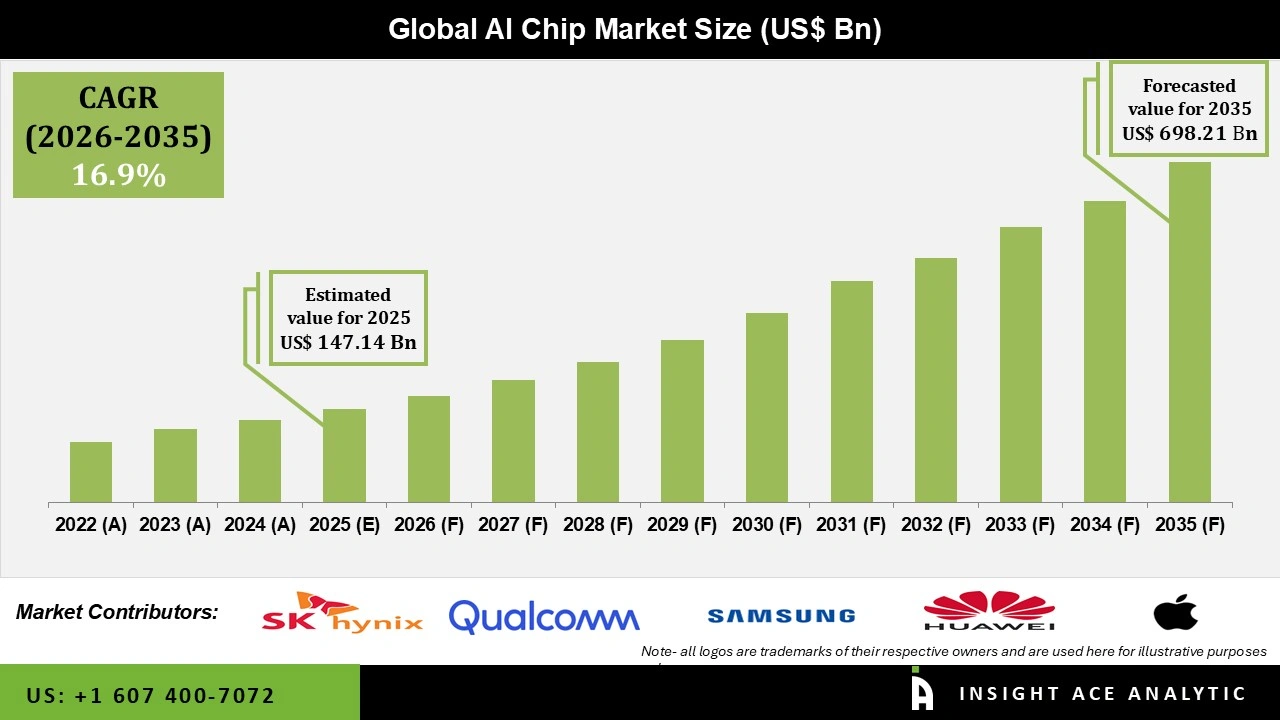
Global Al Chip Market Size is valued at USD 147.14 Bn in 2025 and is predicted to reach USD 698.21 Bn by the year 2035 at a 16.9% CAGR during the forecast period for 2026 to 2035.
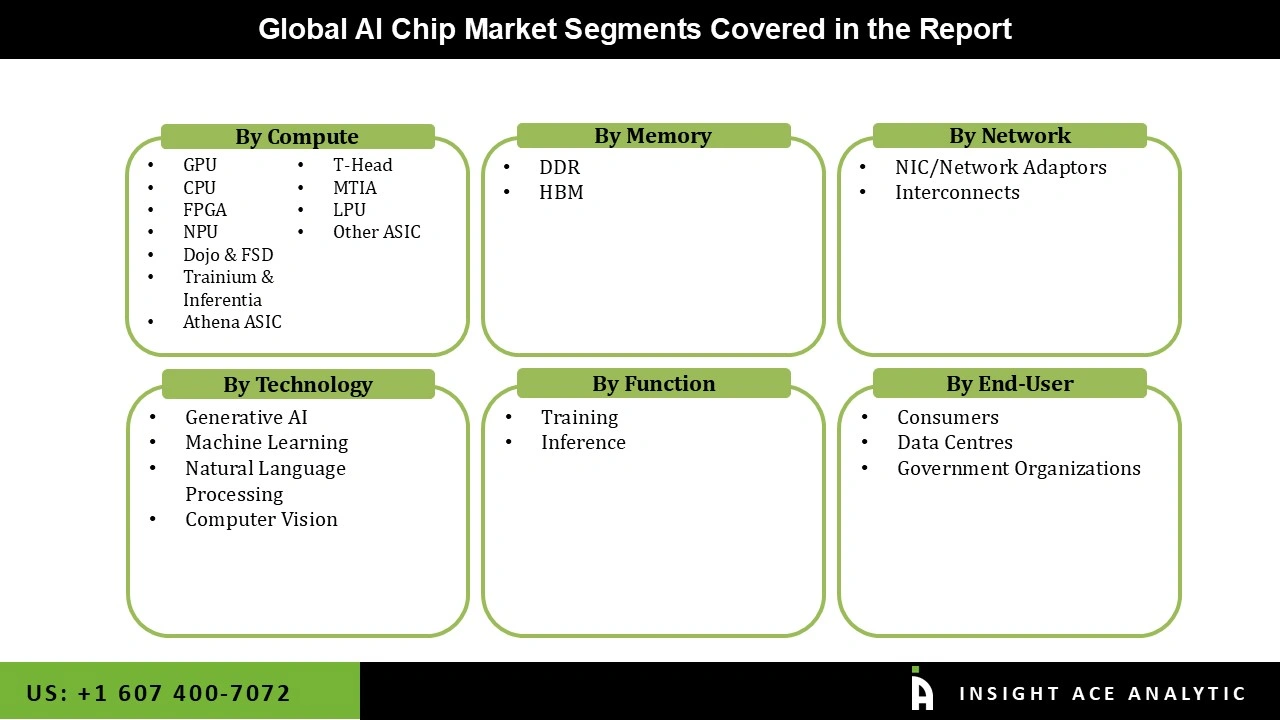
Al Chip Market Size, Share & Trends Analysis Distribution by Memory (HBM and DDR), Function (Inference and Training), Compute (CPU, GPU, MTIA, LPU, Athena ASIC, NPU, Dojo & FSD, Trainium & Inferentia, T-Head, FPGA, and Others), Network (NIC/Network Adaptors and Interconnects), Technology (Natural Language Processing, Generative Al, Computer Vision, and Machine Learning), End-user (Data Centers, Consumers, and Government Organizations), and Segment Forecasts, 2026 to 2035
Al Chip Market Key Takeaways:
|
AI processors are specialized chips including GPUs, TPUs, FPGAs, and custom ASICs designed to accelerate artificial intelligence workloads like machine learning inference and training. Unlike general-purpose CPUs, these processors are optimized for the massive parallel computations required by neural networks, making them essential hardware for enabling everything from voice assistants and autonomous vehicles to medical imaging and industrial automation. The development of AI technology across numerous industries depends on AI chips. Their creation and implementation are now essential to fulfilling the expanding need for complex AI applications. It plays a crucial part in advancing AI technology by facilitating real-time training and inference for a variety of applications. The AI chip market is expanding due in large part to the increased need for deep learning and the broad application of AI across many industries.
The AI chip market is fueled by the expanding use of edge computing, which relies less on centralized cloud servers and instead processes data closer to the point of data generation. To manage real-time applications and minimize latency, edge devices need strong and effective AI processing. Additionally, the market is expanding due to significant investments made in AI research and infrastructure development by governments and large enterprises. Technology development and business expansion are accelerated by funding for AI projects. Furthermore, medical imaging, diagnostics, medication development, and customized medicine are just a few of the healthcare-related prospects that AI chips present. It is anticipated that the need for AI chips designed for medical applications will be driven by AI in healthcare.
Additionally, the global expansion of the AI chip market has been greatly driven by a noticeable increase in funding for research and development (R&D) projects aimed at advancing cutting-edge AI chip technology. The market has also been driven by technological advancements, especially the growing use of robotics in a variety of industries. The constant development and progress of AI applications and technologies, such as machine learning (ML) and deep learning (DL), are important motivators. AI chips are becoming increasingly widely used as a result of the growing need for specialized hardware acceleration brought on by the complexity of AI algorithms. However, the expense of developing, researching, and producing sophisticated AI processors is high. High initial costs prevent startups and smaller businesses from entering the market, which reduces competition overall.
Competitive Landscape
Which are the Leading Players in Al Chip Market?
- SAMSUNG
- Huawei Technologies Co., Ltd.
- Qualcomm Technologies, Inc.
- Apple Inc.
- NVIDIA Corporation
- Imagination Technologies
- Graphcore
- Cerebras
- Micron Technology, Inc.
- Groq, Inc.
- Advanced Micro Devices, Inc.
- Intel Corporation
- SK HYNIX INC
Market Dynamics
Driver
Growing Integration of AI and Digitalization in the Healthcare Sector
The healthcare sector's increasing digitalization and AI integration are fueling the AI chip market expansion. Globally, the healthcare industry is rapidly going digital due to government initiatives and support. Large amounts of healthcare data are being produced as a result of the rapid adoption of digital health technology, such as telemedicine, electronic health records, and other advances, by nations like Germany, South Korea, and India, among others. Since AI chips are essential for effectively collecting and evaluating this data, demand from medical device manufacturers worldwide has significantly increased. Additionally, the use of AI in radiology is rapidly growing due to its potential to improve patient care, expedite workflows, and improve diagnostic accuracy. Using AI algorithms and machine learning gives radiologists access to important information that aids in abnormality identification, enhances diagnosis, and improves care overall. Many medical device makers have decided to integrate AI into their products as a result of this advancement.
Restrain/Challenge
High Cost of Creation and Integration of AI Chips
The high expenses related to the creation and integration of AI chips are a major barrier to the AI chip market. Cutting-edge manufacturing techniques, specialized materials, and significant expenditure in research and development (R&D) are necessary for the design and production of sophisticated AI chips. Additionally, the costs are increased by the fact that incorporating these chips into programs requires a great deal of testing and tuning to guarantee compatibility and performance. Moreover, the adoption of AI technologies by small and medium-sized businesses (SMEs) may be hindered by these large initial expenditures. This cost barrier slows down industry innovation in addition to limiting the admission of new firms, which hinders the AI chip market expansion. In order to promote a more competitive and diverse AI chip market and enable wider access to AI technology, these cost issues must be resolved.
GPU Segment is Expected to Drive the AI Chip Market
The GPU category held the largest share in the AI chip market in 2025. The intrinsic architecture of GPUs, which is remarkably well-suited for managing the parallel processing demands of artificial intelligence and machine learning workloads, is responsible for this leadership. GPUs are made with thousands of smaller, more effective cores that can do several jobs at once, in contrast to standard CPUs. Additionally, because of this ability, they are perfect for speeding up the computation of AI algorithms, which drastically cuts down on the amount of time needed for data processing and analysis. The GPU segment's broad use in a number of high-growth industries, such as deep learning applications, high-performance computing, and autonomous vehicles, further supports its dominance. Furthermore, a wider number of sectors can now use GPUs due to the ongoing developments in the technology, which are characterized by gains in processing power, energy efficiency, and integration capabilities.
Natural Language Processing Segment is Growing at the Highest Rate in the Al Chip Market
In 2025, the Natural Language Processing category dominated the Al Chip market because it acts as the foundation for numerous revolutionary services and technologies in a variety of industries. The necessity for specialized AI chips in NLP has increased due to the rise in AI-powered chatbots and virtual assistants. Additionally, language-based tasks including translation, sentiment analysis, speech recognition, and text generation—which span industries from e-commerce to healthcare—rely heavily on natural language processing (NLP). NLP is being used more and more in the healthcare industry for activities like analyzing medical records, among others. Furthermore, NLP-optimized chips improve communication in the field of robotics and autonomous systems. NLP's adaptability is increased by its multilingual and cross-lingual applications. NLP is still essential to human-machine interaction as AI continues to transform industries, which guarantees a steady demand for AI chips built to perform well in NLP activities.
Why North America Led the Al Chip Market?
The Al Chip market was dominated by North American region in 2025 spurred by the quick uptake of AI technology across a variety of sectors, including banking, IT, healthcare, and automobile. The growing investments in data centers, cloud computing, edge AI, and autonomous systems, as well as the growing need for high-performance, energy-efficient processors for machine learning, deep learning, and real-time analytics, are all contributing factors to the market's expansion.
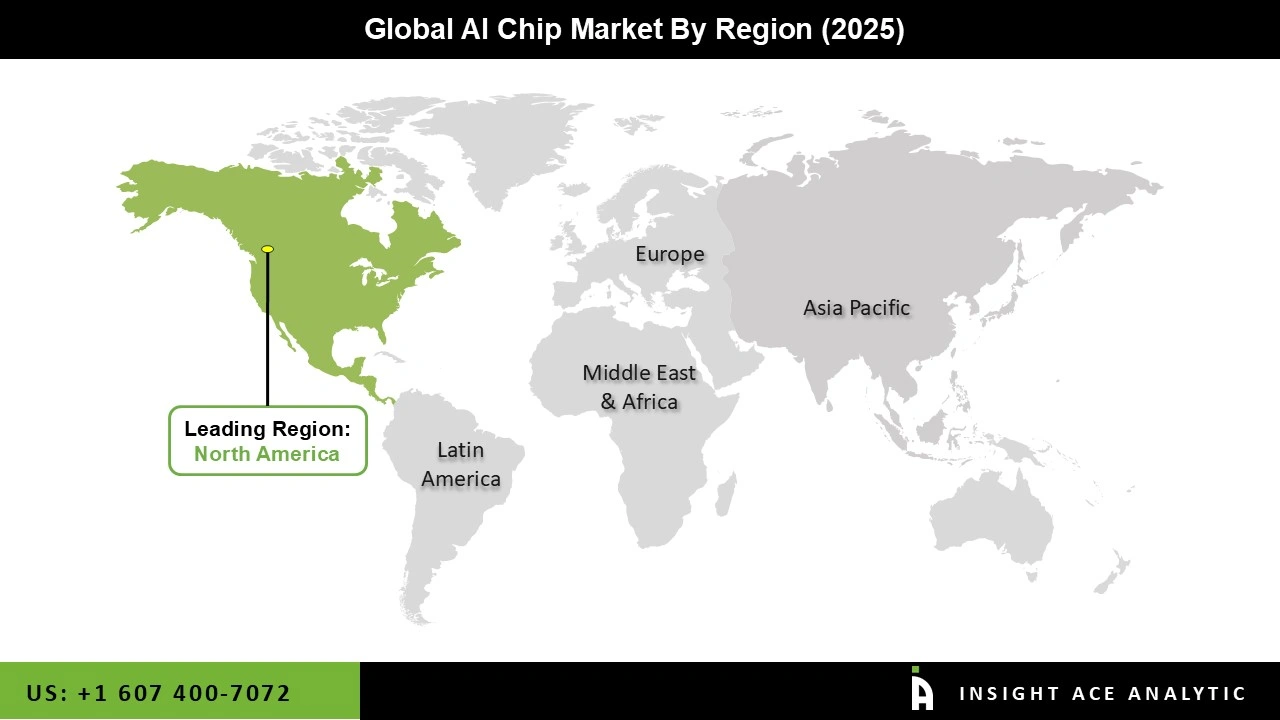
Additional factors that speed up regional expansion include government assistance, research projects, and early adoption of cutting-edge AI applications. The development of high-performance, energy-efficient AI chip specifically for North American sectors such as healthcare, banking, IT, and automotive should also be a priority for manufacturers.
Key Development
In July 2024, AMD successfully acquired the European AI lab Silo AI. By incorporating the knowledge and skills of the engineers and scientists at Silo AI, who have previously worked for a number of well-known clients, AMD hopes to broaden its portfolio of AI models. On AMD platforms, the Silo AI team has been in charge of creating multilingual, open-source Large Language Models like Viking and Poro.
Al Chip Market Report Scope:
| Report Attribute | Specifications |
| Market size value in 2025 | USD 147.14 Bn |
| Revenue forecast in 2035 | USD 698.21 Bn |
| Growth Rate CAGR | CAGR of 16.9% from 2026 to 2035 |
| Quantitative Units | Representation of revenue in US$ Bn and CAGR from 2026 to 2035 |
| Historic Year | 2022 to 2025 |
| Forecast Year | 2026-2035 |
| Report Coverage | The forecast of revenue, the position of the company, the competitive market structure, growth prospects, and trends |
| Segments Covered | Memory, Function, Compute, Network, Technology, End-user and Region |
| Regional Scope | North America; Europe; Asia Pacific; Latin America; Middle East & Africa |
| Country Scope | U.S.; Canada; U.K.; Germany; China; India; Japan; Brazil; Mexico; The UK; France; Italy; Spain; China; Japan; India; South Korea; Southeast Asia; South Korea; Southeast Asia |
| Competitive Landscape | SAMSUNG, Huawei Technologies Co., Ltd., Qualcomm Technologies, Inc., Apple Inc., NVIDIA Corporation, Imagination Technologies, Graphcore, Cerebras, Micron Technology, Inc., Google, Groq, Inc., Advanced Micro Devices, Inc., Intel Corporation, and SK HYNIX INC |
| Customization Scope | Free customization report with the procurement of the report, Modifications to the regional and segment scope. Geographic competitive landscape. |
| Pricing and Available Payment Methods | Explore pricing alternatives that are customized to your particular study requirements. |
Segmentation of Al Chip Market:
Al Chip Market by Memory-
- HBM
- DDR
Al Chip Market by Function-
- Inference
- Training
Al Chip Market by Compute-
- CPU
- GPU
- MTIA
- LPU
- Athena ASIC
- NPU
- Dojo & FSD
- Trainium & Inferentia
- T-Head
- FPGA
- Others
Al Chip Market by Network-
- NIC/Network Adaptors
- Interconnects
Al Chip Market by Technology-
- Natural Language Processing
- Generative Al
- Computer Vision
- Machine Learning
Al Chip Market by End-user-
- Data Centers
- Consumers
- Government Organizations
Al Chip Market by region-
- North America-
- The US
- Canada
- Europe-
- Germany
- The UK
- France
- Italy
- Spain
- Rest of Europe
- Asia-Pacific-
- China
- Japan
- India
- South Korea
- South East Asia
- Rest of Asia Pacific
- Latin America-
- Brazil
- Argentina
- Mexico
- Rest of Latin America
- Middle East & Africa-
- GCC Countries
- South Africa
- Rest of Middle East and Africa
Research Design and Approach
This study employed a multi-step, mixed-method research approach that integrates:
- Secondary research
- Primary research
- Data triangulation
- Hybrid top-down and bottom-up modelling
- Forecasting and scenario analysis
This approach ensures a balanced and validated understanding of both macro- and micro-level market factors influencing the market.
Secondary Research
Secondary research for this study involved the collection, review, and analysis of publicly available and paid data sources to build the initial fact base, understand historical market behaviour, identify data gaps, and refine the hypotheses for primary research.
Sources Consulted
Secondary data for the market study was gathered from multiple credible sources, including:
- Government databases, regulatory bodies, and public institutions
- International organizations (WHO, OECD, IMF, World Bank, etc.)
- Commercial and paid databases
- Industry associations, trade publications, and technical journals
- Company annual reports, investor presentations, press releases, and SEC filings
- Academic research papers, patents, and scientific literature
- Previous market research publications and syndicated reports
These sources were used to compile historical data, market volumes/prices, industry trends, technological developments, and competitive insights.

Primary Research
Primary research was conducted to validate secondary data, understand real-time market dynamics, capture price points and adoption trends, and verify the assumptions used in the market modelling.
Stakeholders Interviewed
Primary interviews for this study involved:
- Manufacturers and suppliers in the market value chain
- Distributors, channel partners, and integrators
- End-users / customers (e.g., hospitals, labs, enterprises, consumers, etc., depending on the market)
- Industry experts, technology specialists, consultants, and regulatory professionals
- Senior executives (CEOs, CTOs, VPs, Directors) and product managers
Interview Process
Interviews were conducted via:
- Structured and semi-structured questionnaires
- Telephonic and video interactions
- Email correspondences
- Expert consultation sessions
Primary insights were incorporated into demand modelling, pricing analysis, technology evaluation, and market share estimation.
Data Processing, Normalization, and Validation
All collected data were processed and normalized to ensure consistency and comparability across regions and time frames.
The data validation process included:
- Standardization of units (currency conversions, volume units, inflation adjustments)
- Cross-verification of data points across multiple secondary sources
- Normalization of inconsistent datasets
- Identification and resolution of data gaps
- Outlier detection and removal through algorithmic and manual checks
- Plausibility and coherence checks across segments and geographies
This ensured that the dataset used for modelling was clean, robust, and reliable.
Market Size Estimation and Data Triangulation
Bottom-Up Approach
The bottom-up approach involved aggregating segment-level data, such as:
- Company revenues
- Product-level sales
- Installed base/usage volumes
- Adoption and penetration rates
- Pricing analysis
This method was primarily used when detailed micro-level market data were available.

Top-Down Approach
The top-down approach used macro-level indicators:
- Parent market benchmarks
- Global/regional industry trends
- Economic indicators (GDP, demographics, spending patterns)
- Penetration and usage ratios
This approach was used for segments where granular data were limited or inconsistent.
Hybrid Triangulation Approach
To ensure accuracy, a triangulated hybrid model was used. This included:
- Reconciling top-down and bottom-up estimates
- Cross-checking revenues, volumes, and pricing assumptions
- Incorporating expert insights to validate segment splits and adoption rates
This multi-angle validation yielded the final market size.
Forecasting Framework and Scenario Modelling
Market forecasts were developed using a combination of time-series modelling, adoption curve analysis, and driver-based forecasting tools.
Forecasting Methods
- Time-series modelling
- S-curve and diffusion models (for emerging technologies)
- Driver-based forecasting (GDP, disposable income, adoption rates, regulatory changes)
- Price elasticity models
- Market maturity and lifecycle-based projections
Scenario Analysis
Given inherent uncertainties, three scenarios were constructed:
- Base-Case Scenario: Expected trajectory under current conditions
- Optimistic Scenario: High adoption, favourable regulation, strong economic tailwinds
- Conservative Scenario: Slow adoption, regulatory delays, economic constraints
Sensitivity testing was conducted on key variables, including pricing, demand elasticity, and regional adoption.
Request Customization
Add countries, segments, company profiles, or extend forecast — free 10% customization with purchase.
Customize This Report →Enquire Before Buying
Speak with our analyst team about scope, methodology, pricing, or deliverable formats.
Enquire Now →Frequently Asked Questions
Al Chip Market Size is valued at USD 147.14 Bn in 2025 and is predicted to reach USD 698.21 Bn by the year 2035
Al Chip Market is expected to grow at a 16.9% CAGR during the forecast period for 2026 to 2035
SAMSUNG, Huawei Technologies Co., Ltd., Qualcomm Technologies, Inc., Apple Inc., NVIDIA Corporation, Imagination Technologies, Graphcore, Cerebras, Micron Technology, Inc., Google, Groq, Inc., Advanced Micro Devices, Inc., Intel Corporation, SK HYNIX INC and Other.
Al Chip Market is segmented into Memory, Function, Compute, Network, Technology, End-user and Other.
North America region is leading the Al Chip Market.