AI Sensor Market Size, Trend, Forecast Report 2026 to 2035
What is AI Sensor Market Size?
AI Sensor Market Size is valued at USD 2.89 Bn in 2025 and is predicted to reach USD 166.61 Bn by the year 2035 at a 50.2% CAGR during the forecast period for 2026 to 2035.
AI Sensor Market Size, Share & Trends Analysis By Sensor Type (Motion and Position Sensors, Ultrasonic Sensors, Image Sensors, Radar Sensors, LiDAR Sensors, Environmental Sensors, Pressure Sensors, Temperature Sensors, and Other AI Sensors), Technology (Machine Learning, Natural Language Processing, Computer Vision, and Context-aware Computing), Architecture Type (Standalone AI Sensing, and Sensing Fusion System), Application (Automotive and Mobility, Consumer Electronics and Wearables, Industrial Manufacturing and Robotics, Aerospace, Defense and Public Safety, Smart Homes, Buildings and Infrastructure, Healthcare and Life Sciences, Retail, Logistics and Supply Chain, and Agriculture and Environmental Monitoring), and Segment Forecasts, 2026 to 2035
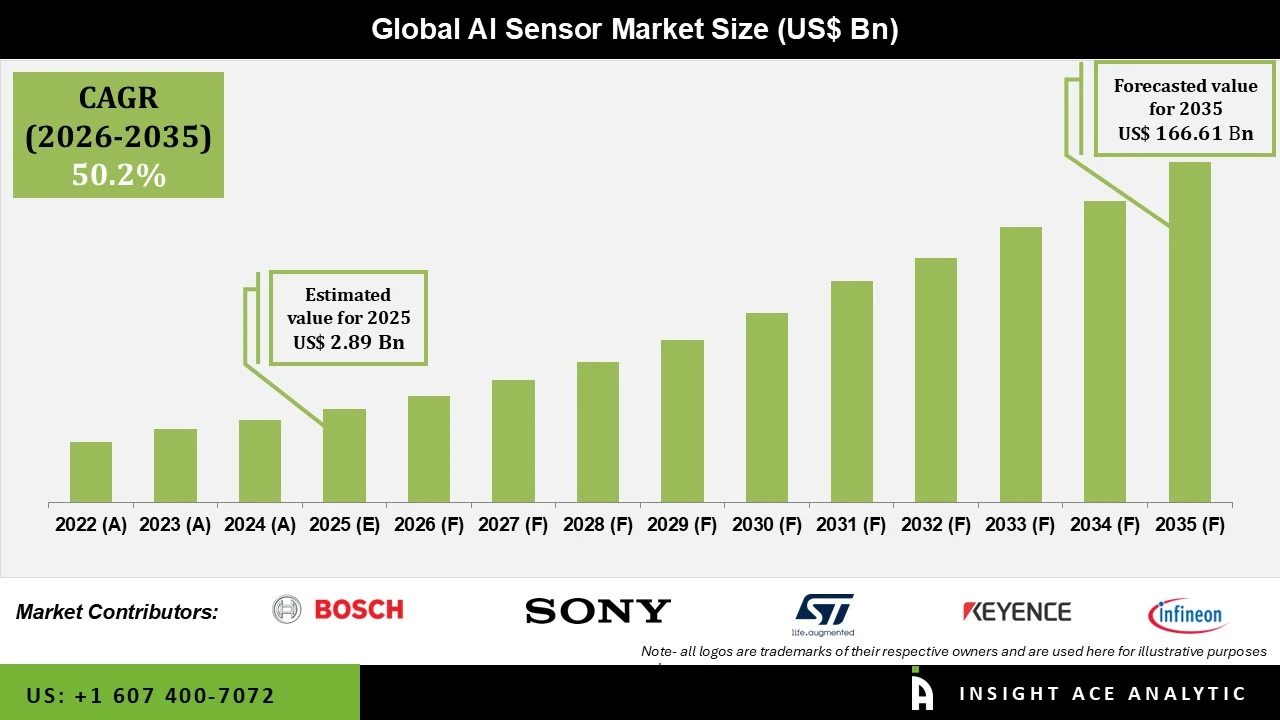
AI sensors are innovative sensing tools which consist of traditional sensor equipment combined with artificial intelligence, machine learning or other types of embedded computational techniques. In contrast to traditional sensors, which are mostly used to capture and transmit information, AI sensors have the ability to analyze the collected information near the point of data collection.
Development of the AI Sensor Market occurs due to increased demand for immediate intelligence in automotive, consumer electronics, industrial automation, health care, robotics, smart home and security solutions. Combination of sensors, edge AI and low-power computation leads to better reaction times while transmitting less amounts of unprocessed data to cloud computing facilities.
There are changes also concerning sensor interpretation through artificial intelligence. Traditional sensors provide information about certain parameters (light, motion, temperature, pressure, sound, distance, etc.), but AI equipped sensors are able to merge data from traditional sensors and analyze them in order to discover complex patterns of behavior. Such a technology is helpful in areas like autonomous cars, industrial inspection, preventive maintenance, robotics, smart buildings and health care.
Another important direction is the development of sensor fusion. Instead of usage of only one sensing technique, AI-based systems are capable to combine data from various sensors like cameras, radar, LiDAR, ultrasonic, motion, environmental and others. It will be beneficial in cases of rapidly changing surroundings. Current market trends are oriented on the use of low-power and edge AI architectures, which makes always-on sensors possible in connected products.
Competitive Landscape
Which are the Leading Players in AI Sensor Market?
• Sony Corporation
• STMicroelectronics N.V.
• Keyence Corporation
• Infineon Technologies AG
• Samsung Electronics Co., Ltd.
• Robert Bosch GmbH
• Bosch Sensortec GmbH
• Teledyne Technologies Incorporated
• TDK Corporation
• OMNIVISION Technologies, Inc.
• onsemi
• Analog Devices, Inc.
• Texas Instruments Incorporated
• Sensata Technologies Holding plc
• Sensirion AG
• ams-OSRAM AG
• Murata Manufacturing Co., Ltd.
• NXP Semiconductors N.V.
• Prophesee S.A.
• Ambarella, Inc.
• SICK AG
• Renesas Electronics Corporation
• Goertek Inc.
• PixArt Imaging Inc.
• Qualcomm Technologies, Inc.
Market Dynamics
Driver
Growing Adoption of Edge AI and Real-Time Processing
The growing adoption of edge AI is one of the major factors supporting the AI Sensor Market. Conventional sensing systems often transfer large amounts of raw data to a central processor or cloud platform for analysis. AI sensors can perform some of this processing locally, which can reduce latency, bandwidth requirements, and dependence on continuous cloud connectivity. This is particularly important for applications that require immediate responses. Autonomous vehicles, industrial robots, security cameras, medical monitoring systems, and smart-home devices can benefit from local processing because decisions can be made closer to the source of the data. The increasing availability of low-power AI processors, embedded neural processing units, and machine-learning algorithms is making intelligent sensing more practical for smaller and battery-powered devices. This is creating opportunities for AI sensors across both industrial and consumer applications.
Restrain/Challenge
High Development Cost and Sensor Integration Complexity
The design and manufacture of AI sensors involves the assembly of sensors, processors, memories, AI algorithms, connectivity, and software components into one product. Therefore, the product creation process becomes complicated as compared to the traditional production of sensors. It would also involve trade-offs in terms of processing speed and power consumption in cases where battery powers these devices. The training process of AI algorithms will often demand large datasets and variations in operating conditions might affect the accuracy of the trained models. Another complication comes in the form of data fusion which is difficult to achieve when dealing with data collected by various types of sensors. A final issue is related to cost where advanced sensors and AI processing systems will increase costs. Therefore, the deployment of such solutions in consumer and industrial products is likely to be slow due to high costs until larger volumes are attained.
Optical Sensor Segment is Expected to Drive the AI Sensor Market
Optical sensors will continue to be significant players in the product segmentation due to the widespread usage of sensors in consumer electronic devices like smartphones, as well as other devices and systems including automotive systems, industry, surveillance, and machine vision applications. According to Global Market Insights, optical sensors will hold around 32.1% of the AI sensor market in 2025.
AI processing enables devices to recognize objects, categorize images, detect movements, and analyze visual input.
In this way, AI processing enhances the usefulness of optical sensing.Image sensing is also gaining more connections with AI processing. Not only does it involve capturing of image but also enables recognizing the relevant information and filtering out the unnecessary inputs.Machine Learning Segment is Expected to Remain a Major Technology Segment It is also foreseen that machine learning will stay as an important technology segment, for instance, when it can be deployed into sensing systems to analyze patterns and make forecasts based on the sensor information. As estimated by Grand View Research, the market share of machine learning in the artificial intelligence sensors' segment in 2025 was 29.0%. This technology is being applied within such areas as predictive maintenance, object recognition, anomaly recognition, autonomous navigation, inspection in the industrial sector, and smart home applications. The development of compact AI processors enables machine-learning algorithms to work on edge devices. The development of deep learning and computer vision is becoming significant when the sensor requires processing visual or multimodal information. Also, context-aware computing becomes an emerging area, as sensing systems need to comprehend the surroundings in order to adapt to the environment.
Why Asia Pacific Led the AI Sensor Market?
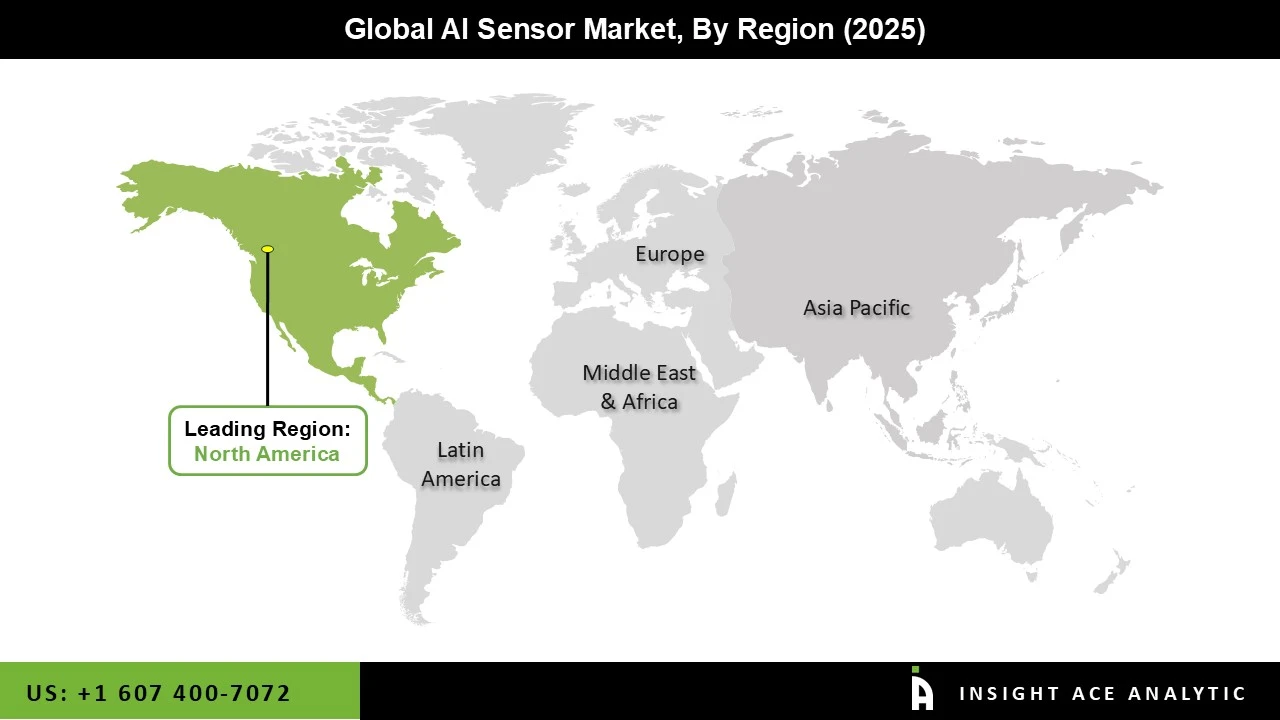
The region will dominate the AI Sensor Market owing to its large electronics manufacturing presence, the semiconductor industry, automotive manufacturing sector, and rise in use of smart devices. According to Global Market Insights, Asia Pacific is one of the largest and fastest growing regional markets. Key markets include China, Japan, South Korea, Taiwan, and India, on account of their semiconductor, electronics, automotive, robotics, and consumer electronics industry presence. Japan is a key player within the field of imaging, industrial automation, sensing, and robotics. Sony, Keyence, and TDK are some of the prominent players operating in the region.
There is an increase in the Chinese investments in robotics, autonomous technologies, industrial automation, and smart manufacturing sectors.
Growing deployment of intelligent machinery in the nation will fuel demand for advanced machine perception solutions based on artificial intelligence. Emerging markets include India, on the back of growth in the electronics manufacturing, automotive production, automation, intelligent infrastructure, and use of artificial intelligence technologies. Growth in connected devices and automation can trigger further demand for smart sensing and intelligence technologies. Other important markets for this technology include North America, owing to high investments in AI, autonomous vehicles, robotics, healthcare sector, industrial automation, and edge computing.
AI Sensor Market Report Scope:
| Report Attribute | Specifications |
| Market size value in 2025 | USD 2.89 Bn |
| Revenue forecast in 2035 | USD 166.61 Bn |
| Growth Rate CAGR | CAGR of 50.2% from 2026 to 2035 |
| Quantitative Units | Representation of revenue in US$ Bn and CAGR from 2026 to 2035 |
| Historic Year | 2022 to 2025 |
| Forecast Year | 2026-2035 |
| Report Coverage | The forecast of revenue, the position of the company, the competitive market structure, growth prospects, and trends |
| Segments Covered | Sensor Type, Technology, Architecture, Application, End-user Industry, and By Region |
| Regional Scope | North America; Europe; Asia Pacific; Latin America; Middle East & Africa |
| Country Scope | U.S.; Canada; U.K.; Germany; China; India; Japan; Brazil; Mexico; The UK; France; Italy; Spain; China; Japan; India; South Korea; Southeast Asia; South Korea; Southeast Asia |
| Competitive Landscape | Sony, STMicroelectronics, Keyence, Infineon Technologies, Samsung, Bosch Sensortec, Teledyne Technologies, TDK, OMNIVISION, onsemi, Analog Devices, Texas Instruments, Sensata Technologies, Sensirion, ams-OSRAM, Murata Manufacturing, NXP Semiconductors, Prophesee, Ambarella, SICK and others. |
| Customization Scope | Free customization report with the procurement of the report, Modifications to the regional and segment scope. Geographic competitive landscape. |
| Pricing and Available Payment Methods | Explore pricing alternatives that are customized to your particular study requirements. |
Market Segmentation:
AI Sensor Market by Sensor Type -
• Optical Sensors
• Motion & Position Sensors
• Image Sensors
• Radar Sensors
• LiDAR Sensors
• Ultrasonic Sensors
• Environmental Sensors
• Temperature Sensors
• Pressure Sensors
• Audio Sensors
• Others
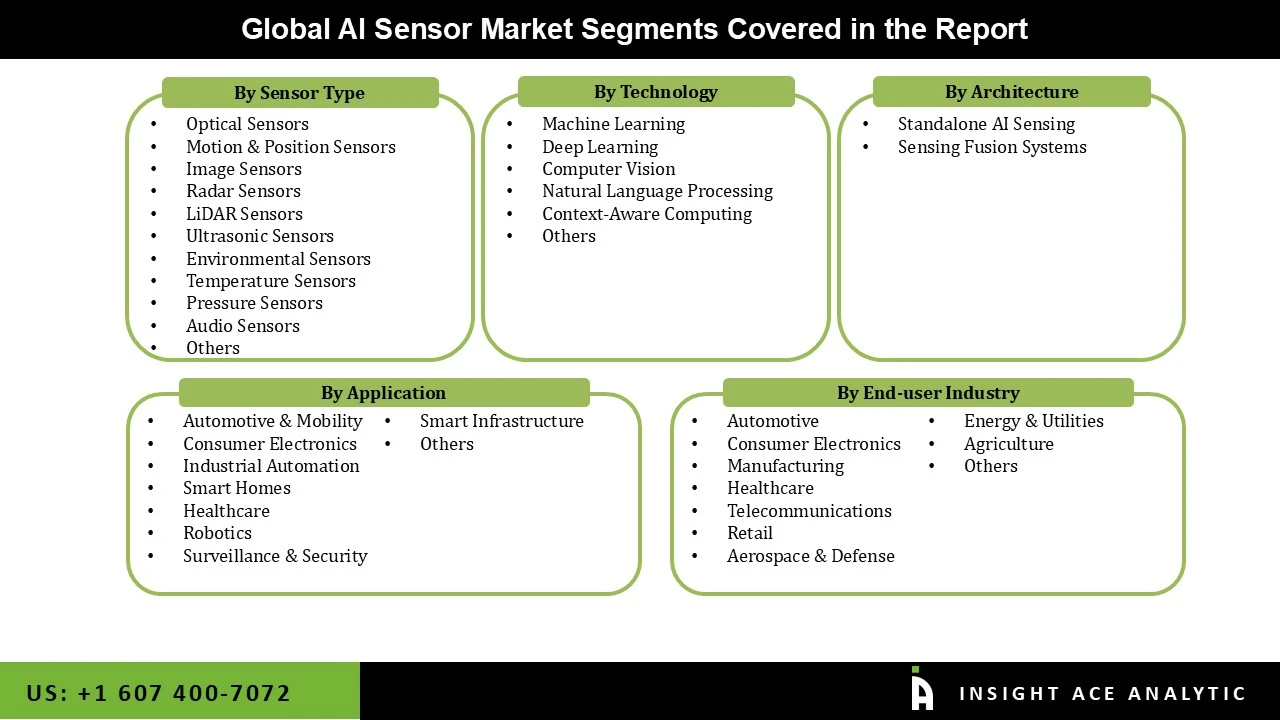
AI Sensor Market by Technology -
• Machine Learning
• Deep Learning
• Computer Vision
• Natural Language Processing
• Context-Aware Computing
• Others
AI Sensor Market by Architecture -
• Standalone AI Sensing
• Sensing Fusion Systems
AI Sensor Market by Application-
• Automotive & Mobility
• Consumer Electronics
• Industrial Automation
• Smart Homes
• Healthcare
• Robotics
• Surveillance & Security
• Smart Infrastructure
• Others
AI Sensor Market by End-user Industry -
• Automotive
• Consumer Electronics
• Manufacturing
• Healthcare
• Telecommunications
• Retail
• Aerospace & Defense
• Energy & Utilities
• Agriculture
• Others
By Region-
North America-
• The US
• Canada
Europe-
• Germany
• The UK
• France
• Italy
• Spain
• Rest of Europe
Asia-Pacific-
• China
• Japan
• India
• South Korea
• South East Asia
• Rest of Asia Pacific
Latin America-
• Brazil
• Argentina
• Mexico
• Rest of Latin America
Middle East & Africa-
• GCC Countries
• South Africa
• Rest of Middle East and Africa
Research Design and Approach
This study employed a multi-step, mixed-method research approach that integrates:
- Secondary research
- Primary research
- Data triangulation
- Hybrid top-down and bottom-up modelling
- Forecasting and scenario analysis
This approach ensures a balanced and validated understanding of both macro- and micro-level market factors influencing the market.
Secondary Research
Secondary research for this study involved the collection, review, and analysis of publicly available and paid data sources to build the initial fact base, understand historical market behaviour, identify data gaps, and refine the hypotheses for primary research.
Sources Consulted
Secondary data for the market study was gathered from multiple credible sources, including:
- Government databases, regulatory bodies, and public institutions
- International organizations (WHO, OECD, IMF, World Bank, etc.)
- Commercial and paid databases
- Industry associations, trade publications, and technical journals
- Company annual reports, investor presentations, press releases, and SEC filings
- Academic research papers, patents, and scientific literature
- Previous market research publications and syndicated reports
These sources were used to compile historical data, market volumes/prices, industry trends, technological developments, and competitive insights.

Primary Research
Primary research was conducted to validate secondary data, understand real-time market dynamics, capture price points and adoption trends, and verify the assumptions used in the market modelling.
Stakeholders Interviewed
Primary interviews for this study involved:
- Manufacturers and suppliers in the market value chain
- Distributors, channel partners, and integrators
- End-users / customers (e.g., hospitals, labs, enterprises, consumers, etc., depending on the market)
- Industry experts, technology specialists, consultants, and regulatory professionals
- Senior executives (CEOs, CTOs, VPs, Directors) and product managers
Interview Process
Interviews were conducted via:
- Structured and semi-structured questionnaires
- Telephonic and video interactions
- Email correspondences
- Expert consultation sessions
Primary insights were incorporated into demand modelling, pricing analysis, technology evaluation, and market share estimation.
Data Processing, Normalization, and Validation
All collected data were processed and normalized to ensure consistency and comparability across regions and time frames.
The data validation process included:
- Standardization of units (currency conversions, volume units, inflation adjustments)
- Cross-verification of data points across multiple secondary sources
- Normalization of inconsistent datasets
- Identification and resolution of data gaps
- Outlier detection and removal through algorithmic and manual checks
- Plausibility and coherence checks across segments and geographies
This ensured that the dataset used for modelling was clean, robust, and reliable.
Market Size Estimation and Data Triangulation
Bottom-Up Approach
The bottom-up approach involved aggregating segment-level data, such as:
- Company revenues
- Product-level sales
- Installed base/usage volumes
- Adoption and penetration rates
- Pricing analysis
This method was primarily used when detailed micro-level market data were available.

Top-Down Approach
The top-down approach used macro-level indicators:
- Parent market benchmarks
- Global/regional industry trends
- Economic indicators (GDP, demographics, spending patterns)
- Penetration and usage ratios
This approach was used for segments where granular data were limited or inconsistent.
Hybrid Triangulation Approach
To ensure accuracy, a triangulated hybrid model was used. This included:
- Reconciling top-down and bottom-up estimates
- Cross-checking revenues, volumes, and pricing assumptions
- Incorporating expert insights to validate segment splits and adoption rates
This multi-angle validation yielded the final market size.
Forecasting Framework and Scenario Modelling
Market forecasts were developed using a combination of time-series modelling, adoption curve analysis, and driver-based forecasting tools.
Forecasting Methods
- Time-series modelling
- S-curve and diffusion models (for emerging technologies)
- Driver-based forecasting (GDP, disposable income, adoption rates, regulatory changes)
- Price elasticity models
- Market maturity and lifecycle-based projections
Scenario Analysis
Given inherent uncertainties, three scenarios were constructed:
- Base-Case Scenario: Expected trajectory under current conditions
- Optimistic Scenario: High adoption, favourable regulation, strong economic tailwinds
- Conservative Scenario: Slow adoption, regulatory delays, economic constraints
Sensitivity testing was conducted on key variables, including pricing, demand elasticity, and regional adoption.
Request Customization
Add countries, segments, company profiles, or extend forecast — free 10% customization with purchase.
Customize This Report →Enquire Before Buying
Speak with our analyst team about scope, methodology, pricing, or deliverable formats.
Enquire Now →Frequently Asked Questions
AI Sensor Market Size is valued at USD 2.89 Bn in 2025 and is predicted to reach USD 166.61 Bn by the year 2035
AI Sensor Market is expected to grow at a 50.2% CAGR during the forecast period for 2026 to 2035.
Sony, STMicroelectronics, Keyence, Infineon Technologies, Samsung, Bosch Sensortec, Teledyne Technologies, TDK, OMNIVISION, onsemi, Analog Devices, Texas Instruments, Sensata Technologies, Sensirion, ams-OSRAM, Murata Manufacturing, NXP Semiconductors, Prophesee, Ambarella, SICK and others.
AI Sensor Market Sensor Type, Technology, Architecture, Application, End-user Industry, and By Region.
Asia Pacific region is leading the AI Sensor Market.