AI Optimized Bioprocessing Market Size, Trend, Revenue Report 2026 to 2035
What is AI Optimized Bioprocessing Market Size?
AI Optimized Bioprocessing Market Size is valued at USD 989.11 Mn in 2025 and is predicted to reach USD 11,672.68 Mn by the year 2035 at a 28.2% CAGR during the forecast period for 2026 to 2035.
AI-Optimized Bioprocessing Market Size, Share & Trends Analysis By Offering / Solution Layer (Process Development & Digital-Twin Modeling, Manufacturing Intelligence, Monitoring & Control, Bioprocess Data & Digital-CMC Platforms (AI-Enabled), and AI-Guided Process-Development Services), By Workflow Stage (Cell-Line & Early Development, Upstream Process Development, Downstream Process Development, Scale-Up & Technology Transfer, and Commercial GMP Manufacturing & QC), By Deployment Model (Cloud / SaaS, On-Premise / Self-Hosted, and Hybrid & Edge (On-Reactor / Embedded)), By Product Class (Biologics / Biopharmaceuticals, Vaccines, Cell & Gene Therapy / ATMPs, and Precision Fermentation, Industrial Biotech & Alt-Proteins), By End User (Biopharmaceutical Companies, Emerging Biotech & Synthetic-Biology Firms, CDMOs / CMOs, and Industrial-Biotech, Food & Ingredient Manufacturers), and Segment Forecasts, 2026 to 2035.
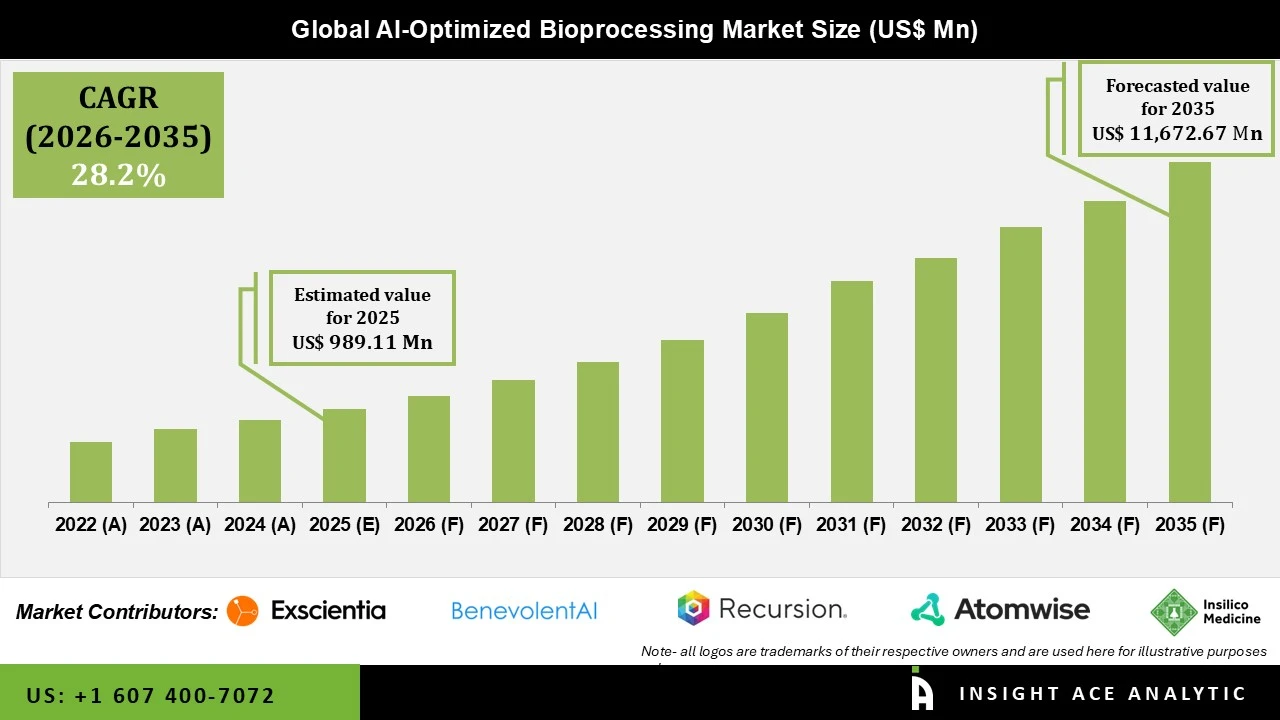
AI-optimized bioprocessing refers to the integration of artificial intelligence, machine learning, predictive analytics, digital twins, and intelligent automation into biomanufacturing processes. These technologies collect and analyze large volumes of manufacturing data generated by bioreactors, sensors, laboratory instruments, manufacturing execution systems, process analytical technology platforms, and quality-management systems. The resulting insights help manufacturers monitor critical process parameters, predict process deviations, optimize production conditions, improve product quality, and support data-driven manufacturing decisions.
The growing demand for biologics, biosimilars, cell and gene therapy products, monoclonal antibodies, and innovative vaccines becomes one of the major factors driving the development of the AI-optimized bioprocessing market. Nowadays biologics production occurs in very complicated environments where process consistency and product quality become of high importance. Predictive analytics and machine learning algorithms allow optimizing conditions of cell culture, composition of media, fermentation process, purification process, and equipment performance. In this regard, modern manufacturers are becoming more interested in intelligent bioprocessing systems.
Market growth is even being further fueled by the fast-paced deployment of the Industry 4.0 technologies in pharmaceutical manufacturing units. With digital twins, industrial Internet of Things sensors, advanced analytics, cloud computing, and automated process control systems becoming an integral part of biomanufacturing, AI is able to monitor and analyze process deviations, predict equipment breakdowns, provide recommendations for process changes, and make autonomous manufacturing decisions.
Competitive Landscape
Which are the Leading Players in AI-Optimized Bioprocessing Market?
- Körber
- Genedata
- DataHow
- Novasign
- Culture Biosciences
- Invert
- Aizon
- Qubicon
- Cytiva
- Yokogawa
- AspenTech
- Siemens
- Rockwell Automation
- New Wave Biotech
- Differential Bio
- Algocell
- MOA Foodtech
- Aise Bio
- Cellcraft
- BioprocessAI
- WuXi Biologics
- Multiply Labs
- TetraScience
- Benchling
- IDBS
- Synthace
- HighRes Biosolutions
- Quartic.ai
Market Dynamics
Driver
Increasing Adoption of AI-driven Smart Biomanufacturing Technologies
The growing adoption of AI technology in biopharmaceutical manufacturing plants is anticipated to fuel the growth of the AI-based bioprocessing market during the forecast period. Biomanufacturing operations produce vast quantities of data from bioreactors, chromatography columns, filtration systems, lab instrumentation, and environmental control systems. The application of AI technology converts the data produced by these systems into valuable insights for making decisions to enhance production efficiency and reduce manufacturing risks. Machine learning algorithms constantly monitor key process parameters like temperature, pH, dissolved oxygen levels, nutrient levels, agitator speed, and cell viability to ensure the detection of any anomalies. Predictive models offer real-time recommendations about adjusting processes for ensuring maximum yield while reducing material waste. The degree of automation achieved through AI technology provides substantial improvement over traditional process monitoring techniques.
Restrain/Challenge
High Implementation Costs and Complex Integration with Legacy Biomanufacturing Systems
One of the major challenges limiting the growth of the AI-optimized bioprocessing market is the high cost associated with implementing AI-driven manufacturing infrastructure. Deploying AI platforms requires significant investment in digital sensors, industrial IoT devices, cloud computing infrastructure, advanced analytics software, high-performance computing resources, and workforce training. Small and medium-sized biotechnology companies often face budget constraints, making large-scale AI adoption more challenging than for multinational biopharmaceutical manufacturers.
Another important challenge is integrating AI solutions with existing manufacturing systems. Many pharmaceutical production facilities continue to operate using legacy automation platforms, standalone laboratory information management systems (LIMS), manufacturing execution systems (MES), and supervisory control and data acquisition (SCADA) systems that were not originally designed for AI integration. Differences in data formats, communication protocols, and software architectures can complicate implementation and delay digital transformation initiatives.
Biopharmaceutical Companies Segment is Expected to Drive the AI-Optimized Bioprocessing Market
Segment-wise, the biopharmaceutical companies were the leading contributors to the market size of AI-optimized bioprocessing in 2025. Increased complexity in the manufacture of biologicals, biosimilars, monoclonal antibodies, recombinant proteins, and cell and gene therapies is driving the use of AI-enabled process optimization software. AI technologies help manufacturers to monitor their upstream and downstream processes continuously, ensuring there is no deviation in the process that can affect the quality of the products being manufactured.
They also help in improving the performance of fermentation, optimization of purification techniques, reducing the downtime, and minimizing the cost of production. Furthermore, quality monitoring through AI-assisted tools allows manufacturers to comply with all regulatory guidelines and accelerate the time-to-market of products. With the increasing number of smart biomanufacturing plants around the world along with increasing investments in digital manufacturing solutions, the adoption of AI-optimized bioprocessing technologies among biopharmaceutical companies is expected to remain strong over the forecast period.
Machine Learning Segment is Growing at the Highest Rate in the AI-Optimized Bioprocessing Market
The machine learning category accounted for a major share in the AI-optimized bioprocessing market in 2025 and is estimated to hold the largest growth rate during the forecast period. The machine learning algorithms help in analyzing past as well as present manufacturing data to detect the complicated interplay between process variables and outcomes. These capabilities help manufacturers optimize their process conditions such as cell growth condition, medium, fermentation process, purification efficiency, and use of equipment. Machine learning also helps in predictive maintenance by understanding the equipment performance pattern to predict future failure before the actual production downtime occurs. This leads to reduction in maintenance costs and prevents production disruptions.
Why North America Led the AI-Optimized Bioprocessing Market?
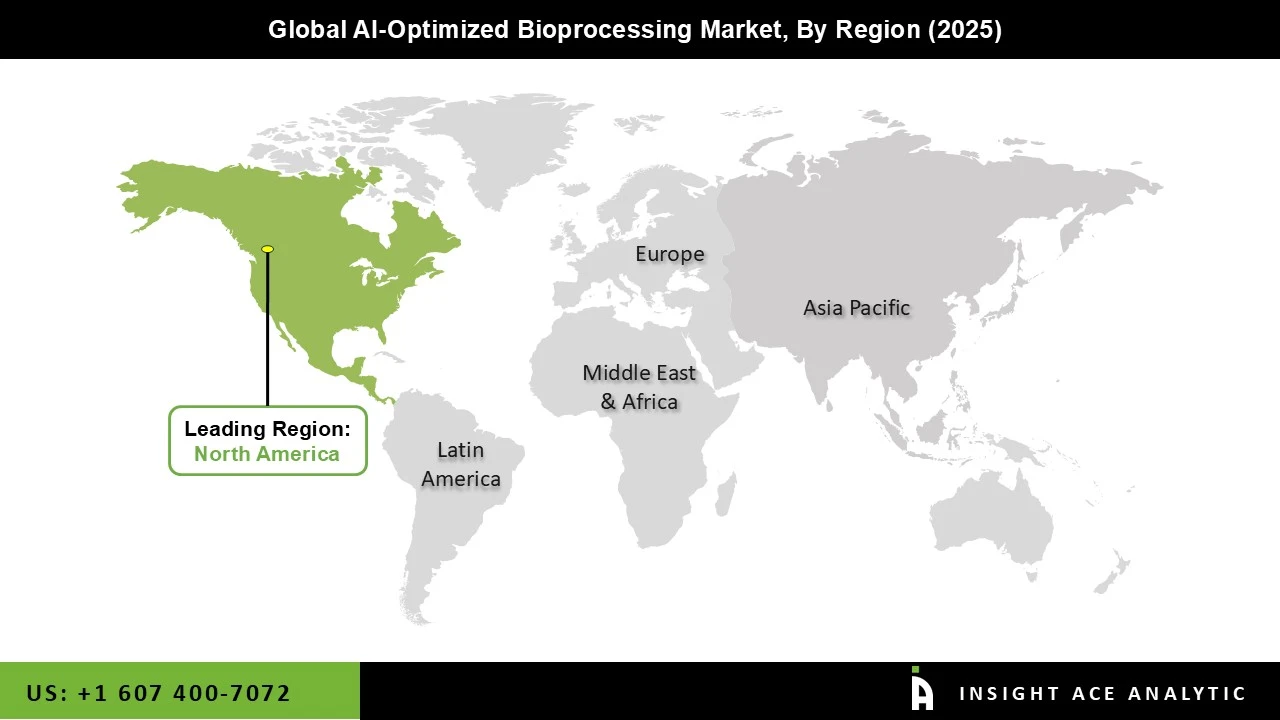
North America accounted for the largest share of the global AI-optimized bioprocessing market owing to its advanced infrastructure for biopharmaceutical manufacturing, strong biotechnology sector, and early adaptation of digital manufacturing. The North American region is characterized by presence of several large pharmaceutical companies, biotech firms, contract development and manufacturing organizations (CDMOs), and AI technology companies investing heavily into smart manufacturing.
There have been substantial investments made in manufacturing capacities for biologics, vaccines, precision medicines, and advanced therapy manufacturing. More importantly, there has been integration of AI technologies into process analytical technology (PAT), manufacturing execution system (MES), LIMS, and industrial automation platforms.
Key Development:
• In April 2025, Sartorius Stedim Biotech entered a strategic partnership with Tulip Interfaces to develop Biobrain Operate powered by Tulip. The digital-manufacturing application suite is designed to integrate with Sartorius process equipment, reduce manual operational errors, improve production visibility, support paperless workflows, and reduce process variability in single-use bioprocessing.
AI Optimized Bioprocessing Market Report Scope:
| Report Attribute | Specifications |
| Market size value in 2025 | USD 989.11 Mn |
| Revenue forecast in 2035 | USD 11,672.68 Mn |
| Growth Rate CAGR | CAGR of 28.2% from 2026 to 2035 |
| Quantitative Units | Representation of revenue in US$ Mn and CAGR from 2026 to 2035 |
| Historic Year | 2022 to 2025 |
| Forecast Year | 2026-2035 |
| Report Coverage | The forecast of revenue, the position of the company, the competitive market structure, growth prospects, and trends |
| Segments Covered | Offering / Solution Layer, Workflow Stage , Deployment Model , Product Class, End User and By Region |
| Regional Scope | North America; Europe; Asia Pacific; Latin America; Middle East & Africa |
| Country Scope | U.S.; Canada; U.K.; Germany; China; India; Japan; Brazil; Mexico; The UK; France; Italy; Spain; China; Japan; India; South Korea; Southeast Asia; South Korea; Southeast Asia |
| Competitive Landscape | Körber, Genedata, DataHow, Novasign, Culture Biosciences, Invert, Aizon, Qubicon, Cytiva, Yokogawa, AspenTech, Siemens, Rockwell Automation, New Wave Biotech, Differential Bio, Algocell, MOA Foodtech, Aise Bio, Cellcraft, BioprocessAI, WuXi Biologics, Multiply Labs, TetraScience, Benchling, IDBS, Synthace, HighRes Biosolutions, Quartic.ai and Others. |
| Customization Scope | Free customization report with the procurement of the report, Modifications to the regional and segment scope. Geographic competitive landscape. |
| Pricing and Available Payment Methods | Explore pricing alternatives that are customized to your particular study requirements. |
Segmentations of AI-Optimized Bioprocessing Market:
AI-Optimized Bioprocessing Market by Offering / Solution Layer –
- Process Development & Digital-Twin Modeling
- Hybrid / mechanistic digital twins
- ML / multivariate development analytics (MVDA)
- Model-guided DoE & experiment optimization
- Process simulation & scale-up prediction
- Manufacturing Intelligence, Monitoring & Control
- Real-time batch monitoring & golden-batch comparison
- Soft sensors & quality / titer prediction
- Deviation / yield prediction & root-cause / CPV
- Model-predictive & closed-loop control
- Bioprocess Data & Digital-CMC Platforms (AI-Enabled)
- AI-ready data contextualization
- Governed / agentic-AI analytics environments
- Digital-CMC & tech-transfer data management
- AI-Guided Process-Development Services
- Cloud-connected bioreactor experimentation (experimentation-as-a-service)
- Managed model-building & optimization services
- Model-based scale-up & tech-transfer advisory
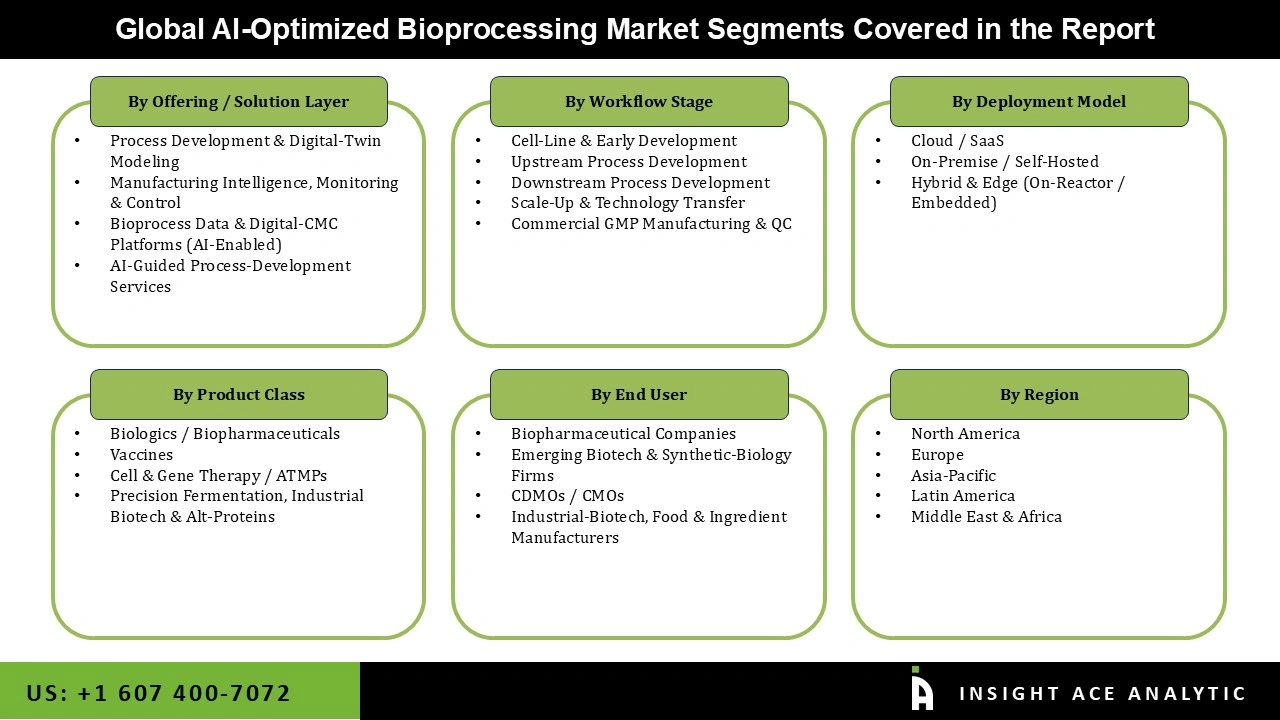
AI-Optimized Bioprocessing Market by Workflow Stage –
- Cell-Line & Early Development
- Upstream Process Development
- Downstream Process Development
- Scale-Up & Technology Transfer
- Commercial GMP Manufacturing & QC
AI-Optimized Bioprocessing Market by Deployment Model –
- Cloud / SaaS
- On-Premise / Self-Hosted
- Hybrid & Edge (On-Reactor / Embedded)
AI-Optimized Bioprocessing Market by Product Class –
- Biologics / Biopharmaceuticals
- Monoclonal antibodies & recombinant proteins
- Antibody-drug conjugates & complex biologics
- Vaccines
- mRNA / nucleic-acid vaccines
- Viral-vector & protein-subunit vaccines
- Cell & Gene Therapy / ATMPs
- Cell therapy (CAR-T & other)
- Gene therapy & viral vectors
- Precision Fermentation, Industrial Biotech & Alt-Proteins
- Precision-fermentation proteins & ingredients
- Cultivated meat & biomaterials
AI-Optimized Bioprocessing Market by End User –
- Biopharmaceutical Companies
- Emerging Biotech & Synthetic-Biology Firms
- CDMOs / CMOs
- Industrial-Biotech, Food & Ingredient Manufacturers
AI-Optimized Bioprocessing Market By Region-
- North America-
- The US
- Canada
- Europe-
- Germany
- The UK
- France
- Italy
- Spain
- Rest of Europe
- Asia-Pacific-
- China
- Japan
- India
- South Korea
- South East Asia
- Rest of Asia Pacific
- Latin America-
- Brazil
- Argentina
- Mexico
- Rest of Latin America
- Middle East and Africa-
- GCC Countries
- South Africa
- Rest of Middle East and Africa
Research Design and Approach
This study employed a multi-step, mixed-method research approach that integrates:
- Secondary research
- Primary research
- Data triangulation
- Hybrid top-down and bottom-up modelling
- Forecasting and scenario analysis
This approach ensures a balanced and validated understanding of both macro- and micro-level market factors influencing the market.
Secondary Research
Secondary research for this study involved the collection, review, and analysis of publicly available and paid data sources to build the initial fact base, understand historical market behaviour, identify data gaps, and refine the hypotheses for primary research.
Sources Consulted
Secondary data for the market study was gathered from multiple credible sources, including:
- Government databases, regulatory bodies, and public institutions
- International organizations (WHO, OECD, IMF, World Bank, etc.)
- Commercial and paid databases
- Industry associations, trade publications, and technical journals
- Company annual reports, investor presentations, press releases, and SEC filings
- Academic research papers, patents, and scientific literature
- Previous market research publications and syndicated reports
These sources were used to compile historical data, market volumes/prices, industry trends, technological developments, and competitive insights.

Primary Research
Primary research was conducted to validate secondary data, understand real-time market dynamics, capture price points and adoption trends, and verify the assumptions used in the market modelling.
Stakeholders Interviewed
Primary interviews for this study involved:
- Manufacturers and suppliers in the market value chain
- Distributors, channel partners, and integrators
- End-users / customers (e.g., hospitals, labs, enterprises, consumers, etc., depending on the market)
- Industry experts, technology specialists, consultants, and regulatory professionals
- Senior executives (CEOs, CTOs, VPs, Directors) and product managers
Interview Process
Interviews were conducted via:
- Structured and semi-structured questionnaires
- Telephonic and video interactions
- Email correspondences
- Expert consultation sessions
Primary insights were incorporated into demand modelling, pricing analysis, technology evaluation, and market share estimation.
Data Processing, Normalization, and Validation
All collected data were processed and normalized to ensure consistency and comparability across regions and time frames.
The data validation process included:
- Standardization of units (currency conversions, volume units, inflation adjustments)
- Cross-verification of data points across multiple secondary sources
- Normalization of inconsistent datasets
- Identification and resolution of data gaps
- Outlier detection and removal through algorithmic and manual checks
- Plausibility and coherence checks across segments and geographies
This ensured that the dataset used for modelling was clean, robust, and reliable.
Market Size Estimation and Data Triangulation
Bottom-Up Approach
The bottom-up approach involved aggregating segment-level data, such as:
- Company revenues
- Product-level sales
- Installed base/usage volumes
- Adoption and penetration rates
- Pricing analysis
This method was primarily used when detailed micro-level market data were available.

Top-Down Approach
The top-down approach used macro-level indicators:
- Parent market benchmarks
- Global/regional industry trends
- Economic indicators (GDP, demographics, spending patterns)
- Penetration and usage ratios
This approach was used for segments where granular data were limited or inconsistent.
Hybrid Triangulation Approach
To ensure accuracy, a triangulated hybrid model was used. This included:
- Reconciling top-down and bottom-up estimates
- Cross-checking revenues, volumes, and pricing assumptions
- Incorporating expert insights to validate segment splits and adoption rates
This multi-angle validation yielded the final market size.
Forecasting Framework and Scenario Modelling
Market forecasts were developed using a combination of time-series modelling, adoption curve analysis, and driver-based forecasting tools.
Forecasting Methods
- Time-series modelling
- S-curve and diffusion models (for emerging technologies)
- Driver-based forecasting (GDP, disposable income, adoption rates, regulatory changes)
- Price elasticity models
- Market maturity and lifecycle-based projections
Scenario Analysis
Given inherent uncertainties, three scenarios were constructed:
- Base-Case Scenario: Expected trajectory under current conditions
- Optimistic Scenario: High adoption, favourable regulation, strong economic tailwinds
- Conservative Scenario: Slow adoption, regulatory delays, economic constraints
Sensitivity testing was conducted on key variables, including pricing, demand elasticity, and regional adoption.
Request Customization
Add countries, segments, company profiles, or extend forecast — free 10% customization with purchase.
Customize This Report →Enquire Before Buying
Speak with our analyst team about scope, methodology, pricing, or deliverable formats.
Enquire Now →Frequently Asked Questions
AI Optimized Bioprocessing Market Size is valued at USD 989.11 Mn in 2025 and is predicted to reach USD 11,672.68 Mn by the year 2035
AI Optimized Bioprocessing Market is expected to grow at a 28.2% CAGR during the forecast period for 2026 to 2035.
Körber, Genedata, DataHow, Novasign, Culture Biosciences, Invert, Aizon, Qubicon, Cytiva, Yokogawa, AspenTech, Siemens, Rockwell Automation, New Wave Biotech, Differential Bio, Algocell, MOA Foodtech, Aise Bio, Cellcraft, BioprocessAI, WuXi Biologics, Multiply Labs, TetraScience, Benchling, IDBS, Synthace, HighRes Biosolutions, Quartic.ai and Others.
AI Optimized Bioprocessing Market is segmented into Offering / Solution Layer, Workflow Stage , Deployment Model , Product Class, End User and Other.
North America region is leading the AI Optimized Bioprocessing Market.