Agentic CPU Market Size, Revenue, Forecast Report 2026 to 2035
What is Agentic CPU Market Size?
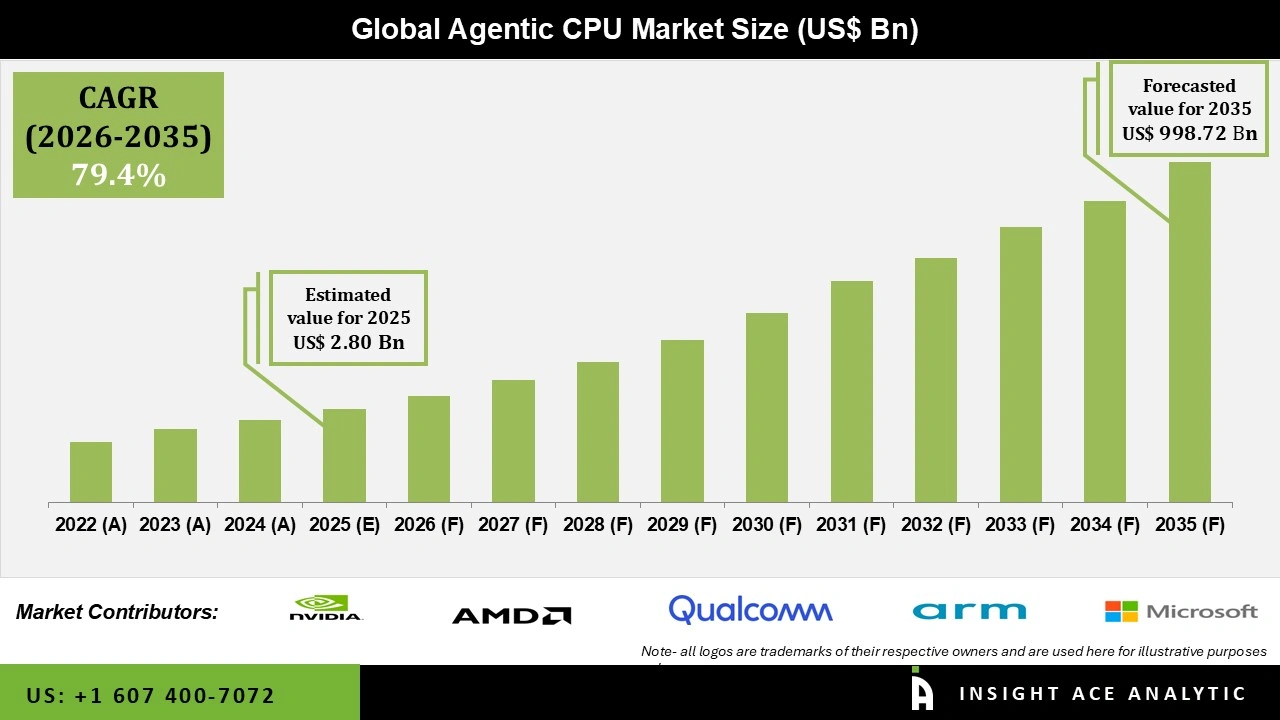
Global Agentic CPU Market Size is valued at USD 2.80 Bn in 2025 and is predicted to reach USD 998.72 Bn by the year 2035 at a 79.4% CAGR during the forecast period for 2026 to 2035.
Agentic CPU Market Size, Share & Trends Analysis CPU Architecture (x86 Processors, ARM-Based Processors, RISC-V Processors, and Custom Proprietary Architectures), Deployment Environment (Cloud Data Centers, Enterprise Data Centers, Edge AI Infrastructure, and Hybrid Cloud Infrastructure), Application (AI Agent Orchestration, Multi-Agent Systems, Retrieval-Augmented Generation (RAG), AI Copilots & Digital Agents, Autonomous Software Development, Robotics & Physical AI, Research & Scientific Computing, and Other Agentic Workflows), End-user (Hyperscale Cloud Providers, AI Model Developers, Enterprises, Government & Defense Organizations, Research Institutions, and Telecommunications Providers), and Segment Forecasts, 2026 to 2035.
Agentic CPUs denote processors or CPU platforms to address the computing needs of agentic AI that includes capabilities like planning, reasoning, tool usage, data retrieval, software execution, and completion of multiple-step operations without much human involvement. Generative AI applications, which might only include model inference, have traditionally been viewed as the domain of GPU hardware acceleration. However, agentic AI is continually shifting from data retrieval, planning, tool execution, memory access, security, verification and interworking of accelerators. Therefore, agentic AI expands the share of CPUs in the AI computing architecture.
Agentic CPU market emerges due to the migration by organizations and cloud providers from AI assistants to autonomous AI agents. Such AI demands powerful processors that would be able to handle large amounts of tasks simultaneously, fast memory access, quick data transfer and coordination of GPUs and other accelerators. As AMD mentions, agentic AI changes the CPU/GPU paradigm because CPUs will become more essential for planning and data preparation, memory and IO operations, security, and tool execution around AI applications.
The significance of CPUs can be demonstrated through emerging processor and rack solutions. For example, Vera CPU developed by NVIDIA was designed particularly for agentic operations. Moreover, in March 2026, Arm has introduced its own Arm AGI CPU that is the company's first Arm-based data center CPU. According to Arm, the performance of AGI CPU exceeds two times in relation to x86 solutions when it comes to certain types of workloads. Consequently, AI infrastructure market is not limited any longer by the perception that AI hardware market is dominated by GPU vendors. Agentic AI infrastructure demands more CPUs in order to execute the software environment, coordinate workloads, perform memory and data management as well as provide information for accelerators for continuous operation.
Competitive Landscape
Which are the Leading Players in Agentic CPU Market?
- NVIDIA Corporation
- AMD
- Intel Corporation
- Arm Holdings
- Ampere Computing
- Qualcomm Technologies
- Amazon Web Services
- Microsoft
- IBM
- Marvell Technology
- Broadcom
- Fujitsu
- Huawei Technologies
- SiPearl
- RISC-V International ecosystem companies
Market Dynamics
Driver
Rising CPU Demand from Multi-step Agentic AI Workloads
The growing use of AI agents is seen to be one of the major drivers of the agentic CPU market. The use of an AI agent is not limited to producing a single response but includes breaking down tasks into small actions, fetching relevant information, executing APIs, code, verifying responses, and repeating the entire process until completion of the task. All these contribute to increased CPU workload.
According to AMD, agentic AI refers to a new kind of workload that results in increased CPU workloads through gateway processing, context assembling, planning, fetching, tool execution, verification, and response generation. Hence, CPUs play a significant role in the entire AI process and are no longer confined to working as host chips for the GPU.
This is a critical development for the operators of data centers as more agent activities would mean greater CPU demands in addition to the GPU clusters currently installed. Agentic AI has also been listed by Morgan Stanley as one of the elements that might result in increased AI semiconductor expenditure on CPU and memory along with GPUs.
Restrain/Challenge
High Infrastructure Cost and Rapid Processor Development Cycles
One of the biggest difficulties facing the global agentic CPU market is the expense of building AI data center hardware for upgrades. The agentic workloads might necessitate an upgrade in CPU servers, memory capacity, networking, storage, cooling, and connection to accelerators, according to some experts. The switch to a more advanced architecture requires substantial investment in companies that have their current infrastructure.
The fast pace of semiconductor innovation is the other issue. CPU architectures have changed at an accelerated rate with the emergence of various CPUs, custom silicon, Arm architectures, and new generation of rackscale architectures. Companies need to find the right balance between instant speed gains and the danger of buying hardware that will lose competitiveness in the following generations.
Availability and cost of hardware can be factors that affect the market. According to TrendForce, April 2026 noted that CPU data center significance was growing in tandem with its scarcity and pricing consideration among leading companies.
x86 Processors Segment is Expected to Drive the Global Agentic CPU Market
The x86 architecture can be expected to remain strong due to its installed base, mature software environment, enterprise readiness, and established presence in cloud and data center market segments. Many AI systems are currently running on x86 servers, which means that companies can more easily introduce agentic tasks by using x86 without having to replace their entire platform. The advancement of the AMD EPYC and Intel Xeon processors used in servers also contributes to the market segment. AMD targets three key agentic use cases for its EPYC processors, namely agent sandbox computing, AI host-node computing, and generic CPU computation workload.
Simultaneously, Arm and custom architectures pose a threat to the x86 market segment and thus make the competitive landscape change in favor of comparisons based not only on the architecture but on the performance per watt, memory bandwidth, software ecosystem, core density, TCO, and performance at the rack level.
RISC-V Segment is Growing at the Highest Rate in the Global Agentic CPU Market
There is likely to be more interest in RISC-V since the instruction set architecture that is open source makes it easy for businesses to have highly tailored chips. There is significant variability when it comes to Agentic AI workload, and customization would make it possible for engineers to tailor chips to their particular memory, security, orchestration, or edge computing needs.
This architecture will fit well for businesses that want increased control in the development of processors and their associated supply chain. But RISC-V has to enhance its software eco-systems and have developers on board before they can rival the x86 and arm server ecosystems at the same level.
Why North America Led the Agentic CPU Market?
North America is projected to be the largest regional market within the global agentic CPU market due to the presence of various hyperscale cloud vendors, semiconductor suppliers, AI players, enterprise software companies, and advanced data centers. In addition, the US is significant since most AI hardware companies and cloud vendors operating in this country are building agentic computing platforms
Moreover, North America has started witnessing adoption of dedicated CPU architecture for agentic computing. Vera CPUs by NVIDIA, EPYC portfolio by AMD, and AGI CPUs by Arm can be regarded as examples of distinct efforts taken by different companies to meet the increased demands for CPU in agentic workload environment.
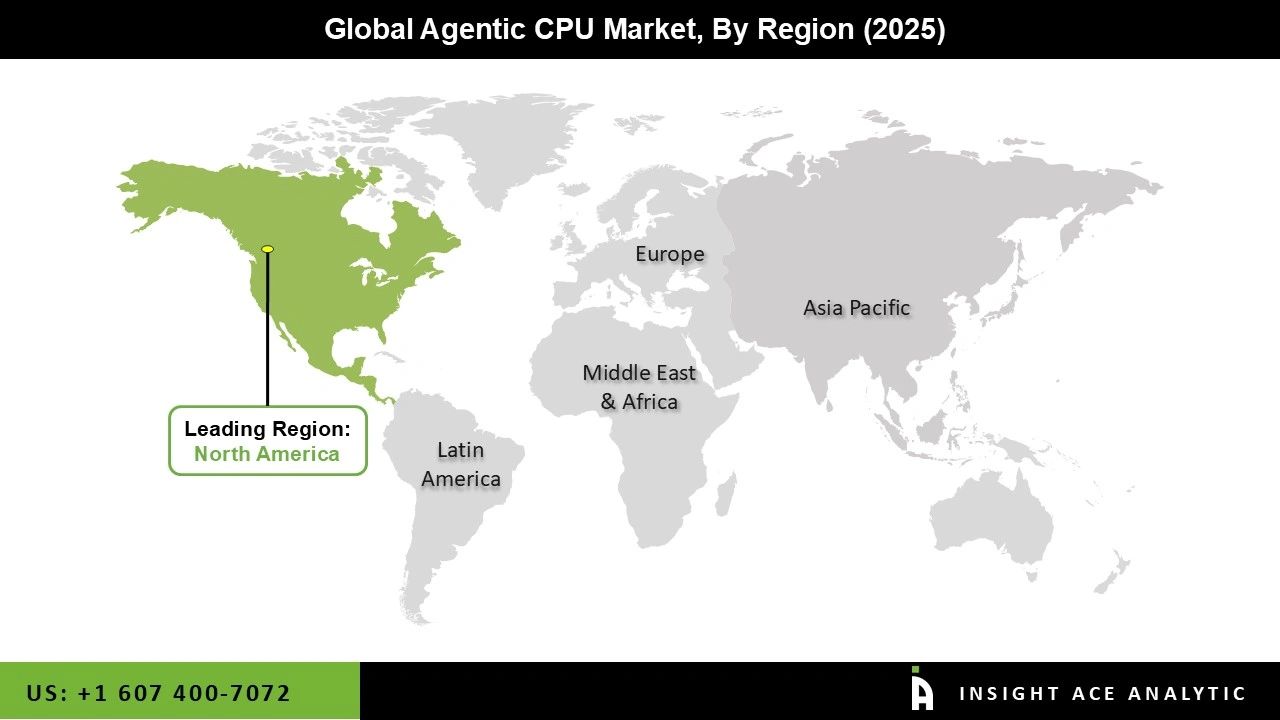
Asia Pacific is forecasted to show considerable growth during the forecast period owing to the presence of strong capabilities of semiconductor production, rapid development of cloud infrastructures, and growing investments into AI technologies. Major APAC countries such as Japan, South Korea, China, India, Taiwan, and others are anticipated to contribute to the growth.
Key Development:
In July 2026, NVIDIA announced that its Vera CPU systems have been deployed commercially by leading AI players as a dedicated platform for agentic AI and reinforcement-learning workloads. According to NVIDIA, Vera could perform 1.8 times faster agentic sandboxing when compared to leading x86 CPUs according to NVIDIA benchmarks.
Agentic CPU Market Report Scope:
| Report Attribute | Specifications |
| Market size value in 2025 | USD 2.80 Bn |
| Revenue forecast in 2035 | USD 998.72 Bn |
| Growth Rate CAGR | CAGR of 79.4% from 2026 to 2035 |
| Quantitative Units | Representation of revenue in US$ Bn and CAGR from 2026 to 2035 |
| Historic Year | 2022 to 2025 |
| Forecast Year | 2026-2035 |
| Report Coverage | The forecast of revenue, the position of the company, the competitive market structure, growth prospects, and trends |
| Segments Covered | CPU Architecture, Deployment Environment, Application, End-user, and By Region |
| Regional Scope | North America; Europe; Asia Pacific; Latin America; Middle East & Africa |
| Country Scope | U.S.; Canada; U.K.; Germany; China; India; Japan; Brazil; Mexico; The UK; France; Italy; Spain; China; Japan; India; South Korea; Southeast Asia; South Korea; Southeast Asia |
| Competitive Landscape | NVIDIA Corporation, AMD, Intel Corporation, Arm Holdings, Ampere Computing, Qualcomm Technologies, Amazon Web Services, Google, Microsoft, IBM, Marvell Technology, Broadcom, Fujitsu, Huawei Technologies, SiPearl, and RISC-V ecosystem companies. |
| Customization Scope | Free customization report with the procurement of the report, Modifications to the regional and segment scope. Geographic competitive landscape. |
| Pricing and Available Payment Methods | Explore pricing alternatives that are customized to your particular study requirements. |
Segmentations Agentic CPU Market :
Agentic CPU Market by CPU Architecture -
- x86 Processors
- ARM-Based Processors
- RISC-V Processors
- Custom Proprietary Architectures
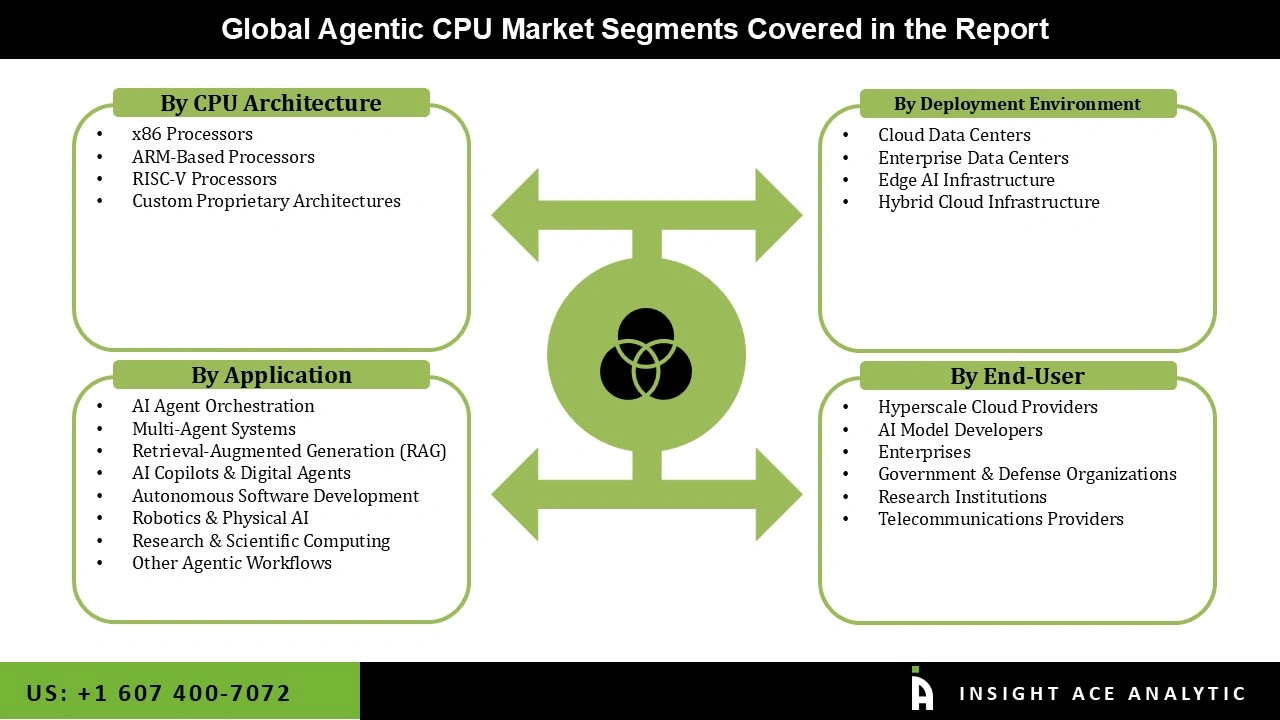
Agentic CPU Market by Deployment Environment -
- Cloud Data Centers
- Enterprise Data Centers
- Edge AI Infrastructure
- Hybrid Cloud Infrastructure
Agentic CPU Market by Application -
- AI Agent Orchestration
- Multi-Agent Systems
- Retrieval-Augmented Generation (RAG)
- AI Copilots & Digital Agents
- Autonomous Software Development
- Robotics & Physical AI
- Research & Scientific Computing
- Other Agentic Workflows
Agentic CPU Market by End User -
- Hyperscale Cloud Providers
- AI Model Developers
- Enterprises
- Government & Defense Organizations
- Research Institutions
- Telecommunications Providers
Agentic CPU Market by Region-
- North America-
- The US
- Canada
- Europe-
- Germany
- The UK
- France
- Italy
- Spain
- Rest of Europe
- Asia-Pacific-
- China
- Japan
- India
- South Korea
- South East Asia
- Rest of Asia Pacific
- Latin America-
- Brazil
- Argentina
- Mexico
- Rest of Latin America
- Middle East and Africa-
- GCC Countries
- South Africa
- Rest of Middle East and Africa
Research Design and Approach
This study employed a multi-step, mixed-method research approach that integrates:
- Secondary research
- Primary research
- Data triangulation
- Hybrid top-down and bottom-up modelling
- Forecasting and scenario analysis
This approach ensures a balanced and validated understanding of both macro- and micro-level market factors influencing the market.
Secondary Research
Secondary research for this study involved the collection, review, and analysis of publicly available and paid data sources to build the initial fact base, understand historical market behaviour, identify data gaps, and refine the hypotheses for primary research.
Sources Consulted
Secondary data for the market study was gathered from multiple credible sources, including:
- Government databases, regulatory bodies, and public institutions
- International organizations (WHO, OECD, IMF, World Bank, etc.)
- Commercial and paid databases
- Industry associations, trade publications, and technical journals
- Company annual reports, investor presentations, press releases, and SEC filings
- Academic research papers, patents, and scientific literature
- Previous market research publications and syndicated reports
These sources were used to compile historical data, market volumes/prices, industry trends, technological developments, and competitive insights.

Primary Research
Primary research was conducted to validate secondary data, understand real-time market dynamics, capture price points and adoption trends, and verify the assumptions used in the market modelling.
Stakeholders Interviewed
Primary interviews for this study involved:
- Manufacturers and suppliers in the market value chain
- Distributors, channel partners, and integrators
- End-users / customers (e.g., hospitals, labs, enterprises, consumers, etc., depending on the market)
- Industry experts, technology specialists, consultants, and regulatory professionals
- Senior executives (CEOs, CTOs, VPs, Directors) and product managers
Interview Process
Interviews were conducted via:
- Structured and semi-structured questionnaires
- Telephonic and video interactions
- Email correspondences
- Expert consultation sessions
Primary insights were incorporated into demand modelling, pricing analysis, technology evaluation, and market share estimation.
Data Processing, Normalization, and Validation
All collected data were processed and normalized to ensure consistency and comparability across regions and time frames.
The data validation process included:
- Standardization of units (currency conversions, volume units, inflation adjustments)
- Cross-verification of data points across multiple secondary sources
- Normalization of inconsistent datasets
- Identification and resolution of data gaps
- Outlier detection and removal through algorithmic and manual checks
- Plausibility and coherence checks across segments and geographies
This ensured that the dataset used for modelling was clean, robust, and reliable.
Market Size Estimation and Data Triangulation
Bottom-Up Approach
The bottom-up approach involved aggregating segment-level data, such as:
- Company revenues
- Product-level sales
- Installed base/usage volumes
- Adoption and penetration rates
- Pricing analysis
This method was primarily used when detailed micro-level market data were available.

Top-Down Approach
The top-down approach used macro-level indicators:
- Parent market benchmarks
- Global/regional industry trends
- Economic indicators (GDP, demographics, spending patterns)
- Penetration and usage ratios
This approach was used for segments where granular data were limited or inconsistent.
Hybrid Triangulation Approach
To ensure accuracy, a triangulated hybrid model was used. This included:
- Reconciling top-down and bottom-up estimates
- Cross-checking revenues, volumes, and pricing assumptions
- Incorporating expert insights to validate segment splits and adoption rates
This multi-angle validation yielded the final market size.
Forecasting Framework and Scenario Modelling
Market forecasts were developed using a combination of time-series modelling, adoption curve analysis, and driver-based forecasting tools.
Forecasting Methods
- Time-series modelling
- S-curve and diffusion models (for emerging technologies)
- Driver-based forecasting (GDP, disposable income, adoption rates, regulatory changes)
- Price elasticity models
- Market maturity and lifecycle-based projections
Scenario Analysis
Given inherent uncertainties, three scenarios were constructed:
- Base-Case Scenario: Expected trajectory under current conditions
- Optimistic Scenario: High adoption, favourable regulation, strong economic tailwinds
- Conservative Scenario: Slow adoption, regulatory delays, economic constraints
Sensitivity testing was conducted on key variables, including pricing, demand elasticity, and regional adoption.
Request Customization
Add countries, segments, company profiles, or extend forecast — free 10% customization with purchase.
Customize This Report →Enquire Before Buying
Speak with our analyst team about scope, methodology, pricing, or deliverable formats.
Enquire Now →Frequently Asked Questions
Agentic CPU Market Size is valued at USD 2.80 Bn in 2025 and is predicted to reach USD 998.72 Bn by the year 2035
The Agentic CPUMarket is expected to grow at a 79.4% CAGR during the forecast period for 2026 to 2035
NVIDIA Corporation, AMD, Intel Corporation, Arm Holdings, Ampere Computing, Qualcomm Technologies, Amazon Web Services, Google, Microsoft, IBM, Marvell Technology, Broadcom, Fujitsu, Huawei Technologies, SiPearl, RISC-V ecosystem companies and Others.
Agentic CPUMarket is segmented into CPU Architecture, Deployment Environment, Application, End-user, and Other.
North America region is leading the Agentic CPUMarket.