Novel Feed Additives Market Size, Share and Trends Analysis 2025 to 2034
Share With :



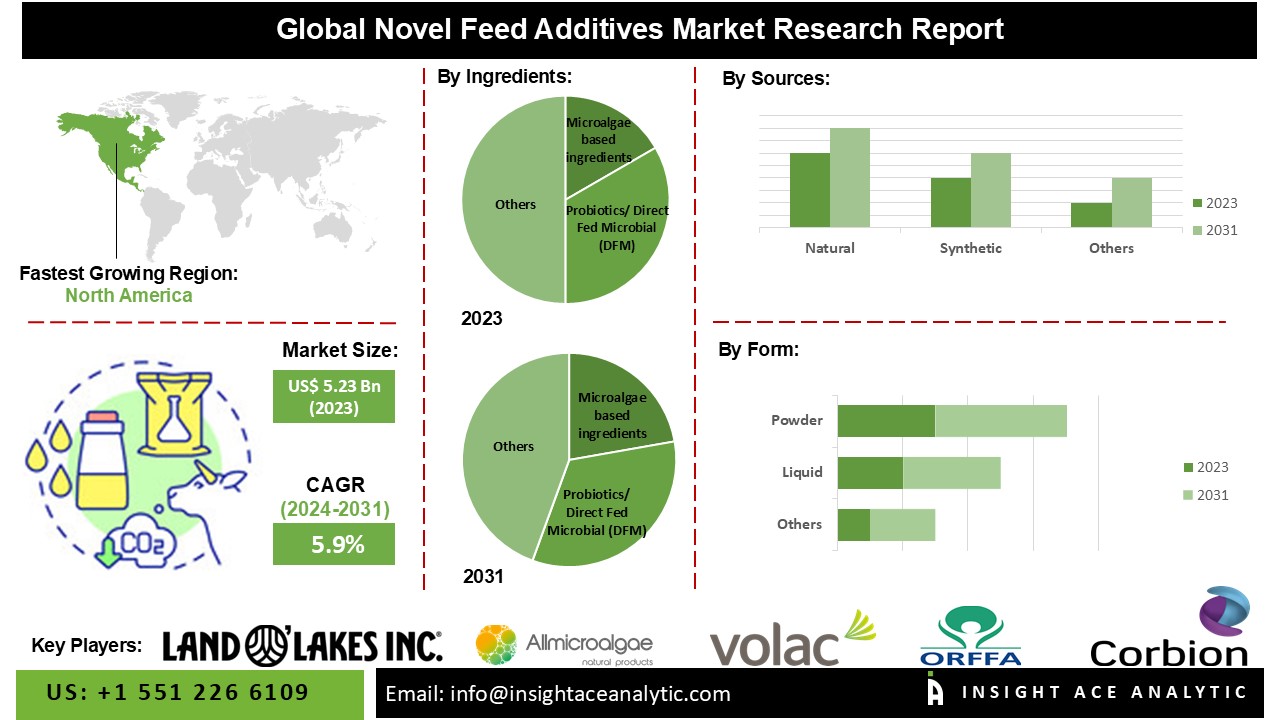
Global Novel Feed Additives Market Size is valued at USD 5.23 billion in 2023 and is predicted to reach USD 8.16 billion by the year 2031 at a 5.9% CAGR during the forecast period for 2024-2031.
Novel Feed Additives Market Size, Share & Trends Analysis Report By Ingredients (Microalgae-based ingredients (De-oiled Microalgae meal, Microalgae oil), Probiotics/DFM, Prebiotics (Yeast Cell Wall, Clay minerals), Alkalizers and buffers, Antibiotic Growth Promoters, Phytobiotics, Acidifiers/Organic Acids, Nanoparticles as feed additives, Antifungal additives and Mycotoxin binders, Bio-minerals or Chelated trace minerals, Others), By Source, By Form, By Species, By Region, And By Segment Forecasts, 2024-2031.
Innovative substances or mixtures added to animal feed with the goal of enhancing sustainability, production, and animal health are known as novel feed additives. These additions are intended to improve intestinal health, lessen environmental effects, or improve nutrient utilization. They are becoming more and more significant as substitutes for antibiotics, which are being phased out in many nations because of worries about antibiotic resistance. The industry is expanding due to remarkable consumer demand for animal products devoid of antibiotics and artificial ingredients.
Additionally, customers' concerns regarding the safety and quality of milk, eggs, and meat are growing. Producers are being pressured by this trend to utilize feed additives that enhance animal health without using antibiotics. This will boost the novel feed additives market growth.
Furthermore, the novel feed additives market is seeing a change in favour of natural substitutes, with businesses like Kemin Industries and Cargill at the forefront of the supply of antioxidants and plant-based additives to satisfy consumer demand for animal products devoid of antibiotics. Antimicrobial resistance is one of the largest problems facing the cattle business. In order to solve this problem, businesses are creating probiotic formulations and non-antibiotic growth boosters that improve animal health and accelerate market expansion.
Some Major Key Players In The Novel Feed Additives Market:
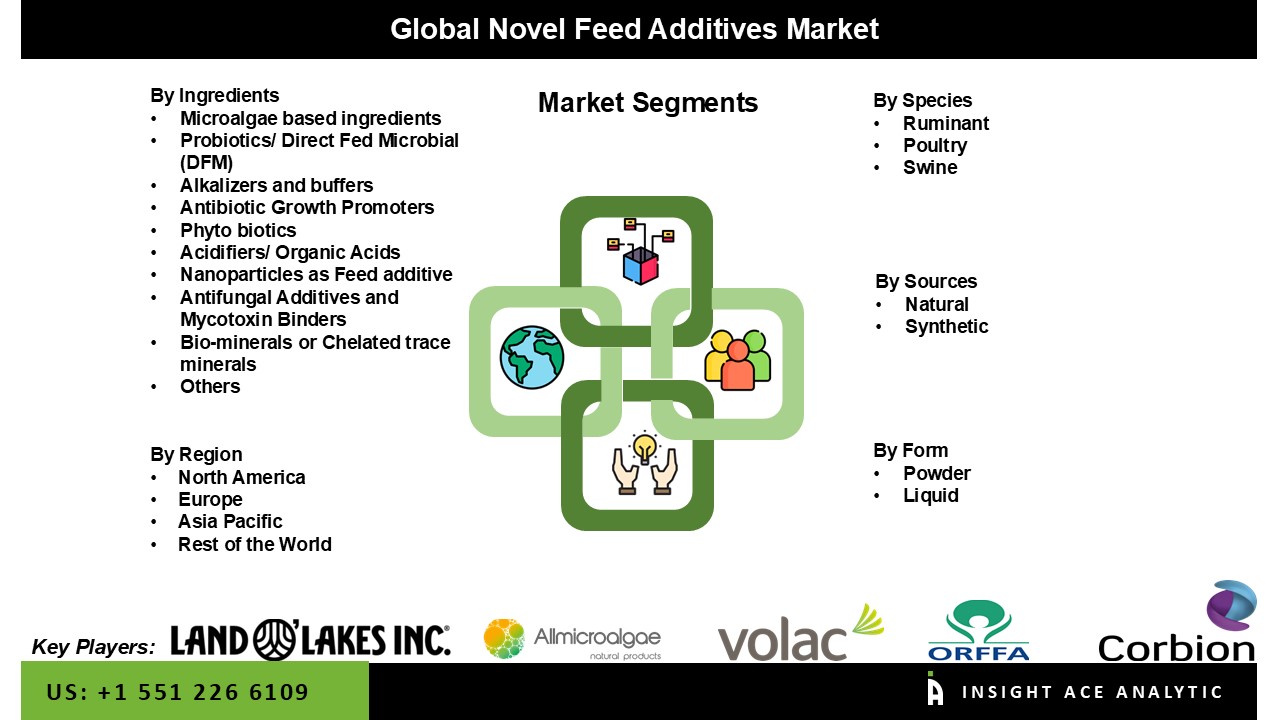
The novel feed additives market is segmented based on ingredients, source, assay type, indication, and end-user. As per the ingredients, the market is segmented into Microalgae based ingredients (De-oiled Microalgae meal and Microalgae oil), Probiotics/ Direct Fed Microbial (DFM), Prebiotics (Yeast Cell Wall, and Clay minerals), Alkalizers and buffers, Antibiotic Growth Promoters, Phyto biotics, Acidifiers/ Organic Acids, Nanoparticles as Feed additive, Antifungal Additives and Mycotoxin Binders, Bio-minerals or Chelated trace minerals, and Others. The source segment includes Natural (Plants, Animals, Micro-organisms) and Synthetic. By form, the market is segmented into Powder and Liquid. By species, the market is segmented into Ruminant (Calves, Dairy, Cattle, Beef Cattle, and Others), Poultry (Boilers, Layers, Ducks, Turkey, and Others (Geese, pheasants)), Swine, Aquaculture, and Pet animals.
The natural category is expected to hold a major global market share in 2023. Farmers are turning to natural feed additives because customers are attracted to organic and antibiotic-free animal products. The primary sources of these feed products include microbes, plants, and even animals. Companies like Kemin Industries are using cutting-edge technology to create natural performance boosters like essential oils and antioxidants. These goods are also in great demand since they fulfil customer preferences and the guidelines for producing organic food. The acceptance of natural alternative additives is also influenced by growing environmental concerns about the effects of animal agriculture.
Producers must improve the animals' health and feed conversion efficiency in order to meet the growing demand for chicken products. The industry is increasingly using probiotics, prebiotics, and other such additions to help enhance the digestive health of chickens, which in turn helps increase growth and lower mortality rates. In addition to probiotics, the makers concentrate on creating compounds that aid in boosting the production and calibre of eggs. For instance, the reproductive activities of hens depend on calcium regulators. Businesses are embracing innovative approaches to boost the expansion of chicken producers by enhancing nutritional absorption via meal additives-containing enzymes.
The North American novel feed additives market is expected to record the significant market share in revenue in the near future. One key driver of growth in this area is the increasing emphasis on antibiotic-free animal husbandry. Companies like Elance and Zoetis have developed innovative feed components that support livestock health and growth without requiring the use of antibiotics due to limitations combined with consumer preference for meat free of antibiotics. In addition, Asia Pacific is projected to grow rapidly in the global novel feed additives market. The government's emphasis on environmentally friendly and productive livestock production is a major component in the industry's healthy expansion in this region. Innovative feed additives are becoming possible thanks to rules that increase feed efficiency and reduce the usage of antibiotics.
| Report Attribute | Specifications |
| Market Size Value In 2023 | USD 5.23 Bn |
| Revenue Forecast In 2031 | USD 8.16 Bn |
| Growth Rate CAGR | CAGR of 5.9% from 2024 to 2031 |
| Quantitative Units | Representation of revenue in US$ Bn and CAGR from 2024 to 2031 |
| Historic Year | 2019 to 2023 |
| Forecast Year | 2024-2031 |
| Report Coverage | The forecast of revenue, the position of the company, the competitive market structure, growth prospects, and trends |
| Segments Covered | By Ingredients, Source, Form, Species |
| Regional Scope | North America; Europe; Asia Pacific; Latin America; Middle East & Africa |
| Country Scope | U.S.; Canada; U.K.; Germany; China; India; Japan; Brazil; Mexico; France; Italy; Spain; South East Asia; South Korea |
| Competitive Landscape | Volac International Limited, All microalgae, Chemlife Innovations Pvt Ltd, DSM, Corbion, Land O'Lakes, Inc. (PMI Nutrition), Bioproton, Imerys, Orffa, Arshine Feed Additives Co., Ltd., and Others. |
| Customization Scope | Free customization report with the procurement of the report and modifications to the regional and segment scope. Particular Geographic competitive landscape. |
| Pricing And Available Payment Methods | Explore pricing alternatives that are customized to your particular study requirements. |
Segmentation of Novel Feed Additives Market-
Novel Feed Additives Market By Ingredients-
Novel Feed Additives Market By Source-
Novel Feed Additives Market By Form-
Novel Feed Additives Market By Species-
Novel Feed Additives Market By Region-
North America-
Europe-
Asia-Pacific-
Latin America-
Middle East & Africa-
This study employed a multi-step, mixed-method research approach that integrates:
This approach ensures a balanced and validated understanding of both macro- and micro-level market factors influencing the market.
Secondary research for this study involved the collection, review, and analysis of publicly available and paid data sources to build the initial fact base, understand historical market behaviour, identify data gaps, and refine the hypotheses for primary research.
Secondary data for the market study was gathered from multiple credible sources, including:
These sources were used to compile historical data, market volumes/prices, industry trends, technological developments, and competitive insights.

Primary research was conducted to validate secondary data, understand real-time market dynamics, capture price points and adoption trends, and verify the assumptions used in the market modelling.
Primary interviews for this study involved:
Interviews were conducted via:
Primary insights were incorporated into demand modelling, pricing analysis, technology evaluation, and market share estimation.
All collected data were processed and normalized to ensure consistency and comparability across regions and time frames.
The data validation process included:
This ensured that the dataset used for modelling was clean, robust, and reliable.
The bottom-up approach involved aggregating segment-level data, such as:
This method was primarily used when detailed micro-level market data were available.

The top-down approach used macro-level indicators:
This approach was used for segments where granular data were limited or inconsistent.
To ensure accuracy, a triangulated hybrid model was used. This included:
This multi-angle validation yielded the final market size.
Market forecasts were developed using a combination of time-series modelling, adoption curve analysis, and driver-based forecasting tools.
Given inherent uncertainties, three scenarios were constructed:
Sensitivity testing was conducted on key variables, including pricing, demand elasticity, and regional adoption.