Fuel Cell Commercial Vehicle Market Size, Scope, Revenue Report 2026 to 2035
Segmentation of Fuel Cell Commercial Vehicle Market :
Fuel Cell Commercial Vehicle Market, by Vehicle -
- Light commercial vehicles
- Medium commercial vehicles
- Heavy commercial vehicles
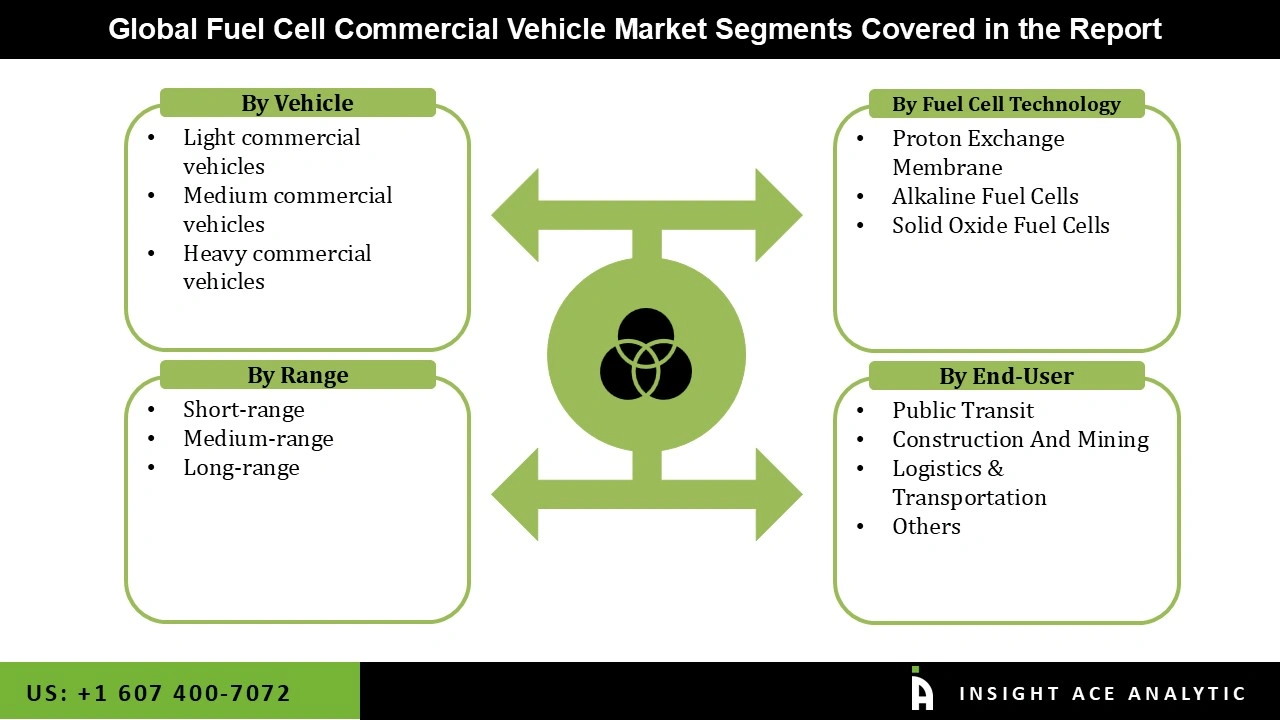
Fuel Cell Commercial Vehicle Market, by Fuel Cell Technology-
- Proton Exchange Membrane
- Alkaline Fuel Cells
- Solid Oxide Fuel Cells
Fuel Cell Commercial Vehicle Market, by Range -
- Short-range
- Medium-range
- Long-range
Fuel Cell Commercial Vehicle Market, by End User -
- Public Transit
- Construction And Mining
- Logistics & Transportation
- Others
Fuel Cell Commercial Vehicle Market, by Region-
- North America-
- The US
- Canada
- Europe-
- Germany
- The UK
- France
- Italy
- Spain
- Rest of Europe
- Asia-Pacific-
- China
- Japan
- India
- South Korea
- South East Asia
- Rest of Asia Pacific
- Latin America-
- Brazil
- Argentina
- Mexico
- Rest of Latin America
- Middle East & Africa-
- GCC Countries
- South Africa
- Rest of Middle East and Africa
Chapter 1. Methodology and Scope
1.1. Research Methodology
1.2. Research Scope & Assumptions
Chapter 2. Executive Summary
Chapter 3. Global Fuel Cell Commercial Vehicle Market Snapshot
Chapter 4. Global Fuel Cell Commercial Vehicle Market Variables, Trends & Scope
4.1. Market Segmentation & Scope
4.2. Drivers
4.3. Challenges
4.4. Trends
4.5. Investment and Funding Analysis
4.6. Porter's Five Forces Analysis
4.7. Incremental Opportunity Analysis (US$ MN), 2024-2031
4.8. Global Fuel Cell Commercial Vehicle Market Penetration & Growth Prospect Mapping (US$ Mn), 2023-2031
4.9. Competitive Landscape & Market Share Analysis, By Key Player (2023)
4.10. Use/impact of AI on Fuel Cell Commercial Vehicle Industry Trends
Chapter 5. Fuel Cell Commercial Vehicle Market Segmentation 1: By Vehicle, Estimates & Trend Analysis
5.1. Market Share by Vehicle, 2023 & 2031
5.2. Market Size (Value US$ Mn) & Forecasts and Trend Analyses, 2019 to 2031 for the following Vehicle:
5.2.1. Light Commercial Vehicles
5.2.2. Medium Commercial Vehicles
5.2.3. Heavy Commercial Vehicles
Chapter 6. Fuel Cell Commercial Vehicle Market Segmentation 2: By Fuel Cell Technology, Estimates & Trend Analysis
6.1. Market Share by Fuel Cell Technology, 2023 & 2031
6.2. Market Size (Value US$ Mn) & Forecasts and Trend Analyses, 2019 to 2031 for the following Fuel Cell Technology:
6.2.1. Proton Exchange Membrane
6.2.2. Alkaline Fuel Cells
6.2.3. Solid Oxide Fuel Cells
Chapter 7. Fuel Cell Commercial Vehicle Market Segmentation 3: By Range, Estimates & Trend Analysis
7.1. Market Share by Range, 2023 & 2031
7.2. Market Size (Value US$ Mn) & Forecasts and Trend Analyses, 2019 to 2031 for the following Range:
7.2.1. Short-range
7.2.2. Medium-range
7.2.3. Long-range
Chapter 8. Fuel Cell Commercial Vehicle Market Segmentation 4: By End User, Estimates & Trend Analysis
8.1. Market Share by End User, 2023 & 2031
8.2. Market Size (Value US$ Mn) & Forecasts and Trend Analyses, 2019 to 2031 for the following End User:
8.2.1. Public Transit
8.2.2. Construction And Mining
8.2.3. Logistics & Transportation
8.2.4. Others
Chapter 9. Fuel Cell Commercial Vehicle Market Segmentation 5: Regional Estimates & Trend Analysis
9.1. Global Fuel Cell Commercial Vehicle Market, Regional Snapshot 2023 & 2031
9.2. North America
9.2.1. North America Fuel Cell Commercial Vehicle Market Revenue (US$ Million) Estimates and Forecasts by Country, 2024-2031
9.2.1.1. US
9.2.1.2. Canada
9.2.2. North America Fuel Cell Commercial Vehicle Market Revenue (US$ Million) Estimates and Forecasts by Vehicle, 2024-2031
9.2.3. North America Fuel Cell Commercial Vehicle Market Revenue (US$ Million) Estimates and Forecasts by Fuel Cell Technology, 2024-2031
9.2.4. North America Fuel Cell Commercial Vehicle Market Revenue (US$ Million) Estimates and Forecasts by Range, 2024-2031
9.2.5. North America Fuel Cell Commercial Vehicle Market Revenue (US$ Million) Estimates and Forecasts by End User, 2024-2031
9.3. Europe
9.3.1. Europe Fuel Cell Commercial Vehicle Market Revenue (US$ Million) Estimates and Forecasts by Country, 2024-2031
9.3.1.1. Germany
9.3.1.2. U.K.
9.3.1.3. France
9.3.1.4. Italy
9.3.1.5. Spain
9.3.1.6. Rest of Europe
9.3.2. Europe Fuel Cell Commercial Vehicle Market Revenue (US$ Million) Estimates and Forecasts by Vehicle, 2024-2031
9.3.3. Europe Fuel Cell Commercial Vehicle Market Revenue (US$ Million) Estimates and Forecasts by Fuel Cell Technology, 2024-2031
9.3.4. Europe Fuel Cell Commercial Vehicle Market Revenue (US$ Million) Estimates and Forecasts by Range, 2024-2031
9.3.5. Europe Fuel Cell Commercial Vehicle Market Revenue (US$ Million) Estimates and Forecasts by End User, 2024-2031
9.4. Asia Pacific
9.4.1. Asia Pacific Fuel Cell Commercial Vehicle Market Revenue (US$ Million) Estimates and Forecasts by Country, 2024-2031
9.4.1.1. India
9.4.1.2. China
9.4.1.3. Japan
9.4.1.4. Australia
9.4.1.5. South Korea
9.4.1.6. Hong Kong
9.4.1.7. Southeast Asia
9.4.1.8. Rest of Asia Pacific
9.4.2. Asia Pacific Fuel Cell Commercial Vehicle Market Revenue (US$ Million) Estimates and Forecasts by Vehicle, 2024-2031
9.4.3. Asia Pacific Fuel Cell Commercial Vehicle Market Revenue (US$ Million) Estimates and Forecasts by Fuel Cell Technology, 2024-2031
9.4.4. Asia Pacific Fuel Cell Commercial Vehicle Market Revenue (US$ Million) Estimates and Forecasts by Range, 2024-2031
9.4.5. Asia Pacific Fuel Cell Commercial Vehicle Market Revenue (US$ Million) Estimates and Forecasts by End User, 2024-2031
9.5. Latin America
9.5.1. Latin America Fuel Cell Commercial Vehicle Market Revenue (US$ Million) Estimates and Forecasts by Country, 2024-2031
9.5.1.1. Brazil
9.5.1.2. Mexico
9.5.1.3. Rest of Latin America
9.5.2. Latin America Fuel Cell Commercial Vehicle Market Revenue (US$ Million) Estimates and Forecasts by Vehicle, 2024-2031
9.5.3. Latin America Fuel Cell Commercial Vehicle Market Revenue (US$ Million) Estimates and Forecasts by Fuel Cell Technology, 2024-2031
9.5.4. Latin America Fuel Cell Commercial Vehicle Market Revenue (US$ Million) Estimates and Forecasts by Range, 2024-2031
9.5.5. Latin America Fuel Cell Commercial Vehicle Market Revenue (US$ Million) Estimates and Forecasts by End User, 2024-2031
9.6. Middle East & Africa
9.6.1. Middle East & Africa Fuel Cell Commercial Vehicle Market Revenue (US$ Million) Estimates and Forecasts by country, 2024-2031
9.6.1.1. GCC Countries
9.6.1.2. Israel
9.6.1.3. South Africa
9.6.1.4. Rest of Middle East and Africa
9.6.2. Middle East & Africa Fuel Cell Commercial Vehicle Market Revenue (US$ Million) Estimates and Forecasts by Vehicle, 2024-2031
9.6.3. Middle East & Africa Fuel Cell Commercial Vehicle Market Revenue (US$ Million) Estimates and Forecasts by Fuel Cell Technology, 2024-2031
9.6.4. Middle East & Africa Fuel Cell Commercial Vehicle Market Revenue (US$ Million) Estimates and Forecasts by Range, 2024-2031
9.6.5. Middle East & Africa Fuel Cell Commercial Vehicle Market Revenue (US$ Million) Estimates and Forecasts by End User, 2024-2031
Chapter 10. Competitive Landscape
10.1. Major Mergers and Acquisitions/Strategic Alliances
10.2. Company Profiles
10.2.1. Foton Motor
10.2.1.1. Business Overview
10.2.1.2. Key Product/Service Offerings
10.2.1.3. Financial Performance
10.2.1.4. Geographical Presence
10.2.1.5. Recent Developments with Business Strategy
10.2.2. Honda Motor
10.2.3. Hyundai Motor
10.2.4. Hyzon Motors
10.2.5. Mercedes-Benz Group
10.2.6. New Flyer
10.2.7. Nikola
10.2.8. PACCAR
10.2.9. Renault
10.2.10. Solaris Bus & Coach
10.2.11. Tata Motors
10.2.12. Toyota Motor Company
10.2.13. Volkswagen Group (Scania)
10.2.14. Volvo Group
10.2.15. Zhejiang Geely Holding Group
10.2.16. Other Prominent Players
Research Design and Approach
This study employed a multi-step, mixed-method research approach that integrates:
- Secondary research
- Primary research
- Data triangulation
- Hybrid top-down and bottom-up modelling
- Forecasting and scenario analysis
This approach ensures a balanced and validated understanding of both macro- and micro-level market factors influencing the market.
Secondary Research
Secondary research for this study involved the collection, review, and analysis of publicly available and paid data sources to build the initial fact base, understand historical market behaviour, identify data gaps, and refine the hypotheses for primary research.
Sources Consulted
Secondary data for the market study was gathered from multiple credible sources, including:
- Government databases, regulatory bodies, and public institutions
- International organizations (WHO, OECD, IMF, World Bank, etc.)
- Commercial and paid databases
- Industry associations, trade publications, and technical journals
- Company annual reports, investor presentations, press releases, and SEC filings
- Academic research papers, patents, and scientific literature
- Previous market research publications and syndicated reports
These sources were used to compile historical data, market volumes/prices, industry trends, technological developments, and competitive insights.
Primary Research
Primary research was conducted to validate secondary data, understand real-time market dynamics, capture price points and adoption trends, and verify the assumptions used in the market modelling.
Stakeholders Interviewed
Primary interviews for this study involved:
- Manufacturers and suppliers in the market value chain
- Distributors, channel partners, and integrators
- End-users / customers (e.g., hospitals, labs, enterprises, consumers, etc., depending on the market)
- Industry experts, technology specialists, consultants, and regulatory professionals
- Senior executives (CEOs, CTOs, VPs, Directors) and product managers
Interview Process
Interviews were conducted via:
- Structured and semi-structured questionnaires
- Telephonic and video interactions
- Email correspondences
- Expert consultation sessions
Primary insights were incorporated into demand modelling, pricing analysis, technology evaluation, and market share estimation.
Data Processing, Normalization, and Validation
All collected data were processed and normalized to ensure consistency and comparability across regions and time frames.
The data validation process included:
- Standardization of units (currency conversions, volume units, inflation adjustments)
- Cross-verification of data points across multiple secondary sources
- Normalization of inconsistent datasets
- Identification and resolution of data gaps
- Outlier detection and removal through algorithmic and manual checks
- Plausibility and coherence checks across segments and geographies
This ensured that the dataset used for modelling was clean, robust, and reliable.
Market Size Estimation and Data Triangulation
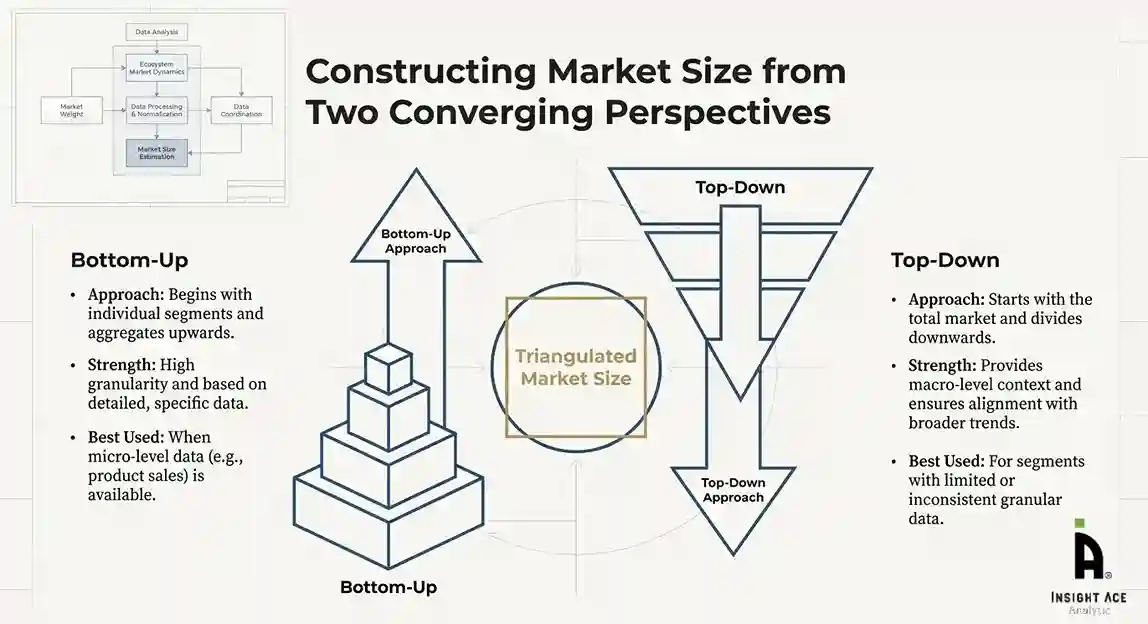
Bottom-Up Approach
The bottom-up approach involved aggregating segment-level data, such as:
- Company revenues
- Product-level sales
- Installed base/usage volumes
- Adoption and penetration rates
- Pricing analysis
This method was primarily used when detailed micro-level market data were available.
Top-Down Approach
The top-down approach used macro-level indicators:
- Parent market benchmarks
- Global/regional industry trends
- Economic indicators (GDP, demographics, spending patterns)
- Penetration and usage ratios
This approach was used for segments where granular data were limited or inconsistent.
Hybrid Triangulation Approach
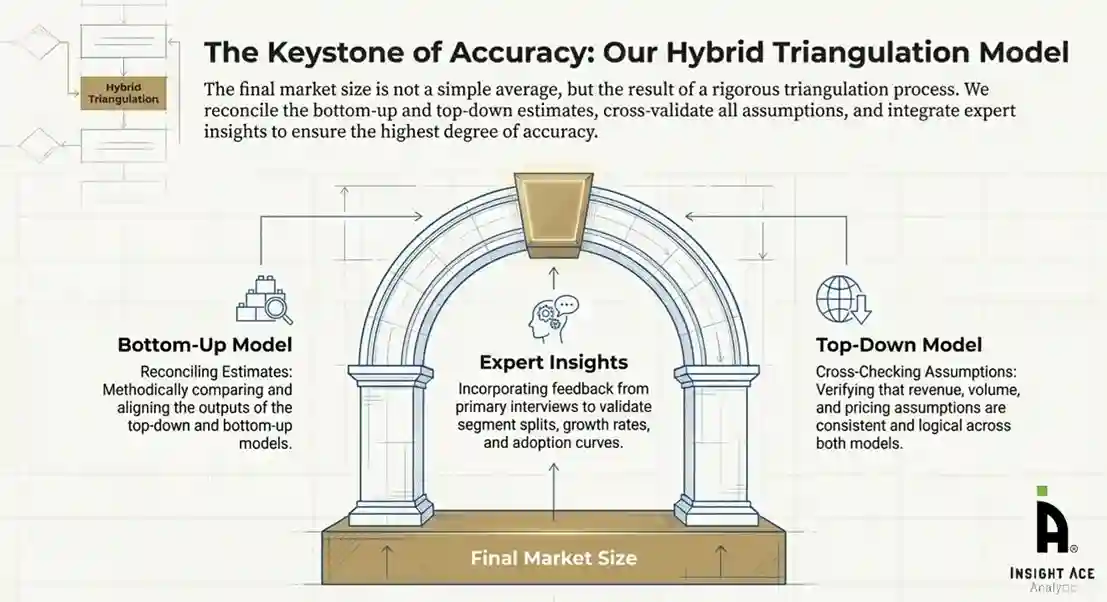
To ensure accuracy, a triangulated hybrid model was used. This included:
- Reconciling top-down and bottom-up estimates
- Cross-checking revenues, volumes, and pricing assumptions
- Incorporating expert insights to validate segment splits and adoption rates
This multi-angle validation yielded the final market size.
Forecasting Framework and Scenario Modelling
Market forecasts were developed using a combination of time-series modelling, adoption curve analysis, and driver-based forecasting tools.
Forecasting Methods
- Time-series modelling
- S-curve and diffusion models (for emerging technologies)
- Driver-based forecasting (GDP, disposable income, adoption rates, regulatory changes)
- Price elasticity models
- Market maturity and lifecycle-based projections
Scenario Analysis
Given inherent uncertainties, three scenarios were constructed:
- Base-Case Scenario: Expected trajectory under current conditions
- Optimistic Scenario: High adoption, favourable regulation, strong economic tailwinds
- Conservative Scenario: Slow adoption, regulatory delays, economic constraints
Sensitivity testing was conducted on key variables, including pricing, demand elasticity, and regional adoption.
Request Customization
Add countries, segments, company profiles, or extend forecast — free 10% customization with purchase.
Customize This Report →Enquire Before Buying
Speak with our analyst team about scope, methodology, pricing, or deliverable formats.
Enquire Now →Frequently Asked Questions
Fuel Cell Commercial Vehicle Market Size is valued at USD 1.41 Bn in 2025 and is predicted to reach USD 16.48 Bn by the year 2035
Fuel Cell Commercial Vehicle Market is expected to grow at an 28.0% CAGR during the forecast period for 2026 to 2035.
Foton Motor, Honda Motor, Hyundai Motor, Hyzon Motors, Mercedes-Benz Group, New Flyer, Nikola, PACCAR, Renault, Solaris Bus & Coach, Tata Motors, Toyota Motor Company, Volkswagen Group (Scania), Volvo Group, Zhejiang Geely Holding Group and Other.
Fuel Cell Commercial Vehicle Market is segmented in ehicle (Light Commercial Vehicles, Medium Commercial Vehicles, Heavy Commercial Vehicles), Fuel Cell Technology (Proton Exchange Membrane, Alkaline Fuel Cells, Solid Oxide Fuel Cells), Range (Short-Range, Medium-Range, Long-Range), End User and other.
North America region is leading the Fuel Cell Commercial Vehicle Market.