Artificial Intelligence (AI) In Animal Health Market Size, Share, Forecast Report 2026 to 2035
Segmentation of Artificial Intelligence (AI) In Animal Health Market-
AI in Animal Health Market by Animal Cohort & Production System –
● Companion Animals
○ Dogs
○ Cats
○ Other Small Companion & Exotic Species
● Equine
○ Performance & Sport Horses
○ Breeding, Leisure & Working Equids
● Production Livestock
○ Dairy Cattle
○ Beef Cattle
○ Swine
○ Poultry
○ Small Ruminants & Other Managed Livestock
● Aquaculture
○ Marine Finfish
○ Land-Based & Recirculating Aquaculture Systems (RAS)
○ Shrimp & Other Aquatic Species
AI in Animal Health Market by AI Application / Capability –
● Diagnostic Imaging & Sample-Analysis AI
○ Radiographic & Dental-Radiographic Interpretation
○ Point-of-Care Cytology, Haematology, Blood Morphology & Urine Sediment
○ Digital Pathology & Reference-Laboratory Image AI
○ AI-Assisted Teleradiology Reporting & Quality Assurance
● Continuous Health Monitoring & Early-Warning AI
○ Wearable & Implantable Sensing
○ Computer-Vision Behaviour, Gait & Body-Condition Analytics
○ Acoustic & Bioacoustic Health Monitoring
○ Owner-Facing Mobile Image & Video Screening
○ Environmental & Micro-Climate Sensing Analytics
● Clinical Workflow, Documentation & Decision-Support AI
○ Ambient Scribes & Clinical-Record Generation
○ PIMS- & Herd-System-Embedded AI
○ Teletriage, Symptom Assessment & Client Communication
○ Clinical Decision Support & Dosing Verification
● Production, Reproduction & Resource-Optimisation AI
○ Oestrus Detection & Reproductive Management
○ Feed, Nutrition & Appetite Optimisation
○ Biomass, Weight & Growth Prediction
○ Virtual Fencing & Grazing Automation
○ Hatchery, Handling & Sorting Vision
● Biosecurity, Surveillance & Epidemiological-Prediction AI
○ Disease-Risk & Outbreak Forecasting
○ Environmental & Pathogen Bio-Surveillance
○ Antimicrobial-Use Analytics & Stewardship Reporting
○ Cross-Site Benchmarking & One Health Platforms
● Precision Medicine, Genomics & AI-Enabled Discovery
○ Tumour Genomic Profiling & Therapy Matching
○ Predictive Genomics & Breeding-Value Modelling
○ Generative-AI Biologic & Molecule Design Platforms
AI in Animal Health Market by Component / Delivery Form –
● AI Software & Platforms
○ Standalone & Vendor-Neutral AI Applications
○ Embedded AI Modules in PIMS, Herd & Aquaculture Platforms
● AI-Embedded Devices & Edge Systems
○ AI-Enabled Point-of-Care Analysers & Imaging Systems
○ Connected-Animal Sensing Devices
○ Vision & Acoustic Monitoring Systems
○ Edge Gateways & Inference Appliances
● AI-Enabled Services
○ AI Interpretation & Reporting Services
○ Implementation, Integration & Commissioning
○ Managed Cloud / SaaS Operations
○ Analytics-as-a-Service & Benchmarking
AI in Animal Health Market by Deployment Model –
● Cloud / SaaS
● On-Premise & On-Device Edge
● Hybrid
AI in Animal Health Market by End User / Buyer –
● Veterinary Clinics, Hospitals & Corporate Practice Groups
● Reference Laboratories & Diagnostic-Service Providers
● Livestock & Poultry Producers and Integrators
● Aquaculture Producers & Farm Operators
● Animal-Health Corporates, Pharmaceutical & CRO R&D
● Pet Owners – Direct-to-Consumer
● Government, Academic & Institutional Buyers
By Region-
North America-
- The US
- Canada
- Mexico
Europe-
- Germany
- The UK
- France
- Italy
- Spain
- Rest of Europe
Asia-Pacific-
- China
- Japan
- India
- South Korea
- South East Asia
- Rest of Asia Pacific
Latin America-
- Brazil
- Argentina
- Rest of Latin America
Middle East & Africa-
- GCC Countries
- South Africa
- Rest of the Middle East and Africa
Chapter 1. Methodology and Scope
1.1. Research Methodology
1.2. Research Scope & Assumptions (Units: US$ Mn; Base Year 2025; Forecast 2026–2035)
Chapter 2. Executive Summary
Chapter 3. Global AI in Animal Health Market Snapshot
Chapter 4. Global AI in Animal Health Market Variables, Trends & Scope
4.1. Market Segmentation & Scope
4.2. Market Drivers
4.3. Market Challenges
4.4. Market Trends
4.5. Regulatory & Validation Landscape (Veterinary AI)
4.6. Technology & Adoption Analysis
4.7. Porter's Five Forces Analysis
4.8. Incremental Opportunity Analysis (US$ Mn), 2025–2035
4.9. Market Penetration & Growth Prospect Mapping (US$ Mn), 2026–2035
4.10. Competitive Landscape & Market Share Analysis, 2026
Chapter 5. AI in Animal Health Market Segmentation 1: By Animal Cohort & Production System
5.1. Market Share, 2025 & 2035
5.2. Market Size (US$ Mn), 2022–2035
5.2.1. Companion Animals
5.2.1.1. Dogs
5.2.1.2. Cats
5.2.1.3. Other Small Companion & Exotic Species
5.2.2. Equine
5.2.2.1. Performance & Sport Horses
5.2.2.2. Breeding, Leisure & Working Equids
5.2.3. Production Livestock
5.2.3.1. Dairy Cattle
5.2.3.2. Beef Cattle
5.2.3.3. Swine
5.2.3.4. Poultry
5.2.3.5. Small Ruminants & Other Managed Livestock
5.2.4. Aquaculture
5.2.4.1. Marine Finfish
5.2.4.2. Land-Based & Recirculating Aquaculture Systems (RAS)
5.2.4.3. Shrimp & Other Aquatic Species
Chapter 6. AI in Animal Health Market Segmentation 2: By AI Application / Capability
6.1. Market Share, 2025 & 2035
6.2. Market Size (US$ Mn), 2022–2035
6.2.1. Diagnostic Imaging & Sample-Analysis AI
6.2.1.1. Radiographic & Dental-Radiographic Interpretation
6.2.1.2. Point-of-Care Cytology, Haematology, Blood Morphology & Urine Sediment
6.2.1.3. Digital Pathology & Reference-Laboratory Image AI
6.2.1.4. AI-Assisted Teleradiology Reporting & Quality Assurance
6.2.2. Continuous Health Monitoring & Early-Warning AI
6.2.2.1. Wearable & Implantable Sensing
6.2.2.2. Computer-Vision Behaviour, Gait & Body-Condition Analytics
6.2.2.3. Acoustic & Bioacoustic Health Monitoring
6.2.2.4. Owner-Facing Mobile Image & Video Screening
6.2.2.5. Environmental & Micro-Climate Sensing Analytics
6.2.3. Clinical Workflow, Documentation & Decision-Support AI
6.2.3.1. Ambient Scribes & Clinical-Record Generation
6.2.3.2. PIMS- & Herd-System-Embedded AI
6.2.3.3. Teletriage, Symptom Assessment & Client Communication
6.2.3.4. Clinical Decision Support & Dosing Verification
6.2.4. Production, Reproduction & Resource-Optimisation AI
6.2.4.1. Oestrus Detection & Reproductive Management
6.2.4.2. Feed, Nutrition & Appetite Optimisation
6.2.4.3. Biomass, Weight & Growth Prediction
6.2.4.4. Virtual Fencing & Grazing Automation
6.2.4.5. Hatchery, Handling & Sorting Vision
6.2.5. Biosecurity, Surveillance & Epidemiological-Prediction AI
6.2.5.1. Disease-Risk & Outbreak Forecasting
6.2.5.2. Environmental & Pathogen Bio-Surveillance
6.2.5.3. Antimicrobial-Use Analytics & Stewardship Reporting
6.2.5.4. Cross-Site Benchmarking & One Health Platforms
6.2.6. Precision Medicine, Genomics & AI-Enabled Discovery
6.2.6.1. Tumour Genomic Profiling & Therapy Matching
6.2.6.2. Predictive Genomics & Breeding-Value Modelling
6.2.6.3. Generative-AI Biologic & Molecule Design Platforms
Chapter 7. AI in Animal Health Market Segmentation 3: By Component / Delivery Form
7.1. Market Share, 2025 & 2035
7.2. Market Size (US$ Mn), 2022–2035
7.2.1. AI Software & Platforms
7.2.1.1. Standalone & Vendor-Neutral AI Applications
7.2.1.2. Embedded AI Modules in PIMS, Herd & Aquaculture Platforms
7.2.2. AI-Embedded Devices & Edge Systems
7.2.2.1. AI-Enabled Point-of-Care Analysers & Imaging Systems
7.2.2.2. Connected-Animal Sensing Devices
7.2.2.3. Vision & Acoustic Monitoring Systems
7.2.2.4. Edge Gateways & Inference Appliances
7.2.3. AI-Enabled Services
7.2.3.1. AI Interpretation & Reporting Services
7.2.3.2. Implementation, Integration & Commissioning
7.2.3.3. Managed Cloud / SaaS Operations
7.2.3.4. Analytics-as-a-Service & Benchmarking
Chapter 8. AI in Animal Health Market Segmentation 4: By Deployment Model
8.1. Market Share, 2025 & 2035
8.2. Market Size (US$ Mn), 2022–2035
8.2.1. Cloud / SaaS
8.2.2. On-Premise & On-Device Edge
8.2.3. Hybrid
Chapter 9. AI in Animal Health Market Segmentation 5: By End User / Buyer
9.1. Market Share, 2025 & 2035
9.2. Market Size (US$ Mn), 2022–2035
9.2.1. Veterinary Clinics, Hospitals & Corporate Practice Groups
9.2.2. Reference Laboratories & Diagnostic-Service Providers
9.2.3. Livestock & Poultry Producers and Integrators
9.2.4. Aquaculture Producers & Farm Operators
9.2.5. Animal-Health Corporates, Pharmaceutical & CRO R&D
9.2.6. Pet Owners – Direct-to-Consumer
9.2.7. Government, Academic & Institutional Buyers
Chapter 10. Regional Market Estimates & Trend Analysis
10.1. Global Market Regional Snapshot, 2025 & 2035
10.2. North America
10.2.1. Market Revenue by Country (US, Canada), 2022–2035
10.2.2. North America AI in Animal Health Market Revenue (US$ Mn) By Animal Cohort & Production System, 2022–2035
10.2.3. North America AI in Animal Health Market Revenue (US$ Mn) By AI Application / Capability, 2022–2035
10.2.4. North America AI in Animal Health Market Revenue (US$ Mn) By Component / Delivery Form, 2022–2035
10.2.5. North America AI in Animal Health Market Revenue (US$ Mn) By Deployment Model, 2022–2035
10.2.6. North America AI in Animal Health Market Revenue (US$ Mn) By End User / Buyer, 2022–2035
10.3. Europe
10.3.1. Market Revenue by Country (Germany, UK, France, Netherlands, Nordics, Southern Europe, Rest of Europe), 2022–2035
10.3.2. Europe AI in Animal Health Market Revenue (US$ Mn) By Animal Cohort & Production System, 2022–2035
10.3.3. Europe AI in Animal Health Market Revenue (US$ Mn) By AI Application / Capability, 2022–2035
10.3.4. Europe AI in Animal Health Market Revenue (US$ Mn) By Component / Delivery Form, 2022–2035
10.3.5. Europe AI in Animal Health Market Revenue (US$ Mn) By Deployment Model, 2022–2035
10.3.6. Europe AI in Animal Health Market Revenue (US$ Mn) By End User / Buyer, 2022–2035
10.4. Asia Pacific
10.4.1. Market Revenue by Country (China, Japan, India, Australia & NZ, South Korea, Rest of APAC), 2022–2035
10.4.2. Asia Pacific AI in Animal Health Market Revenue (US$ Mn) By Animal Cohort & Production System, 2022–2035
10.4.3. Asia Pacific AI in Animal Health Market Revenue (US$ Mn) By AI Application / Capability, 2022–2035
10.4.4. Asia Pacific AI in Animal Health Market Revenue (US$ Mn) By Component / Delivery Form, 2022–2035
10.4.5. Asia Pacific AI in Animal Health Market Revenue (US$ Mn) By Deployment Model, 2022–2035
10.4.6. Asia Pacific AI in Animal Health Market Revenue (US$ Mn) By End User / Buyer, 2022–2035
10.5. Latin America
10.5.1. Market Revenue by Country (Brazil, Mexico, Chile, Rest of LatAm), 2022–2035
10.5.2. Latin America AI in Animal Health Market Revenue (US$ Mn) By Animal Cohort & Production System, 2022–2035
10.5.3. Latin America AI in Animal Health Market Revenue (US$ Mn) By AI Application / Capability, 2022–2035
10.5.4. Latin America AI in Animal Health Market Revenue (US$ Mn) By Component / Delivery Form, 2022–2035
10.5.5. Latin America AI in Animal Health Market Revenue (US$ Mn) By Deployment Model, 2022–2035
10.5.6. Latin America AI in Animal Health Market Revenue (US$ Mn) By End User / Buyer, 2022–2035
10.6. Middle East & Africa
10.6.1. Market Revenue by Country (GCC, South Africa, Rest of MEA), 2022–2035
10.6.2. Middle East & Africa AI in Animal Health Market Revenue (US$ Mn) By Animal Cohort & Production System, 2022–2035
10.6.3. Middle East & Africa AI in Animal Health Market Revenue (US$ Mn) By AI Application / Capability, 2022–2035
10.6.4. Middle East & Africa AI in Animal Health Market Revenue (US$ Mn) By Component / Delivery Form, 2022–2035
10.6.5. Middle East & Africa AI in Animal Health Market Revenue (US$ Mn) By Deployment Model, 2022–2035
10.6.6. Middle East & Africa AI in Animal Health Market Revenue (US$ Mn) By End User / Buyer, 2022–2035
Chapter 11. Competitive Landscape
11.1. Key Strategic Developments (Acquisitions, Partnerships, Product Launches)
11.2. Market Share Analysis, 2026
11.3. Company Profiles (44 Players)
Integrated Animal-Health Platform Leaders
11.3.1. Zoetis Inc.
11.3.2. IDEXX Laboratories, Inc.
11.3.3. Mars, Incorporated (Antech Diagnostics / Mars Science & Diagnostics)
11.3.4. Merck Animal Health / MSD Animal Health
11.3.5. Boehringer Ingelheim Animal Health
11.3.6. GEA Group AG
Precision Livestock & Production Intelligence Specialists
11.3.7. Halter
11.3.8. Nedap N.V.
11.3.9. smaXtec GmbH
11.3.10. CowManager B.V.
11.3.11. Afimilk Ltd.
11.3.12. Connecterra B.V.
11.3.13. Ever.Ag (Cainthus)
11.3.14. Cargill, Incorporated
11.3.15. TARGAN Inc.
11.3.16. SoundTalks NV
11.3.17. DeLaval International AB
11.3.18. Lely International N.V.
Companion-Animal Diagnostics, Imaging & Precision Medicine Specialists
11.3.19. SignalPET
11.3.20. Vetology Innovations
11.3.21. Picoxia
11.3.22. Radimal
11.3.23. VitalRADS
11.3.24. One Health Company (FidoCure)
11.3.25. Aiforia Technologies Oyj
11.3.26. Moichor
11.3.27. ImpriMed, Inc.
Veterinary Workflow, Documentation & Connected-Pet Platforms
11.3.28. Digitail
11.3.29. VetRec
11.3.30. CoVet
11.3.31. Scribenote
11.3.32. Talkatoo
11.3.33. HappyDoc
11.3.34. Petriage
11.3.35. PetPace
11.3.36. Tractive
11.3.37. AI For Pet (TTcare)
11.3.38. Felcana
Aquaculture Health & Welfare Intelligence Specialists
11.3.39. Aquabyte AS
11.3.40. ReelData AI
11.3.41. OptoScale AS
11.3.42. Manolin
11.3.43. UMITRON Pte. Ltd.
11.3.44. Ace Aquatec
11.4. Emerging, Regional & Adjacent Innovators (51 Players)
Veterinary Clinical & Workflow AI
11.4.1. Sylvester.ai
11.4.2. ScribbleVet
11.4.3. Otto
11.4.4. Vetibble
11.4.5. PetDesk Scribe
11.4.6. Shepherd Veterinary Software
11.4.7. Heidi Health
11.4.8. Vetspire
11.4.9. Provet Cloud
11.4.10. Instinct Science
11.4.11. Petalife
11.4.12. OpenVet
Livestock, Poultry & Biosecurity AI
11.4.13. metaBIX Biotech
11.4.14. Vet Vision AI
11.4.15. Moocall
11.4.16. Faromatics (ChickenBoy)
11.4.17. Barn Talk
11.4.18. Datamars
11.4.19. Knex
Virtual Fencing
11.4.20. Nofence
11.4.21. Gallagher eShepherd
11.4.22. Vence
11.4.23. Corral Technologies
Aquaculture
11.4.24. AKVA Group ASA
11.4.25. Innovasea Systems
11.4.26. BioSort (iFarm)
11.4.27. Observe Technologies
11.4.28. Eruvaka Technologies
11.4.29. XpertSea
11.4.30. Wittaya Aqua
11.4.31. GoSmart
11.4.32. CreateView
11.4.33. TidalX AI
11.4.34. Bluegrove (CageEye)
11.4.35. Aquaticode
Dairy & Herd Platforms with AI Modules
11.4.36. BouMatic
11.4.37. Fullwood Packo
11.4.38. Trimble Agriculture
11.4.39. Uniform-Agri
11.4.40. Farmbrite
AI-Enabled Discovery & Genomics
11.4.41. Invetx (Dechra)
11.4.42. Absci Corporation
11.4.43. Basepaws (Zoetis)
11.4.44. Wisdom Panel (Mars)
11.4.45. Embark Veterinary
Animal-Health Corporates with Limited Standalone AI Revenue
11.4.46. Elanco Animal Health
11.4.47. Ceva Santé Animale
11.4.48. Virbac
11.4.49. Vetoquinol
11.4.50. Phibro Animal Health
11.4.51. Dechra Pharmaceuticals
Research Design and Approach
This study employed a multi-step, mixed-method research approach that integrates:
- Secondary research
- Primary research
- Data triangulation
- Hybrid top-down and bottom-up modelling
- Forecasting and scenario analysis
This approach ensures a balanced and validated understanding of both macro- and micro-level market factors influencing the market.
Secondary Research
Secondary research for this study involved the collection, review, and analysis of publicly available and paid data sources to build the initial fact base, understand historical market behaviour, identify data gaps, and refine the hypotheses for primary research.
Sources Consulted
Secondary data for the market study was gathered from multiple credible sources, including:
- Government databases, regulatory bodies, and public institutions
- International organizations (WHO, OECD, IMF, World Bank, etc.)
- Commercial and paid databases
- Industry associations, trade publications, and technical journals
- Company annual reports, investor presentations, press releases, and SEC filings
- Academic research papers, patents, and scientific literature
- Previous market research publications and syndicated reports
These sources were used to compile historical data, market volumes/prices, industry trends, technological developments, and competitive insights.
Primary Research
Primary research was conducted to validate secondary data, understand real-time market dynamics, capture price points and adoption trends, and verify the assumptions used in the market modelling.
Stakeholders Interviewed
Primary interviews for this study involved:
- Manufacturers and suppliers in the market value chain
- Distributors, channel partners, and integrators
- End-users / customers (e.g., hospitals, labs, enterprises, consumers, etc., depending on the market)
- Industry experts, technology specialists, consultants, and regulatory professionals
- Senior executives (CEOs, CTOs, VPs, Directors) and product managers
Interview Process
Interviews were conducted via:
- Structured and semi-structured questionnaires
- Telephonic and video interactions
- Email correspondences
- Expert consultation sessions
Primary insights were incorporated into demand modelling, pricing analysis, technology evaluation, and market share estimation.
Data Processing, Normalization, and Validation
All collected data were processed and normalized to ensure consistency and comparability across regions and time frames.
The data validation process included:
- Standardization of units (currency conversions, volume units, inflation adjustments)
- Cross-verification of data points across multiple secondary sources
- Normalization of inconsistent datasets
- Identification and resolution of data gaps
- Outlier detection and removal through algorithmic and manual checks
- Plausibility and coherence checks across segments and geographies
This ensured that the dataset used for modelling was clean, robust, and reliable.
Market Size Estimation and Data Triangulation
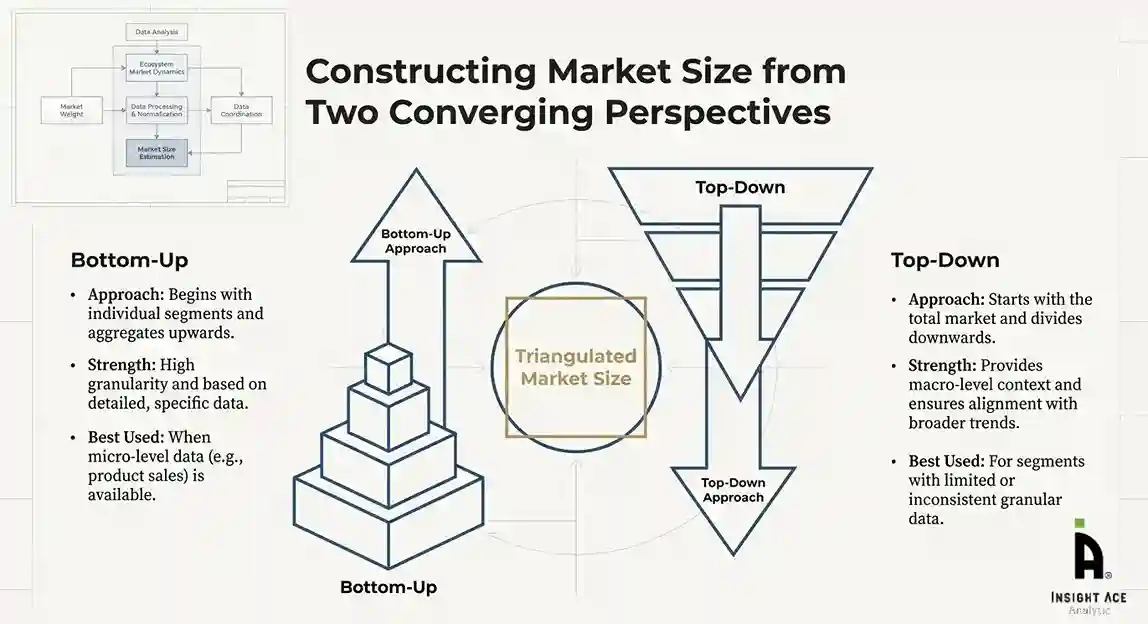
Bottom-Up Approach
The bottom-up approach involved aggregating segment-level data, such as:
- Company revenues
- Product-level sales
- Installed base/usage volumes
- Adoption and penetration rates
- Pricing analysis
This method was primarily used when detailed micro-level market data were available.
Top-Down Approach
The top-down approach used macro-level indicators:
- Parent market benchmarks
- Global/regional industry trends
- Economic indicators (GDP, demographics, spending patterns)
- Penetration and usage ratios
This approach was used for segments where granular data were limited or inconsistent.
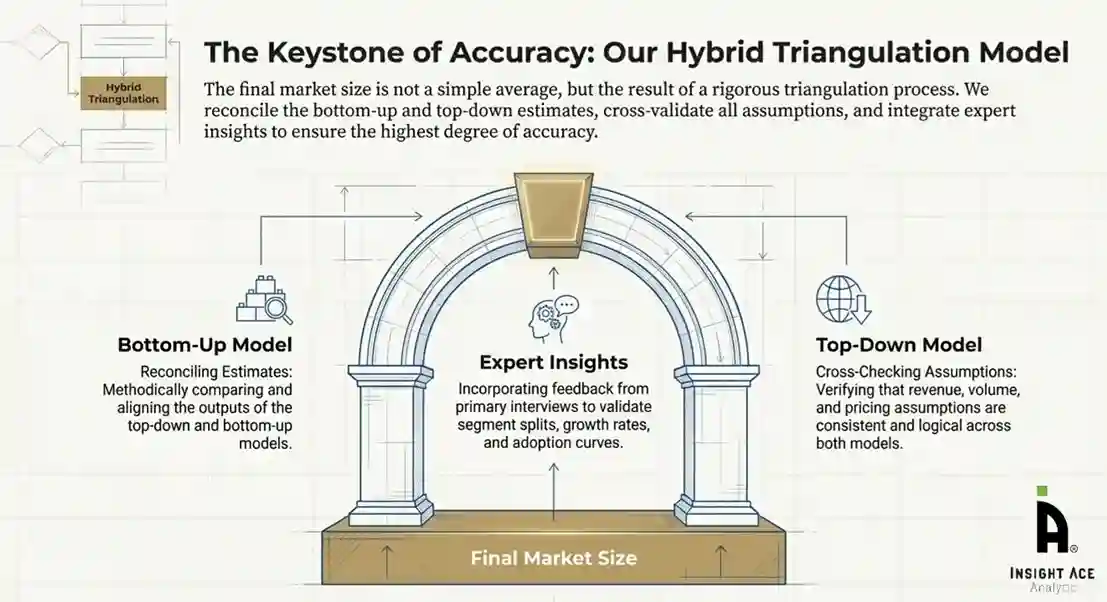
Hybrid Triangulation Approach
To ensure accuracy, a triangulated hybrid model was used. This included:
- Reconciling top-down and bottom-up estimates
- Cross-checking revenues, volumes, and pricing assumptions
- Incorporating expert insights to validate segment splits and adoption rates
This multi-angle validation yielded the final market size.
Forecasting Framework and Scenario Modelling
Market forecasts were developed using a combination of time-series modelling, adoption curve analysis, and driver-based forecasting tools.
Forecasting Methods
- Time-series modelling
- S-curve and diffusion models (for emerging technologies)
- Driver-based forecasting (GDP, disposable income, adoption rates, regulatory changes)
- Price elasticity models
- Market maturity and lifecycle-based projections
Scenario Analysis
Given inherent uncertainties, three scenarios were constructed:
- Base-Case Scenario: Expected trajectory under current conditions
- Optimistic Scenario: High adoption, favourable regulation, strong economic tailwinds
- Conservative Scenario: Slow adoption, regulatory delays, economic constraints
Sensitivity testing was conducted on key variables, including pricing, demand elasticity, and regional adoption.
Request Customization
Add countries, segments, company profiles, or extend forecast — free 10% customization with purchase.
Customize This Report →Enquire Before Buying
Speak with our analyst team about scope, methodology, pricing, or deliverable formats.
Enquire Now →Frequently Asked Questions
Artificial Intelligence (AI) In Animal Health Market Size is valued at 1,501.52 Mn in 2025 and is predicted to reach 10,037.21 Mn by the year 2035.
Artificial Intelligence (AI) In Animal Health Market expected to grow at a 21.80% CAGR during the forecast period for 2026-2035.
Alpha Phenomics Inc., Animals.ai, EIO Diagnostics Inc, Farm4Trade, FarmSee, Halter USA Inc., Heska Corporation, IDEXX Laboratories, Inc.,
Artificial Intelligence (AI) In Animal Health Market is segmented as solution, application, and animal type. According to the solution segment, the market is segmented into Hardware, Software & Services.
North American region is leading the Artificial Intelligence (AI) In Animal Health Market.