AI-Powered Video Analytics for Workplace Safety Market Size, Share, Revenue Report 2026 to 2035
What is AI-Powered Video Analytics for Workplace Safety Market Size?
Global AI-Powered Video Analytics for Workplace Safety Market is predicted to grow at a 20.5% CAGR during the forecast period for 2026 to 2035.
AI-Powered Video Analytics for Workplace Safety Market Size, Share & Trends Analysis Distribution by Component & Delivery Layer (Software, Edge Hardware & Appliances, Services), By Safety Application (PPE & Personal Compliance Monitoring, Vehicle–Pedestrian & Mobile Equipment Safety, Restricted-Area, Danger-Zone & Machine-Guarding Control, Behavioural Safety & Ergonomics, Emergency, Environmental & Housekeeping Hazards, SOP, Process & Permit-to-Work Compliance), By Industry Vertical, By Deployment Architecture, and By Camera & Capture Infrastructure and Segment Forecasts, 2026 to 2035.
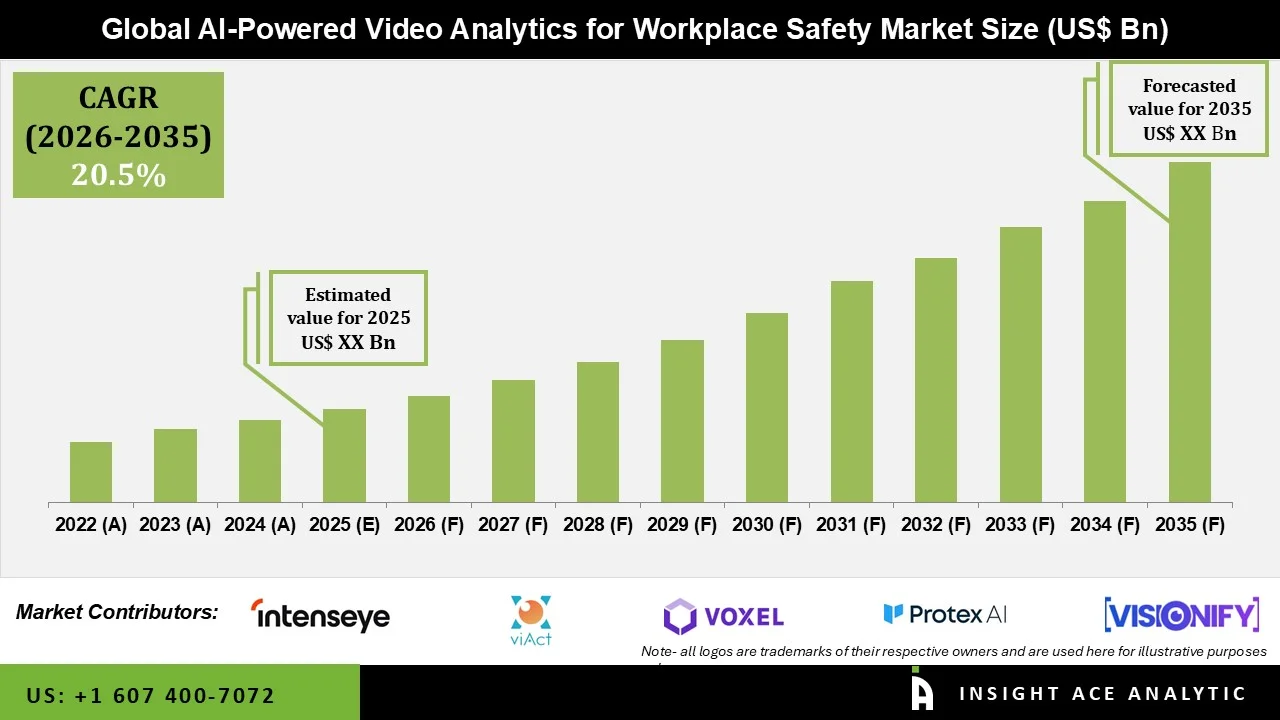
AI-powered video analytics for workplace safety combines computer vision, artificial intelligence, and edge/cloud-based video processing to monitor industrial workplaces continuously. It identifies unsafe conditions and sends real-time alerts before incidents happen. Unlike traditional CCTV systems that depend on manual observation and post-event investigations, these smart platforms automatically detect personal protective equipment (PPE) compliance, worker proximity to hazardous machinery, vehicle-pedestrian interactions, restricted-area intrusions, unsafe behaviors, ergonomic risks, housekeeping issues, and emergency situations. The technology can be used with existing surveillance systems or purpose-built AI cameras. It integrates with safety management systems, industrial IoT platforms, access control, and enterprise workflows to support automatic incident reporting and corrective actions. Its applications include manufacturing facilities, warehouses, construction sites, mining operations, oil and gas facilities, utilities, transportation hubs, pharmaceuticals, food processing plants, and other high-risk industrial environments. Continuous monitoring improves worker safety, regulatory compliance, and operational efficiency.
The AI-powered video analytics for workplace safety market is growing rapidly as organizations move from reactive incident management to predictive and preventive safety strategies. The digitalization of industrial operations, the wider use of AI-enabled surveillance systems, improvements in edge computing, and computer vision, as well as the increasing focus on worker well-being and regulatory compliance, are accelerating market growth. Companies are investing in smart safety platforms to improve hazard detection, reduce workplace incidents, promote a safety culture, and gain useful insights from operational data. Ongoing innovations in multimodal AI, real-time analytics, cloud-edge hybrid setups, and integration with enterprise safety systems are further enhancing workplace safety solutions. This positions AI-powered video analytics as a vital part of modern industrial safety and operational success.
Competitive Landscape
Which are the Leading Players in the AI-Powered Video Analytics for Workplace Safety Market?
- Intenseye
- Protex AI
- Voxel
- viAct
- Visionify
- Ailytics
- Detect Technologies
- Everguard.ai
- Wobot.ai
- SmartCone Technologies
- Invisible AI
- Avathon
- Vaidio (IronYun)
- Spot AI
- Matroid
- Irisity
- DroneDeploy
- Axis Communications
- Hanwha Vision
- Motorola Solutions (Avigilon)
- Hikvision
- Dahua Technology
- Genetec
- Milestone Systems
- Bosch Building Technologies
Market Dynamics
Driver
Shift from Reactive to Proactive Workplace Safety Management Through AI-Based Real-Time Hazard Detection
Organizations in high-risk industries are shifting away from traditional safety practices that depend on manual inspections and incident reports. AI-powered video analytics allows for continuous monitoring of workplaces. It automatically detects unsafe behaviors and dangerous conditions in real time, generating instant alerts before accidents happen. This proactive approach helps reduce workplace injuries, improve regulatory compliance, lower operational downtime, and enhance overall safety performance. As industries increasingly focus on worker well-being, operational strength, and ESG goals, investments in AI-driven workplace safety solutions keep growing.
Restrain/Challenge
Workforce Acceptance, and Data Governance Concerns
The broad use of AI-driven video analytics raises serious concerns about employee privacy, constant surveillance, and how sensitive video data is managed. Workers and labor groups might view AI monitoring as intrusive, resulting in pushback and reduced acceptance. Meanwhile, businesses need to follow changing data protection laws (like GDPR and similar regional privacy rules), create clear governance policies, secure stored video data, and stop the misuse of AI-generated insights. Finding the right balance between effective safety monitoring, employee trust, and following regulations is a significant challenge, especially for global companies operating in various regions.
Software Segment is Expected to Drive the AI-Powered Video Analytics for Workplace Safety Market
The Software segment is leading the AI-powered video analytics for workplace safety market. It acts as the intelligence layer that allows for real-time hazard detection, monitoring of PPE compliance, analysis of safety behavior, management of incidents, and predictive safety insights. Ongoing improvements in computer vision, deep learning, edge AI, and cloud-based analytics have greatly increased detection accuracy and broadened safety applications in various industries. Moreover, easy integration with existing CCTV systems, video management platforms, IoT devices, and EHS software, along with regular software subscriptions and updates for AI models, is speeding up enterprise adoption. This makes software the largest and most influential part of the market.
PPE & Personal Compliance Monitoring Segment is Growing at the Highest Rate in the AI-Powered Video Analytics for Workplace Safety Market
The PPE and personal compliance monitoring segment leads the AI-powered video analytics for workplace safety market. This is due to its wide use in manufacturing, construction, mining, oil and gas, logistics, and other high-risk industries. AI-powered video analytics allows for continuous real-time monitoring of safety helmets, high-visibility vests, gloves, safety glasses, masks, and other protective gear. It automatically spots non-compliance and sends instant alerts. Stricter regulations, a growing focus on reducing workplace injuries, and the need to replace manual safety checks with automated monitoring are speeding up the adoption of AI-driven PPE compliance solutions. Their easy setup with existing camera systems and immediate effect on improving worker safety and meeting regulations further establish PPE monitoring as the top application segment in the market.
Why North America Led the AI-Powered Video Analytics for Workplace Safety Market?
North America leads the AI-powered video analytics for workplace safety market due to its early use of artificial intelligence, computer vision, and Industry 4.0 technologies in manufacturing, logistics, construction, oil and gas, and utilities. The region has a strong presence of top AI workplace safety vendors like Intenseye, Voxel, Spot AI, Invisible AI, and Motorola Solutions.
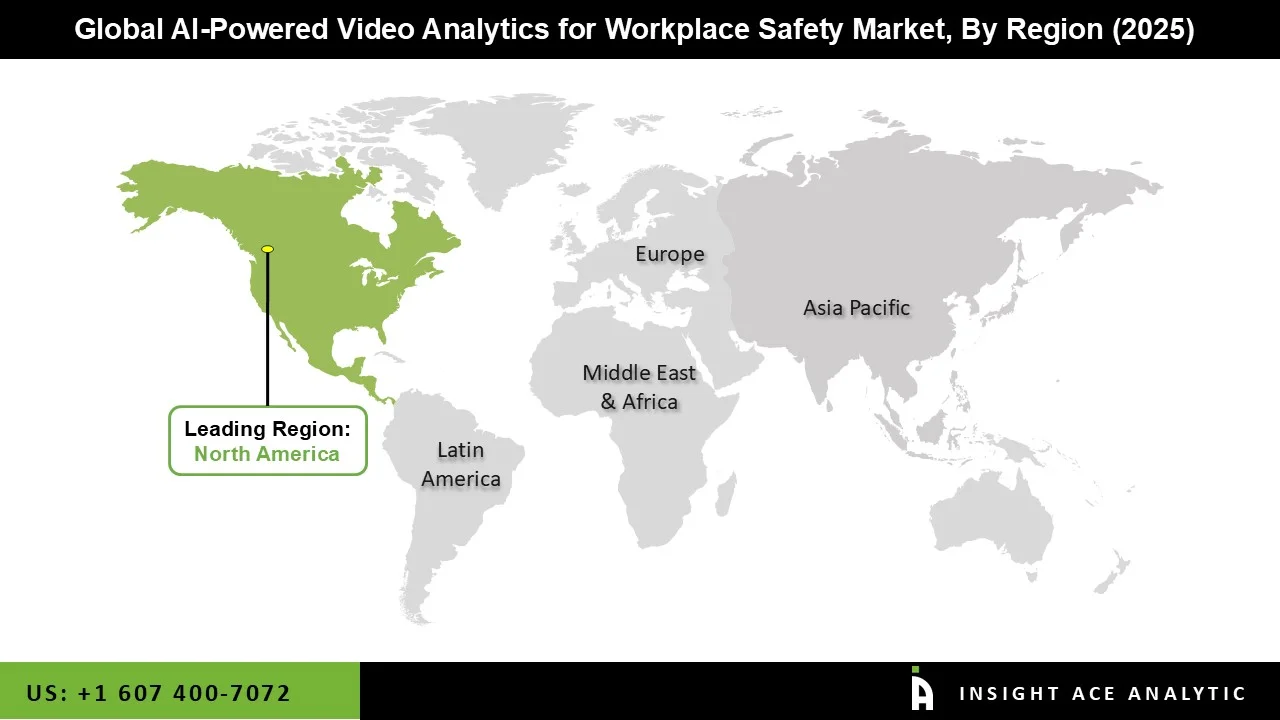
It also has broad use of modern surveillance systems and cloud-based platforms. Strict workplace safety rules, rising investments in digital change, and a growing emphasis on lowering workplace incidents with predictive and real-time safety monitoring are driving market growth. Additionally, high spending on AI-enabled industrial automation and ongoing innovation in edge AI, video analytics, and smart safety solutions support North America's dominance in the global market.
Key Development:
- July 2024: Motorola Solutions acquired Noggin to strengthen its AI-powered safety and critical event management portfolio, enhancing enterprise incident response and operational resilience.
AI-Powered Video Analytics for Workplace Safety Market Report Scope:
| Report Attribute | Specifications |
| Growth Rate CAGR | CAGR of 20.5% from 2026 to 2035 |
| Quantitative Units | Representation of revenue in US$ Bn and CAGR from 2026 to 2035 |
| Historic Year | 2022 to 2025 |
| Forecast Year | 2026-2035 |
| Report Coverage | The forecast of revenue, the position of the company, the competitive market structure, growth prospects, and trends |
| Segments Covered | Component & Delivery Layer, Safety Application, Industry Vertical, Deployment Architecture, Camera & Capture Infrastructure and By Region |
| Regional Scope | North America; Europe; Asia Pacific; Latin America; Middle East & Africa |
| Country Scope | U.S.; Canada; U.K.; Germany; China; India; Japan; Brazil; Mexico; France; Italy; Spain; South Korea; Southeast Asia |
| Competitive Landscape | Intenseye, Protex AI, Voxel, viAct, Visionify, Ailytics, Detect Technologies, Everguard.ai, Wobot.ai, SmartCone Technologies, Invisible AI |
| Customization Scope | Free customization report with the procurement of the report, Modifications to the regional and segment scope. Geographic competitive landscape. |
| Pricing and Available Payment Methods | Explore pricing alternatives that are customized to your particular study requirements. |
Segmentations of AI-Powered Video Analytics for Workplace Safety Market :
AI-Powered Video Analytics for Workplace Safety Market by Component & Delivery Layer -
- Software
- Core Detection & Analytics Engine
- Rules, Zone & Scene Configuration Engine
- Safety Intelligence, Workflow & Case Management
- Reporting, Leading-Indicator & Multi-Site Benchmarking
- Integration, API & Platform Extensions
- Edge Hardware & Appliances
- Edge AI Inference Appliances & Vision Boxes
- Purpose-Built AI Safety Cameras & Sensor-Fused Nodes
- Mobile, Temporary & Solar-Powered Safety Camera Units
- Industrial Gateways, Alert Actuators & Signalling Hardware
- Services
- Deployment Services (Camera Survey, Installation & Commissioning)
- Configuration & Custom Model Development
- Systems Integration Services
- Training, Support & Customer Success
- Managed Safety Monitoring & Event Review
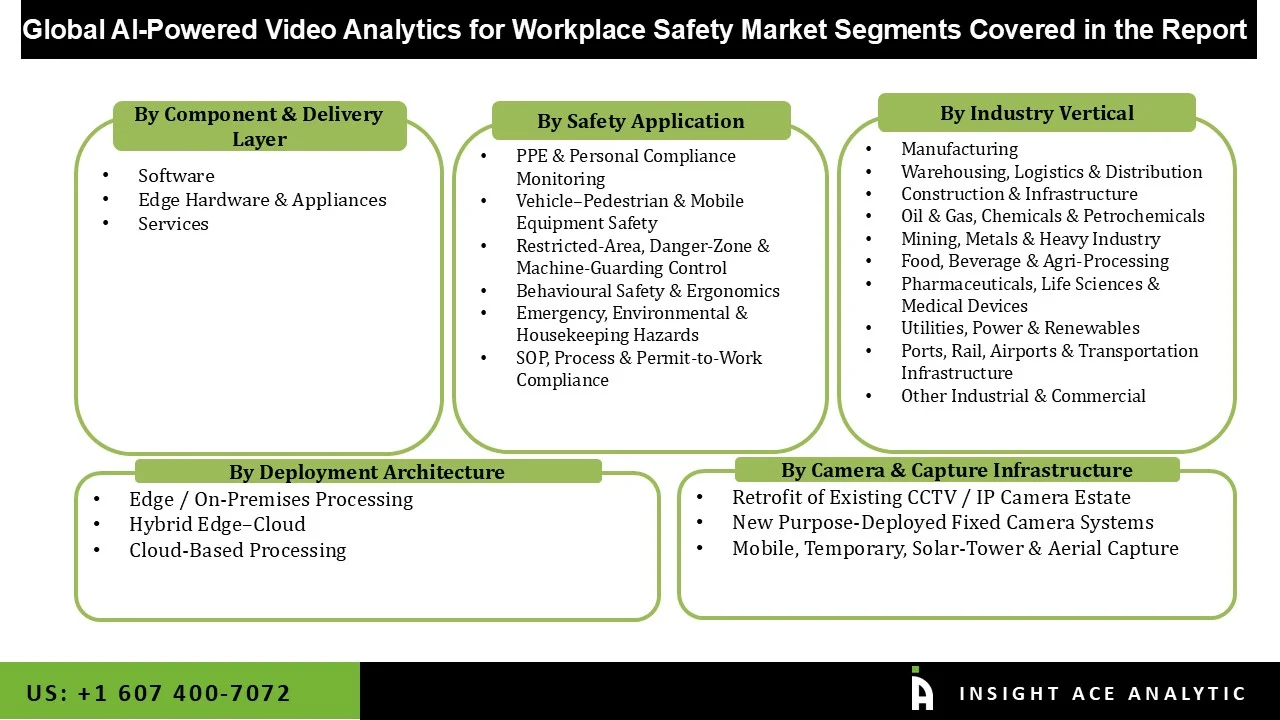
AI-Powered Video Analytics for Workplace Safety Market by Safety Application -
- PPE & Personal Compliance Monitoring
- Vehicle–Pedestrian & Mobile Equipment Safety
- Restricted-Area, Danger-Zone & Machine-Guarding Control
- Behavioural Safety & Ergonomics
- Emergency, Environmental & Housekeeping Hazards
- SOP, Process & Permit-to-Work Compliance
AI-Powered Video Analytics for Workplace Safety Market by Industry Vertical -
- Manufacturing
- Discrete Manufacturing
- Automotive & Tier-1 Suppliers
- Electronics & Semiconductor
- Heavy Fabrication & Machinery
- Process Manufacturing
- Warehousing, Logistics & Distribution
- Third-Party Logistics & Distribution Centres
- E-Commerce Fulfilment
- Parcel & Postal
- Cold Chain & Temperature-Controlled
- Construction & Infrastructure
- Building Construction
- Civil & Infrastructure
- Industrial Construction & Turnarounds
- Oil & Gas, Chemicals & Petrochemicals
- Upstream
- Refining & Petrochemicals
- Midstream & Terminals
- Specialty & Industrial Chemicals
- Mining, Metals & Heavy Industry
- Mining & Quarrying
- Steel & Aluminium
- Foundries & Smeltin
- Food, Beverage & Agri-Processing
- Pharmaceuticals, Life Sciences & Medical Devices
- Utilities, Power & Renewables
- Ports, Rail, Airports & Transportation Infrastructure
- Other Industrial & Commercial
AI-Powered Video Analytics for Workplace Safety Market by Deployment Architecture -
- Edge / On-Premises Processing
- Hybrid Edge–Cloud
- Cloud-Based Processing
AI-Powered Video Analytics for Workplace Safety Market by Camera & Capture Infrastructure -
- Retrofit of Existing CCTV / IP Camera Estate
- New Purpose-Deployed Fixed Camera Systems
- Mobile, Temporary, Solar-Tower & Aerial Capture
AI-Powered Video Analytics for Workplace Safety Market by Region-
- North America-
- The US
- Canada
- Europe-
- Germany
- The UK
- France
- Italy
- Spain
- Rest of Europe
- Asia-Pacific-
- China
- Japan
- India
- South Korea
- South East Asia
- Rest of Asia Pacific
- Latin America-
- Brazil
- Argentina
- Mexico
- Rest of Latin America
- Middle East and Africa-
- GCC Countries
- South Africa
- Rest of Middle East and Africa
Research Design and Approach
This study employed a multi-step, mixed-method research approach that integrates:
- Secondary research
- Primary research
- Data triangulation
- Hybrid top-down and bottom-up modelling
- Forecasting and scenario analysis
This approach ensures a balanced and validated understanding of both macro- and micro-level market factors influencing the market.
Secondary Research
Secondary research for this study involved the collection, review, and analysis of publicly available and paid data sources to build the initial fact base, understand historical market behaviour, identify data gaps, and refine the hypotheses for primary research.
Sources Consulted
Secondary data for the market study was gathered from multiple credible sources, including:
- Government databases, regulatory bodies, and public institutions
- International organizations (WHO, OECD, IMF, World Bank, etc.)
- Commercial and paid databases
- Industry associations, trade publications, and technical journals
- Company annual reports, investor presentations, press releases, and SEC filings
- Academic research papers, patents, and scientific literature
- Previous market research publications and syndicated reports
These sources were used to compile historical data, market volumes/prices, industry trends, technological developments, and competitive insights.

Primary Research
Primary research was conducted to validate secondary data, understand real-time market dynamics, capture price points and adoption trends, and verify the assumptions used in the market modelling.
Stakeholders Interviewed
Primary interviews for this study involved:
- Manufacturers and suppliers in the market value chain
- Distributors, channel partners, and integrators
- End-users / customers (e.g., hospitals, labs, enterprises, consumers, etc., depending on the market)
- Industry experts, technology specialists, consultants, and regulatory professionals
- Senior executives (CEOs, CTOs, VPs, Directors) and product managers
Interview Process
Interviews were conducted via:
- Structured and semi-structured questionnaires
- Telephonic and video interactions
- Email correspondences
- Expert consultation sessions
Primary insights were incorporated into demand modelling, pricing analysis, technology evaluation, and market share estimation.
Data Processing, Normalization, and Validation
All collected data were processed and normalized to ensure consistency and comparability across regions and time frames.
The data validation process included:
- Standardization of units (currency conversions, volume units, inflation adjustments)
- Cross-verification of data points across multiple secondary sources
- Normalization of inconsistent datasets
- Identification and resolution of data gaps
- Outlier detection and removal through algorithmic and manual checks
- Plausibility and coherence checks across segments and geographies
This ensured that the dataset used for modelling was clean, robust, and reliable.
Market Size Estimation and Data Triangulation
Bottom-Up Approach
The bottom-up approach involved aggregating segment-level data, such as:
- Company revenues
- Product-level sales
- Installed base/usage volumes
- Adoption and penetration rates
- Pricing analysis
This method was primarily used when detailed micro-level market data were available.

Top-Down Approach
The top-down approach used macro-level indicators:
- Parent market benchmarks
- Global/regional industry trends
- Economic indicators (GDP, demographics, spending patterns)
- Penetration and usage ratios
This approach was used for segments where granular data were limited or inconsistent.
Hybrid Triangulation Approach
To ensure accuracy, a triangulated hybrid model was used. This included:
- Reconciling top-down and bottom-up estimates
- Cross-checking revenues, volumes, and pricing assumptions
- Incorporating expert insights to validate segment splits and adoption rates
This multi-angle validation yielded the final market size.
Forecasting Framework and Scenario Modelling
Market forecasts were developed using a combination of time-series modelling, adoption curve analysis, and driver-based forecasting tools.
Forecasting Methods
- Time-series modelling
- S-curve and diffusion models (for emerging technologies)
- Driver-based forecasting (GDP, disposable income, adoption rates, regulatory changes)
- Price elasticity models
- Market maturity and lifecycle-based projections
Scenario Analysis
Given inherent uncertainties, three scenarios were constructed:
- Base-Case Scenario: Expected trajectory under current conditions
- Optimistic Scenario: High adoption, favourable regulation, strong economic tailwinds
- Conservative Scenario: Slow adoption, regulatory delays, economic constraints
Sensitivity testing was conducted on key variables, including pricing, demand elasticity, and regional adoption.
Request Customization
Add countries, segments, company profiles, or extend forecast — free 10% customization with purchase.
Customize This Report →Enquire Before Buying
Speak with our analyst team about scope, methodology, pricing, or deliverable formats.
Enquire Now →Frequently Asked Questions
AI-Powered Video Analytics for Workplace Safety Market is predicted to grow at a 20.5% CAGR during the forecast period for 2026 to 2035.
Intenseye, Protex AI, Voxel, viAct, Visionify, Ailytics, Detect Technologies, Everguard.ai, Wobot.ai, SmartCone Technologies, Invisible AI
AI-Powered Video Analytics for Workplace Safety Market is segmented into Component & Delivery Layer, Safety Application, Industry Vertical, Deployment Architecture, Camera & Capture Infrastructure and Other.
North America region is leading the AI-Powered Video Analytics for Workplace Safety Market.