World Defense Budget Analysis Market Size, Share & Trends Analysis Report By Allocation Type (Military expense, Admin expense), By Departmental Allocation (Military, Homeland), By Platform Allocation (Land, Airborne, Naval, Space), By System Allocation, By Domain Allocation, By Technology Allocation, By Sales Allocation, By Region, And By Segment Forecasts, 2025-2034
Global World Defense Budget Analysis Market Size is valued at USD 2042.35 Bn in 2024 and is predicted to reach USD 3079.94 Bn by the year 2034 at a 4.4% CAGR during the forecast period for 2025-2034.
Key Industry Insights & Findings from the Report:
- Innovations in defense technology, including artificial intelligence, unmanned systems, and advanced surveillance capabilities, are significant drivers of defense spending.
- Rising geopolitical tensions and security threats, such as regional conflicts, terrorism, and cyber threats, drive nations to allocate more resources to defense.
- North America dominated the market and accounted for a global revenue share in 2024.
- Governments frequently have to deal with fiscal and budgetary restrictions, which can make it difficult to provide enough money for defense. The expansion of the defense budget may be constrained by competing demands for few resources, economic downturns, or financial crises.
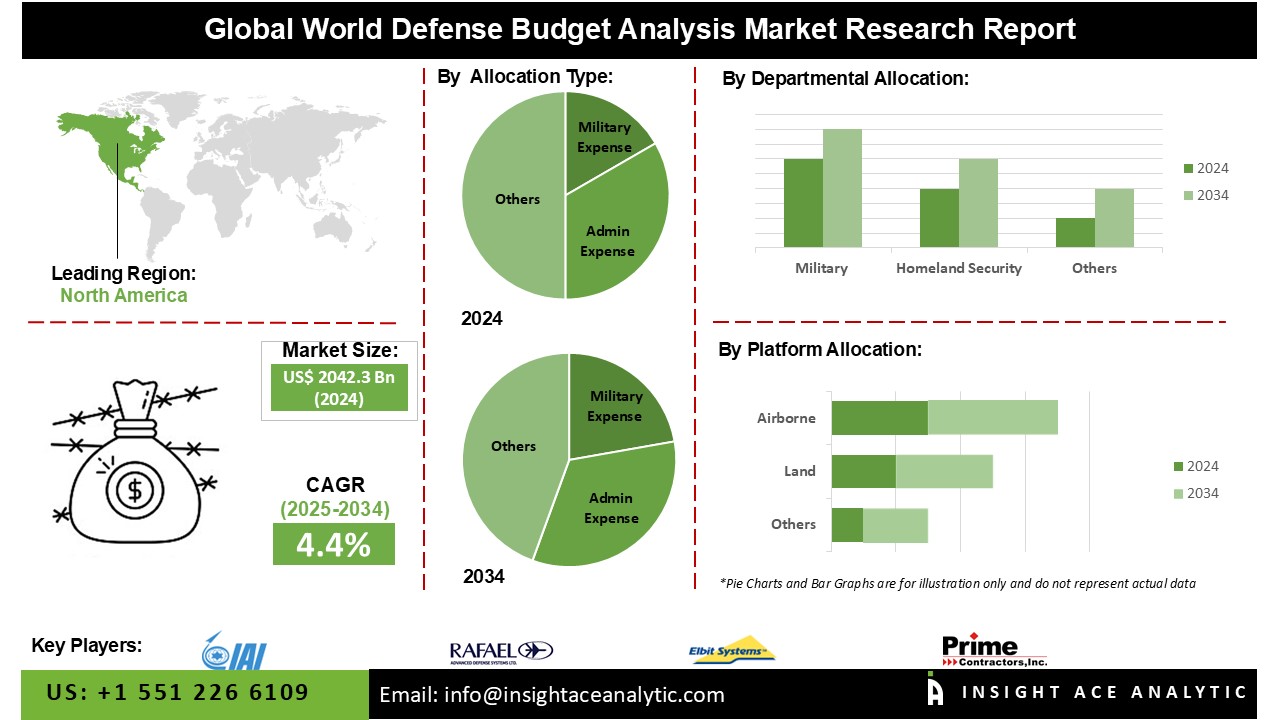
World defence budgets reveal that countries are boosting spending and pouring money into national security measures in response to increased geopolitical tensions, regional wars, and emerging security concerns. Increases in defence spending and other large resource allocations are common responses to rising geopolitical tensions, regional conflicts, and new security concerns. The goal is to safeguard national interests, preserve the country's ability to deter threats and guarantee the nation's independence and security. Across the globe, both domestic and international military confrontations and disagreements have increased. Worldwide, militaries are undergoing modernization efforts to increase the effectiveness of their present platforms. Programs like this are designed to bolster the underlying infrastructure's robustness, adaptability, and strength. Manufacturers of defence platforms put a premium on integrating main guns, remote weapons, ballistic armour, and composite technology.
However, the market growth is hampered by the strict regulatory criteria for the safety and health of world defence budget analysis, and the difficulty in efficiently distributing defence resources is a direct result of the intricate nature of defence procurement procedures. The value and efficiency of defence spending can be improved by careful planning, coordination, and oversight in areas such as acquiring cutting-edge military equipment, maintaining open communication channels, mitigating corruption concerns, and administrating contracts and supply chains.
Competitive Landscape
Some Major Key Players In The World Defense Budget Analysis Market:
- Lockheed Martin Corporation
- BAE Systems plc
- Northrop Grumman Corporation
- Boeing Company
- Raytheon Technologies Corporation
- General Dynamics Corporation
- L3Harris Technologies, Inc.
- Thales Group
- SAIC (Science Applications International Corporation)
- CACI International Inc
- Hyundai Rotem Co
- Hanwha Corporation
- Korea Aerospace Industries Ltd. (KAI)
- NEC Corporation
- Mitsubishi Heavy Industries, Ltd.
- Kawasaki Heavy Industries, Ltd.
- Hindustan Aeronautics Ltd.
- Bharat Electronics Ltd.
- Others
Market Segmentation:
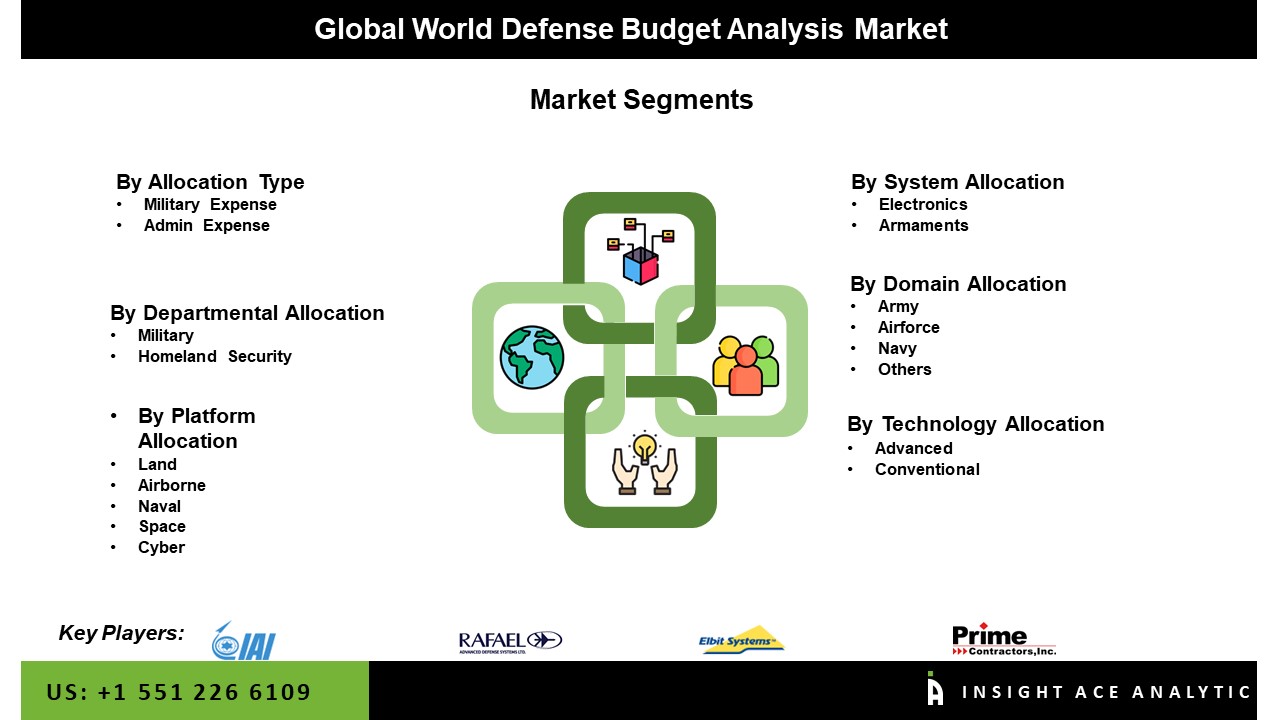
The World defence budget analysis market is segmented based on allocation type, departmental allocation, platform allocation, system allocation, domain allocation, technology allocation, and sales allocation. Based on allocation type, the market is segmented into military expenses and admin expenses. By departmental allocation, the market is segmented into military and homeland security. By platform allocation, the market is segmented into land, airborne, naval, and space. By system allocation, the market is segmented into electronics and armaments. By domain allocation, the market is segmented into military forces and special forces. By technology allocation, the market is segmented into advanced and conventional. By Sales Allocation, the market is segmented into foreign military expense sales and indigenous sales.
Based On The Allocation Type, The Military Expense World Defence Budget Analysis Market Segment Is A Major Contributor To The World Defence Budget Analysis Market
The military expense world defence budget analysis is expected to hold a major global market share in 2024. Military spending is expected to overtake all other categories of government spending shortly as governments everywhere prioritize and allocate substantial money to improving their defence capabilities. Global security concerns, geopolitical conflicts, and the need to upgrade military forces all contribute to the ever-increasing expense of defence.
Advanced Segment To Witness Growth At A Rapid Rate
The advanced segment is projected to grow rapidly in the global defence budget analysis market. The advanced subsegment is anticipated to grow fastest, ultimately leading to market dominance. Digital defence systems, such as digital communication networks, data analytics, and command and control structures, provide many advantages, including enhanced situational awareness, operational efficiency, and decision-making, especially in countries like the US, Germany, the UK, China, and India.
In The Region, The North American World Defence Budget Analysis Market Holds A Significant Revenue Share
The North American world defence budget analysis market is expected to record the maximum market share in revenue in the near future. It can be attributed to the largest defence budget, investing extensively in the modernization of its armed forces and making great strides in strengthening its military. In addition, Asia Pacific is projected to grow rapidly in the global world defence budget analysis market. The research service stresses the importance of collaboration between international and domestic military firms and increased investment in R&D by both to maintain market share.
Recent Developments:
- In May 2023, Mitsubishi Heavy Industries announced that, with Japan launching its biggest military build-up since World War Two, it expected to set records for defence equipment orders this fiscal year. Within five years, the government intended to quadruple defence spending to about 2% of GDP. This included promises to increase military contracts' profitability and provide subsidies to Japan's divided defence industry.
- In July 2023, Hyundai Rotem Company entered into a Memorandum of Understanding with the Defense Acquisition Program Administration, Korea Advanced Institute of Science and Technology, Hanwha Aerospace, and Korea Aerospace Industries to collaborate on developing international defence cooperation.
World Defense Budget Analysis Market Report Scope:
| Report Attribute | Specifications |
| Market Size Value In 2024 | USD 2042.35 Bn |
| Revenue Forecast In 2034 | USD 3079.94 Bn |
| Growth Rate CAGR | CAGR of 4.4% from 2025 to 2034 |
| Quantitative Units | Representation of revenue in US$ Bn and CAGR from 2025 to 2034 |
| Historic Year | 2021 to 2024 |
| Forecast Year | 2025-2034 |
| Report Coverage | The forecast of revenue, the position of the company, the competitive market structure, growth prospects, and trends |
| Segments Covered | By Allocation Type, By Departmental Allocation, By Platform Allocation, By System Allocation, By Domain Allocation, By Technology Allocation, By Sales Allocation |
| Regional Scope | North America; Europe; Asia Pacific; Latin America; Middle East & Africa |
| Country Scope | U.S.; Canada; U.K.; Germany; China; India; Japan; Brazil; Mexico ; France; Italy; Spain; South Korea; South East |
| Competitive Landscape | Lockheed Martin Corporation, BAE Systems plc, Northrop Grumman Corporation, Boeing Company, Raytheon Technologies Corporation, General Dynamics Corporation, L3Harris Technologies, Inc., Thales Group, SAIC (Science Applications International Corporation), CACI International Inc. Hyundai Rotem Co, Hanwha Corporation, Korea Aerospace Industries Ltd. (KAI), NEC Corporation, Mitsubishi Heavy Industries, Ltd., Kawasaki Heavy Industries, Ltd., Hindustan Aeronautics Ltd., Bharat Electronics Ltd |
| Customization Scope | Free customization report with the procurement of the report and modifications to the regional and segment scope. Particular Geographic competitive landscape. |
| Pricing And Available Payment Methods | Explore pricing alternatives that are customized to your particular study requirements. |
Segmentation Of World Defence Budget Analysis Market-
World Defence Budget Analysis Market By Allocation Type -
- Military expense
- Admin expense
World Defence Budget Analysis Market By Departmental Allocation -
- Military
- Homeland
World Defence Budget Analysis Market By Platform Allocation-
- Land
- Airborne
- Naval
- Space
World Defence Budget Analysis Market By System Allocation-
- Electronics
- Intelligence, surveillance, and reconnaissance
- Communication, navigation, and surveillance
- Global navigation satellite system
- Electronic warfare
- Digital battlefield
- Armaments
- Weapons and munitions
- Firearms and ammunition
World Defence Budget Analysis Market By Domain Allocation-
- Military forces
- Special forces
World Defence Budget Analysis Market By Technology Allocation-
- Advanced
- Conventional
World Defence Budget Analysis Market By Sales Allocation-
- Foreign military expense sales
- Indigenous sales
World Defence Budget Analysis Market By Region-
North America-
- The US
- Canada
Europe-
- Germany
- The UK
- France
- Italy
- Spain
- Rest of Europe
Asia-Pacific-
- China
- Japan
- India
- South Korea
- South East Asia
- Rest of Asia Pacific
Latin America-
- Brazil
- Argentina
- Mexico
- Rest of Latin America
Middle East & Africa-
- GCC Countries
- South Africa
- Rest of the Middle East and Africa
Research Design and Approach
This study employed a multi-step, mixed-method research approach that integrates:
- Secondary research
- Primary research
- Data triangulation
- Hybrid top-down and bottom-up modelling
- Forecasting and scenario analysis
This approach ensures a balanced and validated understanding of both macro- and micro-level market factors influencing the market.
Secondary Research
Secondary research for this study involved the collection, review, and analysis of publicly available and paid data sources to build the initial fact base, understand historical market behaviour, identify data gaps, and refine the hypotheses for primary research.
Sources Consulted
Secondary data for the market study was gathered from multiple credible sources, including:
- Government databases, regulatory bodies, and public institutions
- International organizations (WHO, OECD, IMF, World Bank, etc.)
- Commercial and paid databases
- Industry associations, trade publications, and technical journals
- Company annual reports, investor presentations, press releases, and SEC filings
- Academic research papers, patents, and scientific literature
- Previous market research publications and syndicated reports
These sources were used to compile historical data, market volumes/prices, industry trends, technological developments, and competitive insights.

Primary Research
Primary research was conducted to validate secondary data, understand real-time market dynamics, capture price points and adoption trends, and verify the assumptions used in the market modelling.
Stakeholders Interviewed
Primary interviews for this study involved:
- Manufacturers and suppliers in the market value chain
- Distributors, channel partners, and integrators
- End-users / customers (e.g., hospitals, labs, enterprises, consumers, etc., depending on the market)
- Industry experts, technology specialists, consultants, and regulatory professionals
- Senior executives (CEOs, CTOs, VPs, Directors) and product managers
Interview Process
Interviews were conducted via:
- Structured and semi-structured questionnaires
- Telephonic and video interactions
- Email correspondences
- Expert consultation sessions
Primary insights were incorporated into demand modelling, pricing analysis, technology evaluation, and market share estimation.
Data Processing, Normalization, and Validation
All collected data were processed and normalized to ensure consistency and comparability across regions and time frames.
The data validation process included:
- Standardization of units (currency conversions, volume units, inflation adjustments)
- Cross-verification of data points across multiple secondary sources
- Normalization of inconsistent datasets
- Identification and resolution of data gaps
- Outlier detection and removal through algorithmic and manual checks
- Plausibility and coherence checks across segments and geographies
This ensured that the dataset used for modelling was clean, robust, and reliable.
Market Size Estimation and Data Triangulation
Bottom-Up Approach
The bottom-up approach involved aggregating segment-level data, such as:
- Company revenues
- Product-level sales
- Installed base/usage volumes
- Adoption and penetration rates
- Pricing analysis
This method was primarily used when detailed micro-level market data were available.

Top-Down Approach
The top-down approach used macro-level indicators:
- Parent market benchmarks
- Global/regional industry trends
- Economic indicators (GDP, demographics, spending patterns)
- Penetration and usage ratios
This approach was used for segments where granular data were limited or inconsistent.
Hybrid Triangulation Approach
To ensure accuracy, a triangulated hybrid model was used. This included:
- Reconciling top-down and bottom-up estimates
- Cross-checking revenues, volumes, and pricing assumptions
- Incorporating expert insights to validate segment splits and adoption rates
This multi-angle validation yielded the final market size.
Forecasting Framework and Scenario Modelling
Market forecasts were developed using a combination of time-series modelling, adoption curve analysis, and driver-based forecasting tools.
Forecasting Methods
- Time-series modelling
- S-curve and diffusion models (for emerging technologies)
- Driver-based forecasting (GDP, disposable income, adoption rates, regulatory changes)
- Price elasticity models
- Market maturity and lifecycle-based projections
Scenario Analysis
Given inherent uncertainties, three scenarios were constructed:
- Base-Case Scenario: Expected trajectory under current conditions
- Optimistic Scenario: High adoption, favourable regulation, strong economic tailwinds
- Conservative Scenario: Slow adoption, regulatory delays, economic constraints
Sensitivity testing was conducted on key variables, including pricing, demand elasticity, and regional adoption.
Request Customization
Add countries, segments, company profiles, or extend forecast — free 10% customization with purchase.
Customize This Report →Enquire Before Buying
Speak with our analyst team about scope, methodology, pricing, or deliverable formats.
Enquire Now →Frequently Asked Questions
World Defense Budget Analysis Market Size is valued at USD 2042.35 Bn in 2024 and is predicted to reach USD 3079.94 Bn by the year 2034
World Defense Budget Analysis Market is expected to grow at a 4.4% CAGR during the forecast period for 2025-2034.
Korea Aerospace Industries Ltd. (KAI), NEC Corporation, Mitsubishi Heavy Industries, Ltd., Kawasaki Heavy Industries, Ltd., Hindustan Aeronautics Ltd.
World defence budget analysis market is segmented based on allocation type, departmental allocation, platform allocation, system allocation, domain al
North America region is leading the World defence budget analysis Market.