Veterinary CRO & CDMO Market Size, Share & Trends Analysis Report By Sustainability Focus (Climate Impact, Energy Efficiency, Material Sustainability, And Supply Chain Sustainability), Application (Energy & Emissions Management, Mobility & Transportation, Infrastructure,Circular Economy), And Vertical (Industrial [Discrete, Process], Commercial, And Residential), By Region, And By Segment Forecasts, 2025-2034
Veterinary CRO & CDMO Market Size is valued at USD 1475.63 Mn in 2024 and is predicted to reach USD 118868.03 Mn by the year 2034 at 55.2% CAGR during the forecast period for 2025-2034.
Both Veterinary CROs and CDMOs play a collaborative role in advancing veterinary medicine, offering expertise, resources, and infrastructure that enable the efficient and effective development of new treatments and health products for animals. By partnering with these organizations, veterinary product developers can accelerate the time to market for new therapies, contributing to animal health and welfare while also addressing the needs of the veterinary market. These organizations provide a variety of services, including preclinical and clinical studies, regulatory support, formulation development, and commercial-scale manufacturing of veterinary pharmaceuticals. The veterinary CRO and CDMO industry has expanded significantly due to rising demand for safe and effective veterinary pharmaceuticals, the requirement for regulatory compliance, and increased investment in animal healthcare. These organizations play a critical role in veterinary pharmaceutical development, ensuring their safety and efficacy, and assisting corporations in navigating the veterinary industry's complex regulatory structure.
The veterinary CRO and CDMO market is being pushed by rising awareness of animal health and welfare, severe regulatory requirements, and a need for specialized services. Rising pet ownership, improved livestock production, and the prevalence of zoonotic diseases have all contributed to increased investment in veterinary pharmaceutical research and development. Stringent safety and efficacy criteria have increased demand for specialized services. Advances in veterinary medicine and technology have offered prospects for novel medicines, accelerating market growth. Pharmaceutical companies and CRO/CDMOs can collaborate strategically to create drugs at a lower cost and with greater efficiency. Overall, these aspects contribute to the market's growth.
Competitive Landscape
Some Major Key Players In The Veterinary CRO & CDMO Market:
- Labcorp Drug Development
- Charles River Laboratories
- Clinvet
- Klifovet GmbH
- Oncovet Clinical Research (OCR)
- Knoell Triveritasm
- Vetspin,
- Inotiv
- Idexx Laboratories
- Zoetis Nexvet
- PAREXEL International Corporation
- ICON plc
- Pharmaceutical Product Development, LLC (PPD)
- Syneos Health
- WuXi AppTec
- Medpace
- Envigo
- Vetio Animal Health
- Clinipace
- MPI Research
- Veterinary Research Management (VRM)
- VetPharm, Inc.
- Merck Animal Health
- Other prominent players
Market Segmentation:
The Veterinary CRO & CDMO Market is segmented by animal type, application type and service type,. Based on animal type, the market is segrigated into companion and livestock animals. By application type, the market is segmented into medicine and medical devices. By service type, the market is segmented into discovery, development, manufacturing, packaging & labeling, and market approval & post-marketing.
Based On Animal Type, The Livestock Animal Category Dominated The Industry.
The livestock animal segment led the business in 2022, accounting for 40.4% of total revenue because to the high production rate of vaccinations, medicines, and infectious disease diagnostic goods aimed primarily at food-producing animals. The dominant share is also attributed to rising protein consumption, milk or meat requirements, and expanding live animal markets worldwide. Furthermore, rising zoonotic concerns and increased spending on livestock animals are driving the demand for CROs and CDMOs to support huge medication production.
The Medical Devices Segment Is Estimated To Increase At The Quickest CAGR Throughout The Forecast Period.
The medical devices segment is estimated to increase at the quickest CAGR throughout the forecast period. Rising technical breakthroughs in veterinary diagnostics, rising animal healthcare expenditure, and the widespread availability of contract veterinary equipment manufacturers and raw material suppliers are driving segment expansion. Furthermore, corporations are investing more in expanding their production capacity through the use of broad networks of CROs and CDMOs, which has a beneficial impact on and supports subsequent growth rates.
In The Region, The North American Veterinary CRO & CDMO Market Holds A Significant Revenue Share.
North America dominated the animal health CRO & CDMO market, accounting for more than 30% of total revenue. This considerable share can be attributable to the strong presence of important companies coupled with the rising number of drug development and veterinary product launch activities in the region. Rising veterinary clinical trial activities in the United States, increased availability of contract organizations in veterinary product development, improved manufacturing infrastructure in the region's developed countries, and increasing animal healthcare investments all contribute to market growth. The Asia Pacific area would exhibit the quickest CAGR during the predicted period. This is primarily due to the region's attractiveness, as well as the low-cost and flexible sourcing provided by large networks of veterinary outsourcing companies. Countries, like China and India, have been dominating in medical outsourcing for some years; moreover, recently, Southeast Asian countries, like Philippines, Malaysia, Indonesia, and Vietnam, are garnering market attention with significant potential. Similarly, popular destinations for veterinary outsourcing activities include Latin America, the Middle East, and Africa.
Recent Developments:
- In April 2022, Clinical validation of a next-generation sequencing-based multi-cancer detection 'liquid biopsy' blood test in over 1,000 canines using an independent testing set: The CANcer Detection in canines was a clinical investigation funded by PetDx. Assessing the efficacy of a novel multi-cancer blood test in identifying and classifying cancer in canines was the objective of this clinical investigation.
- In January 2022, Covetrus, a global leader in animal health technology and services, has announced the release of Covetrus Pulse, an innovative cloud-based veterinary operating system (vOS) that easily connects veterinarians to the technology they require to manage their practices and gives them more time to spend with the animals in their care.
- In March 2022, Clinvet acquired a stake in RTI Labs, a CRO headquartered in South Dakota that specialized in food-producing animal preclinical trials. Complementing the spectrum of services provided by Clinvet's large animals' facilities in South Africa and Morocco, RTI's research facilities in the United States and expertise in infectious disease and immunology research enhanced Clinvet's presence and service offering in North America.
Veterinary CRO & CDMO Market Report Scope
| Report Attribute | Specifications |
| Growth Rate CAGR | CAGR of 55.2% from 2025 to 2034 |
| Quantitative Units | Representation of revenue in US$ Bn and CAGR from 2025 to 2034 |
| Historic Year | 2021 to 2024 |
| Forecast Year | 2025-2034 |
| Report Coverage | The forecast of revenue, the position of the company, the competitive market structure, growth prospects, and trends |
| Segments Covered | By Animal Type, Application Type, Service Type |
| Regional Scope | North America; Europe; Asia Pacific; Latin America; Middle East & Africa |
| Country Scope | U.S.; Canada; U.K.; Germany; China; India; Japan; Brazil; Mexico; France; Italy; Spain; Southeast Asia; South Korea |
| Competitive Landscape | Aare Labcorp Drug Development, Charles River Laboratories, Clinvet, Klifovet GmbH, Oncovet Clinical Research (OCR), Knoell Triveritasm, Vetspin, Inotiv, Idexx Laboratories, Zoetis Nexvet, PAREXEL International Corporation, ICON plc, Pharmaceutical Product Development, LLC (PPD), Syneos Health, WuXi AppTec, Medpace, Envigo, Vetio Animal Health, Clinipace, MPI Research, Veterinary Research Management (VRM), VetPharm, Inc., Merck Animal Health and others. |
| Customization Scope | Free customization report with the procurement of the report and modifications to the regional and segment scope. Particular Geographic competitive landscape. |
| Pricing And Available Payment Methods | Explore pricing alternatives that are customized to your particular study requirements. |
Segmentation of Veterinary CRO & CDMO Market-
Veterinary CRO & CDMO Market By Animal Type -
- Companion
- Livestock Animals
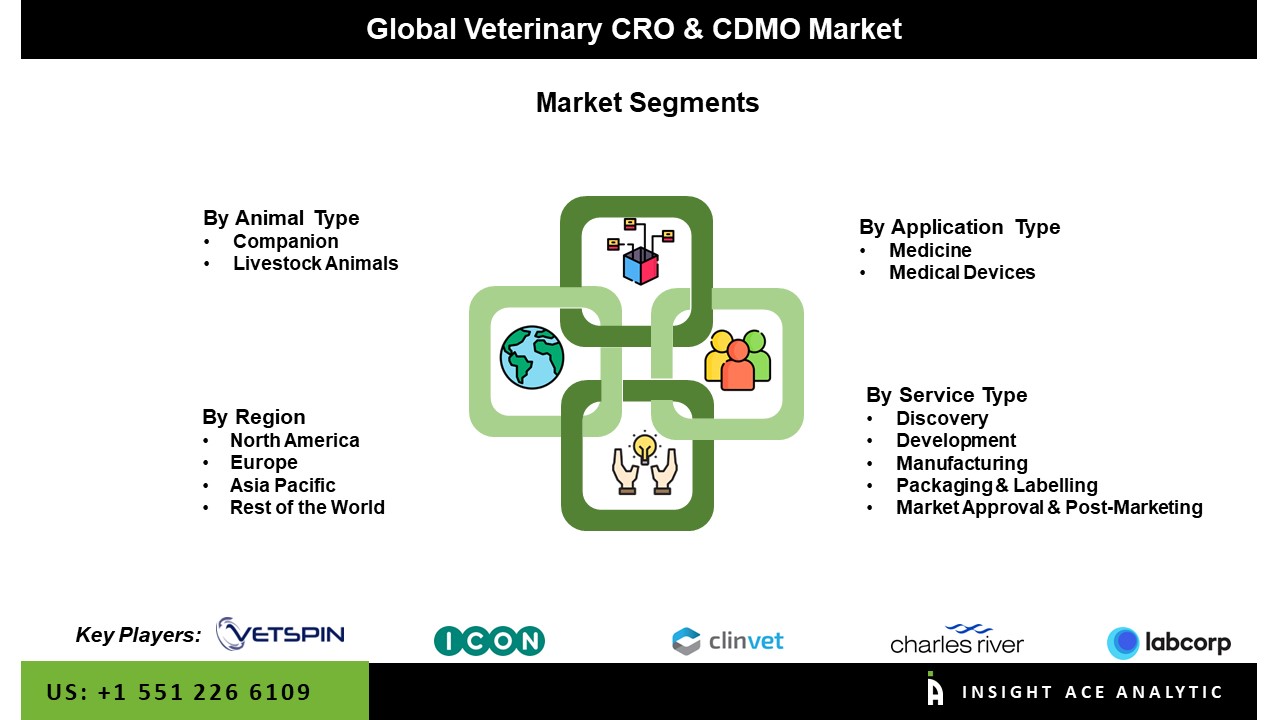
Veterinary CRO & CDMO Market By Application Type -
- Medicine
- Medical Devices
Veterinary CRO & CDMO Market By Service Type -
- Discovery
- Development
- Manufacturing
- Packaging & Labelling
- Market Approval & Post-Marketing
Veterinary CRO & CDMO Market By Region-
North America-
- The US
- Canada
- Mexico
Europe-
- Germany
- The UK
- France
- Italy
- Spain
- Rest of Europe
Asia-Pacific-
- China
- Japan
- India
- South Korea
- South East Asia
- Rest of Asia Pacific
Latin America-
- Brazil
- Argentina
- Rest of Latin America
Middle East & Africa-
- GCC Countries
- South Africa
- Rest of Middle East and Africa
Research Design and Approach
This study employed a multi-step, mixed-method research approach that integrates:
- Secondary research
- Primary research
- Data triangulation
- Hybrid top-down and bottom-up modelling
- Forecasting and scenario analysis
This approach ensures a balanced and validated understanding of both macro- and micro-level market factors influencing the market.
Secondary Research
Secondary research for this study involved the collection, review, and analysis of publicly available and paid data sources to build the initial fact base, understand historical market behaviour, identify data gaps, and refine the hypotheses for primary research.
Sources Consulted
Secondary data for the market study was gathered from multiple credible sources, including:
- Government databases, regulatory bodies, and public institutions
- International organizations (WHO, OECD, IMF, World Bank, etc.)
- Commercial and paid databases
- Industry associations, trade publications, and technical journals
- Company annual reports, investor presentations, press releases, and SEC filings
- Academic research papers, patents, and scientific literature
- Previous market research publications and syndicated reports
These sources were used to compile historical data, market volumes/prices, industry trends, technological developments, and competitive insights.

Primary Research
Primary research was conducted to validate secondary data, understand real-time market dynamics, capture price points and adoption trends, and verify the assumptions used in the market modelling.
Stakeholders Interviewed
Primary interviews for this study involved:
- Manufacturers and suppliers in the market value chain
- Distributors, channel partners, and integrators
- End-users / customers (e.g., hospitals, labs, enterprises, consumers, etc., depending on the market)
- Industry experts, technology specialists, consultants, and regulatory professionals
- Senior executives (CEOs, CTOs, VPs, Directors) and product managers
Interview Process
Interviews were conducted via:
- Structured and semi-structured questionnaires
- Telephonic and video interactions
- Email correspondences
- Expert consultation sessions
Primary insights were incorporated into demand modelling, pricing analysis, technology evaluation, and market share estimation.
Data Processing, Normalization, and Validation
All collected data were processed and normalized to ensure consistency and comparability across regions and time frames.
The data validation process included:
- Standardization of units (currency conversions, volume units, inflation adjustments)
- Cross-verification of data points across multiple secondary sources
- Normalization of inconsistent datasets
- Identification and resolution of data gaps
- Outlier detection and removal through algorithmic and manual checks
- Plausibility and coherence checks across segments and geographies
This ensured that the dataset used for modelling was clean, robust, and reliable.
Market Size Estimation and Data Triangulation
Bottom-Up Approach
The bottom-up approach involved aggregating segment-level data, such as:
- Company revenues
- Product-level sales
- Installed base/usage volumes
- Adoption and penetration rates
- Pricing analysis
This method was primarily used when detailed micro-level market data were available.

Top-Down Approach
The top-down approach used macro-level indicators:
- Parent market benchmarks
- Global/regional industry trends
- Economic indicators (GDP, demographics, spending patterns)
- Penetration and usage ratios
This approach was used for segments where granular data were limited or inconsistent.
Hybrid Triangulation Approach
To ensure accuracy, a triangulated hybrid model was used. This included:
- Reconciling top-down and bottom-up estimates
- Cross-checking revenues, volumes, and pricing assumptions
- Incorporating expert insights to validate segment splits and adoption rates
This multi-angle validation yielded the final market size.
Forecasting Framework and Scenario Modelling
Market forecasts were developed using a combination of time-series modelling, adoption curve analysis, and driver-based forecasting tools.
Forecasting Methods
- Time-series modelling
- S-curve and diffusion models (for emerging technologies)
- Driver-based forecasting (GDP, disposable income, adoption rates, regulatory changes)
- Price elasticity models
- Market maturity and lifecycle-based projections
Scenario Analysis
Given inherent uncertainties, three scenarios were constructed:
- Base-Case Scenario: Expected trajectory under current conditions
- Optimistic Scenario: High adoption, favourable regulation, strong economic tailwinds
- Conservative Scenario: Slow adoption, regulatory delays, economic constraints
Sensitivity testing was conducted on key variables, including pricing, demand elasticity, and regional adoption.
Request Customization
Add countries, segments, company profiles, or extend forecast — free 10% customization with purchase.
Customize This Report →Enquire Before Buying
Speak with our analyst team about scope, methodology, pricing, or deliverable formats.
Enquire Now →Frequently Asked Questions
Veterinary CRO & CDMO Market Size is predicted to grow at a 55.2% CAGR during the forecast period for 2025-2034.
Syneos Health, WuXi AppTec, Medpace, Envigo, Vetio Animal Health, Clinipace, MPI Research, Veterinary Research Management (VRM), VetPharm, Inc., Merck
Veterinary CRO & CDMO Market Size is valued at USD 1475.63 Mn in 2024 and is predicted to reach USD 118868.03 Mn by the year 2034
Aare Labcorp Drug Development, Charles River Laboratories, Clinvet, Klifovet GmbH, Oncovet Clinical Research (OCR), Knoell Triveritasm, Vetspin, Inoti
North America region is leading the Veterinary CRO & CDMO Market.