UV-Robotic Disinfection Networks Market Size, Share & Trends Analysis Distribution By Type (Manual UV Disinfection Robots and Autonomous UV Disinfection Robots), By Operation Type (Remote and Semi-Autonomous), Application (Hospitals, Commercial Buildings, Public Transport, and Industrial Facilities), By End-use (Hospitality, Healthcare, Transportation, and Industry), and By Segment Forecasts, 2025-2034
Global UV-Robotic Disinfection Networks Market Size is predicted grow with an 20.0% CAGR during the forecast period for 2025-2034.
UV-robotic disinfection networks employ UVC radiation to break down the DNA of bacteria, viruses, and other hazardous organic matter in the environment. This stops the spread of these organisms and makes the environment safer. They utilize sensors to engage with and navigate their environment, enabling UV-C light to penetrate previously obscured regions of a room by initiating and ceasing illumination as required. Movable robots known as UV robots are employed in ultraviolet sanitisation processes.
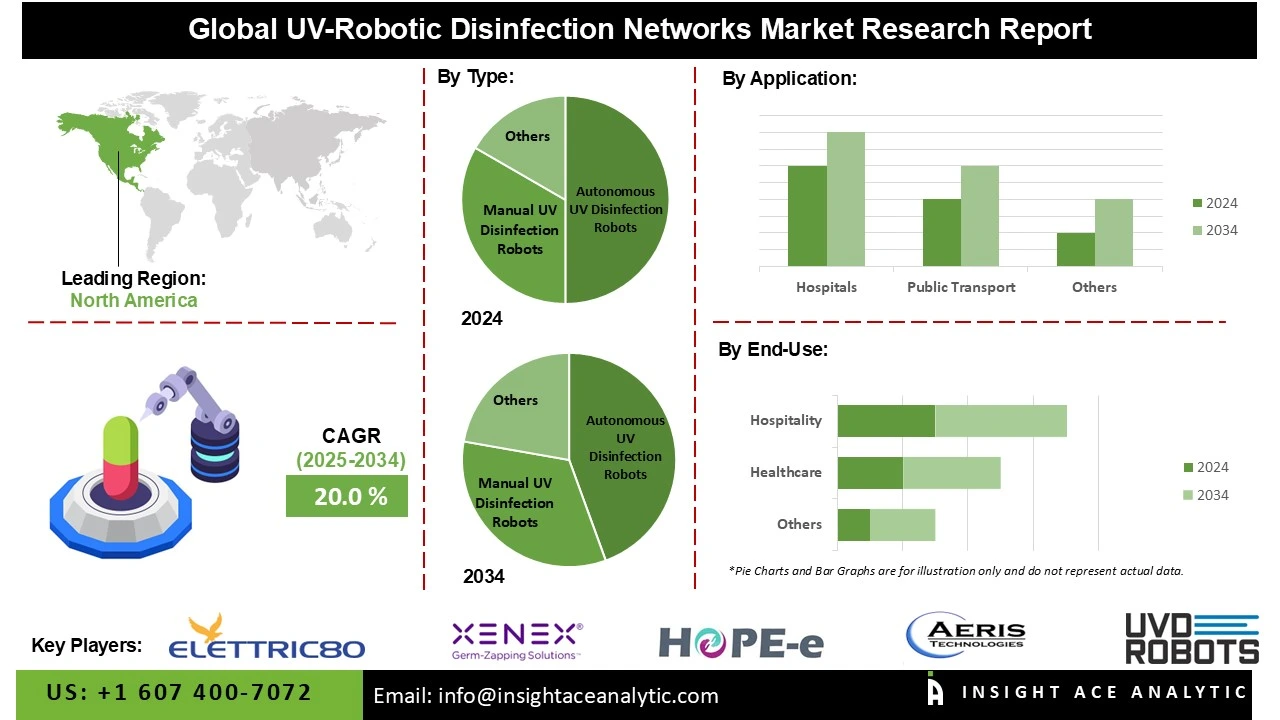
All categories of UV-disinfection robots employ contactless technology that emanates effective radiation to eliminate bacteria while leaving dirt and biological residues intact. The demand for enhanced disinfection techniques and increasing concerns regarding infection prevention are propelling the swift worldwide growth of the UV-robotic disinfection networks market.
Moreover, technological advancements, increased awareness since COVID-19, and a renewed focus on reducing healthcare-related illnesses are driving the expansion of the UV-robotic disinfection networks market. Because these robots offer a reliable, independent method of disinfection, their market share is likely to grow, helping strengthen global public health initiatives. However, the high initial cost of acquiring and deploying these robotic systems is a significant obstacle to the UV-robotic disinfection networks market. The initial cost of buying UV-robotic disinfection networks and any related infrastructure changes can deter some prospective buyers. On the other hand, the UV-robotic disinfection networks market has significant growth potential due to government programs and funding. Governments worldwide are taking action to promote the use of contemporary disinfection technologies, recognising their importance to public health.
Competitive Landscape
Some of the Key Players in UV-Robotic Disinfection Networks Market:
· Blue Ocean Robotics
· UVD Robots
· Aerisa Technologies
· Elettric80
· Automation Solutions Inc.
· Bioquell
· Panasonic Corporation
· Hitachi
· Essensor
· PDI Healthcare
· Truvox International
· Sterilwave
· Nevoa
· Hope Innovation
· English Electric
· Xylem Inc.
· Mederi Technologies
· Xenex Disinfection Services
· CleanRobotics
· TechnoElectro
· Trident Robotics
· Shanghai Dimer
· Shenzhen Zhiyuan
· Samsung Electronics
· Eurofins Scientific
· Other Prominent Players
Market Segmentation:
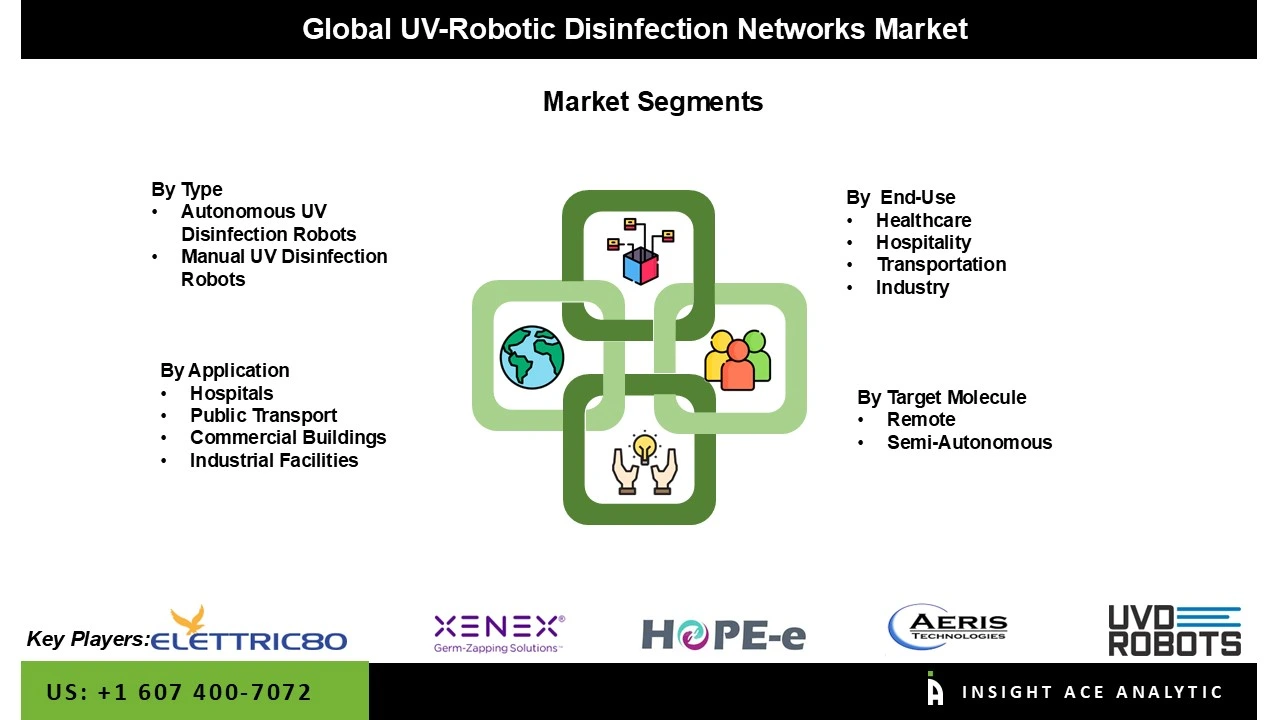
The UV-robotic disinfection networks market is segmented by type, operation type, application, and end-use. By type, the market is segmented into manual UV disinfection robots and autonomous UV disinfection robots. By operation type, the market is segmented into remote and semi-autonomous. By application, the market is segmented into hospitals, commercial buildings, public transport, and industrial facilities. By end-use, the market is segmented into hospitality, healthcare, transportation, and industry.
By Operation Type, the Semi-Autonomous Segment is Expected to Drive the UV-Robotic Disinfection Networks Market
The semi-autonomous category held the UV-robotic disinfection networks market in 2024. The semi-autonomous robots, which incorporate both automatic and manual features, are designed to work in conjunction with human operators. Smaller businesses or spaces with intricate designs that occasionally require human supervision are best suited for these robots. Staff can target specific high-touch surfaces or hard-to-reach areas using semi-autonomous robots, which typically feature user-friendly interfaces, remote control, and adjustable disinfection settings.
Healthcare Segment by End-use is Growing at the Highest Rate in the UV-Robotic Disinfection Networks Market
In 2024, the healthcare category led the UV-robotic disinfection networks market. There is ongoing pressure on hospitals, clinics, and outpatient facilities to adhere to strict infection control guidelines and maintain sterile environments. In operating rooms, patient wards, and isolation units, where prompt and complete disinfection is essential, UV-robotic disinfection networks have emerged as critical equipment. These robots are highly effective in reducing healthcare-associated illnesses and enhancing patient safety, as they can inactivate a wide range of pathogens, including bacteria, viruses, and fungi.
Regionally, North America Led the UV-Robotic Disinfection Networks Market
In 2024, due to the increasing usage of UV robots in the retail, healthcare, and transportation sectors, the North American region dominated the UV-robotic disinfection networks market. The region's growing demand for UV robots is influenced by several factors, including the expanding e-commerce industry and the presence of large companies that frequently introduce new products to the market. Additionally, the firms and production facilities in the region that support the expansion of the UV-robotic disinfection networks market are also driving the rise in demand for UV robots.
Over the forecast period, Asia Pacific is emerging as the fastest-growing region in the UV-robotic disinfection networks market, driven by increased government efforts to combat infectious diseases, expanding healthcare infrastructure, and rapid urbanization. The demand for cutting-edge disinfection solutions is being driven by significant investments in smart city initiatives, public transit systems, and hospital modernisation in nations such as China, Japan, South Korea, and India. Additionally, the demand for scalable, affordable cleaning technology, the expanding middle class, and greater health consciousness are all contributing to the region's market expansion for UV-robotic disinfection networks.
UV-Robotic Disinfection Networks Market Report Scope :
Segmentation of UV-Robotic Disinfection Networks Market -
UV-Robotic Disinfection Networks Market by Type-
· Manual UV Disinfection Robots
· Autonomous UV Disinfection Robots
UV-Robotic Disinfection Networks Market by Operation Type -
· Remote
· Semi-Autonomous
UV-Robotic Disinfection Networks Market by Application-
· Hospitals
· Commercial Buildings
· Public Transport
· Industrial Facilities
UV-Robotic Disinfection Networks Market by End-use-
· Hospitality
· Healthcare
· Transportation
· Industry
UV-Robotic Disinfection Networks Market by Region-
North America-
· The US
· Canada
Europe-
· Germany
· The UK
· France
· Italy
· Spain
· Rest of Europe
Asia-Pacific-
· China
· Japan
· India
· South Korea
· Southeast Asia
· Rest of Asia Pacific
Latin America-
· Brazil
· Argentina
· Mexico
· Rest of Latin America
Middle East & Africa-
· GCC Countries
· South Africa
· Rest of the Middle East and Africa
Research Design and Approach
This study employed a multi-step, mixed-method research approach that integrates:
- Secondary research
- Primary research
- Data triangulation
- Hybrid top-down and bottom-up modelling
- Forecasting and scenario analysis
This approach ensures a balanced and validated understanding of both macro- and micro-level market factors influencing the market.
Secondary Research
Secondary research for this study involved the collection, review, and analysis of publicly available and paid data sources to build the initial fact base, understand historical market behaviour, identify data gaps, and refine the hypotheses for primary research.
Sources Consulted
Secondary data for the market study was gathered from multiple credible sources, including:
- Government databases, regulatory bodies, and public institutions
- International organizations (WHO, OECD, IMF, World Bank, etc.)
- Commercial and paid databases
- Industry associations, trade publications, and technical journals
- Company annual reports, investor presentations, press releases, and SEC filings
- Academic research papers, patents, and scientific literature
- Previous market research publications and syndicated reports
These sources were used to compile historical data, market volumes/prices, industry trends, technological developments, and competitive insights.
Primary Research
Primary research was conducted to validate secondary data, understand real-time market dynamics, capture price points and adoption trends, and verify the assumptions used in the market modelling.
Stakeholders Interviewed
Primary interviews for this study involved:
- Manufacturers and suppliers in the market value chain
- Distributors, channel partners, and integrators
- End-users / customers (e.g., hospitals, labs, enterprises, consumers, etc., depending on the market)
- Industry experts, technology specialists, consultants, and regulatory professionals
- Senior executives (CEOs, CTOs, VPs, Directors) and product managers
Interview Process
Interviews were conducted via:
- Structured and semi-structured questionnaires
- Telephonic and video interactions
- Email correspondences
- Expert consultation sessions
Primary insights were incorporated into demand modelling, pricing analysis, technology evaluation, and market share estimation.
Data Processing, Normalization, and Validation
All collected data were processed and normalized to ensure consistency and comparability across regions and time frames.
The data validation process included:
- Standardization of units (currency conversions, volume units, inflation adjustments)
- Cross-verification of data points across multiple secondary sources
- Normalization of inconsistent datasets
- Identification and resolution of data gaps
- Outlier detection and removal through algorithmic and manual checks
- Plausibility and coherence checks across segments and geographies
This ensured that the dataset used for modelling was clean, robust, and reliable.
Market Size Estimation and Data Triangulation
Bottom-Up Approach
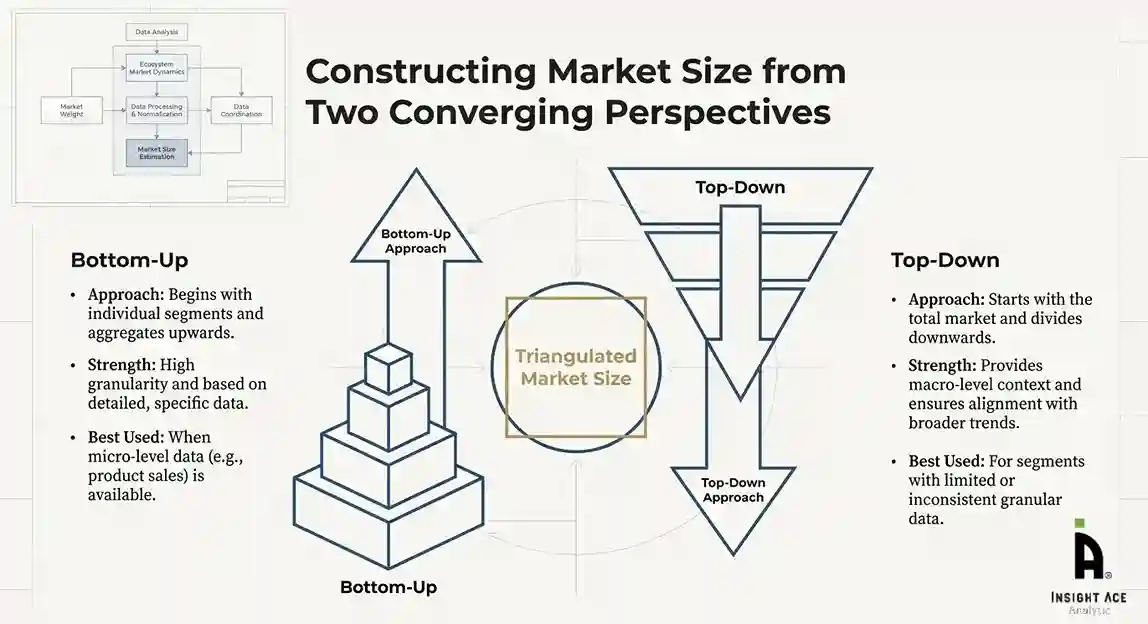
The bottom-up approach involved aggregating segment-level data, such as:
- Company revenues
- Product-level sales
- Installed base/usage volumes
- Adoption and penetration rates
- Pricing analysis
This method was primarily used when detailed micro-level market data were available.
Top-Down Approach
The top-down approach used macro-level indicators:
- Parent market benchmarks
- Global/regional industry trends
- Economic indicators (GDP, demographics, spending patterns)
- Penetration and usage ratios
This approach was used for segments where granular data were limited or inconsistent.
Hybrid Triangulation Approach
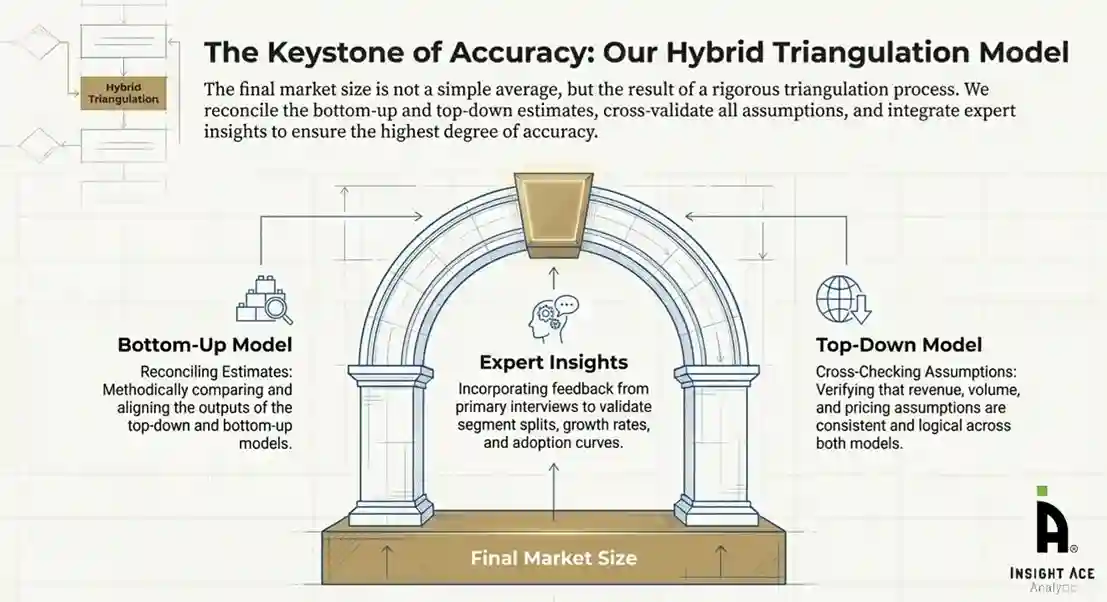
To ensure accuracy, a triangulated hybrid model was used. This included:
- Reconciling top-down and bottom-up estimates
- Cross-checking revenues, volumes, and pricing assumptions
- Incorporating expert insights to validate segment splits and adoption rates
This multi-angle validation yielded the final market size.
Forecasting Framework and Scenario Modelling
Market forecasts were developed using a combination of time-series modelling, adoption curve analysis, and driver-based forecasting tools.
Forecasting Methods
- Time-series modelling
- S-curve and diffusion models (for emerging technologies)
- Driver-based forecasting (GDP, disposable income, adoption rates, regulatory changes)
- Price elasticity models
- Market maturity and lifecycle-based projections
Scenario Analysis
Given inherent uncertainties, three scenarios were constructed:
- Base-Case Scenario: Expected trajectory under current conditions
- Optimistic Scenario: High adoption, favourable regulation, strong economic tailwinds
- Conservative Scenario: Slow adoption, regulatory delays, economic constraints
Sensitivity testing was conducted on key variables, including pricing, demand elasticity, and regional adoption.
Request Customization
Add countries, segments, company profiles, or extend forecast — free 10% customization with purchase.
Customize This Report →Enquire Before Buying
Speak with our analyst team about scope, methodology, pricing, or deliverable formats.
Enquire Now →Frequently Asked Questions
The UV-Robotic Disinfection Networks Market Size is predicted to grow at an 20.0% CAGR over the forecast period.
The major players in the UV-Robotic Disinfection Networks market are Blue Ocean Robotics, UVD Robots, Aerisa Technologies, Elettric80, Automation Solutions Inc., Bioquell, Panasonic Corporation, Hitachi, Essensor, PDI Healthcare, Truvox International, Sterilwave, Nevoa, Hope Innovation, English Electric, Xylem Inc., Mederi Technologies, Xenex Disinfection Services, CleanRobotics, TechnoElectro, Trident Robotics, Shanghai Dimer, Shenzhen Zhiyuan, Samsung Electronics, and Eurofins Scientific.
The primary UV-Robotic Disinfection Networks market segments are Type, Operation Type, Application, and End-use.
North America leads the market for UV-Robotic Disinfection Networks due to the increasing usage of UV robots in the retail, healthcare, and transportation sectors.