Ultraviolet Acrylic Hot Melt Resin Market Size, Share & Trends Analysis Report By Application (Packaging, Electronics, Construction, Automotive, Textiles), By Region, And by Segment Forecasts, 2025-2034

Report Id: 2006 Pages: 180 Last Updated: 26 May 2025 Format: PDF / PPT / Excel / Power BI
Share With : linkedin twitter facebook

The Ultraviolet Acrylic Hot Melt Resin Market Size is predicted to show a 7.2% CAGR during the forecast period for 2025-2034.

Ultraviolet Acrylic Hot Melt Resin Market info

Increased consumer awareness regarding environmental impact and the desirability of sustainable products has led to heightened demand for eco-friendly solutions spanning diverse industries. UV acrylic hot melt resin is typically composed of acrylic polymers that are designed to become flowable and adhesive when heated. These polymers contain photoinitiators that enable the adhesive to cure rapidly when exposed to ultraviolet light. Ultraviolet Acrylic Hot Melt Resins, being solvent-free and characterized by minimal VOC emissions, align with this prevailing consumer inclination.

Additionally, the market focus on research and development has galvanized rapid technological progress across various sectors. This encompassing advancement encompasses refined bonding methodologies, enhanced equipment, and elevated UV light sources, all of which have collectively bolstered the practicality and dependability of Ultraviolet Acrylic Hot Melt Resins.

However, within the landscape of competitive technologies, the market growth trajectory of UV acrylic hot melt resin could potentially encounter limitations. The utilization of these resins necessitates dedicated UV curing equipment, a requirement that prompts enterprises to make investments in this specialized machinery. This dynamic poses a barrier to growth, particularly for small to medium-sized enterprises or those transitioning from conventional adhesive practices. 

Competitive Landscape:

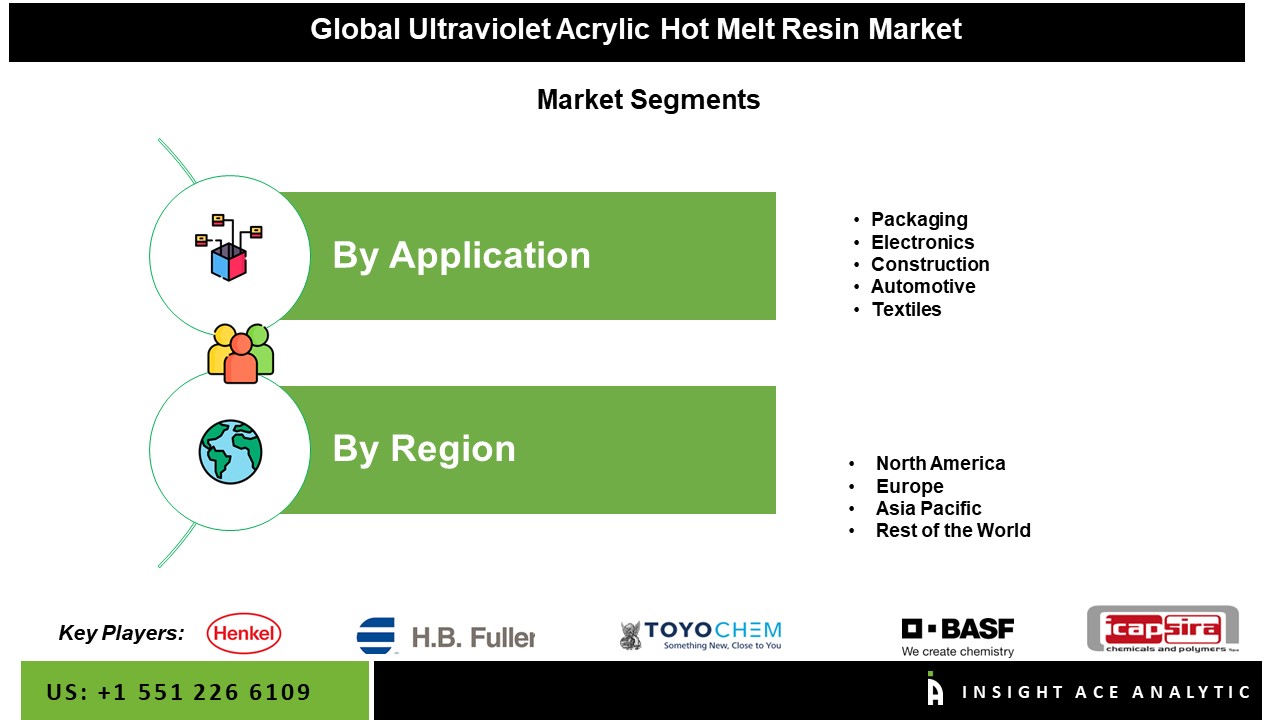
Some Major Key Players In The Ultraviolet Acrylic Hot Melt Resin Market:

  • BASF SE.
  • Henkel AG & Co. KGaA
  • ICAP-SIRA CHEMICALS AND POLYMERS S.P.A.
  • Fuller Company
  • TOYOCHEM CO., LTD.

Market Segmentation:

The ultraviolet acrylic hot melt resin market is segmented based on application. By application, the Ultraviolet Acrylic Hot Melt Resin market is segmented into packaging, electronics, automotive, construction and textiles.

Based On Applications, The Automotive Segment Is A Major Contributor To The Ultraviolet Acrylic Hot Melt Resin Market

The automotive category will hold a major share of the global Ultraviolet Acrylic Hot Melt Resin market in 2022. The automotive industry utilizes UV acrylic hot melt resins in headlamp assembly.

The resins provide reliable bonding for intricate headlamp components, ensuring structural integrity and water resistance. Automotive manufacturers use UV acrylic hot melt resins for vibration-damping applications. By bonding vibration-dampening materials to automotive components, these resins contribute to a smoother and quieter driving experience. UV acrylic hot melt resins are employed in automotive electronics to encapsulate sensitive electronic components. The fast-curing time prevents potential damage to delicate electronics during encapsulation.

The North America Ultraviolet Acrylic Hot Melt Resin Market Holds A Significant Revenue Share

The North America Ultraviolet Acrylic Hot Melt Resin market is expected to register a tremendous market share. North American industries often collaborate with research institutions and technology providers to innovate and adopt advanced materials. This collaborative approach facilitates the integration of Ultraviolet Acrylic Hot Melt Resins into diverse applications. North America is home to substantial automotive and aerospace sectors.

Both industries are increasingly adopting lightweight materials for improved performance and efficiency. Ultraviolet Acrylic Hot Melt Resins offer strong bonding capabilities without adding significant weight, making them a valuable choice for these sectors. In addition, Asia Pacific is projected to grow rapidly in the global ultraviolet acrylic hot melt resin market driven by several key factors reflecting the region's industrial advancements, environmental consciousness, and technological innovation. 

Ultraviolet Acrylic Hot Melt Resin Market Report Scope:

Report Attribute Specifications
Growth Rate CAGR CAGR of 7.2% from 2025 to 2034
Quantitative Units Representation of revenue in US$ Million and CAGR from 2025 to 2034
Historic Year 2021 to 2024
Forecast Year 2025-2034
Report Coverage The forecast of revenue, the position of the company, the competitive market structure, growth prospects, and trends
Segments Covered By Application
Regional Scope North America; Europe; Asia Pacific; Latin America; Middle East & Africa
Country Scope U.S.; Canada; U.K.; Germany; China; India; Japan; Brazil; Mexico; France; Italy; Spain; South Korea; South East Asia
Competitive Landscape BASF SE., Henkel AG & Co. KGaA, ICAP-SIRA CHEMICALS AND POLYMERS S.P.A., H.B. Fuller Company, TOYOCHEM CO., LTD.
Customization Scope Free customization report with the procurement of the report, Modifications to the regional and segment scope. Particular Geographic competitive landscape.
Pricing And Available Payment Methods Explore pricing alternatives that are customized to your particular study requirements.

Segmentation of Ultraviolet Acrylic Hot Melt Resin Market-

Ultraviolet Acrylic Hot Melt Resin Market By Application

  • Packaging
  • Electronics
  • Automotive
  • Construction
  • Textiles

Ultraviolet Acrylic Hot Melt Resin Market

Ultraviolet Acrylic Hot Melt Resin Market By Region-

North America-

  • The US
  • Canada

Europe-

  • Germany
  • The UK
  • France
  • Italy
  • Spain
  • Rest of Europe

Asia-Pacific-

  • China
  • Japan
  • India
  • South Korea
  • Southeast Asia
  • Rest of Asia Pacific

Latin America-

  • Brazil
  • Argentina
  • Mexico
  • Rest of Latin America

 Middle East & Africa-

  • GCC Countries
  • South Africa
  • Rest of Middle East and Africa

Need specific information/chapter from the report of the custom data table, graph or complete report? Tell us more.

Research Design and Approach

This study employed a multi-step, mixed-method research approach that integrates:

  • Secondary research
  • Primary research
  • Data triangulation
  • Hybrid top-down and bottom-up modelling
  • Forecasting and scenario analysis

This approach ensures a balanced and validated understanding of both macro- and micro-level market factors influencing the market.

Secondary Research

Secondary research for this study involved the collection, review, and analysis of publicly available and paid data sources to build the initial fact base, understand historical market behaviour, identify data gaps, and refine the hypotheses for primary research.

Sources Consulted

Secondary data for the market study was gathered from multiple credible sources, including:

  • Government databases, regulatory bodies, and public institutions
  • International organizations (WHO, OECD, IMF, World Bank, etc.)
  • Commercial and paid databases
  • Industry associations, trade publications, and technical journals
  • Company annual reports, investor presentations, press releases, and SEC filings
  • Academic research papers, patents, and scientific literature
  • Previous market research publications and syndicated reports

These sources were used to compile historical data, market volumes/prices, industry trends, technological developments, and competitive insights.

Secondary Research

Primary Research

Primary research was conducted to validate secondary data, understand real-time market dynamics, capture price points and adoption trends, and verify the assumptions used in the market modelling.

Stakeholders Interviewed

Primary interviews for this study involved:

  • Manufacturers and suppliers in the market value chain
  • Distributors, channel partners, and integrators
  • End-users / customers (e.g., hospitals, labs, enterprises, consumers, etc., depending on the market)
  • Industry experts, technology specialists, consultants, and regulatory professionals
  • Senior executives (CEOs, CTOs, VPs, Directors) and product managers

Interview Process

Interviews were conducted via:

  • Structured and semi-structured questionnaires
  • Telephonic and video interactions
  • Email correspondences
  • Expert consultation sessions

Primary insights were incorporated into demand modelling, pricing analysis, technology evaluation, and market share estimation.

Data Processing, Normalization, and Validation

All collected data were processed and normalized to ensure consistency and comparability across regions and time frames.

The data validation process included:

  • Standardization of units (currency conversions, volume units, inflation adjustments)
  • Cross-verification of data points across multiple secondary sources
  • Normalization of inconsistent datasets
  • Identification and resolution of data gaps
  • Outlier detection and removal through algorithmic and manual checks
  • Plausibility and coherence checks across segments and geographies

This ensured that the dataset used for modelling was clean, robust, and reliable.

Market Size Estimation and Data Triangulation

Bottom-Up Approach

The bottom-up approach involved aggregating segment-level data, such as:

  • Company revenues
  • Product-level sales
  • Installed base/usage volumes
  • Adoption and penetration rates
  • Pricing analysis

This method was primarily used when detailed micro-level market data were available.

Bottom Up Approach

Top-Down Approach

The top-down approach used macro-level indicators:

  • Parent market benchmarks
  • Global/regional industry trends
  • Economic indicators (GDP, demographics, spending patterns)
  • Penetration and usage ratios

This approach was used for segments where granular data were limited or inconsistent.

Hybrid Triangulation Approach

To ensure accuracy, a triangulated hybrid model was used. This included:

  • Reconciling top-down and bottom-up estimates
  • Cross-checking revenues, volumes, and pricing assumptions
  • Incorporating expert insights to validate segment splits and adoption rates

This multi-angle validation yielded the final market size.

Forecasting Framework and Scenario Modelling

Market forecasts were developed using a combination of time-series modelling, adoption curve analysis, and driver-based forecasting tools.

Forecasting Methods

  • Time-series modelling
  • S-curve and diffusion models (for emerging technologies)
  • Driver-based forecasting (GDP, disposable income, adoption rates, regulatory changes)
  • Price elasticity models
  • Market maturity and lifecycle-based projections

Scenario Analysis

Given inherent uncertainties, three scenarios were constructed:

  • Base-Case Scenario: Expected trajectory under current conditions
  • Optimistic Scenario: High adoption, favourable regulation, strong economic tailwinds
  • Conservative Scenario: Slow adoption, regulatory delays, economic constraints

Sensitivity testing was conducted on key variables, including pricing, demand elasticity, and regional adoption.


Name field cannot be blank!
Email field cannot be blank!(Use email format)
Designation field cannot be blank!
Company field cannot be blank!
Contact No field cannot be blank!
Message field cannot be blank!
3892
Security Code field cannot be blank!

Frequently Asked Questions

Ultraviolet Acrylic Hot Melt Resin Market expected to grow at a a 7.2% CAGR during the forecast period for 2025-2034

BASF SE., Henkel AG & Co. KGaA, ICAP-SIRA CHEMICALS AND POLYMERS S.P.A., H.B. Fuller Company, TOYOCHEM CO., LTD

Application is the key segment of the Ultraviolet Acrylic Hot Melt Resin Market.

North American region is leading the Ultraviolet Acrylic Hot Melt Resin Market.
Get Sample Report Enquiry Before Buying