Super Generics Market Size, Share & Trends Analysis Report By Therapeutic Area (Cardiovascular Disorders, Metabolic Disorders, Neurological Disorders, Oncological Disorders, Respiratory Disorders and Other Disorders), By Route of Administration (Intravenous, Oral, Subcutaneous and Others), By Type of Molecule (Small and Other Molecules), By Type of Small Molecule (Generics and Other Small Molecules), By Type of Product (Aerosols, Capsules, Prefilled Syringes, Tablets, Vials and Other Products), By Region, And By Segment Forecasts, 2025-2034
Global Super Generics Market Size is valued at USD 77.4 Bn in 2024 and is predicted to reach USD 157.7 Bn by the year 2034 at a 7.5% CAGR during the forecast period for 2025-2034.
Super generics, commonly referred to as value-added generics, are improved versions of generic medications. They provide extra benefits above regular generics, such as better efficacy, safety, and convenience of use. Super generics are created using unique formulation methods or novel delivery systems, which offer advantages such as fewer side effects and more convenient dosing schedules. These innovations attempt to provide a competitive advantage in the market while more efficiently meeting unique patient needs.

However, stringent regulations pose a notable constraint hindering the growth of generic drugs, as regulatory bodies like the FDA meticulously scrutinize aspects such as accuracy, potential side effects, and ingredients utilized in generic formulations. Non-compliance with regulatory guidelines often results in drug recalls. This juncture calls for businesses to carefully assess investment opportunities before determining their next product venture. As evidenced below, the landscape of opportunities and challenges varies significantly across different product categories. Generic drugs provide a more economical option compared to branded counterparts, enabling patients to access vital cancer treatments at reduced costs. With the escalating number of cancer cases, the demand for affordable treatment alternatives surges, thereby fueling the expansion of the generic drugs market.
Competitive Landscape
Some Major Key Players In The Super Generics Market:
- Accord Healthcare
- Alcon Laboratories
- Ascendia Pharmaceuticals
- Azurity Pharmaceuticals
- Baxter
- CritiTech
- Crossject
- DelSiTech
- Reddy’s Laboratories
- Exela Pharma Sciences
- Harrow Health
- Heron Therapeutics
- Hikma Pharmaceuticals
- Intellipharmaceutics International
- Kashiv BioSciences
- Latitude Pharmaceuticals
- Mayne Pharma
- Meda pharmaceuticals
- Neurelis
- Rubicon Research
- Sun Pharmaceutical industries
- Taiwan Liposome Company
- Tesa Labtec
- Teva Pharmaceutical
- Other Market Players
Market Segmentation:
The Super Generics Market market is segmented on the basis of product and application. Based on the therapeutic area, the super generics market is categorised into cardiovascular disorders, metabolic disorders, neurological disorders, oncological disorders, respiratory disorders and other disorders. By small molecule, the Super Generics market is segmented into Generics and Other Small Molecules . The Super Generics market is segmented into intravenous oral, subcutaneous, and other categories. By type of molecules, the Super Generics market is segmented into Small and Other Molecules. By type of product, the Super Generics market is segmented into aerosols, capsules, prefilled syringes, tablets, Vials, and other products.
Based On The Product, The Cardiovascular Diseases Segment Is Accounted For As A Major Contributor To The Supermarket Market.
The cardiovascular diseases category is expected to hold a major share of the global super generics market. The escalating prevalence of cardiovascular disorders represents a significant driver for growth within the Super Generics market. Cardiovascular diseases, including hypertension, coronary artery disease, and heart failure, continue to be leading causes of morbidity and mortality worldwide. As the global burden of cardiovascular disorders rises, there is an increasing demand for cost-effective and accessible treatment options, driving the uptake of super-genetics within this therapeutic area. Additionally, regulatory agencies worldwide are increasingly encouraging the development and approval of generic cardiovascular medications to improve access to essential treatments and reduce healthcare costs. This regulatory support facilitates the entry of super-genics into the cardiovascular segment, fostering market growth.
The Intravenous Segment Witnessed Growth At A Rapid Rate.
The intravenous category is projected to grow at a rapid rate in the global Super Generics Market market. A significant trend observed in the Super Generics market is the increasing demand for intravenous (IV) medications, which is propelled by various factors. Firstly, IV drugs offer a swift onset of action and precise dosing, rendering them indispensable for critical care scenarios and emergency treatments. As healthcare facilities endeavour to enhance patient outcomes and streamline treatment protocols, the need for IV medications continues to escalate. Furthermore, IV formulations are frequently favoured for their superior bioavailability and effectiveness compared to oral medications, particularly in instances where patients encounter challenges with swallowing or absorbing oral drugs. This preference for IV administration contributes substantially to the mounting demand for intravenous medications within the Super Generics market.
In The Region, The North American Super Generics Market Market Holds A Significant Revenue Share.
The Super Generics Market presents a dichotomy of challenges and opportunities. In North America, the market is driven by elements such as the presence of advanced healthcare infrastructure, a strong regulatory framework, and high levels of healthcare expenditure. Additionally, the region benefits from a robust pharmaceutical industry and extensive research and development activities. This environment fosters innovation in generic drug development, leading to the emergence of super generics – enhanced versions of generic drugs with improved efficacy, safety, or delivery mechanisms.
On the other hand, the APAC region represents a rapidly expanding market for Super Generics, driven by factors such as growing populations, rising healthcare expenditure, and increasing awareness of healthcare among consumers. In countries like India and China, where there is a large patient population and significant demand for affordable medications, the Super Generics market is poised for substantial growth. However, businesses must carefully navigate the regulatory landscape and assess investment opportunities before venturing into this dynamic market.
Recent Developments:
- In June 2023, Pharmaceutical manufacturer Dr. Reddy's Laboratories entered the Indian commercial generics market with the formation of RGenX, a new specialized division. Unlike branded medications, trade generics are distributed directly to consumers without any advertising.
- In Dec 2022, Accord Healthcare, Inc., a prominent manufacturer of generic pharmaceuticals, expanded its range of chemotherapy medications with the addition of Bendamustine Lyo. Injection. Accord's medication has received an AP rating, which is equivalent to Teva's Treanda®. It is available in vials of both 25-mg and 100-mg.
Super Generics Market Report Scope
| Report Attribute | Specifications |
| Market Size Value In 2024 | USD 77.4 Bn |
| Revenue Forecast In 2034 | USD 157.7 Bn |
| Growth Rate CAGR | CAGR of 7.5% from 2025 to 2034 |
| Quantitative Units | Representation of revenue in US$ Bn and CAGR from 2025 to 2034 |
| Historic Year | 2021 to 2024 |
| Forecast Year | 2025-2034 |
| Report Coverage | The forecast of revenue, the position of the company, the competitive market structure, growth prospects, and trends |
| Segments Covered | By Therapeutic Area, Route of Administration, Type of Molecule, Type of Small Molecule, Type of Product |
| Regional Scope | North America; Europe; Asia Pacific; Latin America; Middle East & Africa |
| Country Scope | U.S.; Canada; U.K.; Germany; China; India; Japan; Brazil; Mexico; France; Italy; Spain; Southeast Asia; South Korea |
| Competitive Landscape | Accord Healthcare Alcon Laboratories, Ascendia Pharmaceuticals, Azurity Pharmaceuticals, Baxter, CritiTech, Crossject, DelSiTech, Dr. Reddy’s Laboratories, Exela Pharma Sciences, Harrow Health, Heron Therapeutics, Hikma Pharmaceuticals, Intellipharmaceutics International, Kashiv BioSciences, Latitude Pharmaceuticals, Mayne Pharma, meda pharmaceuticals, Neurelis, Rubicon Research, Sun Pharmaceutical Industries, Taiwan Liposome Company and Tesa Labtec and Teva Pharmaceutical. |
| Customization Scope | Free customization report with the procurement of the report and modifications to the regional and segment scope. Particular Geographic competitive landscape. |
| Pricing And Available Payment Methods | Explore pricing alternatives that are customized to your particular study requirements. |
Segmentation of Super Generics Market -
Super Generics Market By Therapeutic Area
- Cardiovascular Disorders
- Metabolic Disorders
- Neurological Disorders
- Oncological Disorders
- Respiratory Disorders
- Other Disorder
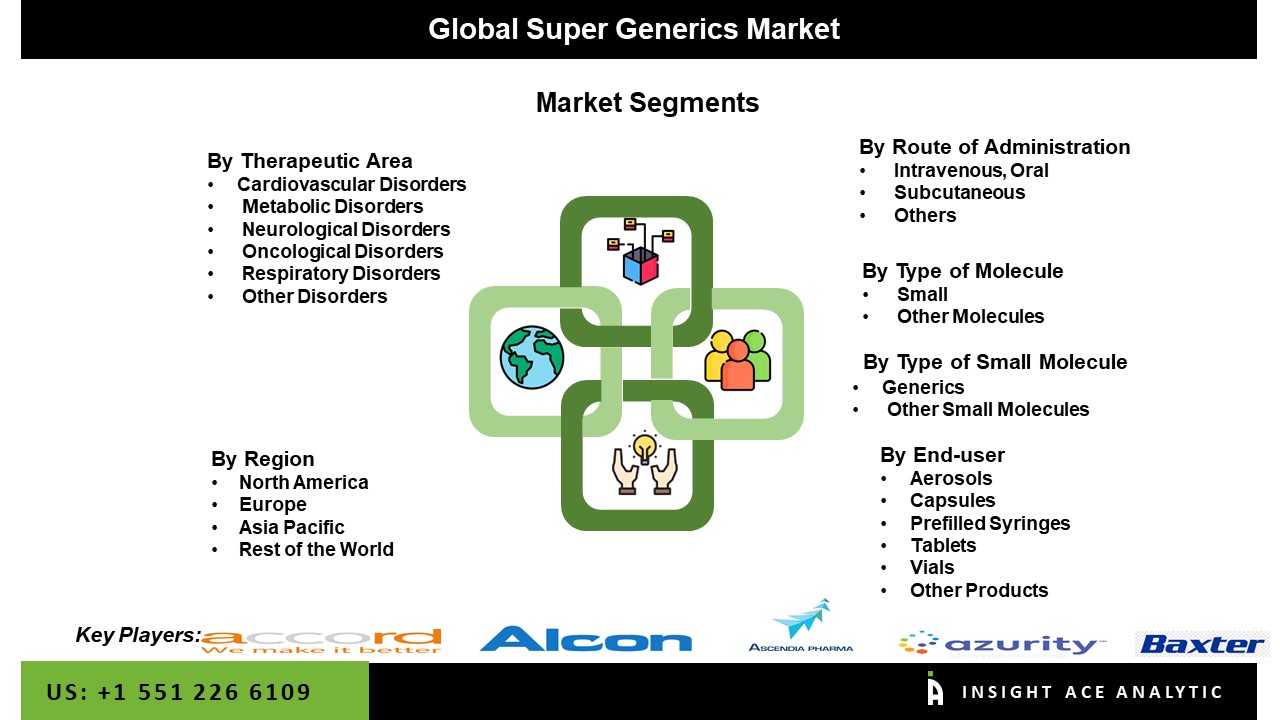
Super Generics Market By Route of Administration
- Intravenous
- Oral
- Subcutaneous
- Others
Super Generics Market By Type of Molecule
- Small
- Other Molecules
Super Generics Market By Type of Small Molecule
- Generics
- Other Small Molecules
Super Generics Market By Type of Product
- Aerosols
- Capsules
- Prefilled Syringes
- Tablets
- Vials
- Other Products
Super Generics Market By Region-
North America-
- The US
- Canada
Europe-
- Germany
- The UK
- France
- Italy
- Spain
- Rest of Europe
Asia-Pacific-
- China
- Japan
- India
- South Korea
- South East Asia
- Rest of Asia Pacific
Latin America-
- Brazil
- Mexico
- Argentina
- Rest of Latin America
Middle East & Africa-
- GCC Countries
- South Africa
- Rest of Middle East and Africa
Research Design and Approach
This study employed a multi-step, mixed-method research approach that integrates:
- Secondary research
- Primary research
- Data triangulation
- Hybrid top-down and bottom-up modelling
- Forecasting and scenario analysis
This approach ensures a balanced and validated understanding of both macro- and micro-level market factors influencing the market.
Secondary Research
Secondary research for this study involved the collection, review, and analysis of publicly available and paid data sources to build the initial fact base, understand historical market behaviour, identify data gaps, and refine the hypotheses for primary research.
Sources Consulted
Secondary data for the market study was gathered from multiple credible sources, including:
- Government databases, regulatory bodies, and public institutions
- International organizations (WHO, OECD, IMF, World Bank, etc.)
- Commercial and paid databases
- Industry associations, trade publications, and technical journals
- Company annual reports, investor presentations, press releases, and SEC filings
- Academic research papers, patents, and scientific literature
- Previous market research publications and syndicated reports
These sources were used to compile historical data, market volumes/prices, industry trends, technological developments, and competitive insights.

Primary Research
Primary research was conducted to validate secondary data, understand real-time market dynamics, capture price points and adoption trends, and verify the assumptions used in the market modelling.
Stakeholders Interviewed
Primary interviews for this study involved:
- Manufacturers and suppliers in the market value chain
- Distributors, channel partners, and integrators
- End-users / customers (e.g., hospitals, labs, enterprises, consumers, etc., depending on the market)
- Industry experts, technology specialists, consultants, and regulatory professionals
- Senior executives (CEOs, CTOs, VPs, Directors) and product managers
Interview Process
Interviews were conducted via:
- Structured and semi-structured questionnaires
- Telephonic and video interactions
- Email correspondences
- Expert consultation sessions
Primary insights were incorporated into demand modelling, pricing analysis, technology evaluation, and market share estimation.
Data Processing, Normalization, and Validation
All collected data were processed and normalized to ensure consistency and comparability across regions and time frames.
The data validation process included:
- Standardization of units (currency conversions, volume units, inflation adjustments)
- Cross-verification of data points across multiple secondary sources
- Normalization of inconsistent datasets
- Identification and resolution of data gaps
- Outlier detection and removal through algorithmic and manual checks
- Plausibility and coherence checks across segments and geographies
This ensured that the dataset used for modelling was clean, robust, and reliable.
Market Size Estimation and Data Triangulation
Bottom-Up Approach
The bottom-up approach involved aggregating segment-level data, such as:
- Company revenues
- Product-level sales
- Installed base/usage volumes
- Adoption and penetration rates
- Pricing analysis
This method was primarily used when detailed micro-level market data were available.

Top-Down Approach
The top-down approach used macro-level indicators:
- Parent market benchmarks
- Global/regional industry trends
- Economic indicators (GDP, demographics, spending patterns)
- Penetration and usage ratios
This approach was used for segments where granular data were limited or inconsistent.
Hybrid Triangulation Approach
To ensure accuracy, a triangulated hybrid model was used. This included:
- Reconciling top-down and bottom-up estimates
- Cross-checking revenues, volumes, and pricing assumptions
- Incorporating expert insights to validate segment splits and adoption rates
This multi-angle validation yielded the final market size.
Forecasting Framework and Scenario Modelling
Market forecasts were developed using a combination of time-series modelling, adoption curve analysis, and driver-based forecasting tools.
Forecasting Methods
- Time-series modelling
- S-curve and diffusion models (for emerging technologies)
- Driver-based forecasting (GDP, disposable income, adoption rates, regulatory changes)
- Price elasticity models
- Market maturity and lifecycle-based projections
Scenario Analysis
Given inherent uncertainties, three scenarios were constructed:
- Base-Case Scenario: Expected trajectory under current conditions
- Optimistic Scenario: High adoption, favourable regulation, strong economic tailwinds
- Conservative Scenario: Slow adoption, regulatory delays, economic constraints
Sensitivity testing was conducted on key variables, including pricing, demand elasticity, and regional adoption.
Request Customization
Add countries, segments, company profiles, or extend forecast — free 10% customization with purchase.
Customize This Report →Enquire Before Buying
Speak with our analyst team about scope, methodology, pricing, or deliverable formats.
Enquire Now →Frequently Asked Questions
Super Generics Market Size is valued at USD 77.4 Bn in 2024 and is predicted to reach USD 157.7 Bn by the year 2034
Super Generics Market is expected to grow at a 7.5% CAGR during the forecast period for 2025-2034
meda pharmaceuticals, Neurelis, Rubicon Research, Sun Pharmaceutical Industries, Taiwan Liposome Company and Tesa Labtec and Teva Pharmaceutical.
Therapeutic Area, Route of Administration, Type of Molecule, Type of Small Molecule, and Type of Product are the key segments of the Super Generics Ma
North America region is leading the Super Generics Market.