Psychedelic API Market Size, Share and Trends Analysis 2025 to 2034
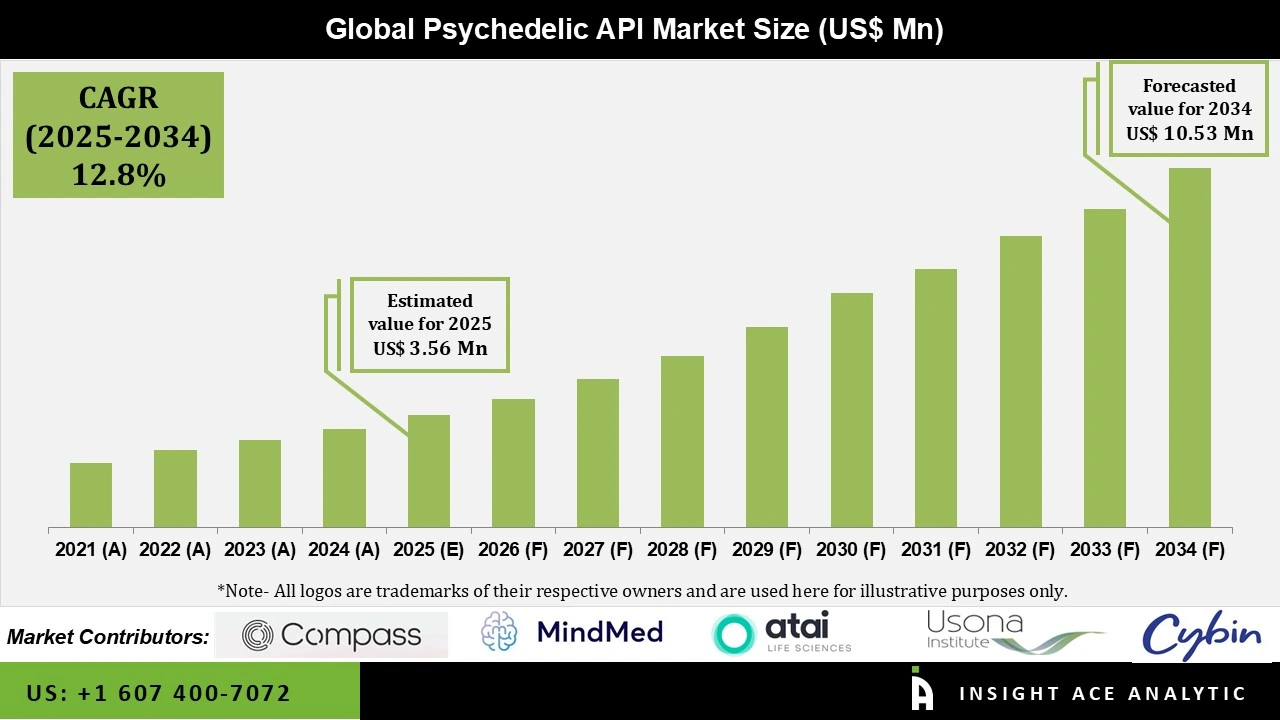
Global Psychedelic API Market Size is valued at US$ 3.5 Bn in 2025 and is predicted to reach US$ 10.5 Bn by the year 2034 at an 12.8% CAGR during the forecast period for 2025 to 2034.
Psychedelic API Market Size, Share & Trends Analysis Distribution By Molecule / Class (Psilocybin / Psilocin, MDMA, MDMA Base, MDMA Salts, Lysergide / LSD, Tryptamines, Iboga Alkaloids, Ketamine Class, Next-Gen 5-HT2A Modulators / Psychoplastogens), By Source / Synthesis Route (Fully Synthetic, Biosynthetic / Fermentation, Engineered Microbial Pathways, And Botanical / Fungal Extraction), By Form / Solid-State & Grade (Salt Forms, Base Forms, Polymorph / Crystal Form, Micronized / Particle-Size Controlled Grades), By Contracting Model, By End Use, and Segment Forecasts, 2025 to 2034.
Psychedelic APIs are mostly utilized as crucial components in the creation of contemporary treatments for mental health issues like anxiety disorders, PTSD, addiction, and depression. They are used by pharmaceutical companies to develop controlled formulations for clinical trials, where the goal is to improve cases that are resistant to therapy. Additionally, they are used in neurobiology research to comprehend cognitive flexibility and consciousness.
These APIs are crucial in developing safer, standardized, and scientifically supported medical treatments as interest in psychedelic-assisted therapy increases. Researchers employ these active ingredients to study their effects on mood, memory, and emotional processing circuits in the brain. The global market for psychedelic API is expanding due to ,more clinical studies demonstrate positive outcomes for treating disorders including severe depression, PTSD, and addiction that don't react well to conventional psychiatric medications.
The rising need for more effective treatments for mental-health disorders, especially depression, PTSD, and addiction is another element propelling the psychedelic API market. The psychedelic API market is expanding because rising public awareness and desire for alternative mental health treatments. The WHO Over 1 billion individuals worldwide suffer from mental, neurological, or drug use illnesses; in 2023, 15% of the global population is predicted to have had a mental disorder. However, strict regulations because many psychedelic compounds are still categorized as prohibited substances, which takes time for research and authorization are some of the obstacles impeding the growth of the psychedelic API sector. Over the course of the forecast period, opportunities for the Psychedelic API market will be created by increasing investments in clinical infrastructure and local active pharmaceutical ingredient (API) synthesis capabilities.
Competitive Landscape
Which are the Leading Players in Psychedelic API Market?
- Compass Pathways
- MindMed
- Atai Life Sciences
- Cybin Inc
- Usona Institute
- Delic Holdings Inc.
- Havn Life Sciences
- Beckley Psytech
- Psilera Inc
- NeonMind Biosciences
- Others
Market Segmentation:
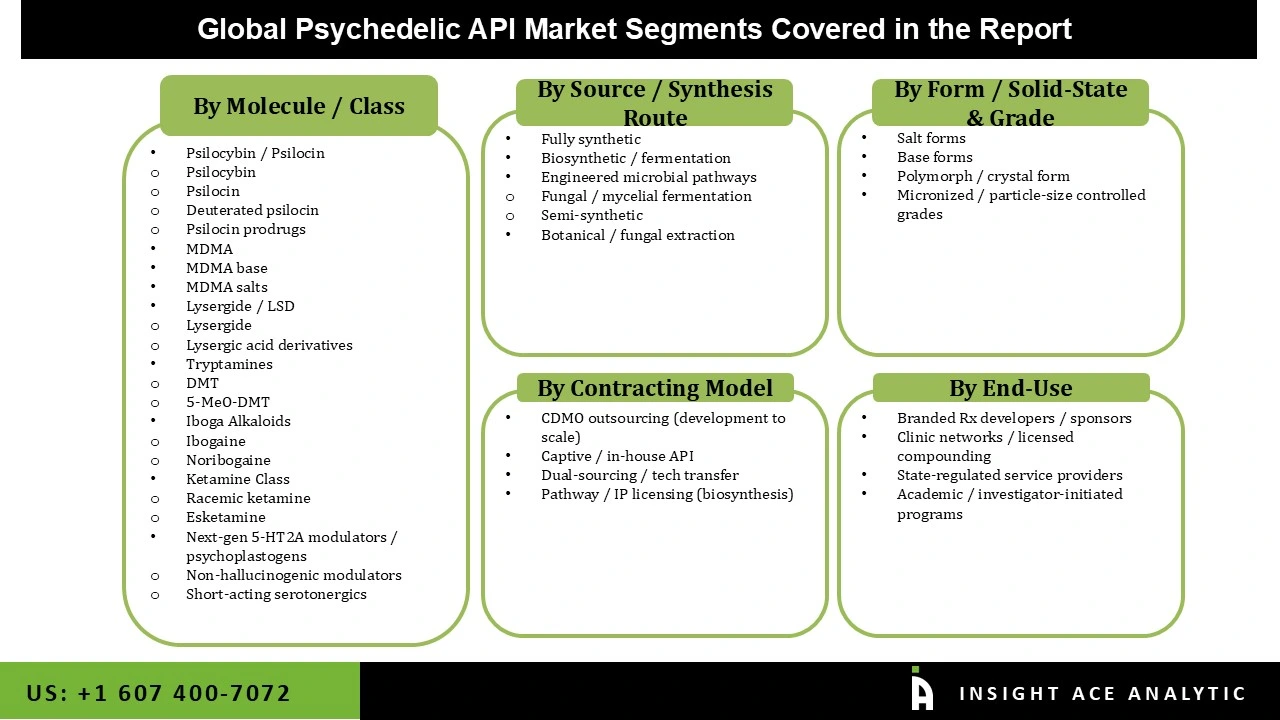
The psychedelic API market is segmented by molecule / class, source / synthesis route, form / solid-state & grade, contracting model, and end use. By molecule / class, the market is segmented into psilocybin / psilocin, MDMA, MDMA base, MDMA salts, lysergide / LSD, tryptamines, Iboga alkaloids (ibogaine, noribogaine), ketamine class, next-gen 5-ht2a modulators / psychoplastogens. Psilocybin / psilocin is further classified into psilocybin, psilocin, deuterated psilocin, and psilocin prodrugs. Lysergide / LSD is categorized into lysergide and lysergic acid derivatives. Tryptamines is sub-segmented into DMT and 5-meo-dmt. Iboga alkaloids is classified into ibogaine and noribogaine. Ketamine class is categorized into racemic ketamine and esketamine, whereas Next-Gen 5-ht2a modulators / psychoplastoge in classified into non-hallucinogenic modulators and short-acting serotonergics. By source / synthesis route, the market is segmented into fully synthetic, biosynthetic / fermentation, engineered microbial pathways and botanical / fungal extraction. Engineered microbial pathways is further classified into fungal / mycelial fermentation and semi-synthetic. By form / solid-state & grade, the market is segmented into salt forms, base forms, polymorph / crystal form, and micronized / particle-size controlled grades. By contracting model, the market is segmented into CDMO outsourcing (development to scale), captive / in-house API, dual-sourcing / tech transfer, and pathway / IP licensing (biosynthesis). By end use, the market is segmented into branded Rx developers / sponsors, clinic networks / licensed compounding, state-regulated service providers, and academic / investigator-initiated programs.
By Molecule / Class, the Ketamine Class Segment is Expected to Drive the Psychedelic API Market
The ketamine segment led the psychedelic API market in 2024. This convergence is because of strong regulatory support and therapeutic acceptance. In order to facilitate the approval of the esketamine class, the FDA has expedited the creation of commercial infrastructure. The sector growth is being fulfilled by the FDA's current authorization of ketamine for treatment-resistant depression. Demand is driven by the widespread usage of ketamine in the treatment of anxiety disorders, depression, and PTSD. Rapid-acting antidepressant qualities, robust manufacturing infrastructure, and broad clinical acceptance characterize this class.
Salt Forms Segment is Growing at the Highest Rate in the Psychedelic API Market
Salt forms represent the largest and fastest-growing segment, driven by increasing novel therapeutic designations and rising clinical trial activity. These forms offer enhanced stability, improved bioavailability, and greater efficiency in manufacturing processes. By optimizing key physicochemical properties, salt forms help create pharmaceutical products that are more suitable for both clinical development and commercial-scale production. For drug manufacturers, they ensure that synthetic APIs remain consistently pure, high quality, and easily scalable, making them a preferred choice across a wide range of pharmaceutical applications.
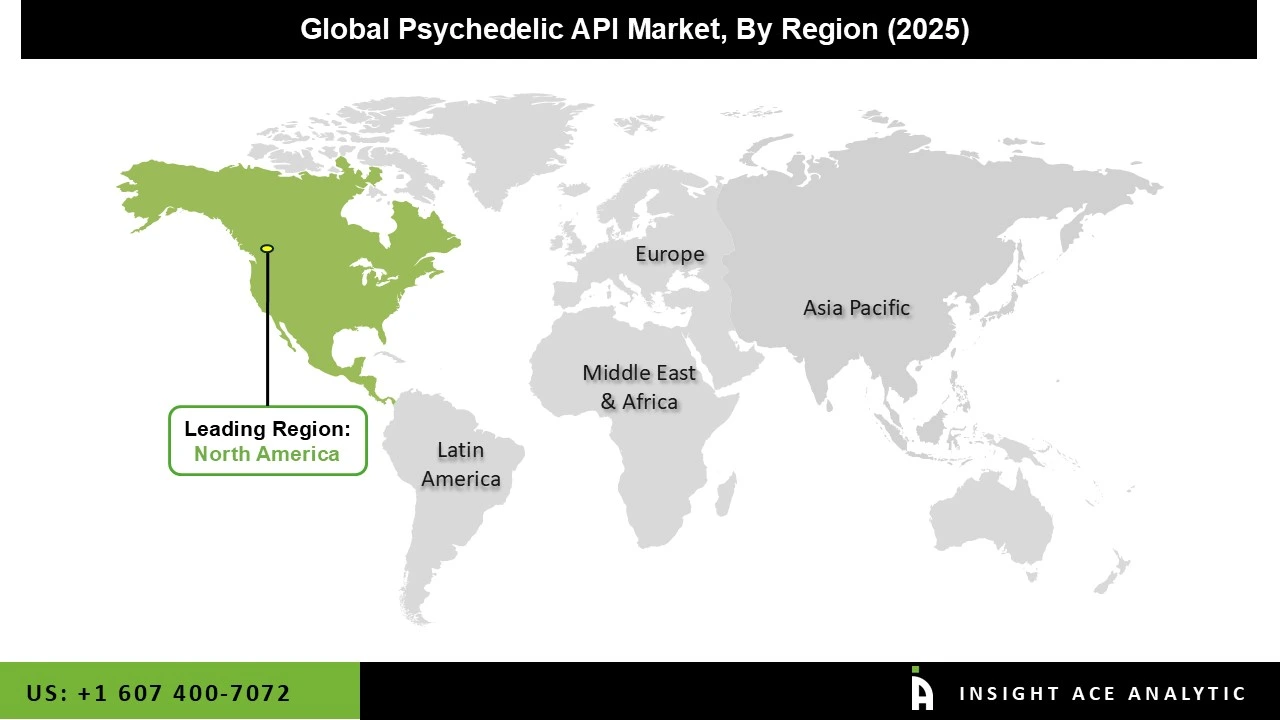
Why North America Led the Psychedelic API Market?
North America dominated the psychedelic API market in 2024. The United States is at the forefront of this expansion. This is due to the The region leads in clinical research, government-approved trials, and investment in mental-health innovations are attributed to this. High-quality APIs are in constant demand due to the active development of psychedelic-based medicines by universities, biotech companies, and pharmaceutical companies.North America's dominance is further reinforced by robust funding, cutting-edge labs, and growing interest in alternative therapies.
Rising prevalence of addiction, stress disorders, and depression is becoming more and more common in the Asia-Pacific area, the psychedelic API market is expanding at the strongest and fastest rate in this region. Additionally, number of nations that are progressively opening doors to innovation in mental health and enhancing their research capacities. The region has a robust production capability for high-purity APIs because to rising investment in biotech manufacturing. The market is expanding quickly as more businesses enter the market as local awareness grows and rules gradually change.
Psychedelic API Market Report Scope :
Segmentation of Psychedelic API Market :
Psychedelic API Market by Molecule / Class
· Psilocybin / Psilocin
o Psilocybin
o Psilocin
o Deuterated psilocin
o Psilocin prodrugs
· MDMA
· MDMA base
· MDMA salts
· Lysergide / LSD
o Lysergide
o Lysergic acid derivatives
· Tryptamines
o DMT
o 5-MeO-DMT
· Iboga Alkaloids
o Ibogaine
o Noribogaine
· Ketamine Class
o Racemic ketamine
o Esketamine
· Next-gen 5-HT2A modulators / psychoplastogens
o Non-hallucinogenic modulators
o Short-acting serotonergics
Psychedelic API Market by Source / Synthesis Route
· Fully synthetic
· Biosynthetic / fermentation
· Engineered microbial pathways
o Fungal / mycelial fermentation
o Semi-synthetic
· Botanical / fungal extraction
Psychedelic API Market by Form / Solid-State & Grade
· Salt forms
· Base forms
· Polymorph / crystal form
· Micronized / particle-size controlled grades
Psychedelic API Market by Contracting Model
· CDMO outsourcing (development to scale)
· Captive / in-house API
· Dual-sourcing / tech transfer
· Pathway / IP licensing (biosynthesis)
Psychedelic API Market by End Use
· Branded Rx developers / sponsors
· Clinic networks / licensed compounding
· State-regulated service providers
· Academic / investigator-initiated programs
Psychedelic API Market by Region
North America-
· The US
· Canada
Europe-
· Germany
· The UK
· France
· Italy
· Spain
· Rest of Europe
Asia-Pacific-
· China
· Japan
· India
· South Korea
· Southeast Asia
· Rest of Asia Pacific
Latin America-
· Brazil
· Argentina
· Mexico
· Rest of Latin America
Middle East & Africa-
· GCC Countries
· South Africa
· Rest of the Middle East and Africa
Research Design and Approach
This study employed a multi-step, mixed-method research approach that integrates:
- Secondary research
- Primary research
- Data triangulation
- Hybrid top-down and bottom-up modelling
- Forecasting and scenario analysis
This approach ensures a balanced and validated understanding of both macro- and micro-level market factors influencing the market.
Secondary Research
Secondary research for this study involved the collection, review, and analysis of publicly available and paid data sources to build the initial fact base, understand historical market behaviour, identify data gaps, and refine the hypotheses for primary research.
Sources Consulted
Secondary data for the market study was gathered from multiple credible sources, including:
- Government databases, regulatory bodies, and public institutions
- International organizations (WHO, OECD, IMF, World Bank, etc.)
- Commercial and paid databases
- Industry associations, trade publications, and technical journals
- Company annual reports, investor presentations, press releases, and SEC filings
- Academic research papers, patents, and scientific literature
- Previous market research publications and syndicated reports
These sources were used to compile historical data, market volumes/prices, industry trends, technological developments, and competitive insights.

Primary Research
Primary research was conducted to validate secondary data, understand real-time market dynamics, capture price points and adoption trends, and verify the assumptions used in the market modelling.
Stakeholders Interviewed
Primary interviews for this study involved:
- Manufacturers and suppliers in the market value chain
- Distributors, channel partners, and integrators
- End-users / customers (e.g., hospitals, labs, enterprises, consumers, etc., depending on the market)
- Industry experts, technology specialists, consultants, and regulatory professionals
- Senior executives (CEOs, CTOs, VPs, Directors) and product managers
Interview Process
Interviews were conducted via:
- Structured and semi-structured questionnaires
- Telephonic and video interactions
- Email correspondences
- Expert consultation sessions
Primary insights were incorporated into demand modelling, pricing analysis, technology evaluation, and market share estimation.
Data Processing, Normalization, and Validation
All collected data were processed and normalized to ensure consistency and comparability across regions and time frames.
The data validation process included:
- Standardization of units (currency conversions, volume units, inflation adjustments)
- Cross-verification of data points across multiple secondary sources
- Normalization of inconsistent datasets
- Identification and resolution of data gaps
- Outlier detection and removal through algorithmic and manual checks
- Plausibility and coherence checks across segments and geographies
This ensured that the dataset used for modelling was clean, robust, and reliable.
Market Size Estimation and Data Triangulation
Bottom-Up Approach
The bottom-up approach involved aggregating segment-level data, such as:
- Company revenues
- Product-level sales
- Installed base/usage volumes
- Adoption and penetration rates
- Pricing analysis
This method was primarily used when detailed micro-level market data were available.

Top-Down Approach
The top-down approach used macro-level indicators:
- Parent market benchmarks
- Global/regional industry trends
- Economic indicators (GDP, demographics, spending patterns)
- Penetration and usage ratios
This approach was used for segments where granular data were limited or inconsistent.
Hybrid Triangulation Approach
To ensure accuracy, a triangulated hybrid model was used. This included:
- Reconciling top-down and bottom-up estimates
- Cross-checking revenues, volumes, and pricing assumptions
- Incorporating expert insights to validate segment splits and adoption rates
This multi-angle validation yielded the final market size.
Forecasting Framework and Scenario Modelling
Market forecasts were developed using a combination of time-series modelling, adoption curve analysis, and driver-based forecasting tools.
Forecasting Methods
- Time-series modelling
- S-curve and diffusion models (for emerging technologies)
- Driver-based forecasting (GDP, disposable income, adoption rates, regulatory changes)
- Price elasticity models
- Market maturity and lifecycle-based projections
Scenario Analysis
Given inherent uncertainties, three scenarios were constructed:
- Base-Case Scenario: Expected trajectory under current conditions
- Optimistic Scenario: High adoption, favourable regulation, strong economic tailwinds
- Conservative Scenario: Slow adoption, regulatory delays, economic constraints
Sensitivity testing was conducted on key variables, including pricing, demand elasticity, and regional adoption.
Request Customization
Add countries, segments, company profiles, or extend forecast — free 10% customization with purchase.
Customize This Report →Enquire Before Buying
Speak with our analyst team about scope, methodology, pricing, or deliverable formats.
Enquire Now →Frequently Asked Questions
The Psychedelic API Market Size is valued at US$ 3.5 Bn in 2025 and is predicted to reach US$ 10.5 Bn by the year 2034 at an 12.8% CAGR over the forecast period.
The major players in the Psychedelic API market are Compass Pathways, MindMed, Atai Life Sciences, Cybin Inc, Usona Institute, Delic Holdings Inc., Havn Life Sciences, Beckley Psytech, Psilera Inc, and NeonMind Biosciences.
The primary Psychedelic API market segments are Molecule / Class, Source / Synthesis Route, Form / Solid-State & Grade, Contracting Model, and End Use.
North America leads the market for Psychedelic API due to the region leads in clinical research, government-approved trials, and investment in mental-health innovations.