Smart Pet Training & Monitoring Devices Market Size, Share & Trends Analysis Report By Pet (Dogs, Cats, Others), By Product Type (AI-based Training Device, AI-based Smart Games & Toys, AI-based Camera, Smart Wearable Trackers, Smart Feeders, Smart Litter Robots, Others), By Region, And By Segment Forecasts, 2025-2034
Smart Pet Training & Monitoring Devices Market Size is predicted to reach an 8.4% CAGR during the forecast period for 2025-2034.

Key Industry Insights & Findings from the Report:
- The increasing demand for these devices is being driven by various factors, including the availability of wearable gadgets, heightened consumer awareness regarding pet health, and growing concerns about the well-being of pets.
- The AI-based Smart Games & Toys segment is poised for significant growth during the forecast period.
- A substantial revenue share is expected within the North American market for smart pet training and monitoring devices.
- However, the primary challenge lies in the high costs and a projected scarcity of skilled professionals, which are projected to impede the growth of the market for smart pet training and monitoring devices.
Smart pet training and monitoring gadgets are technology advancements that help pet owners with tasks like teaching, keeping tabs on, and caring for their dogs. Many gadgets use the internet, wireless connectivity, and other sensors to monitor and report a pet's activity, health, and well-being in real time. Activity trackers, smart collars, smart cameras, automatic feeding, training and behaviour correction devices, smart litter boxes, and health monitoring devices are some smart technologies available for training and monitoring your pet.
These gadgets allow pet parents to keep tabs on their animals afar, ensuring they're healthy, clean, and behaving appropriately. They are practical, and they aid in keeping pets secure. Furthermore, the demand for high-tech tools for educating and surveilling pets increases as more people get them. Technological improvements, notably in the Internet of Things (IoT) and wireless connectivity, have helped build advanced smart pet products.
However, the market growth is hampered by the high cost of the safety and health of smart pet training & monitoring devices and the product's inability to prevent fog in environments with dramatic temperature fluctuations in the smart pet training & monitoring devices market. The high cost of many pet training and monitoring systems may prevent its widespread use, especially among budget-conscious buyers. The high one-time investment and recurring upkeep costs may discourage potential pet owners, particularly in areas with lower average earnings.
Some pet owners may be unaware of the features and advantages of smart pet training and monitoring equipment—the direct impact of COVID-19 on this industry and its subsequent ripples in related fields. The effects of the pandemic on the Smart Dog Collar market are analyzed in this report, both globally and regionally. Market size, characteristics, and growth for the Smart Dog Collar industry are described, using categorization by application, client base, and technology. It also thoroughly evaluates the industry growth drivers before and during the covivirus 19 pandemic. Furthermore, a pastel analysis was performed internally to identify the most significant stakeholders and potential growth barriers.
Competitive Landscape
Some Major Key Players In The Smart Pet Training & Monitoring Devices Market:
- CleverPet
- Companion Labs
- Furbo
- Dogness
- iFetch
- Whisker
- SureFlap Ltd.
- Cheerble
- Findster Technologies
- FitBark
- Puppod
- Petcube Inc.
- Radio Systems Corporation (PetSafe)
- Spectrum Brands Holdings Inc.
- Smarty Pear
- iKuddle
- Petree Litter Box
- Cosmic Pet
- Petnovations Inc.
- PetKit
- Airrobo
- Others
Market Segmentation:
The smart pet training & monitoring devices market is segmented based on pet and product type. Based on pets, the market is segmented into dogs, cats, and others. By product type, the market is segmented into AI-based training devices, AI-based smart games & toys, AI-based cameras, smart wearable trackers, smart feeders, smart litter robots, and others.
Based On The Pet, The Cats Smart Pet Training & Monitoring Devices Market Segment Is A Major Contributor To The Smart Pet Training & Monitoring Devices Market.
The cats smart pet training & monitoring devices market is expected to lead with a major global market share in 2022. Because cats are so autonomous, their human caregivers often turn to technology to help. Smart litter boxes, health monitoring gadgets, and interactive toys designed to meet the unique behavioural and health requirements of cats are all contributing to the sector's growth.
The Smart Wearable Trackers Segment Will Witness Growth At A Rapid Rate.
Smart wearable trackers comprise the bulk of smart pet training and monitoring devices because of their varied applications, from tracking one's movements and whereabouts to providing vital statistics about one's health. Pet owners, especially in countries like the US, Germany, the UK, China, and India, highly value this technology for its ability to monitor their pets in real time, keep them safe, and improve their health.
In The Region, The North American Smart Pet Training & Monitoring Devices Market Holds A Significant Revenue Share.
The North American smart pet training & monitoring devices market is expected to record the maximum market share in revenue in the near future. Because people are paying more attention to animal health and welfare, growth in this region is anticipated to be boosted by increased demand for pet wearables in emerging nations and rising consumer purchasing capacity and per capita income. In addition, Asia Pacific is estimated to grow rapidly in the global smart pet training & monitoring devices market because of rapid technological breakthroughs, a trend towards smart living, and the rising acceptance of IoT-based solutions. The demand for innovative pet care products has increased, fueling the expansion of the area's smart pet training and monitoring devices market.
Recent Developments:
- In October 2023, PetSafe, a manufacturer of pet supplies, developed the NanoBark Bark Collar for Small Dogs, the world's smallest bark collar. The collar fits snugly like a wristwatch and helps dogs learn to stop barking in response to everyday sounds. Since it is waterproof and durable, it can be used at home or on the road.
- In May 2022, Whisker announced the release of Litter-Robot 4, the fourth generation of the self-cleaning litter box. In addition to the brand's aesthetically pleasing, new compact design, the Litter-Robot 4 is equipped with advanced litter-sifting technology, real-time monitoring and health insights, and odour neutralization. It was meticulously designed by Whisker's team of over 35 engineers.
Smart Pet Training & Monitoring Devices Market Report Scope
| Report Attribute | Specifications |
| Growth Rate CAGR | CAGR of 8.4% from 2025 to 2034 |
| Quantitative Units | Representation of revenue in US$ Million and CAGR from 2025 to 2034 |
| Historic Year | 2021 to 2024 |
| Forecast Year | 2025-2034 |
| Report Coverage | The forecast of revenue, the position of the company, the competitive market structure, growth prospects, and trends |
| Segments Covered | By Pet, Product Type |
| Regional Scope | North America; Europe; Asia Pacific; Latin America; Middle East & Africa |
| Country Scope | U.S.; Canada; U.K.; Germany; China; India; Japan; Brazil; Mexico; France; Italy; Spain; Southeast Asia; South Korea |
| Competitive Landscape | CleverPet, Companion Labs, Furbo, Dogness, iFetch, Whisker, SureFlap Ltd., Cheerble, Findster Technologies, FitBark, Puppod, Petcube Inc., Radio Systems Corporation (PetSafe), Spectrum Brands Holdings Inc., Smarty Pear, iKuddle, Petree Litter Box, Cosmic Pet, Petnovations Inc., PetKit, Airrobo and Others |
| Customization Scope | Free customization report with the procurement of the report and modifications to the regional and segment scope. Particular Geographic competitive landscape. |
| Pricing And Available Payment Methods | Explore pricing alternatives that are customized to your particular study requirements. |
Segmentation of Smart Pet Training & Monitoring Devices Market-
Smart Pet Training & Monitoring Devices Market By Pet-
- Dogs
- Cats
- Others
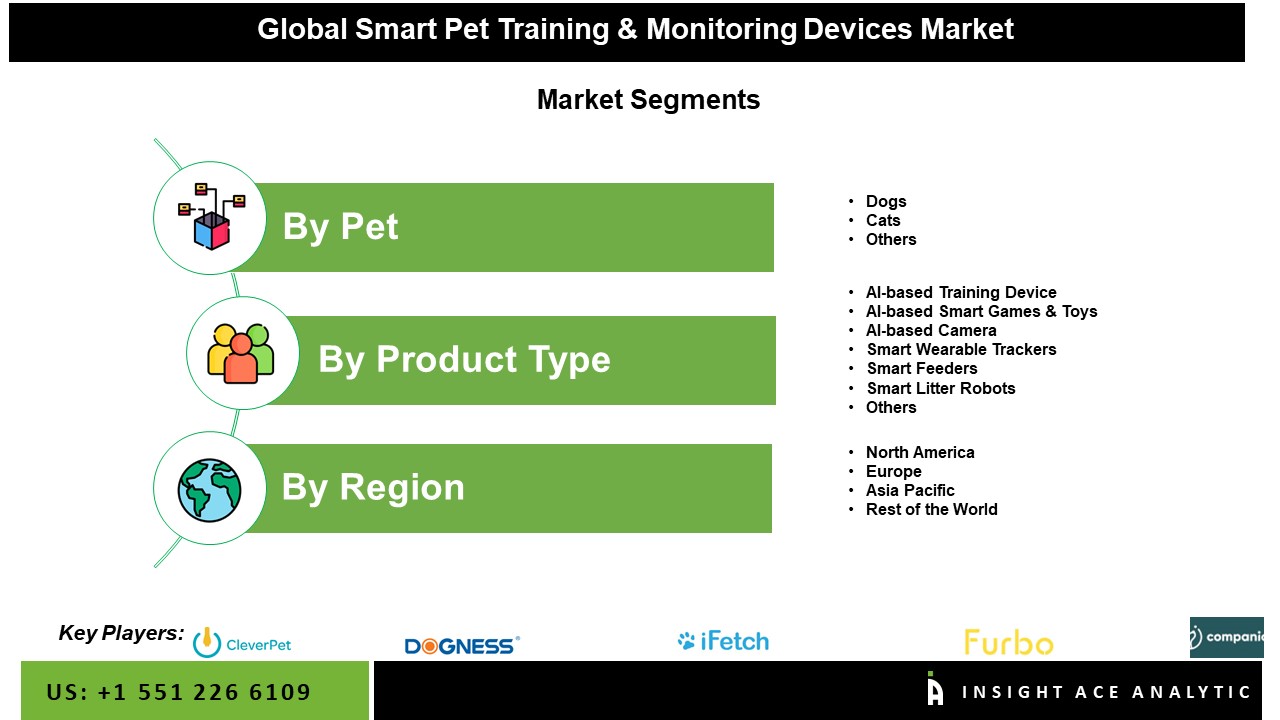
Smart Pet Training & Monitoring Devices Market By Product Type-
- AI-based Training Device
- AI-based Smart Games & Toys
- AI-based Camera
- Smart Wearable Trackers
- Smart Feeders
- Smart Litter Robots
- Others
Smart Pet Training & Monitoring Devices Market By Region-
North America-
- The US
- Canada
Europe-
- Germany
- The UK
- France
- Italy
- Spain
- Rest of Europe
Asia-Pacific-
- China
- Japan
- India
- South Korea
- Southeast Asia
- Rest of Asia Pacific
Latin America-
- Brazil
- Argentina
- Mexico
- Rest of Latin America
Middle East & Africa-
- GCC Countries
- South Africa
- Rest of the Middle East and Africa
Research Design and Approach
This study employed a multi-step, mixed-method research approach that integrates:
- Secondary research
- Primary research
- Data triangulation
- Hybrid top-down and bottom-up modelling
- Forecasting and scenario analysis
This approach ensures a balanced and validated understanding of both macro- and micro-level market factors influencing the market.
Secondary Research
Secondary research for this study involved the collection, review, and analysis of publicly available and paid data sources to build the initial fact base, understand historical market behaviour, identify data gaps, and refine the hypotheses for primary research.
Sources Consulted
Secondary data for the market study was gathered from multiple credible sources, including:
- Government databases, regulatory bodies, and public institutions
- International organizations (WHO, OECD, IMF, World Bank, etc.)
- Commercial and paid databases
- Industry associations, trade publications, and technical journals
- Company annual reports, investor presentations, press releases, and SEC filings
- Academic research papers, patents, and scientific literature
- Previous market research publications and syndicated reports
These sources were used to compile historical data, market volumes/prices, industry trends, technological developments, and competitive insights.

Primary Research
Primary research was conducted to validate secondary data, understand real-time market dynamics, capture price points and adoption trends, and verify the assumptions used in the market modelling.
Stakeholders Interviewed
Primary interviews for this study involved:
- Manufacturers and suppliers in the market value chain
- Distributors, channel partners, and integrators
- End-users / customers (e.g., hospitals, labs, enterprises, consumers, etc., depending on the market)
- Industry experts, technology specialists, consultants, and regulatory professionals
- Senior executives (CEOs, CTOs, VPs, Directors) and product managers
Interview Process
Interviews were conducted via:
- Structured and semi-structured questionnaires
- Telephonic and video interactions
- Email correspondences
- Expert consultation sessions
Primary insights were incorporated into demand modelling, pricing analysis, technology evaluation, and market share estimation.
Data Processing, Normalization, and Validation
All collected data were processed and normalized to ensure consistency and comparability across regions and time frames.
The data validation process included:
- Standardization of units (currency conversions, volume units, inflation adjustments)
- Cross-verification of data points across multiple secondary sources
- Normalization of inconsistent datasets
- Identification and resolution of data gaps
- Outlier detection and removal through algorithmic and manual checks
- Plausibility and coherence checks across segments and geographies
This ensured that the dataset used for modelling was clean, robust, and reliable.
Market Size Estimation and Data Triangulation
Bottom-Up Approach
The bottom-up approach involved aggregating segment-level data, such as:
- Company revenues
- Product-level sales
- Installed base/usage volumes
- Adoption and penetration rates
- Pricing analysis
This method was primarily used when detailed micro-level market data were available.

Top-Down Approach
The top-down approach used macro-level indicators:
- Parent market benchmarks
- Global/regional industry trends
- Economic indicators (GDP, demographics, spending patterns)
- Penetration and usage ratios
This approach was used for segments where granular data were limited or inconsistent.
Hybrid Triangulation Approach
To ensure accuracy, a triangulated hybrid model was used. This included:
- Reconciling top-down and bottom-up estimates
- Cross-checking revenues, volumes, and pricing assumptions
- Incorporating expert insights to validate segment splits and adoption rates
This multi-angle validation yielded the final market size.
Forecasting Framework and Scenario Modelling
Market forecasts were developed using a combination of time-series modelling, adoption curve analysis, and driver-based forecasting tools.
Forecasting Methods
- Time-series modelling
- S-curve and diffusion models (for emerging technologies)
- Driver-based forecasting (GDP, disposable income, adoption rates, regulatory changes)
- Price elasticity models
- Market maturity and lifecycle-based projections
Scenario Analysis
Given inherent uncertainties, three scenarios were constructed:
- Base-Case Scenario: Expected trajectory under current conditions
- Optimistic Scenario: High adoption, favourable regulation, strong economic tailwinds
- Conservative Scenario: Slow adoption, regulatory delays, economic constraints
Sensitivity testing was conducted on key variables, including pricing, demand elasticity, and regional adoption.
Request Customization
Add countries, segments, company profiles, or extend forecast — free 10% customization with purchase.
Customize This Report →Enquire Before Buying
Speak with our analyst team about scope, methodology, pricing, or deliverable formats.
Enquire Now →Frequently Asked Questions
Smart Pet Training & Monitoring Devices Market Size is predicted to reach an 8.4% CAGR during the forecast period for 2025-2034.
Spectrum Brands Holdings Inc., Smarty Pear, iKuddle, Petree Litter Box, Cosmic Pet, Petnovations Inc., PetKit, Airrobo and Others
Smart pet training & monitoring devices market is segmented based on pet and product type.
North America region is leading the Smart pet training & monitoring devices market.