Global Smart or AI In-Vitro Diagnostics Market Size is valued at USD 1.6 Bn in 2024 and is predicted to reach USD 6.2 Bn by the year 2034 at a 14.8% CAGR during the forecast period for 2025-2034.
The healthcare sector continuously adopts innovative technological innovations that boost clinical efficiency, increase patient care, and improve diagnostic accuracy. Artificial intelligence is revolutionizing medical device development, which is used in fields including in vitro diagnostics and digital image analysis.
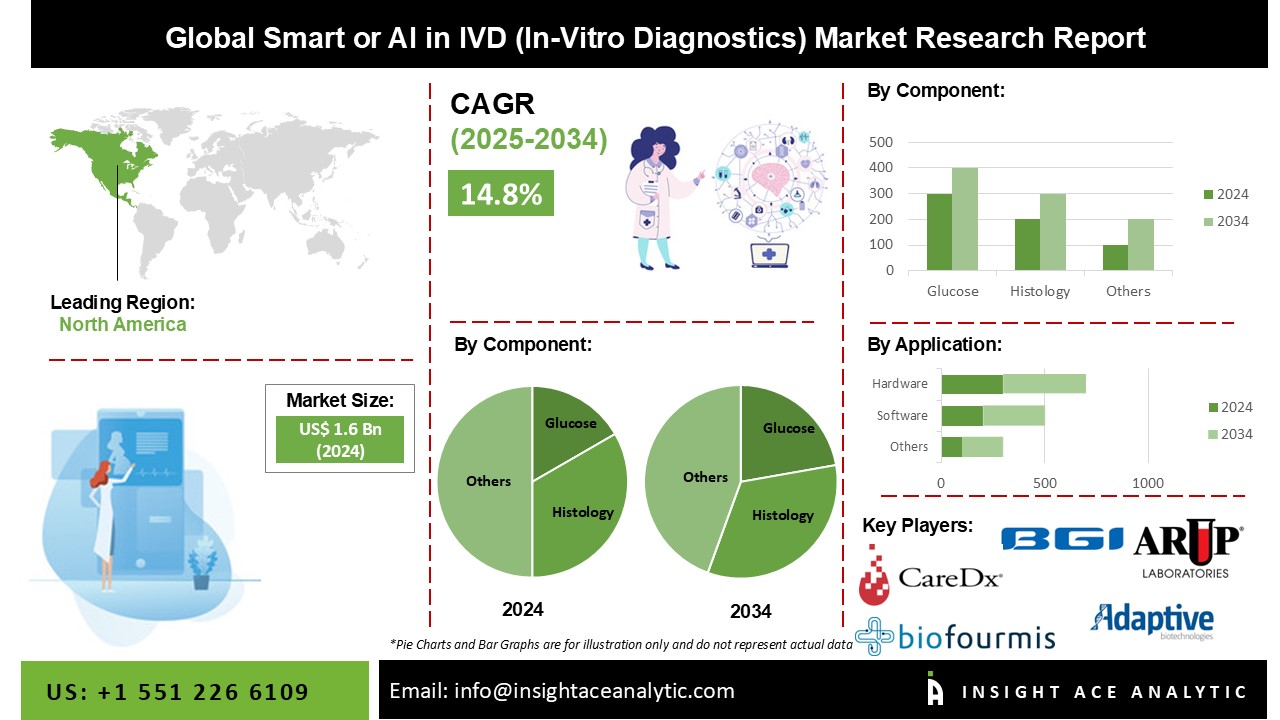
AI in diagnostics helps medical professionals choose the best treatment for their patients. The major factors boosting the AI in-vitro diagnostics market growth are the high prevalence of chronic diseases, rising usage of point-of-care (POC) diagnostics, growing use of individualized healthcare, and companion diagnostics.
Additionally, the market is developing due to the increasing number of IVD (in vitro diagnostics) products being introduced by major companies. Results from IVD products with molecular diagnostic capabilities are precise and effective. In areas like APAC, which is heavily dominated by local firms providing instruments at lower prices, the penetration of IVD goods from established players is minimal. The mobility, accuracy, and cost-effectiveness of technological developments are anticipated to be key factors driving this market.
Competitive Landscape:
The Smart or AI In-Vitro Diagnostics market Players:
- Adaptive Biotechnologies
- Aidoc
- Anumana
- ARUP Laboratories
- Atomwise
- Bayesian Health
- Behold.ai
- BGI Genomics Co. Ltd
- bioMérieux Diagnostics
- Bio-Rad Laboratories, Inc
- Cambridge Cognition
- Cardiologs (Phillips)
- CareDx
- Caris Molecular Diagnostics
- Cleerly
- ClosedLoop AI
- CloudMedX Health
- Deepcell
- Digital Diagnostics
- EKF Diagnostics Holdings
- Freenome
- GE Healthcare
- Glooko
- Idoven
- Illumina
- Infohealth
- Jade
- K Health
- Lunit
- MaxCyte
- Mayo Clinic Laboratories
- Medtronic
- Merative
- Nanox
- NIOX Group
- Niramai Health Analytix
- NVIDIA
- Oncohost
- OraLiva
- Owkin
- Oxford Nanopore Technologies
- Pacific Biosciences
- Paige.AI
- PathAI
- Perthera
- Philips Healthcare
- Prognos
- Qiagen
- Qure.ai
- Renalytix
- Seegene
- Siemens Healthineers
- Sophia Genetics
- Sysmex
- Viz.ai
Market Segmentation:
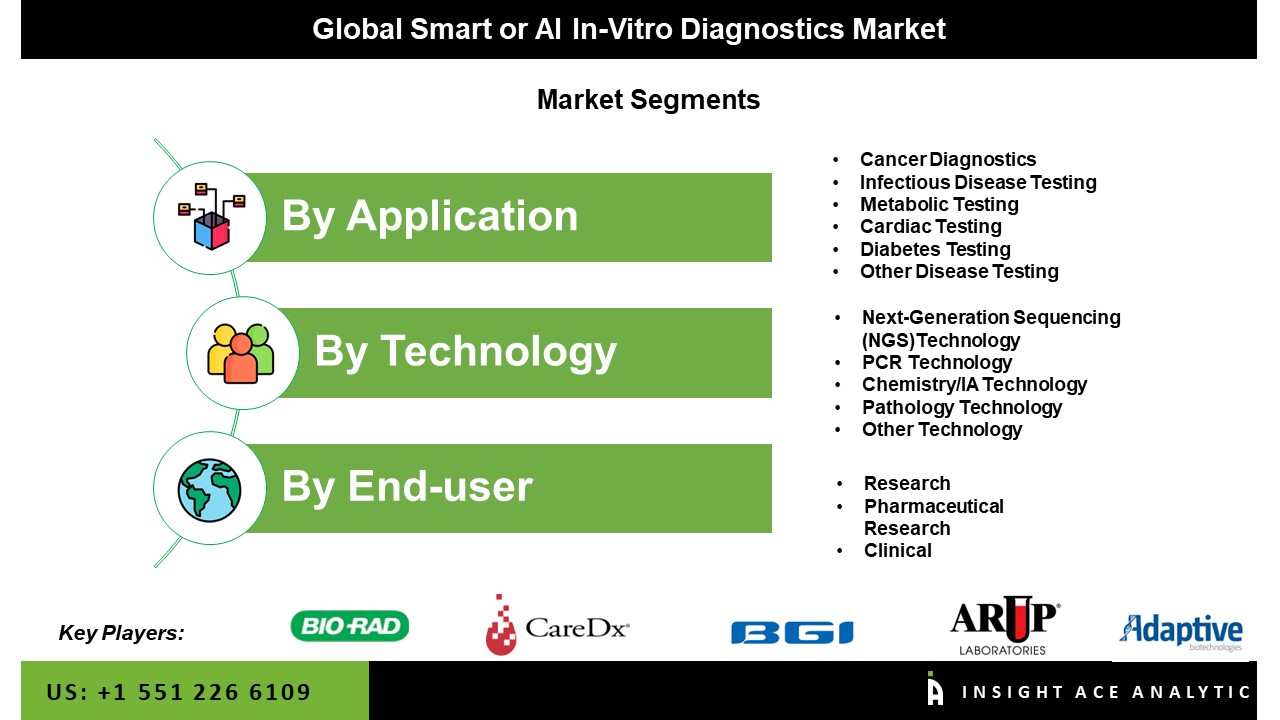
The Smart or AI In-Vitro Diagnostics market is segmented based on application, technology and end-user. Based on application, the market is segmented as Cancer Diagnostics, Infectious Disease Testing, Metabolic Testing, Cardiac Testing, Diabetes Testing, and Other Disease Testing. Technology Segment includes Next-Generation Sequencing (NGS)Technology, PCR Technology, Chemistry/IA Technology, Pathology Technology, and Other Technology. End-user includes Research, Pharmaceutical Research, and Clinical.
Smart or AI In-Vitro Diagnostics Market Insights:
Smart or AI In-Vitro Diagnostics Market expansion is attributable to the increased incidences of chronic diseases, including cancer, diabetes and increased public awareness of the need for early disease diagnosis. The market development is also driven by the automation and digitization of radiology patient workflow, the number of diagnostic imaging treatment procedures performed in hospitals, and the augmented adoption of minimally invasive procedures to improve patient care quality. Also, the spike in testing due to covid-19 pandemic can be ascribed to the growth in IVD use. The market's growth is anticipated to be fueled by the creation of automated IVD systems for labs and hospitals to give a quick, precise, and error-free diagnosis.
The prominent players in the market are focusing on enhancing their product lines and providing clients with a wide range of cutting-edge and creative items. Under the In Vitro Diagnostic Medical Devices Regulation (IVDR) of the European Union (EU), Ibex Medical Analytics' pathology diagnostics platform, Galen Prostate, was awarded the CE mark in February 2023.The new platform was created to aid pathologists in making a preliminary prostate biopsy diagnosis. The platform uses AI to assess samples prior to pathologist review, improving pathology workflows while increasing efficiency and the accuracy of cancer detection.
The North America Smart or AI In-Vitro Diagnostics Market Holds A Significant Revenue Share In The Region
The North America Smart or AI In-Vitro Diagnostics market is expected to register the highest market share in revenue shortly. Throughout the projection period, the region is expected to continue to dominate the market. Several reasons, including the increased prevalence of chronic diseases, the fast-expanding senior population, high healthcare costs, and supportive government financing, drive the industry in this region. Recent product developments and launches by well-known corporations are predicted to lead to a rise in cancer diagnoses among patients. This is anticipated to continue to fuel market revenue growth throughout the forecast. The need for genetic testing to provide more individualized healthcare, such as that for people with diabetes and cancer, is anticipated to fuel market expansion in North America.
In addition, Asia Pacific is projected to grow rapidly in the global Smart or AI In-Vitro Diagnostics market. In vitro diagnostic tests diagnose cancer, cardiovascular problems, and infectious diseases. Various variables, such as stabilized economies, a quickly expanding middle class, pro-business government policies, and fast urbanization are expected to boost the regional market growth.
Smart or AI In-Vitro Diagnostics Market Report Scope:
|
Report Attribute
|
Specifications
|
|
Market Size Value In 2024
|
USD 1.6 Billion
|
|
Revenue Forecast In 2034
|
USD 6.2 Billion
|
|
Growth rate CAGR
|
CAGR of 14.8% from 2025 to 2034
|
|
Quantitative units
|
Representation of revenue in US$ Bn, and CAGR from 2025 to 2034
|
|
Historic Year
|
2021 to 2024
|
|
Forecast Year
|
2025-2034
|
|
Report coverage
|
The forecast of revenue, the position of the company, the competitive market statistics, growth prospects, and trends
|
|
Segments covered
|
Application, Technology And End-User
|
|
Regional scope
|
North America; Europe; Asia Pacific; Latin America; Middle East & Africa
|
|
Country scope
|
U.S.; Canada; U.K.; Germany; China; India; Japan; Brazil; Mexico; The UK; France; Italy; Spain; China; Japan; India; South Korea; Southeast Asia; South Korea; Southeast Asia
|
|
Competitive Landscape
|
Adaptive Biotechnologies, Aidoc, Anumana, ARUP Laboratories, Atomwise, Bayesian Health, Behold.ai, BGI Genomics Co. Ltd, bioMérieux Diagnostics, Bio-Rad Laboratories, Inc, Cambridge Cognition, Cardiologs (Phillips), GE Healthcare, Medtronic and other prominent players.
|
|
Customization scope
|
Free customization report with the procurement of the report, Modifications to the regional and segment scope. Particular Geographic competitive landscape.
|
|
Pricing and available payment methods
|
Explore pricing alternatives that are customized to your particular study requirements.
|
Segmentation of Smart or AI In-Vitro Diagnostics Market-
Smart or AI In-Vitro Diagnostics Market By Application
- Cancer Diagnostics
- Infectious Disease Testing
- Metabolic Testing
- Cardiac Testing
- Diabetes Testing
- Other Disease Testing
Smart or AI In-Vitro Diagnostics Market By Technology
- Next-Generation Sequencing (NGS)Technology
- PCR Technology
- Chemistry/IA Technology
- Pathology Technology
- Other Technology
Smart or AI In-Vitro Diagnostics Market By End-user
- Research
- Pharmaceutical Research
- Clinical
Smart or AI In-Vitro Diagnostics Market By Region-
North America-
Europe-
- Germany
- The UK
- France
- Italy
- Spain
- Rest of Europe
Asia-Pacific-
- China
- Japan
- India
- South Korea
- Southeast Asia
- Rest of Asia Pacific
Latin America-
- Brazil
- Mexico
- Argentina
- Rest of Latin America
Middle East & Africa-
- GCC Countries
- South Africa
- Rest of Middle East and Africa
Application
Cancer Diagnostics
Infectious Disease Testing
Metabolic Testing
Cardiac Testing
Diabetes Testing
Other Disease Testing
Technology
Next-Generation Sequencing (NGS)Technology
PCR Technology
Chemistry/IA Technology
Pathology Technology
Other Technology
End-user
Research
Pharmaceutical Research
Clinical