Selective Serotonin Reuptake Inhibitors Market Size, Share, Trend, Scope Report 2026 to 2035
What is Selective Serotonin Reuptake Inhibitors Market Size?
Selective Serotonin Reuptake Inhibitors Market Size is valued at USD 20.11 Bn in 2025 and is predicted to reach USD 38.62 Bn by the year 2035 at a 7.0% CAGR during the forecast period for 2026 to 2035.
Selective Serotonin Reuptake Inhibitors Market Size, Share & Trends Analysis By Drug Type (Sertraline, Fluoxetine, Escitalopram, Paroxetine, and Others), Indication (Major Depressive Disorder (MDD), Anxiety Disorders, Obsessive Compulsive Disorder (OCD), Post-Traumatic Stress Disorder (PTSD), and Others), Distribution Channel (Hospital Pharmacies, Retail Pharmacies, and Online Pharmacies), and Segment Forecasts, 2026 to 2035
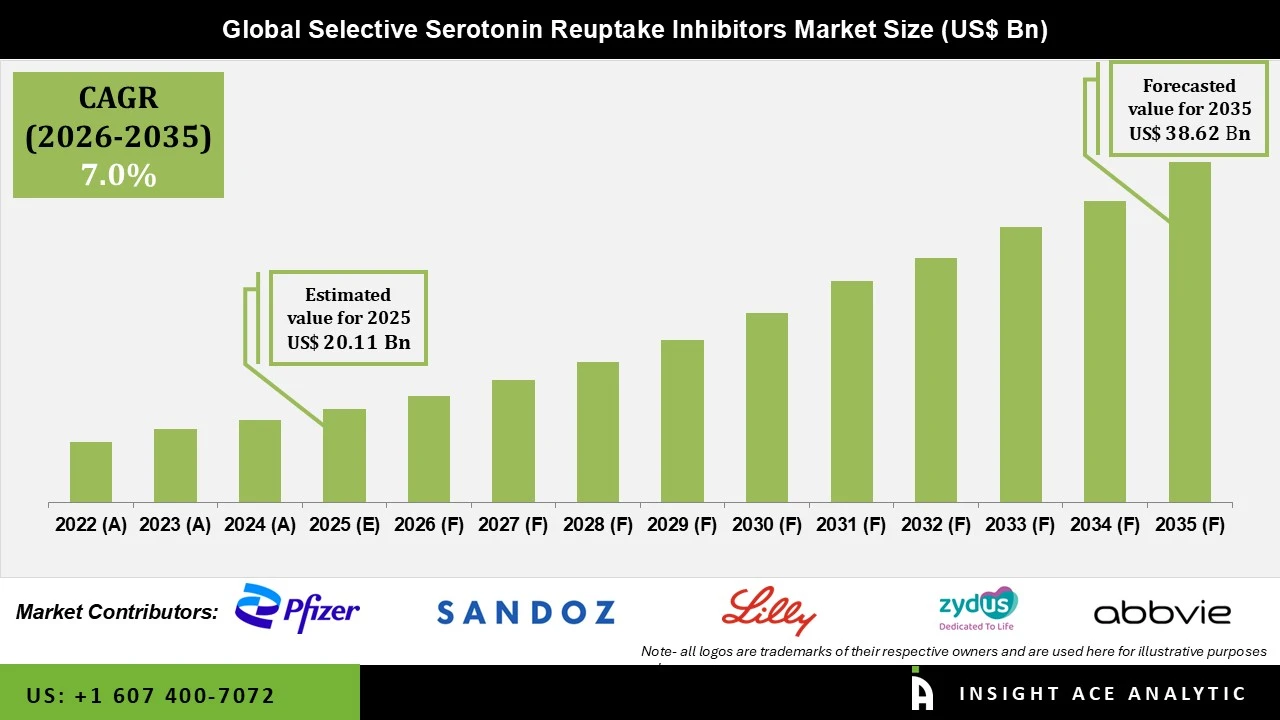
Selective Serotonin Reuptake Inhibitors (SSRIs) are a group of antidepressants used to treat depression and various types of anxiety disorders. This class of drugs is effective in the improvement of mood, emotion stability, and psychological well-being as a result of increased serotonin level in the brain due to the inhibition of serotonin reuptake. SSRIs are prescribed for major depressive disorder, generalized anxiety disorder, OCD (obsessive-compulsive disorder), panic disorder, PTSD (post-traumatic stress disorder), social anxiety disorder, and premenstrual dysphoric disorder (PMDD). Favorable safety profile and fewer adverse reactions than previous antidepressants make them the first choice of treatment in most healthcare systems.
Increasing prevalence of mental health disorders around the world is one of the main reasons why Selective Serotonin Reuptake Inhibitors (SSRIs) market is expanding. People become more aware about depression, anxiety, and stress-induced illnesses and seek help from physicians more actively. Governments, healthcare organizations, and different mental health promotion programs try to popularize early diagnosis and psychiatric treatment that makes the patient base for antidepressants bigger and bigger. Advancements in healthcare system development, growing coverage of insurance services for mental health disorders and increased acceptance of psychiatric drugs boost the market on all economic levels.
Continuous advancements in the pharmaceutical industry, more widespread use of generic SSRIs, and rising investment in neuroscience studies are additional growth drivers for the market. The focus of the pharmaceutical firms lies in ensuring patient compliance by means of different treatment options. Moreover, there has been a significant improvement in terms of access to mental healthcare services due to telepsychiatry and online medical consultations. This is anticipated to offer good chances for the SSRIs market in the forecasted period.
Competitive Landscape
Which are the Leading Players in Selective Serotonin Reuptake Inhibitors Market?
• Pfizer Inc.
• Eli Lilly and Company
• AbbVie Inc.
• H. Lundbeck A/S
• Viatris Inc.
• Teva Pharmaceutical Industries Ltd.
• Sandoz Group AG
• Sun Pharmaceutical Industries Limited
• Dr. Reddy’s Laboratories Ltd.
• Aurobindo Pharma Limited
• Cipla Limited
• Lupin Limited
• Zydus Lifesciences Limited
• Amneal Pharmaceuticals, Inc.
• Torrent Pharmaceuticals Limited
• Apotex Inc.
• Hikma Pharmaceuticals PLC
Market Dynamics
Driver
Increasing Prevalence of Depression and Anxiety Disorders
One of the key factors that are expected to propel the market for selective serotonin reuptake inhibitors (SSRIs) is the increasing number of cases of depression, anxiety disorders, and stress-induced conditions. The development of mental health disorders has emerged as a major public health issue owing to changes in lifestyle, job-related stress, social isolation, and mental repercussions of global pandemics. As a result of the improved understanding of mental health problems, patients have sought professional diagnosis and treatment leading to a greater prescription of SSRIs.
SSRIs continue to be recommended as a primary treatment modality for their clinically proved efficacy, good safety profile, and low chances of adverse effects as compared to other antidepressants like tricyclic antidepressants (TCAs) and monoamine oxidase inhibitors (MAOIs). Moreover, the expansion of the coverage of healthcare, increased availability of mental health experts, and the rise in government initiatives for mental health facilities are some of the key drivers of the market. The rapid uptake of telemedicine services has also played an important role in increased access to SSRIs in developing economies where the number of psychiatric experts is very less.
Restrain/Challenge
Side Effects and Availability of Alternative Therapies
While SSRIs are still viewed as the most favorable choice for a wide range of psychiatric disorders, the market is characterized by certain problems. Certain adverse reactions, such as nausea, insomnia, changes in body weight, headaches, emotional numbness, sexual problems, and withdrawal symptoms upon stopping the medication, can decrease the treatment compliance and make doctors opt for other treatment approaches. Moreover, the rising popularity of the non-medication treatment, which includes such treatment options as CBT, psychotherapy, mindfulness treatments, and online mental health services, can decrease reliance on antidepressant drugs in some patient categories. The patent expiry of branded SSRIs has increased the competition in the market due to the presence of generic drug versions. Moreover, the strict regulation of psychiatric drugs and safety issues of antidepressants are also posing challenges for pharmaceutical companies.
Major Depressive Disorder Segment is Expected to Drive the Selective Serotonin Reuptake Inhibitors (SSRIs) Market
The MDD segment occupied the largest share in the Selective Serotonin Reuptake Inhibitors (SSRIs) market in 2025. Depression is still one of the most prevalent mental health conditions in the world. People of all ages can experience it. SSRIs are still suggested as the first-line drug treatment due to the effectiveness of depressive symptom improvement and good tolerability compared to other types of antidepressants. More frequent awareness campaigns and screening programs along with access to mental healthcare facilities have helped to diagnose and treat the condition earlier and contribute to the development of this segment. Moreover, increased mental healthcare service integration into primary care facilities has expanded the availability of antidepressant treatments. Telemedicine platforms have played an essential role in helping patients to consult their doctors remotely and get their medications.
Escitalopram Segment is Growing at the Highest Rate in the Selective Serotonin Reuptake Inhibitors (SSRIs) Market
Among all kinds of SSRIs, escitalopram is estimated to register the fastest growth in the coming years. Escitalopram is extensively prescribed owing to the efficacy of the drug, good pharmacokinetics, and better safety profile. Doctors have been favoring the use of escitalopram for the treatment of major depressive disorder and generalized anxiety disorder due to minimal drug interaction and compliance issues. Moreover, the increased availability of generics has made the drug affordable, especially in developing countries. Evidence regarding the effectiveness of escitalopram in various anxiety disorders is anticipated to bolster the market share of the drug in the forecasted period.
Why North America Led the Selective Serotonin Reuptake Inhibitors Market?
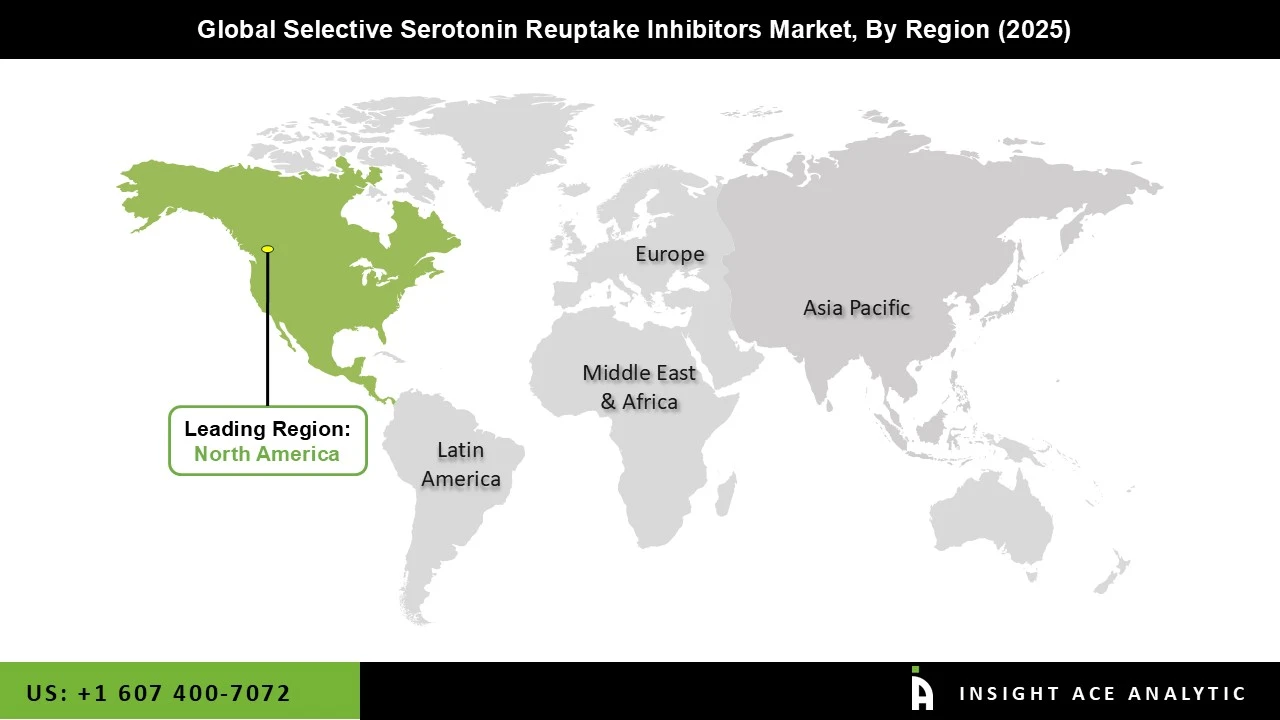
Dominance of North America in the selective serotonin reuptake inhibitors (SSRIs) market is attributed to the well-developed healthcare ecosystem, higher diagnosis rates for mental health diseases, and the availability of prescription antidepressants in the area. The US alone contributes significantly to global antidepressant prescriptions on account of good reimbursement rates, efficient drug manufacturing facilities, and rising mental health awareness among the population. The region is further helped by constant investments in the field of neuroscience research, increasing utilization of telepsychiatry technology, and presence of prominent pharmaceutical organizations involved in the manufacturing of branded and generic SSRIs drugs.
Key Development
• In August 2025, The U.S. FDA approved Almatica Pharma’s escitalopram capsules in a 15 mg strength for the treatment of major depressive disorder in adults younger than 65 years and pediatric patients aged 12 years and older, as well as generalized anxiety disorder in adults younger than 65 years. The approval added a capsule-based dosage option to the escitalopram market.
Selective Serotonin Reuptake Inhibitors Market Report Scope:
| Report Attribute | Specifications |
| Market size value in 2025 | USD 20.11 Bn |
| Revenue forecast in 2035 | USD 38.62 Bn |
| Growth Rate CAGR | CAGR of 7.0% from 2026 to 2035 |
| Quantitative Units | Representation of revenue in US$ Bn and CAGR from 2026 to 2035 |
| Historic Year | 2022 to 2025 |
| Forecast Year | 2026-2035 |
| Report Coverage | The forecast of revenue, the position of the company, the competitive market structure, growth prospects, and trends |
| Segments Covered | Drug Type, Indication, Distribution Channel, and By Region |
| Regional Scope | North America; Europe; Asia Pacific; Latin America; Middle East & Africa |
| Country Scope | U.S.; Canada; U.K.; Germany; China; India; Japan; Brazil; Mexico; The UK; France; Italy; Spain; China; Japan; India; South Korea; Southeast Asia; South Korea; Southeast Asia |
| Competitive Landscape | Pfizer; Eli Lilly and Company; AbbVie; H. Lundbeck; Viatris; Teva Pharmaceutical Industries; Sandoz; Sun Pharmaceutical Industries; Dr. Reddy’s Laboratories; Aurobindo Pharma; Cipla; Lupin; Zydus Lifesciences; Amneal Pharmaceuticals; Torrent Pharmaceuticals; Apotex; Hikma Pharmaceuticals |
| Customization Scope | Free customization report with the procurement of the report, Modifications to the regional and segment scope. Geographic competitive landscape. |
| Pricing and Available Payment Methods | Explore pricing alternatives that are customized to your particular study requirements. |
Market Segmentation:
Selective Serotonin Reuptake Inhibitors Market By Drug Type-
• Sertraline
• Fluoxetine
• Escitalopram
• Paroxetine
• Others
o Citalopram
o Fluvoxamine
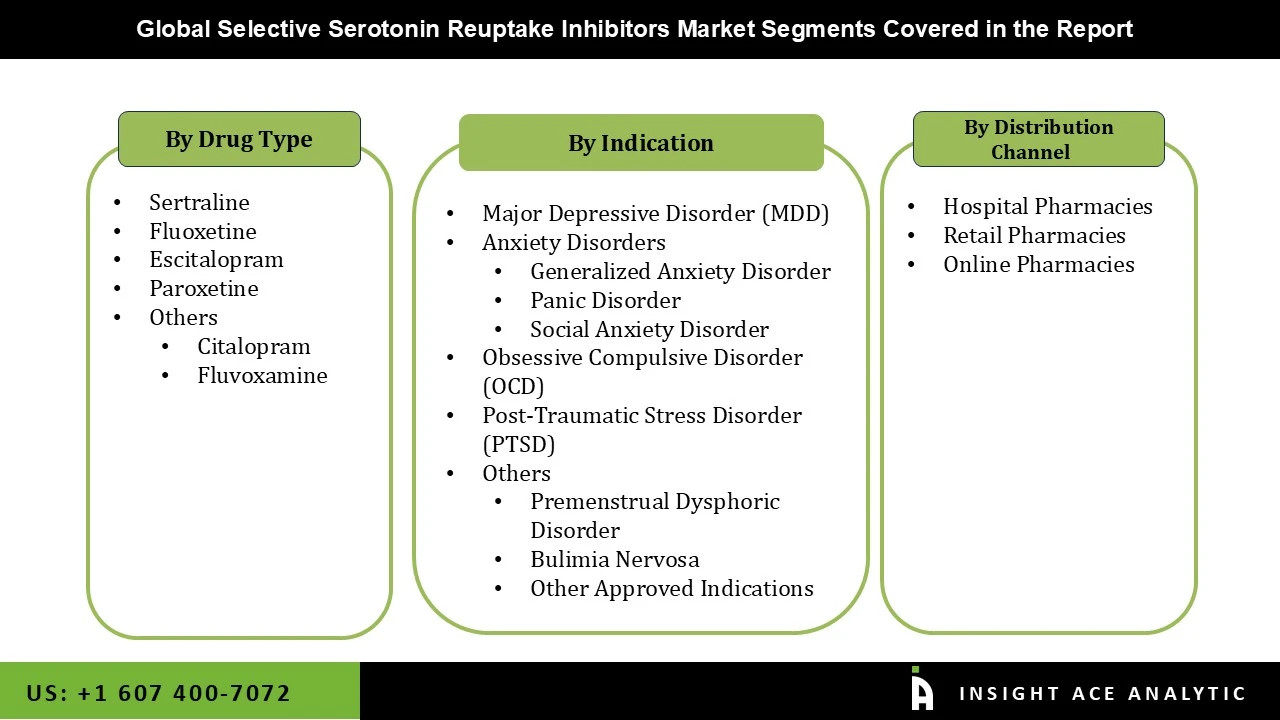
Selective Serotonin Reuptake Inhibitors Market By Indication -
• Major Depressive Disorder (MDD)
• Anxiety Disorders
o Generalized Anxiety Disorder
o Panic Disorder
o Social Anxiety Disorder
• Obsessive Compulsive Disorder (OCD)
• Post-Traumatic Stress Disorder (PTSD)
• Others
o Premenstrual Dysphoric Disorder
o Bulimia Nervosa
o Other Approved Indications
Selective Serotonin Reuptake Inhibitors Market By Distribution Channel -
• Hospital Pharmacies
• Retail Pharmacies
• Online Pharmacies
Selective Serotonin Reuptake Inhibitors Market By Region-
North America-
• The US
• Canada
Europe-
• Germany
• The UK
• France
• Italy
• Spain
• Rest of Europe
Asia-Pacific-
• China
• Japan
• India
• South Korea
• South East Asia
• Rest of Asia Pacific
Latin America-
• Brazil
• Argentina
• Mexico
• Rest of Latin America
Middle East & Africa-
• GCC Countries
• South Africa
• Rest of Middle East and Africa
Research Design and Approach
This study employed a multi-step, mixed-method research approach that integrates:
- Secondary research
- Primary research
- Data triangulation
- Hybrid top-down and bottom-up modelling
- Forecasting and scenario analysis
This approach ensures a balanced and validated understanding of both macro- and micro-level market factors influencing the market.
Secondary Research
Secondary research for this study involved the collection, review, and analysis of publicly available and paid data sources to build the initial fact base, understand historical market behaviour, identify data gaps, and refine the hypotheses for primary research.
Sources Consulted
Secondary data for the market study was gathered from multiple credible sources, including:
- Government databases, regulatory bodies, and public institutions
- International organizations (WHO, OECD, IMF, World Bank, etc.)
- Commercial and paid databases
- Industry associations, trade publications, and technical journals
- Company annual reports, investor presentations, press releases, and SEC filings
- Academic research papers, patents, and scientific literature
- Previous market research publications and syndicated reports
These sources were used to compile historical data, market volumes/prices, industry trends, technological developments, and competitive insights.

Primary Research
Primary research was conducted to validate secondary data, understand real-time market dynamics, capture price points and adoption trends, and verify the assumptions used in the market modelling.
Stakeholders Interviewed
Primary interviews for this study involved:
- Manufacturers and suppliers in the market value chain
- Distributors, channel partners, and integrators
- End-users / customers (e.g., hospitals, labs, enterprises, consumers, etc., depending on the market)
- Industry experts, technology specialists, consultants, and regulatory professionals
- Senior executives (CEOs, CTOs, VPs, Directors) and product managers
Interview Process
Interviews were conducted via:
- Structured and semi-structured questionnaires
- Telephonic and video interactions
- Email correspondences
- Expert consultation sessions
Primary insights were incorporated into demand modelling, pricing analysis, technology evaluation, and market share estimation.
Data Processing, Normalization, and Validation
All collected data were processed and normalized to ensure consistency and comparability across regions and time frames.
The data validation process included:
- Standardization of units (currency conversions, volume units, inflation adjustments)
- Cross-verification of data points across multiple secondary sources
- Normalization of inconsistent datasets
- Identification and resolution of data gaps
- Outlier detection and removal through algorithmic and manual checks
- Plausibility and coherence checks across segments and geographies
This ensured that the dataset used for modelling was clean, robust, and reliable.
Market Size Estimation and Data Triangulation
Bottom-Up Approach
The bottom-up approach involved aggregating segment-level data, such as:
- Company revenues
- Product-level sales
- Installed base/usage volumes
- Adoption and penetration rates
- Pricing analysis
This method was primarily used when detailed micro-level market data were available.

Top-Down Approach
The top-down approach used macro-level indicators:
- Parent market benchmarks
- Global/regional industry trends
- Economic indicators (GDP, demographics, spending patterns)
- Penetration and usage ratios
This approach was used for segments where granular data were limited or inconsistent.
Hybrid Triangulation Approach
To ensure accuracy, a triangulated hybrid model was used. This included:
- Reconciling top-down and bottom-up estimates
- Cross-checking revenues, volumes, and pricing assumptions
- Incorporating expert insights to validate segment splits and adoption rates
This multi-angle validation yielded the final market size.
Forecasting Framework and Scenario Modelling
Market forecasts were developed using a combination of time-series modelling, adoption curve analysis, and driver-based forecasting tools.
Forecasting Methods
- Time-series modelling
- S-curve and diffusion models (for emerging technologies)
- Driver-based forecasting (GDP, disposable income, adoption rates, regulatory changes)
- Price elasticity models
- Market maturity and lifecycle-based projections
Scenario Analysis
Given inherent uncertainties, three scenarios were constructed:
- Base-Case Scenario: Expected trajectory under current conditions
- Optimistic Scenario: High adoption, favourable regulation, strong economic tailwinds
- Conservative Scenario: Slow adoption, regulatory delays, economic constraints
Sensitivity testing was conducted on key variables, including pricing, demand elasticity, and regional adoption.
Request Customization
Add countries, segments, company profiles, or extend forecast — free 10% customization with purchase.
Customize This Report →Enquire Before Buying
Speak with our analyst team about scope, methodology, pricing, or deliverable formats.
Enquire Now →Frequently Asked Questions
Selective Serotonin Reuptake Inhibitors Market Size is valued at USD 20.11 Bn in 2025 and is predicted to reach USD 38.62 Bn by the year 2035
Selective Serotonin Reuptake Inhibitors Market is expected to grow at a 7.0% CAGR during the forecast period for 2026 to 2035.
Pfizer; Eli Lilly and Company; AbbVie; H. Lundbeck; Viatris; Teva Pharmaceutical Industries; Sandoz; Sun Pharmaceutical Industries; Dr. Reddy’s Laboratories; Aurobindo Pharma; Cipla; Lupin; Zydus Lifesciences; Amneal Pharmaceuticals; Torrent Pharmaceuticals; Apotex; Hikma Pharmaceuticals
Selective Serotonin Reuptake Inhibitors Market is segmented into Drug Type, Indication, Distribution Channel, and By Region
North America region is leading the Selective Serotonin Reuptake Inhibitors Market.