Sample Preparation Market Size, Scope, Revenue Report 2026 to 2035
What is Sample Preparation Market Size?
Global Sample Preparation Market Size is valued at USD 7.27 billion in 2025 and is predicted to reach USD 14.61 billion by the year 2035 at a 7.4% CAGR during the forecast period for 2026 to 2035.
Sample Preparation Market Size, Share & Trends Analysis Report By Product (Instruments, Consumable), By Technique (Protein Preparation, Solid-Phase Extraction & Liquid-Liquid Extraction), By Application (Genomics, Proteomics, Epigenomics), End-User (Hospitals, Diagnostic Centers, Pharmaceutical & Biotechnology Industry), & Segment Forecasts, 2026 to 2035.
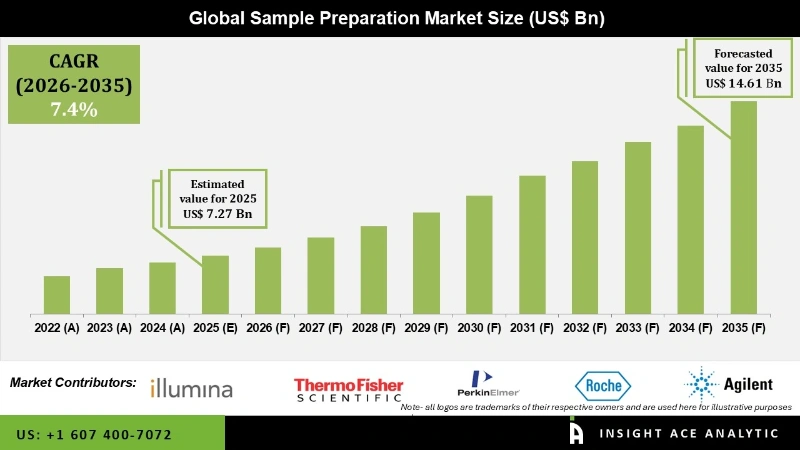
Sample Preparation Market Key Takeaways:
|
Key Industry Insights & Findings from the Report:
- The sample preparation market in emerging nations is growing due to increased investment in healthcare facilities and research capacities.
- Continuous improvement in sample preparation, as well as the incorporation of new technology, such as automated systems, will propel the sample preparation industry forward.
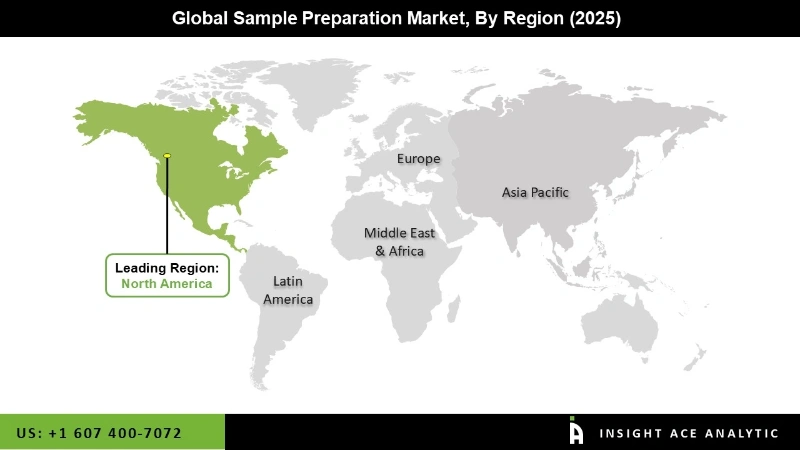
- North America dominated the market and accounted for a revenue share of global revenue in 2023.
- One of the significant concerns restraining industry growth is the absence of globally agreed standard techniques for sample preparation, which can result in diversity in results between laboratories.
The process of extracting analytes from sample matrices into the final analyte solution is known as sample preparation. Drawing, handling, and preparing samples following the standards of contemporary microbiology are all part of the process. It consists of biological and chemical samples for analyzing raw materials to find undesired components in different chemical compounds.
It offers greater separation in chromatography, higher throughput, easier automation, increased sensitivity, and detection of certain functional groups. The sample preparation technique is therefore widely applied across numerous industry sectors. In the coming years, it is projected that more money will be spent on pharmaceutical-related research and development, fueling the industry's expansion. The major companies in the market are concentrating on the development of new products and obtaining regulatory approval. With the ultimate objective of purifying and isolating the analyte from complicated matrixes, improvements in the sample preparation procedure are significant for pharmaceutical research and analysis.
Additionally, the market is anticipated to advance due to the industry's rapid growth and the opening up of numerous opportunities in the biotechnology sector. However, the market may be constrained by elements including the high cost of workstations, challenges in creating established protocols for sample preparation, lack of experience in producing technologically complex products, and less informed consumers.
Recent Developments:
- In June 2020, to effectively link two cutting-edge technologies—single-cell transcriptomics and pooled CRISPR screening—and to give researchers more precise data to understand better the connection between particular genes and diseases, 10x Genomics, Inc. and Merck collaborated.
- In February 2019, NGS library preparation technologies were introduced by Agilent Technologies and were made to handle difficult DNA sequencing tests.
Competitive Landscape
Some of the sample preparation market players are:
- Agilent Technologies Inc.
- Bio-Rad Laboratories, Inc.
- Danaher Corporation
- Hamilton Company
- Illumina Inc.
- Merck KGaA
- Norgen Biotek Corporation
- Perkinelmer, Inc.
- Promega Corporation
- Qiagen N.V.
- Roche Applied Science
- Sigma-Aldrich Corporation
- Tecan Group Ltd.
- Thermo Fisher Scientific Inc.
Market Segmentation:
The sample preparation market is segmented on the product, technique, application, and end-user. On the basis of product, the market is segregated into instruments (extraction system, workstation, automated evaporation system, liquid handling instrument (liquid handling workstations, pipetting systems, reagents dispensers, microplate washer, other liquid handling systems)), consumables and kits (purification kit, isolation kit, extraction kit). Based on technique, the market is segregated into protein preparation, solid-phase extraction and liquid-liquid extraction. Based on application, the sample preparation market is segmented into genomics, proteomics, epigenomics, transcriptomics, and metabolomics. Based on end-user, the market is segregated into hospitals, diagnostic centers, the pharmaceutical and biotechnology industry and others.
Based On Technique, The Protein Preparation Segment Is Accounted As A Major Contributor To The Sample Preparation Market
The protein preparation category witnessed the highest revenue share, and it is anticipated that they will further continue to maintain that position during the anticipated time. The total market is projected to grow rapidly due to the proteomics field's ongoing innovation. Because contaminants are removed during the extraction procedure from the sample, the repeatability of the data is decreased, which might lead to the loss of proteins. By creating a novel strategy, Babraham Institute researchers upgraded the traditional proteomics sample preparation techniques in July 2022. The method increases the inclusion of challenging biological proteins to collect, increasing the readouts of proteomics.
The Genomics Segment Witnessed Growth At A Rapid Rate
The genomics category is anticipated to grow at a significant rate over the forecast period. The total growth rate is anticipated to increase as companies take more strategic actions in the market for genomics applications. For instance, Bionano Genomics, Inc. and Hamilton stated in October 2022 that they were working together to develop a solution to extract and isolate Ultra High Molecular Weight DNA as the first step in the sample preparation procedure. In optical genome mapping, long string vantage points are used. The development of tailored medicine through genomics research is one of the main drivers of this application.
North America Sample Preparation Market Hold A Significant Revenue Share In The Region
North America sample preparation market is expected to register the highest market share in revenue in the near future. The region's established providers and buyers of sample preparation solutions play a key role in accounting for the greatest market share. As a result, this expedites delivery from supplier to the customer at a low cost. Additionally, expanding access to and availability of capital through public and private investors aids new businesses in entering the market. In addition, the Asia Pacific is projected to grow rapidly in the global sample preparation market. This is a result of sequencing being used more frequently in China and India for various purposes, including the creation of individualized medications. Additionally, it is projected that the market will have considerable development potential during the projection period due to the Asia Pacific region's growing interest in genomics and proteomics research.
Sample Preparation Market Report Scope:
| Report Attribute | Specifications |
| Market size value in 2025 | USD 7.27 Bn |
| Revenue forecast in 2035 | USD 14.61 Bn |
| Growth rate CAGR | CAGR of 7.4% from 2026 to 2035 |
| Quantitative units | Representation of revenue in US$ Billion, and CAGR from 2026 to 2035 |
| Historic Year | 2022 to 2025 |
| Forecast Year | 2026-2035 |
| Report coverage | The forecast of revenue, the position of the company, the competitive market statistics, growth prospects, and trends |
| Segments covered | Product, Technique, Application, And End-User |
| Regional scope | North America; Europe; Asia Pacific; Latin America; Middle East & Africa |
| Country scope | U.S.; Canada; U.K.; Germany; China; India; Japan; Brazil; Mexico; The UK; France; Italy; Spain; South Korea; Southeast Asia |
| Competitive Landscape | Merck KgaA, Thermo Fisher Scientific Inc., Bio-RAD Laboratories Inc., Tecan Group Ltd., Agilent Technologies Inc., Hamilton Company, Promega Corporation, Illumina Inc., Roche Applied Science, Danaher Corporation and Qiagen N.V. |
| Customization scope | Free customization report with the procurement of the report, Modifications to the regional and segment scope. Particular Geographic competitive landscape. |
| Pricing and available payment methods | Explore pricing alternatives that are customized to your particular study requirements. |
Segmentation of Sample Preparation Market :
Sample Preparation Market By Product -
- Instruments
- Extraction System
- Workstation
- Automated Evaporation System
- Liquid Handling Instrument
- Liquid handling workstations
- Pipetting systems
- Reagents dispensers
- Microplate washer
- Other liquid handling systems
- Consumable
- Kits
- Purification Kit
- Isolation Kit
- Extraction Kit
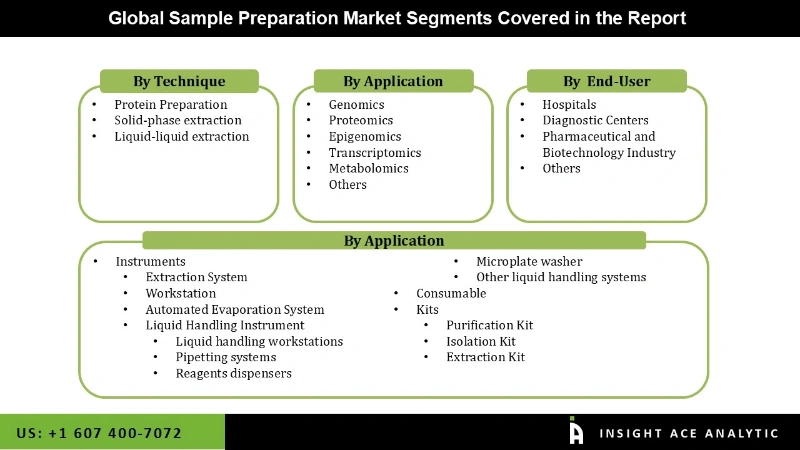
Sample Preparation Market By Technique-
- Protein Preparation
- Solid-phase extraction
- Liquid-liquid extraction
Sample Preparation Market By Application-
- Genomics
- Proteomics
- Epigenomics
- Transcriptomics
- Metabolomics
- Others
Sample Preparation Market By End User-
- Hospitals
- Diagnostic Centers
- Pharmaceutical and Biotechnology Industry
- Others
Sample Preparation Market By Region-
- North America-
- US
- Canada
- Europe-
- Germany
- The UK
- France
- Italy
- Spain
- Rest of Europe
- Asia-Pacific-
- China
- Japan
- India
- South Korea
- Southeast Asia
- Rest of Asia Pacific
- Latin America-
- Mexico
- Brazil
- Argentina
- Rest of Latin America
- Middle East & Africa-
- GCC Countries
- South Africa
- Rest of the Middle East and Africa
Research Design and Approach
This study employed a multi-step, mixed-method research approach that integrates:
- Secondary research
- Primary research
- Data triangulation
- Hybrid top-down and bottom-up modelling
- Forecasting and scenario analysis
This approach ensures a balanced and validated understanding of both macro- and micro-level market factors influencing the market.
Secondary Research
Secondary research for this study involved the collection, review, and analysis of publicly available and paid data sources to build the initial fact base, understand historical market behaviour, identify data gaps, and refine the hypotheses for primary research.
Sources Consulted
Secondary data for the market study was gathered from multiple credible sources, including:
- Government databases, regulatory bodies, and public institutions
- International organizations (WHO, OECD, IMF, World Bank, etc.)
- Commercial and paid databases
- Industry associations, trade publications, and technical journals
- Company annual reports, investor presentations, press releases, and SEC filings
- Academic research papers, patents, and scientific literature
- Previous market research publications and syndicated reports
These sources were used to compile historical data, market volumes/prices, industry trends, technological developments, and competitive insights.

Primary Research
Primary research was conducted to validate secondary data, understand real-time market dynamics, capture price points and adoption trends, and verify the assumptions used in the market modelling.
Stakeholders Interviewed
Primary interviews for this study involved:
- Manufacturers and suppliers in the market value chain
- Distributors, channel partners, and integrators
- End-users / customers (e.g., hospitals, labs, enterprises, consumers, etc., depending on the market)
- Industry experts, technology specialists, consultants, and regulatory professionals
- Senior executives (CEOs, CTOs, VPs, Directors) and product managers
Interview Process
Interviews were conducted via:
- Structured and semi-structured questionnaires
- Telephonic and video interactions
- Email correspondences
- Expert consultation sessions
Primary insights were incorporated into demand modelling, pricing analysis, technology evaluation, and market share estimation.
Data Processing, Normalization, and Validation
All collected data were processed and normalized to ensure consistency and comparability across regions and time frames.
The data validation process included:
- Standardization of units (currency conversions, volume units, inflation adjustments)
- Cross-verification of data points across multiple secondary sources
- Normalization of inconsistent datasets
- Identification and resolution of data gaps
- Outlier detection and removal through algorithmic and manual checks
- Plausibility and coherence checks across segments and geographies
This ensured that the dataset used for modelling was clean, robust, and reliable.
Market Size Estimation and Data Triangulation
Bottom-Up Approach
The bottom-up approach involved aggregating segment-level data, such as:
- Company revenues
- Product-level sales
- Installed base/usage volumes
- Adoption and penetration rates
- Pricing analysis
This method was primarily used when detailed micro-level market data were available.

Top-Down Approach
The top-down approach used macro-level indicators:
- Parent market benchmarks
- Global/regional industry trends
- Economic indicators (GDP, demographics, spending patterns)
- Penetration and usage ratios
This approach was used for segments where granular data were limited or inconsistent.
Hybrid Triangulation Approach
To ensure accuracy, a triangulated hybrid model was used. This included:
- Reconciling top-down and bottom-up estimates
- Cross-checking revenues, volumes, and pricing assumptions
- Incorporating expert insights to validate segment splits and adoption rates
This multi-angle validation yielded the final market size.
Forecasting Framework and Scenario Modelling
Market forecasts were developed using a combination of time-series modelling, adoption curve analysis, and driver-based forecasting tools.
Forecasting Methods
- Time-series modelling
- S-curve and diffusion models (for emerging technologies)
- Driver-based forecasting (GDP, disposable income, adoption rates, regulatory changes)
- Price elasticity models
- Market maturity and lifecycle-based projections
Scenario Analysis
Given inherent uncertainties, three scenarios were constructed:
- Base-Case Scenario: Expected trajectory under current conditions
- Optimistic Scenario: High adoption, favourable regulation, strong economic tailwinds
- Conservative Scenario: Slow adoption, regulatory delays, economic constraints
Sensitivity testing was conducted on key variables, including pricing, demand elasticity, and regional adoption.
Request Customization
Add countries, segments, company profiles, or extend forecast — free 10% customization with purchase.
Customize This Report →Enquire Before Buying
Speak with our analyst team about scope, methodology, pricing, or deliverable formats.
Enquire Now →Frequently Asked Questions
Sample Preparation Market Size is valued at USD 7.27 billion in 2025 and is predicted to reach USD 14.61 billion by the year 2035.
Sample Preparation Market expected to grow at a 7.4% CAGR during the forecast period for 2026-2035.
Merck KgaA, Thermo Fisher Scientific Inc., Bio-RAD Laboratories Inc., Tecan Group Ltd., Agilent Technologies Inc., Hamilton Company, Promega Corporati
Sample preparation market is segmented on the product, technique, application, and end-user. On the basis of product, the market is segregated into instruments (extraction system, workstation, automated evaporation system, liquid handling instrument (liquid handling workstations, pipetting systems, reagents dispensers, microplate washer, other liquid handling systems)), consumables and kits (purification kit, isolation kit, extraction kit).
North America region is leading the Sample preparation market.