Regenerative Agriculture Market Current Trends Analysis 2025 to 2034
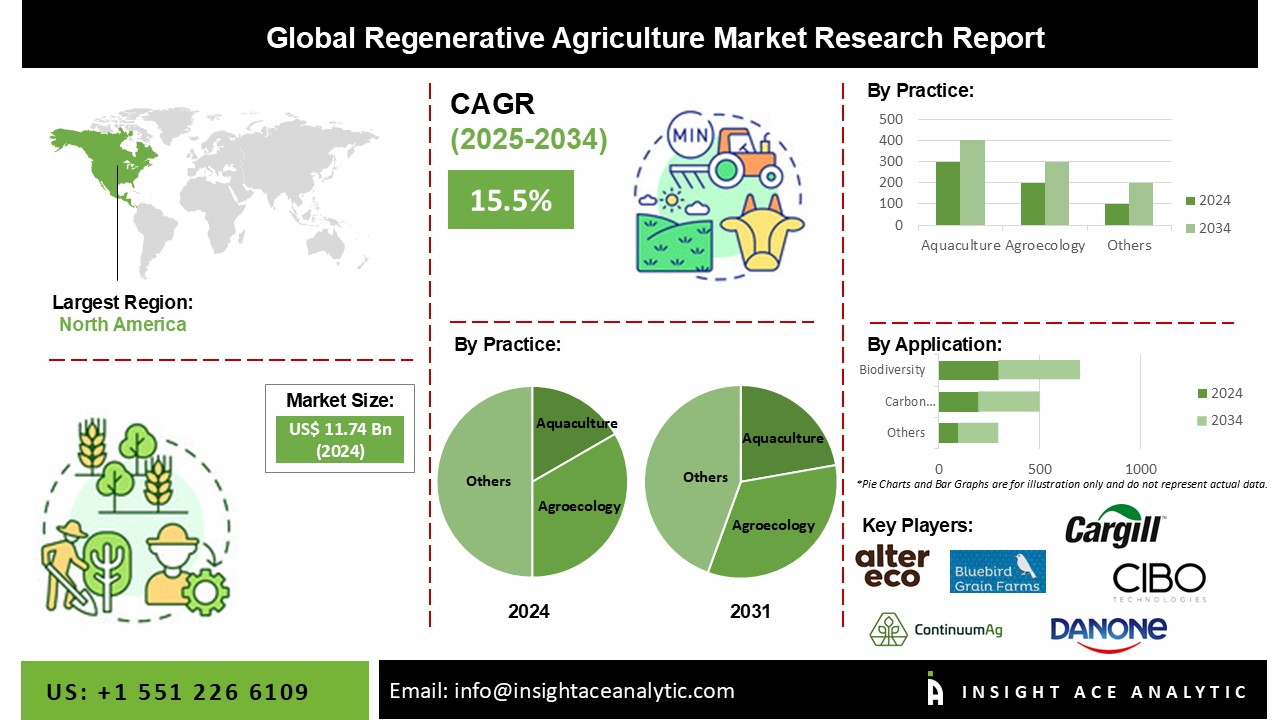
Global Regenerative Agriculture Market Size is valued at USD 11.74 billion in 2024 and is predicted to reach USD 49.07 billion by the year 2034 at a 15.5% CAGR during the forecast period for 2025 to 2034.
Regenerative Agriculture Market Size, Share & Trends Analysis Report By Practice (Aquaculture, Holistic Planned Grazing, Agroforestry, Pasture Cropping, Agroecology, Silvopasture) And Application (Carbon Sequestration, Nutrient Cycling And Biodiversity), By Region, And Segment Forecasts, 2025 to 2034
Key Industry Insights & Findings from the Report:
- Companies are adopting various strategies to penetrate this region, influenced by factors such as elevated disposable income, a growing population, and a significant reliance on agriculture.
- The increasing number of investments and funds from government authorities is also playing a role in creating revenue growth opportunities for the market.
- In terms of practice, the agroforestry segment dominates the market with the highest share.
- North America dominated the market and accounted for a revenue share of global revenue in 2024.
Regenerative agriculture concentrates on optimizing the water cycle, repairing topsoil, expanding variety, elevating nutrient value, and bolstering the vitality and health of agricultural soil. It is a rehabilitation and conservational approach to food and farming systems. It is a comprehensive method of farming that focuses on repairing soils damaged by excessive and repeated use of chemical pesticides and fertilizers.
Furthermore, the desire for elevated foods and food products, the growing need to reduce carbon emissions, improve soil health and water cycles, and the fast-growing worldwide population contribute to regenerative agriculture's revenue growth market. Additional elements like the rising use of cutting-edge farming methods and increased global policy measures to support regenerative farming are anticipated to fuel regenerative agriculture market expansion.
Additionally, increasing disposable income in developing nations and a strong focus on creating cutting-edge, affordable devices and tools are fostering future market revenue growth. Many obstacles, including a need for more knowledge about the advantages of regeneration farming, the need for expensive initial expenditures and maintenance costs, and complicated certification procedures, may hinder the worldwide regenerative agriculture market's ability to grow in terms of revenue.
Recent Developments:
- In July 2023, PepsiCo collaborated with Walmart to pursue investments of $120 million to support U.S. and Canadian farmers to improve soil health and water quality through regenerative agriculture. This effort is a new model for PepsiCo, marking the company’s first large-scale strategic collaboration focused on sustainable agriculture with a retail partner.
- In July 2023, Nestlé started a project to assist wheat farms in implementing regenerative agriculture practices as a part of the supply chain for its DiGiorno pizza brand. This will help increase biodiversity, use less water, energy, and fertilizer, improve soil health and fertility, and mitigate the effects of climate change.
- In September 2022, Agreed Earth received an investment from specialist venture capital firm Regenerate Ventures to promote regenerative farming and reduce nitrogen use.
- In June 2022, General Mills collaborated with Regrow Agriculture to monitor agricultural practices and their environmental impacts across 175 million acres of farmland in North America, Latin America, and Europe.
Competitive Landscape:
Some of the Regenerative Agriculture market players are:
- Agreena Aps
- Alter Eco Americas, Inc
- Amiha
- Aranya
- Bluebird Grain Farms
- Cargill Incorporated
- Cibo Technologies
- Continuum Ag
- Danone S.A.
- Eco Farm
- General Mills, Inc.
- Grounded South Africa
- Indigo Ag, Inc.
- La Delia Verde
- Loam Bio Pty Ltd.
- Nestlé S.A
- New Life Tree Syrups
- Pivot Bio
- Regeneration Canada
- Renature
- Roots Of Nature
- Soil Capital Belgium Sprl
- Unilever Plc
- White Oak Pastures
Market Segmentation:
The regenerative agriculture market is segmented based on practice and application. Based on practice, the market is segmented as aquaculture, holistic planned grazing, agroforestry, pasture cropping, agroecology, Silvopasture, and others. By application, the market is segmented into carbon sequestration, nutrient cycling and biodiversity.
Based On Application, The Carbon Sequestration Segment Is A Significant Contributor To The Regenerative Agriculture Market
The carbon sequestration category will hold a significant share of the global market for regenerative agriculture due to the increasing demand for carbon sequestration to slow down environmental issues and the widespread use of no-till agriculture, intercropping, animal rotation, and decomposition techniques. Carbon sequestration is utilized to remove and store atmospheric carbon dioxide to slow climate change, repair damaged soils, and boost agriculture production.
It is projected that rising concerns about substantial climate disruption and the growing usage of no-till agriculture, crop rotation, animal rotations, and recycling techniques will aid segment growth over the forecast period. These methods efficiently integrate with the philosophy of sustainable farming to produce healthy soil, wholesome food, fresh water, and clean air using affordable, locally sourced resources. This approach, which is long-term and comprehensive, enhances soil quality by supplying nutrients and
The Silvestre Segment Witnessed Growth At A Rapid Rate
The Silvestre segment is projected to grow at a rapid rate in the global regenerative agriculture market due to reasons like the growing emphasis on bioremediation and reducing the impacts of climate change. The simultaneous nibbling of animals, forage and forests is known as Silvestre. It is done to preserve the soil, reduce carbon dioxide emissions, and improve water quality., particularly in countries such as the US, the UK, Germany, China, and India.
The North America Regenerative Agriculture Market Holds A Significant Regional Revenue Share
The North America market is expected to register the highest market share in revenue soon. Due to escalating worries about soil loss in the area, quick progress in agricultural methods, growing consumer demand for premium food, and accessibility to cutting-edge farming equipment. Additionally, the existence of major market players, growing awareness of renewable farming, increasing investments in the creation of advanced products, and increasing need for restocking the atmosphere is anticipated to propel revenue growth in the North American market during the forecast period.
In addition, the Asia Pacific is anticipated to grow rapidly in the global market. This can be ascribed to the quickly expanding farming industry, rising demand for cutting-edge agricultural tools and techniques, population increase, and continuously rising need and demand for food. Future revenue growth in the Asia Pacific market is anticipated to be fueled by aspects like more attention being paid to enhancing soil health, government initiatives to support regenerative agriculture, and pilot projects for regenerative agriculture.
Regenerative Agriculture Market Report Scope:
| Report Attribute | Specifications |
| Market size value in 2024 | USD 11.74 Bn |
| Revenue forecast in 2034 | USD 49.07 Bn |
| Growth rate CAGR | CAGR of 15.5% from 2025 to 2034 |
| Quantitative units | Representation of revenue in US$ Billion, and CAGR from 2025 to 2034 |
| Historic Year | 2021 to 2024 |
| Forecast Year | 2025-2034 |
| Report coverage | The forecast of revenue, the position of the company, the competitive market statistics, growth prospects, and trends |
| Segments covered | Practice And Application |
| Regional scope | North America; Europe; Asia Pacific; Latin America; Middle East & Africa |
| Country scope | U.S.; Canada; U.K.; Germany; China; India; Japan; Brazil; Mexico; France; Italy; Spain; Japan; South Korea; Southeast Asia |
| Competitive Landscape | Alter Eco Americas, Inc., Bluebird Grain Farms, Cargill, Inc., CIBO Technologies, Continuum Ag, Danone SA, Eco Farm, General Mills, Inc, Grounded South Africa, Nestlé S.A., New Life Tree Syrups, Regena, Regeneration Canada, Soil Capital Ltd., and White Oak Pastures. |
| Customization scope | Free customization report with the procurement of the report, Modifications to the regional and segment scope. Particular Geographic competitive landscape. |
| Pricing and available payment methods | Explore pricing alternatives that are customized to your particular study requirements. |
Segmentation of Regenerative Agriculture Market-
Regenerative Agriculture Market By Practice-
- Aquaculture
- Holistic Planned Grazing
- Agroecology
- Agroforestry
- Biochar
- Pasture Cropping
- Silvopasture
- Others
.webp "Regenerative Agriculture Market")
Regenerative Agriculture Market By Application-
- Soil and crop management
- Nitrogen fixation
- Water retention
- Nutrient cycle
- Operations management
- Carbon sequestration
- Ecosystem services
- Biodiversity
- Other applications
Regenerative Agriculture Market By Crop Type-
- Cereals & Grains
- Oilseeds & Pulses
- Fruits & Vegetables
- Cash Crops (coffee, cocoa, cotton, sugarcane, etc.)
- Forage & Grasslands
Regenerative Agriculture Market By End-User / Application-
- Food & Beverage Companies (CPG, sustainable sourcing)
- Farmers / Growers / Producer Cooperatives
- Livestock & Dairy Producers
- Retail & Supermarket Chains (sustainable procurement)
- Governments & NGOs (subsidy, program adoption)
- Carbon Credit & Sustainability Platforms
Regenerative Agriculture Market By Certification / Standard-
- Organic Certified
- Regenerative Organic Certification (ROC)
- Fairtrade & Other Sustainable Labels
- Voluntary Carbon Standards (Verra, Gold Standard, etc.)
Regenerative Agriculture Market By Region-
North America-
- The US
- Canada
- Mexico
Europe-
- Germany
- The UK
- France
- Italy
- Spain
- Rest of Europe
Asia-Pacific-
- China
- Japan
- India
- South Korea
- Southeast Asia
- Rest of Asia Pacific
Latin America-
- Brazil
- Argentina
- Rest of Latin America
Middle East & Africa-
- GCC Countries
- South Africa
- Rest of Middle East and Africa
Research Design and Approach
This study employed a multi-step, mixed-method research approach that integrates:
- Secondary research
- Primary research
- Data triangulation
- Hybrid top-down and bottom-up modelling
- Forecasting and scenario analysis
This approach ensures a balanced and validated understanding of both macro- and micro-level market factors influencing the market.
Secondary Research
Secondary research for this study involved the collection, review, and analysis of publicly available and paid data sources to build the initial fact base, understand historical market behaviour, identify data gaps, and refine the hypotheses for primary research.
Sources Consulted
Secondary data for the market study was gathered from multiple credible sources, including:
- Government databases, regulatory bodies, and public institutions
- International organizations (WHO, OECD, IMF, World Bank, etc.)
- Commercial and paid databases
- Industry associations, trade publications, and technical journals
- Company annual reports, investor presentations, press releases, and SEC filings
- Academic research papers, patents, and scientific literature
- Previous market research publications and syndicated reports
These sources were used to compile historical data, market volumes/prices, industry trends, technological developments, and competitive insights.

Primary Research
Primary research was conducted to validate secondary data, understand real-time market dynamics, capture price points and adoption trends, and verify the assumptions used in the market modelling.
Stakeholders Interviewed
Primary interviews for this study involved:
- Manufacturers and suppliers in the market value chain
- Distributors, channel partners, and integrators
- End-users / customers (e.g., hospitals, labs, enterprises, consumers, etc., depending on the market)
- Industry experts, technology specialists, consultants, and regulatory professionals
- Senior executives (CEOs, CTOs, VPs, Directors) and product managers
Interview Process
Interviews were conducted via:
- Structured and semi-structured questionnaires
- Telephonic and video interactions
- Email correspondences
- Expert consultation sessions
Primary insights were incorporated into demand modelling, pricing analysis, technology evaluation, and market share estimation.
Data Processing, Normalization, and Validation
All collected data were processed and normalized to ensure consistency and comparability across regions and time frames.
The data validation process included:
- Standardization of units (currency conversions, volume units, inflation adjustments)
- Cross-verification of data points across multiple secondary sources
- Normalization of inconsistent datasets
- Identification and resolution of data gaps
- Outlier detection and removal through algorithmic and manual checks
- Plausibility and coherence checks across segments and geographies
This ensured that the dataset used for modelling was clean, robust, and reliable.
Market Size Estimation and Data Triangulation
Bottom-Up Approach
The bottom-up approach involved aggregating segment-level data, such as:
- Company revenues
- Product-level sales
- Installed base/usage volumes
- Adoption and penetration rates
- Pricing analysis
This method was primarily used when detailed micro-level market data were available.

Top-Down Approach
The top-down approach used macro-level indicators:
- Parent market benchmarks
- Global/regional industry trends
- Economic indicators (GDP, demographics, spending patterns)
- Penetration and usage ratios
This approach was used for segments where granular data were limited or inconsistent.
Hybrid Triangulation Approach
To ensure accuracy, a triangulated hybrid model was used. This included:
- Reconciling top-down and bottom-up estimates
- Cross-checking revenues, volumes, and pricing assumptions
- Incorporating expert insights to validate segment splits and adoption rates
This multi-angle validation yielded the final market size.
Forecasting Framework and Scenario Modelling
Market forecasts were developed using a combination of time-series modelling, adoption curve analysis, and driver-based forecasting tools.
Forecasting Methods
- Time-series modelling
- S-curve and diffusion models (for emerging technologies)
- Driver-based forecasting (GDP, disposable income, adoption rates, regulatory changes)
- Price elasticity models
- Market maturity and lifecycle-based projections
Scenario Analysis
Given inherent uncertainties, three scenarios were constructed:
- Base-Case Scenario: Expected trajectory under current conditions
- Optimistic Scenario: High adoption, favourable regulation, strong economic tailwinds
- Conservative Scenario: Slow adoption, regulatory delays, economic constraints
Sensitivity testing was conducted on key variables, including pricing, demand elasticity, and regional adoption.
Request Customization
Add countries, segments, company profiles, or extend forecast — free 10% customization with purchase.
Customize This Report →Enquire Before Buying
Speak with our analyst team about scope, methodology, pricing, or deliverable formats.
Enquire Now →Frequently Asked Questions
Regenerative Agriculture Market Size is valued at USD 11.74 billion in 2024 and is predicted to reach USD 49.07 billion by the year 2034
Regenerative Agriculture Market expected to grow at a 15.5% CAGR during the forecast period for 2025-2034
Alter Eco Americas, Inc., Bluebird Grain Farms, Cargill, Inc., CIBO Technologies, Continuum Ag, Danone SA, Eco Farm, General Mills, Inc, Others
regenerative agriculture market is segmented based on practice and application.
North American region is leading the Artificial Intelligence/Machine Learning Medical Device Market.