Precision Optics Market Size is valued at 29.0 billion in 2024 and is predicted to reach 92.9 billion by the year 2034 at a 12.7% CAGR during the forecast period for 2025-2034.

An optical component, such as an optical mirror, optical lenses, or prism, and the optical material is used to create an advanced optics solution. Optical solutions offer various benefits, including secure communication, low weight, high bandwidth, flexibility, low power consumption, and efficiency. Due to these benefits, advanced optical systems and components are widely used in a wide range of applications, including high-resolution microscopy, gyroscopes, lithography systems, electro-optical/infrared (EO/IR) systems, displays, windows, medical equipment, imaging systems, metrology devices, lighting solutions, security and surveillance systems, spacecraft systems, ophthalmology and retinal imaging, and drone components. Furthermore, the growing digitalization and artificial intelligence use, industry 4.0 technology, a focus on next-generation product development, and huge investments in military, space, and R&D activities are major factors boosting market expansion over the projection period.
However, due to the pandemic, all international trade and industrial operations have been restricted. Many firms are active in the design and development of advanced optical systems for a variety of end-use industries, including commercial, industrial, defense, medical, aviation, automotive, and space.
Recent Developments:
- In December 2022, Precision Optics Corporation, Inc. announced the acquisition of a follow-on production order for optical assembly totaling approximately $2.6 million from one of the major US defense contractors. Furthermore, the order is expected to be fulfilled within 12 to 18 months.
Competitive Landscape:
Some of the Precision Optics Market players are:
- Materion Corporation
- ZEISS International
- Optics & Allied Engineering Pvt. Ltd.
- Edmund Optics Inc.
- Corning Incorporated
- Newport Corporation
- Rochester Precision Optics, LLC
- PFG Optics
- Shanghai Optics
- Precision Optics Corporation, Inc.
- Sierra Precision Optics
- Precision Optical
- Panasonic Holdings Corporation
- Nikon Corporation
- Solaris Optics
- Syntec Optics
- WayRay AG
- Momentum Optics
- Astro Optics Pvt. Ltd.
- Opto Precision Pte. Ltd.
- CLZ Precision Optics
- Zuend Group
Market Segmentation:
The precision optics market is segmented on the basis of end-user and component. Based on end users, the market is segregated into consumer electronics, aerospace & defense, semiconductor, automotive, biomedical, manufacturing, and others. By component, the market is segmented into transmissive and reflective.
Based On End-User, The Consumer Electronics Segment Is Accounted As A Major Contributor In The Precision Optics Market
The consumer electronics category is expected to hold a major share of the global precision optics market in 2024. This is attributed to due to the rising sales of smart electronic gadgets, including smartphones, tablets, laptops, cameras, and augmented and virtual reality devices. Increased investment in developing energy-efficient advanced photonics solutions is expected to drive market expansion. Furthermore, increased demand for quantum optics solutions from a variety of end-use industries, including telecommunications, semiconductors, medical, defense, and space, promotes market expansion throughout the forecast period.
The Transmissive Segment Witnessed Growth At A Rapid Rate
The transmissive segment is projected to grow at a rapid rate in global precision optics. The growing number of smart city projects around the world is driving up demand for modern LED lighting solutions with control technology. Furthermore, the increasing utilization of optical laser light-enabled systems for precise manufacturing is expected to drive market expansion. The segment's growth is also being fueled by lower LED cost-per-watt and higher value-adds in smart and human-centric lighting systems.
Asia Pacific Precision Optics Market Holds A Significant Revenue Share In The Region
Asia Pacific, the precision optics market, is expected to register the highest market share in terms of revenue in the near future. The presence of multiple OEMs in China, Japan, India, South Korea, and Australia is expected to drive market growth during the study period. Furthermore, the rising telecommunications, aviation, defense, healthcare, and semiconductor industries in the aforementioned countries will boost market expansion throughout the projection period. In addition, the increased use of advanced optical technologies such as quantum optics in defense, aviation, industrial, and commercial applications is expected to drive market expansion in North America. Furthermore, substantial defense spending and the presence of numerous key companies in the United States are boosting North America's rising market expansion.
Precision Optics Market Report Scope:
|
Report Attribute
|
Specifications
|
|
Market size value in 2024
|
USD 29.0 Bn
|
|
Revenue forecast in 2034
|
USD 92.9 Bn
|
|
Growth rate CAGR
|
CAGR of 12.7% from 2025 to 2034
|
|
Quantitative units
|
Representation of revenue in US$ Billion, Volume (Units), and CAGR from 2025 to 2034
|
|
Historic Year
|
2021 to 2024
|
|
Forecast Year
|
2025-2034
|
|
Report coverage
|
The forecast of revenue, the position of the company, the competitive market statistics, growth prospects, and trends
|
|
Segments covered
|
End-User And Component
|
|
Regional scope
|
North America; Europe; Asia Pacific; Latin America; Middle East & Africa
|
|
Country scope
|
U.S.; Canada; U.K.; Germany; China; Japan; Brazil; Mexico; The UK; France; Italy; Spain; Japan; India; South Korea; Southeast Asia
|
|
Competitive Landscape
|
Materion Corporation, ZEISS International, Optics & Allied Engineering Pvt. Ltd., Edmund Optics Inc., Corning Incorporated, Newport Corporation, Rochester Precision Optics, LLC, PFG Optics, Shanghai Optics, Precision Optics Corporation, Inc., Sierra Precision Optics, Precision Optical, Panasonic Holdings Corporation, Nikon Corporation, Solaris Optics, Syntec Optics, WayRay AG, Momentum Optics, Astro Optics Pvt. Ltd., Opto Precision Pte. Ltd., CLZ Precision Optics, and Zuend Group
|
|
Customization scope
|
Free customization report with the procurement of the report, Modifications to the regional and segment scope. Particular Geographic competitive landscape.
|
|
Pricing and available payment methods
|
Explore pricing alternatives that are customized to your particular study requirements.
|
Segmentation of Precision Optics Market-
Precision Optics Market By End-User-
- Consumer Electronics
- Aerospace and Defense
- Semiconductor
- Automotive
- Biomedical
- Manufacturing
- Others
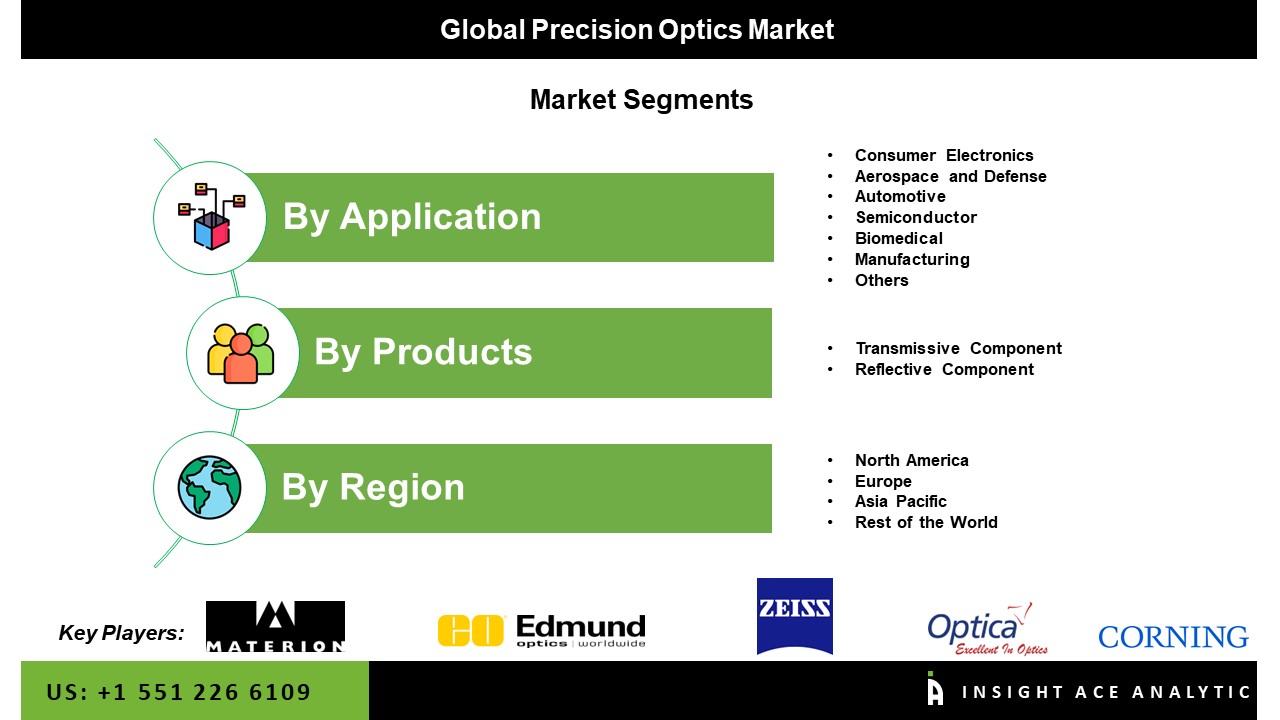
Precision Optics Market By Component-
- Transmissive
- Filters
- Prisms
- Lenses
- Windows
- Polarizers
- Beamsplitters
- Others
- Reflective
- Mirrors
- Retroreflectors
- Others
Precision Optics Market By Region-
North America-
Europe-
- Germany
- The UK
- France
- Italy
- Spain
- Rest of Europe
Asia-Pacific-
- China
- Japan
- India
- South Korea
- South East Asia
- Rest of Asia Pacific
Latin America-
- Brazil
- Argentina
- Rest of Latin America
Middle East & Africa-
- GCC Countries
- South Africa
- Rest of the Middle East and Africa