Portable Power Stations Market Size, Share, Revenue Report 2026 to 2035
WHat is Portable Power Stations Market Size?
Global Portable Power Stations Market Size is valued at USD 808.21 Mn in 2025 and is predicted to reach USD 1896.49 Mn by the year 2035 at an 9.1% CAGR during the forecast period for 2026 to 2035.
Portable Power Stations Market, Share & Trends Analysis Report, By Technology (Lithium-ion, Lead-acid, and Fuel Cell Vehicle (FCV)), By Application (Emergency, Off-grid, and Automotive), By Capacity, By Region, and Segment Forecasts, 2026 to 2035
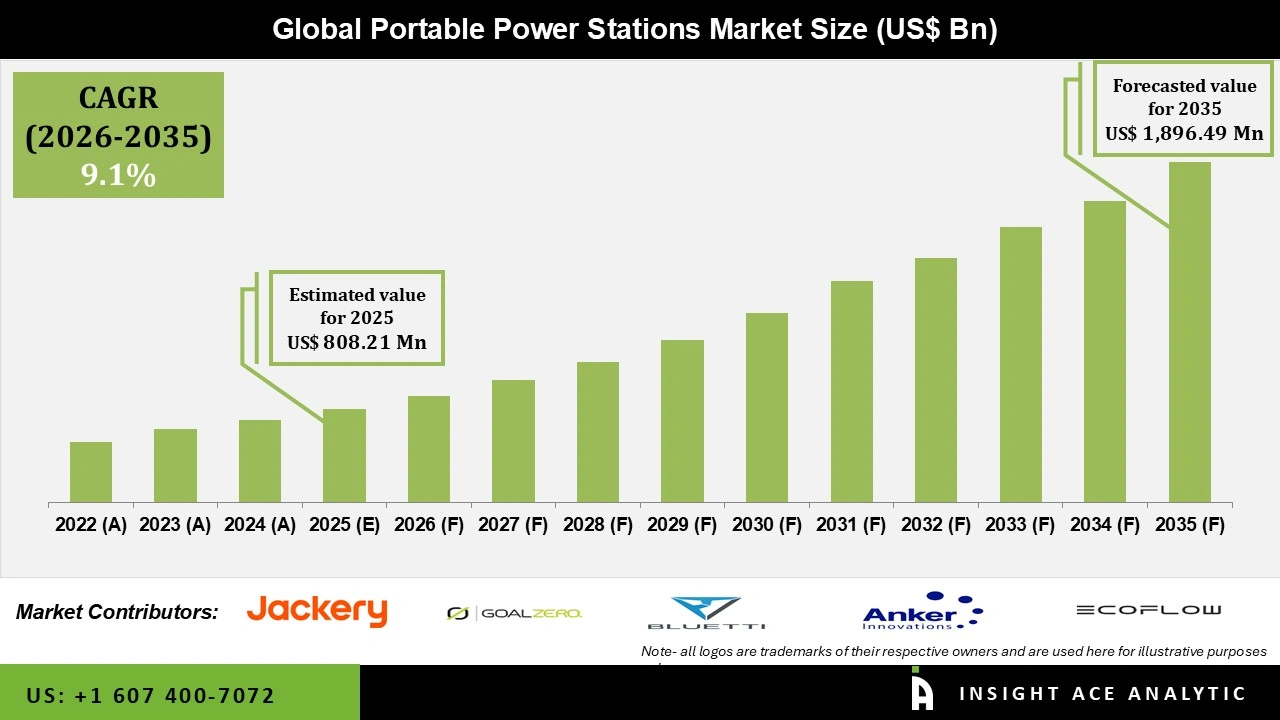
Portable Power Stations Market Key Takeaways:
|
A portable power station is a device equipped with a rechargeable battery, providing a cleaner and safer way to power appliances without much noise and with easy portability. These machines feature multiple USB and AC connectors, enabling users to charge and operate various devices with ease. Typically, most portable power stations use either lithium-ion or lithium-iron phosphate (LiFePO4) batteries, with LiFePO4 being favored for its durability and heat resistance, making it ideal for high-power applications. Portable power stations are especially popular for outdoor activities and off-grid adventures, where they can charge GPS devices, phones, lanterns, cameras, and even small cooking appliances. In addition, solar-rechargeable models are a preferred choice for those seeking sustainable energy solutions. These power stations are also useful for home projects, offering portable power that reduces dependency on extension cords and allows for flexibility in work location.
Many portable power stations offer advanced features, such as smartphone app control, enabling users to monitor battery levels, adjust output settings, and receive notifications. Some models also include built-in air compressors for inflating tires, sports equipment, and more, while others come with integrated solar panels for more efficient and sustainable charging. Growing awareness of climate change and environmental impact has created a shift towards clean, emissions-free power solutions, making portable power stations an attractive alternative to traditional gas generators. They produce no emissions, operate quietly, and are ideal for both indoor and outdoor use. Additionally, many portable power stations are compatible with external solar panels, allowing eco-conscious consumers and outdoor enthusiasts to recharge sustainably and independently of the grid, further positioning portable power stations as a popular choice in renewable energy markets.
Competitive Landscape
Some of the Major Key Players in the Portable Power Stations market are
- Jackery, Inc.
- Goal Zero (Nielsen)
- Bluetti
- Anker Innovations
- EcoFlow
- Yeti (by Goal Zero)
- Renogy
- Paxcess
- AIMTOM
- RAVPower
- ChargeTech
- Duracell Inc
- iForway
- Lion Energy
- Lipower Technology Co., Ltd
- Midland Radio
- Chargetech
- Duracell Inc.
- Drow Enterprise Co., Ltd.
- Generac Power Systems, Inc.
- Suaoki
- Milwaukee Tool
- Other Prominent Players
Market Segmentation
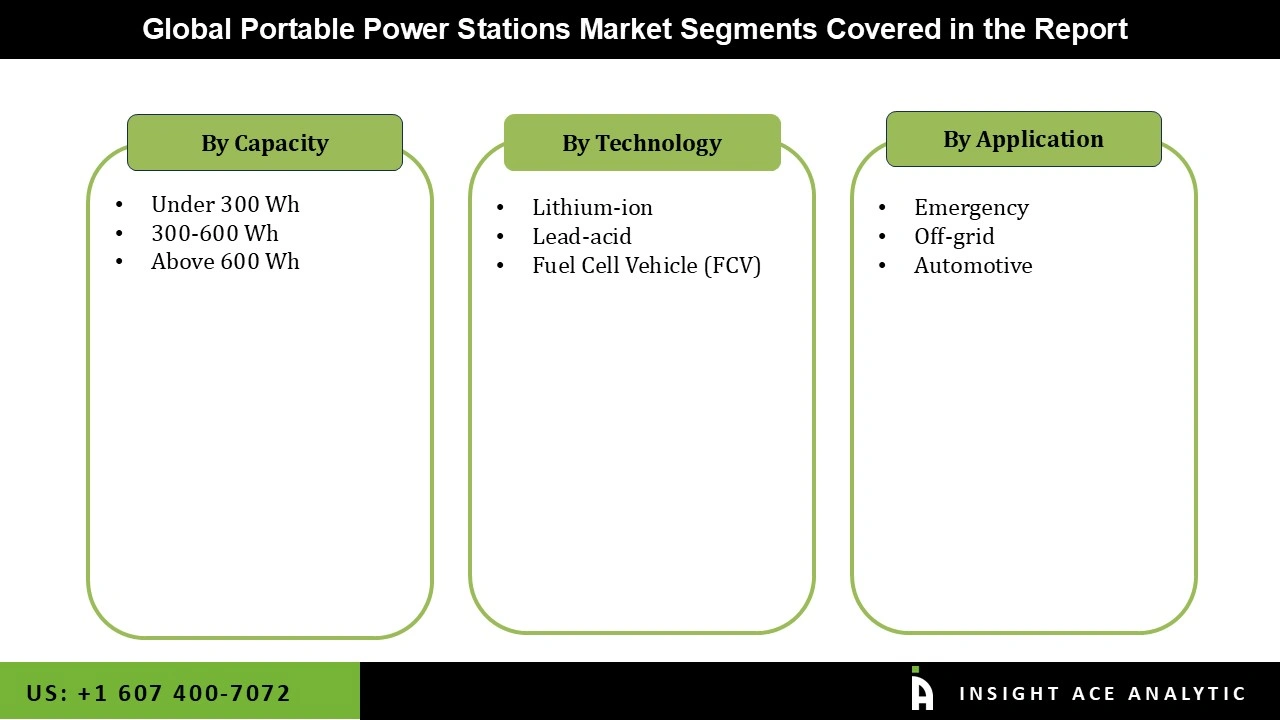
The Portable Power Stations market is segmented based on technology, application, and capacity. Based on the technology, the market is divided into lithium-ion, lead-acid, and fuel cell vehicle (FCV). Based on the application, the market is divided into emergency, off-grid, and automotive. Based on the capacity, the market is divided into under 300 Wh, 300-600 Wh, and above 600 Wh.
The lithium-ion Segment is Expected to Have the Highest Growth Rate During the Forecast Period
Based on the technology, the market is divided into lithium-ion, lead-acid, and fuel cell vehicle (FCV). Among these, the lithium-ion segment is expected to have the highest growth rate during the forecast period. Lithium-ion batteries have a high energy-to-weight ratio, meaning they can store more energy in a compact and lightweight form. This makes portable power stations lighter, smaller, and easier to transport, which is crucial for applications like camping, road trips, and emergency backup.
Lithium-ion batteries have a higher cycle life than lead-acid batteries, retaining their capacity for more charge-discharge cycles. This longevity reduces the need for frequent replacements, which is attractive for both individual consumers and businesses looking to reduce long-term costs. Lithium-ion batteries are more energy-efficient, with lower internal resistance and less self-discharge than lead-acid options. This means users get more consistent power output with minimal maintenance, making lithium-ion stations convenient and reliable for various applications. Many lithium-ion portable power stations are designed to work with solar panels, appealing to eco-conscious consumers and outdoor enthusiasts looking for sustainable power solutions.
The Emergency Power Segment Dominates the Market
Based on the application, the market is divided into emergency, off-grid, and automotive. Natural disasters like hurricanes, wildfires, earthquakes, and severe storms are becoming more frequent and intense, often resulting in extended power outages. Portable power stations provide an immediate, portable solution for households and businesses to power essential devices during these disruptions. Aging infrastructure and rising energy demand have led to a growing number of power outages and rolling blackouts, particularly in regions with overburdened or vulnerable power grids. With portable power stations, users have access to backup power that doesn’t rely on the grid, offering peace of mind and continuity during outages.
Portable power stations are user-friendly, requiring little setup or maintenance, making them accessible even for those unfamiliar with power equipment. Many also support recharging via solar panels, car chargers, or wall outlets, ensuring they can be refueled even in prolonged emergency situations. These factors make the emergency power segment the dominant driver of the portable power station market.
North America Has the Largest Market Share During the Forecast Period.
Increasing awareness and preparedness for natural disasters have led many North American households to invest in emergency kits, often including portable power stations. These devices offer a quiet, safe, and versatile alternative to gas generators, meeting consumer preferences for easy and efficient power solutions. The strong culture of outdoor activities, including camping, hiking, and RV travel, creates a consistent demand for portable power stations. With the rise of “glamping” (luxury camping) and remote work, outdoor enthusiasts seek reliable power sources to charge phones, laptops, and other small appliances during off-grid trips.
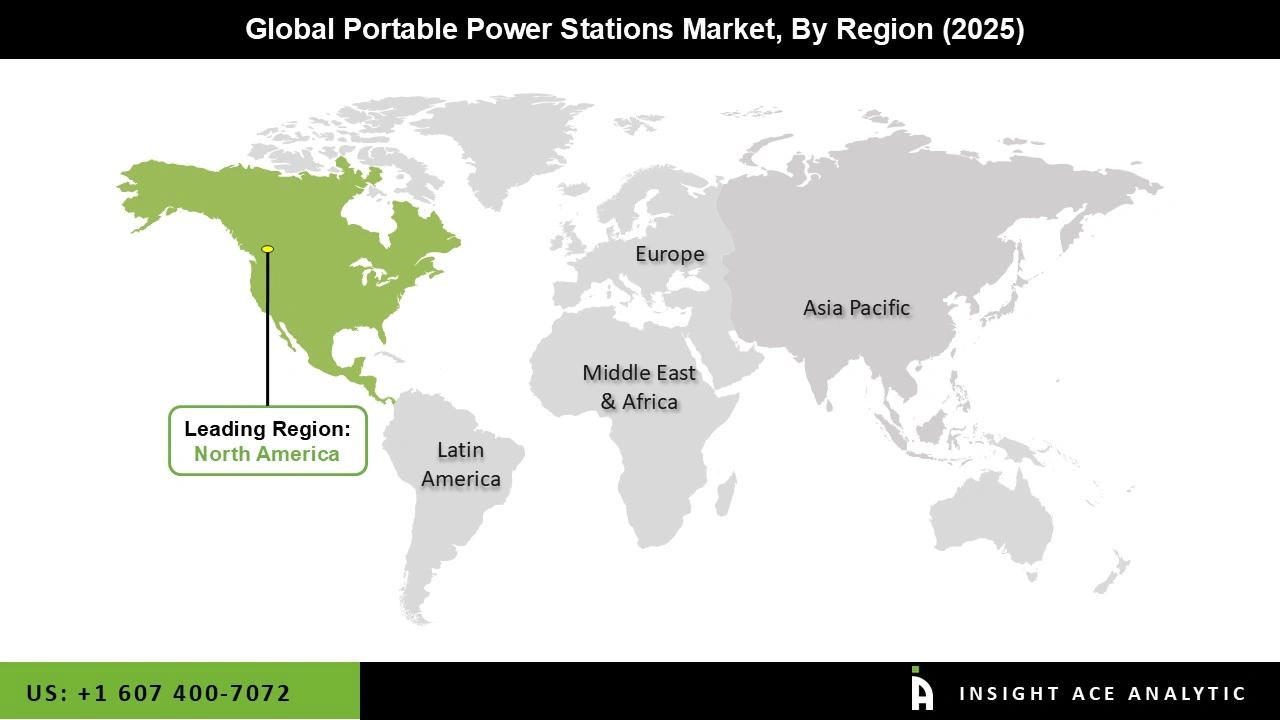
The interest in clean energy solutions and sustainability is high in North America, leading to increased adoption of portable power stations that support solar charging. Many consumers are also eco-conscious, preferring emissions-free battery power stations over fossil-fuel-powered generators.
Recent Developments:
- In Jan 2024, Goal Zero, revealed the newest models in its popular Yeti range of portable power plants. For dependable, adaptable power wherever the journey takes, the new Compact Yeti power station series, which includes the Yeti 300, Yeti 500, and Yeti 700, has industry-leading durability and charging speeds.
- In April 2023, BLUETTI, launched a brand-new model with a bunch of improvements as compared to preceding transportable stations consisting of EB150 and EB240, AC180. Its design package makes it a nicely-deserved portable energy station for emergency backup, unexpected blackouts, excursions, and others.
- In Jan 2022, EcoFlow, introduced the industry-leading DELTA Pro portable household battery in Europe, which has a 3.6 kWh base capacity and can be expanded to 25 kWh. The DELTA Pro is the first portable residential battery in the business and could give houses several days of backup power during emergencies. By offering a robust, low-carbon, and renewable electrical solution for homes, businesses, and individuals, EcoFlow DELTA Pro aims to advance sustainability.
Portable Power Stations Market Report Scope :
| Report Attribute | Specifications |
| Market Size Value In 2025 | USD 808.21 Mn |
| Revenue Forecast In 2035 | USD 1896.49 Mn |
| Growth Rate CAGR | CAGR of 9.1% from 2026 to 2035 |
| Quantitative Units | Representation of revenue in US$ Bn and CAGR from 2026 to 2035 |
| Historic Year | 2022 to 2025 |
| Forecast Year | 2026-2035 |
| Report Coverage | The forecast of revenue, the position of the company, the competitive market structure, growth prospects, and trends |
| Segments Covered | Technology, Application, and Capacity |
| Regional Scope | North America; Europe; Asia Pacific; Latin America; Middle East & Africa |
| Country Scope | U.S.; Canada; U.K.; Germany; China; India; Japan; Brazil; Mexico; The UK; France; Italy; Spain; China; Japan; India; South Korea; Southeast Asia; South Korea; South East Asia |
| Competitive Landscape | Jackery, Inc., Goal Zero, Bluetti, Anker Innovations, EcoFlow, Yeti, Renogy, Paxcess, AIMTOM, RAVPower, ChargeTech, Duracell Inc, iForway, Lion Energy, Lipower Technology Co., Ltd, Midland Radio, Chargetech, Drow Enterprise Co., Ltd., Generac Power Systems, Inc., Suaoki, Milwaukee Tool. |
| Customization Scope | Free customization report with the procurement of the report and modifications to the regional and segment scope. Particular Geographic competitive landscape. |
| Pricing and Available Payment Methods | Explore pricing alternatives that are customized to your particular study requirements. |
Segmentation of Portable Power Stations Market :
Portable Power Stations Market, By Capacity-
- Under 300 Wh
- 300-600 Wh
- Above 600 Wh
Portable Power Stations Market, By Technology-
- Lithium-ion
- Lead-acid
- Fuel Cell Vehicle (FCV)
Portable Power Stations Market ,By Application -
- Emergency
- Off-grid
- Automotive
Portable Power Stations Market,By Region-
- North America-
- The US
- Canada
- Europe-
- Germany
- The UK
- France
- Italy
- Spain
- Rest of Europe
- Asia-Pacific-
- China
- Japan
- India
- South Korea
- South East Asia
- Rest of Asia Pacific
- Latin America-
- Brazil
- Argentina
- Mexico
- Rest of Latin America
- Middle East & Africa-
- GCC Countries
- South Africa
- Rest of Middle East and Africa
Research Design and Approach
This study employed a multi-step, mixed-method research approach that integrates:
- Secondary research
- Primary research
- Data triangulation
- Hybrid top-down and bottom-up modelling
- Forecasting and scenario analysis
This approach ensures a balanced and validated understanding of both macro- and micro-level market factors influencing the market.
Secondary Research
Secondary research for this study involved the collection, review, and analysis of publicly available and paid data sources to build the initial fact base, understand historical market behaviour, identify data gaps, and refine the hypotheses for primary research.
Sources Consulted
Secondary data for the market study was gathered from multiple credible sources, including:
- Government databases, regulatory bodies, and public institutions
- International organizations (WHO, OECD, IMF, World Bank, etc.)
- Commercial and paid databases
- Industry associations, trade publications, and technical journals
- Company annual reports, investor presentations, press releases, and SEC filings
- Academic research papers, patents, and scientific literature
- Previous market research publications and syndicated reports
These sources were used to compile historical data, market volumes/prices, industry trends, technological developments, and competitive insights.

Primary Research
Primary research was conducted to validate secondary data, understand real-time market dynamics, capture price points and adoption trends, and verify the assumptions used in the market modelling.
Stakeholders Interviewed
Primary interviews for this study involved:
- Manufacturers and suppliers in the market value chain
- Distributors, channel partners, and integrators
- End-users / customers (e.g., hospitals, labs, enterprises, consumers, etc., depending on the market)
- Industry experts, technology specialists, consultants, and regulatory professionals
- Senior executives (CEOs, CTOs, VPs, Directors) and product managers
Interview Process
Interviews were conducted via:
- Structured and semi-structured questionnaires
- Telephonic and video interactions
- Email correspondences
- Expert consultation sessions
Primary insights were incorporated into demand modelling, pricing analysis, technology evaluation, and market share estimation.
Data Processing, Normalization, and Validation
All collected data were processed and normalized to ensure consistency and comparability across regions and time frames.
The data validation process included:
- Standardization of units (currency conversions, volume units, inflation adjustments)
- Cross-verification of data points across multiple secondary sources
- Normalization of inconsistent datasets
- Identification and resolution of data gaps
- Outlier detection and removal through algorithmic and manual checks
- Plausibility and coherence checks across segments and geographies
This ensured that the dataset used for modelling was clean, robust, and reliable.
Market Size Estimation and Data Triangulation
Bottom-Up Approach
The bottom-up approach involved aggregating segment-level data, such as:
- Company revenues
- Product-level sales
- Installed base/usage volumes
- Adoption and penetration rates
- Pricing analysis
This method was primarily used when detailed micro-level market data were available.

Top-Down Approach
The top-down approach used macro-level indicators:
- Parent market benchmarks
- Global/regional industry trends
- Economic indicators (GDP, demographics, spending patterns)
- Penetration and usage ratios
This approach was used for segments where granular data were limited or inconsistent.
Hybrid Triangulation Approach
To ensure accuracy, a triangulated hybrid model was used. This included:
- Reconciling top-down and bottom-up estimates
- Cross-checking revenues, volumes, and pricing assumptions
- Incorporating expert insights to validate segment splits and adoption rates
This multi-angle validation yielded the final market size.
Forecasting Framework and Scenario Modelling
Market forecasts were developed using a combination of time-series modelling, adoption curve analysis, and driver-based forecasting tools.
Forecasting Methods
- Time-series modelling
- S-curve and diffusion models (for emerging technologies)
- Driver-based forecasting (GDP, disposable income, adoption rates, regulatory changes)
- Price elasticity models
- Market maturity and lifecycle-based projections
Scenario Analysis
Given inherent uncertainties, three scenarios were constructed:
- Base-Case Scenario: Expected trajectory under current conditions
- Optimistic Scenario: High adoption, favourable regulation, strong economic tailwinds
- Conservative Scenario: Slow adoption, regulatory delays, economic constraints
Sensitivity testing was conducted on key variables, including pricing, demand elasticity, and regional adoption.
Request Customization
Add countries, segments, company profiles, or extend forecast — free 10% customization with purchase.
Customize This Report →Enquire Before Buying
Speak with our analyst team about scope, methodology, pricing, or deliverable formats.
Enquire Now →Frequently Asked Questions
Portable Power Stations Market Size is valued at USD 808.21 Mn in 2025 and is predicted to reach USD 1896.49 Mn by the year 2035
Portable Power Stations Market is expected to grow at an 9.1% CAGR during the forecast period for 2026 to 2035.
Technology, Application, and Capacity are the key segments of the Portable Power Stations Market.
Jackery, Inc., Goal Zero, Bluetti, Anker Innovations, EcoFlow, Yeti, Renogy, Paxcess, AIMTOM, RAVPower, ChargeTech, Duracell Inc, iForway, Lion Energy, Lipower Technology Co., Ltd, Midland Radio, Chargetech, Drow Enterprise Co., Ltd., Generac Power Systems, Inc., Suaoki, Milwaukee Tool. and Other.
North American region is leading the Portable Power Stations Market.