Partially Hydrolyzed Polyacrylamide (PHPA) Market Size, Share & Trends Analysis Report By Type (Anionic, Cationic, Non-ionic, Others), By Function (Viscosifying Agent, Shale bore-hole Stabilizer, Excapsulator, Flocculation Agent, Others), By Application, By End-Use, By Region, And By Segment Forecasts, 2025-2034
Global Partially Hydrolyzed Polyacrylamide (PHPA) Market Size is valued at USD 2.5 Bn in 2024 and is predicted to reach USD 4.6 Bn by the year 2034 at a 6.5% CAGR during the forecast period for 2025-2034.
Key Industry Insights & Findings from the Report:
- The significant driver for the PHPA market is the expanding oil & gas exploration activities worldwide.
- The expanding mining activities worldwide contribute significantly to the demand for PHPA.
- Asia Pacific dominated the market and accounted for a global revenue share in 2024.
- The environmental impact of acrylamide production and disposal of used PHPA products poses challenges for the industry.
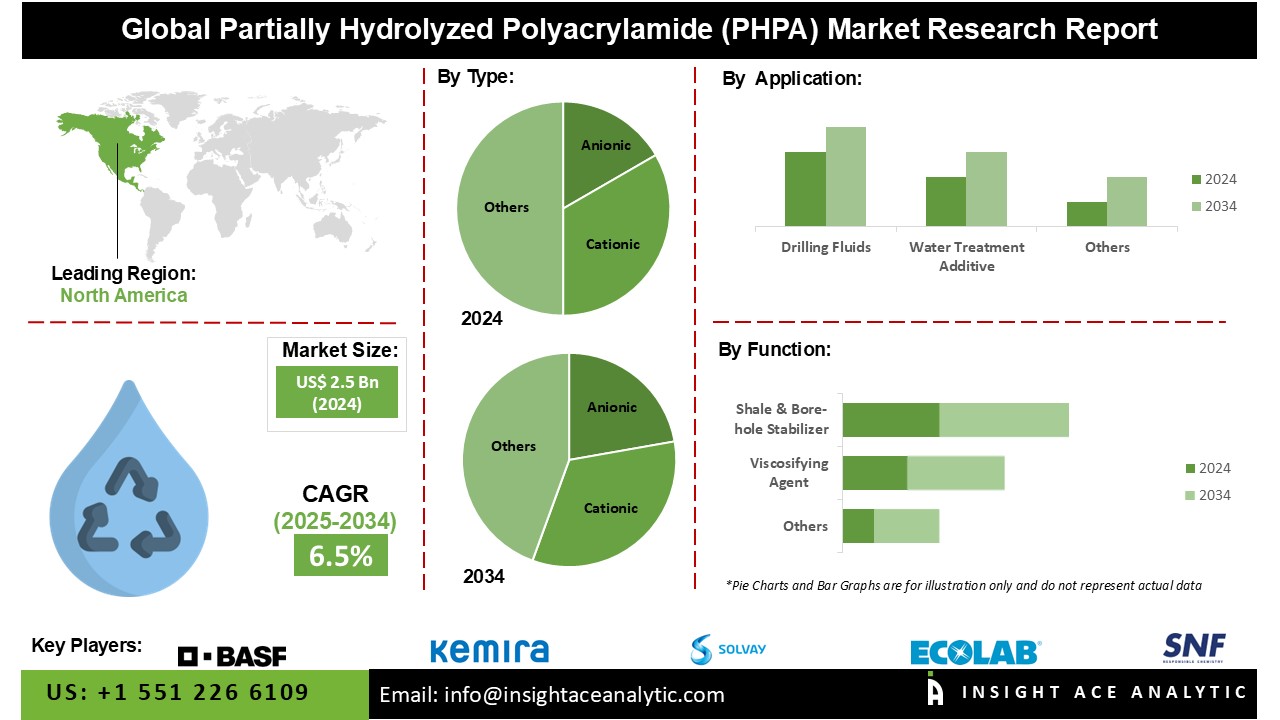
PHPA (Partially Hydrolyzed Polyacrylamide) is a synthetic polymer widely used in industrial and environmental applications. It is created by polymerizing acrylamide and is partially hydrolyzed to make it water-soluble. Various variables drive the Partially Hydrolyzed Polyacrylamide (PHPA) market dynamics, including industry demand, applications in various industries, regulatory developments, environmental concerns, technological improvements, and economic situations. The need for PHPA in the oil and gas industry, notably in drilling and enhanced oil recovery (EOR) applications, is a significant market driver. Oil price fluctuations, exploration and production operations, and the introduction of new drilling techniques all have an impact on PHPA demand.
However, global lockdowns and decreased economic activity resulted in a dramatic drop in oil demand, forcing oil prices to plunge. This had an influence on drilling and exploration operations, which in turn had an impact on the demand for PHPA in drilling fluids and improved oil recovery. Because the oil and gas industry consumes a substantial amount of PHPA, the decrease in drilling activities had a detrimental influence on the PHPA market.
Competitive Landscape:
Some Major Key Players In The Partially Hydrolyzed Polyacrylamide (PHPA) Market:
- BASF SE
- SNF Group
- Kemira
- Solvay
- Ecolab
- Ashland, Inc.
- Anhui Jucheng Fine Chemicals Co., Ltd.
- Shandong Polymer Biochemicals Co., Ltd.
- Beijing Hengju Chemical Group Corporation
- Jiangsu Feymer Technology Co., Ltd.
- Innova Corporate (India)
- Orange Chemicals
Market Segmentation:
The Partially Hydrolyzed Polyacrylamide (PHPA) Market is divided on the basis of type, function, application, and end-use. The segment, type, comprises anionic, cationic, non-ionic, and others types. The function segment includes a viscosifying agent, shale bore-hole stabilizer, encapsulator, and flocculation agent. As per the application, the market is segmented into drilling fluids, water treatment additives, soil stabilization, paper manufacturing, and others. The end-user segment includes oil & gas, wastewater treatment, mining, agriculture, paper, and others.
Based On Type, The Anionic Segment Is Accounted As A Major Contributor In The Partially Hydrolyzed Polyacrylamide (PHPA) Market
The anionic category is expected to hold a major share in the global Partially Hydrolyzed Polyacrylamide (PHPA) Market in 2022. Anionic-type PHPA is often employed in applications where the polymer's flocculation and clarifying qualities are critical. It is frequently used in industries requiring efficient solid-liquid separation, such as wastewater treatment, mining, and the paper industry. Anionic PHPA is used extensively in wastewater treatment to flocculate and settle suspended particulates, enhance water quality, and lessen the environmental effect of wastewater discharge. Stringent water quality and effluent rules promote demand for effective flocculants such as anionic PHPA.
The Oil & Gas Segment Witnessed Development At A Rapid Rate
The oil & gas segment is estimated to grow at a rapid rate in the global Partially Hydrolyzed Polyacrylamide (PHPA) Market. Advanced drilling techniques are required to produce unconventional oil and gas reserves such as shale and tight formations. PHPA is used in hydraulic fracturing (fracking) fluids to control viscosity, reduce fluid loss, and aid in forming and maintaining cracks, all of which improve hydrocarbon recovery. As energy demand rises, oil and gas corporations seek new deposits and optimise existing fields. This increases drilling activity, resulting in a steady demand for drilling fluids, of which PHPA is an important component.
In The Region, The Asia Pacific Partially Hydrolyzed Polyacrylamide (PHPA) Market Holds A Significant Revenue Share
Asia Pacific Partially Hydrolyzed Polyacrylamide (PHPA) Market is expected to record the maximum market share in terms of revenue in the near future. The region is undergoing substantial infrastructural development, including the construction of bridges, roads, buildings, and other projects. The use of PHPA in soil stabilization for these projects contributes to its demand in the building industry. Several countries in this region, including China, India, and Southeast Asian nations, have considerable oil and gas exploration and production activities.
PHPA is a crucial ingredient in drilling fluids and enhanced oil recovery (EOR) technologies, making it an crucial component in the oil and gas sector. Moreover, in North America, PHPA is used in mineral processing, tailings management, and other solid-liquid separation operations. The need for minerals, metals, and aggregates influences the demand for PHPA.
Partially Hydrolyzed Polyacrylamide (PHPA) Market Report Scope:
| Report Attribute | Specifications |
| Market Size Value In 2024 | USD 2.5 Bn |
| Revenue Forecast In 2034 | USD 4.6 Bn |
| Growth Rate CAGR | CAGR of 6.5% from 2025 to 2034 |
| Quantitative Units | Representation of revenue in US$ Bn, Volume (Tons) and CAGR from 2025 to 2034 |
| Historic Year | 2021 to 2024 |
| Forecast Year | 2025-2034 |
| Report Coverage | The forecast of revenue, the position of the company, the competitive market structure, growth prospects, and trends |
| Segments Covered | By Type, Function, Application, End-User |
| Regional Scope | North America; Europe; Asia Pacific; Latin America; Middle East & Africa |
| Country Scope | U.S.; Canada; U.K.; Germany; China; India; Japan; Brazil; Mexico ;The UK; France; Italy; Spain; China; Japan; India; South Korea; South East Asia; South Korea; South East Asia |
| Competitive Landscape | BASF SE, SNF Group, Kemira, Solvay, Ecolab, Ashland, Inc., Anhui Jucheng Fine Chemicals Co., Ltd., Shandong Polymer Biochemicals Co., Ltd., Beijing Hengju Chemical Group Corporation, Jiangsu Feymer Technology Co., Ltd., Innova Corporate (India), Orange Chemicals |
| Customization Scope | Free customization report with the procurement of the report, Modifications to the regional and segment scope. Particular Geographic competitive landscape. |
| Pricing And Available Payment Methods | Explore pricing alternatives that are customized to your particular study requirements. |
Segmentation of Partially Hydrolyzed Polyacrylamide (PHPA) Market-
Partially Hydrolyzed Polyacrylamide (PHPA) Market By Type-
- Anionic
- Cationic
- Non-ionic
- Others
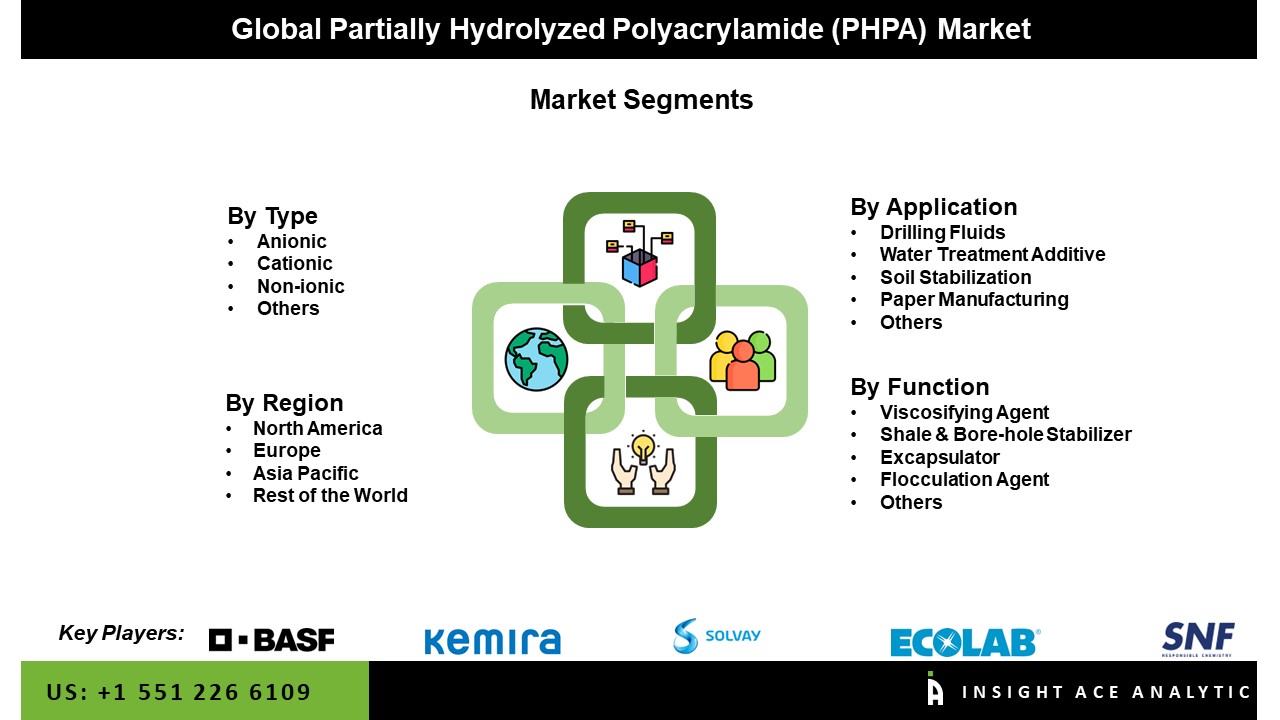
Partially Hydrolyzed Polyacrylamide (PHPA) Market By Function-
- Viscosifying Agent
- Shale bore-hole Stabilizer
- Excapsulator
- Flocculation Agent
- Others
Partially Hydrolyzed Polyacrylamide (PHPA) Market By Application-
- Drilling Fluids
- Water Treatment Additive
- Soil Stabilization
- Paper Manufacturing
- Others
Partially Hydrolyzed Polyacrylamide (PHPA) Market By End-Use-
- Oil & Gas
- Waste Water Treatment
- Mining
- Agriculture
- Paper
- Others
Partially Hydrolyzed Polyacrylamide (PHPA) Market By Region-
North America-
- The US
- Canada
Europe-
- Germany
- The UK
- France
- Italy
- Spain
- Rest of Europe
Asia-Pacific-
- China
- Japan
- India
- South Korea
- Southeast Asia
- Rest of Asia Pacific
Latin America-
- Brazil
- Mexico
- Argentina
- Rest of Latin America
Middle East & Africa-
- GCC Countries
- South Africa
- Rest of the Middle East and Africa
Research Design and Approach
This study employed a multi-step, mixed-method research approach that integrates:
- Secondary research
- Primary research
- Data triangulation
- Hybrid top-down and bottom-up modelling
- Forecasting and scenario analysis
This approach ensures a balanced and validated understanding of both macro- and micro-level market factors influencing the market.
Secondary Research
Secondary research for this study involved the collection, review, and analysis of publicly available and paid data sources to build the initial fact base, understand historical market behaviour, identify data gaps, and refine the hypotheses for primary research.
Sources Consulted
Secondary data for the market study was gathered from multiple credible sources, including:
- Government databases, regulatory bodies, and public institutions
- International organizations (WHO, OECD, IMF, World Bank, etc.)
- Commercial and paid databases
- Industry associations, trade publications, and technical journals
- Company annual reports, investor presentations, press releases, and SEC filings
- Academic research papers, patents, and scientific literature
- Previous market research publications and syndicated reports
These sources were used to compile historical data, market volumes/prices, industry trends, technological developments, and competitive insights.

Primary Research
Primary research was conducted to validate secondary data, understand real-time market dynamics, capture price points and adoption trends, and verify the assumptions used in the market modelling.
Stakeholders Interviewed
Primary interviews for this study involved:
- Manufacturers and suppliers in the market value chain
- Distributors, channel partners, and integrators
- End-users / customers (e.g., hospitals, labs, enterprises, consumers, etc., depending on the market)
- Industry experts, technology specialists, consultants, and regulatory professionals
- Senior executives (CEOs, CTOs, VPs, Directors) and product managers
Interview Process
Interviews were conducted via:
- Structured and semi-structured questionnaires
- Telephonic and video interactions
- Email correspondences
- Expert consultation sessions
Primary insights were incorporated into demand modelling, pricing analysis, technology evaluation, and market share estimation.
Data Processing, Normalization, and Validation
All collected data were processed and normalized to ensure consistency and comparability across regions and time frames.
The data validation process included:
- Standardization of units (currency conversions, volume units, inflation adjustments)
- Cross-verification of data points across multiple secondary sources
- Normalization of inconsistent datasets
- Identification and resolution of data gaps
- Outlier detection and removal through algorithmic and manual checks
- Plausibility and coherence checks across segments and geographies
This ensured that the dataset used for modelling was clean, robust, and reliable.
Market Size Estimation and Data Triangulation
Bottom-Up Approach
The bottom-up approach involved aggregating segment-level data, such as:
- Company revenues
- Product-level sales
- Installed base/usage volumes
- Adoption and penetration rates
- Pricing analysis
This method was primarily used when detailed micro-level market data were available.

Top-Down Approach
The top-down approach used macro-level indicators:
- Parent market benchmarks
- Global/regional industry trends
- Economic indicators (GDP, demographics, spending patterns)
- Penetration and usage ratios
This approach was used for segments where granular data were limited or inconsistent.
Hybrid Triangulation Approach
To ensure accuracy, a triangulated hybrid model was used. This included:
- Reconciling top-down and bottom-up estimates
- Cross-checking revenues, volumes, and pricing assumptions
- Incorporating expert insights to validate segment splits and adoption rates
This multi-angle validation yielded the final market size.
Forecasting Framework and Scenario Modelling
Market forecasts were developed using a combination of time-series modelling, adoption curve analysis, and driver-based forecasting tools.
Forecasting Methods
- Time-series modelling
- S-curve and diffusion models (for emerging technologies)
- Driver-based forecasting (GDP, disposable income, adoption rates, regulatory changes)
- Price elasticity models
- Market maturity and lifecycle-based projections
Scenario Analysis
Given inherent uncertainties, three scenarios were constructed:
- Base-Case Scenario: Expected trajectory under current conditions
- Optimistic Scenario: High adoption, favourable regulation, strong economic tailwinds
- Conservative Scenario: Slow adoption, regulatory delays, economic constraints
Sensitivity testing was conducted on key variables, including pricing, demand elasticity, and regional adoption.
Request Customization
Add countries, segments, company profiles, or extend forecast — free 10% customization with purchase.
Customize This Report →Enquire Before Buying
Speak with our analyst team about scope, methodology, pricing, or deliverable formats.
Enquire Now →Frequently Asked Questions
Partially Hydrolyzed Polyacrylamide (PHPA) Market Size is valued at USD 2.5 Bn in 2024 and is predicted to reach USD 4.6 Bn by the year 2034
Partially Hydrolyzed Polyacrylamide (PHPA) Market is expected to grow at a 6.5% CAGR during the forecast period for 2025-2034
BASF SE, SNF Group, Kemira, Solvay, Ecolab, Ashland, Inc., Anhui Jucheng Fine Chemicals Co., Ltd., Shandong Polymer Biochemicals Co., Ltd., Beijing He
Type, Function, Application and End-User are the key segments of the Partially Hydrolyzed Polyacrylamide (PHPA) Market
North America region is leading the Partially Hydrolyzed Polyacrylamide (PHPA) Market.