Next-Generation Display Materials Market Size, Share & Trends Analysis Report By Product (Organic Light Emitting Diode (OLED), Thin-Film Transistors LCD (TFT-LCD)) And Application (Smartphones, Television And Monitors, Smartwatches, Automotive Displays, Laptops And Tablets), By Region, And Segment Forecasts, 2024-2031
The Global Next-Generation Display Materials Market Size is valued at 150.35 billion in 2023 and is predicted to reach 259.31 billion by the year 2031 at an 7.22% CAGR during the forecast period for 2024-2031.
Key Industry Insights & Findings from the Report:
- An increasing number of individuals are looking for display technologies that are aesthetically pleasing, environmentally friendly, and of excellent quality, which is leading to market growth.
- The growing interest in organic light-emitting diode screens is driven by rising disposable income and the expansion of this market.
- North America dominated the market and accounted for a global revenue share in 2023.
- One of the significant concerns is restraining the high startup costs of industrial facilities, numerous tests, and lengthy development cycles required to bring new display materials to market.
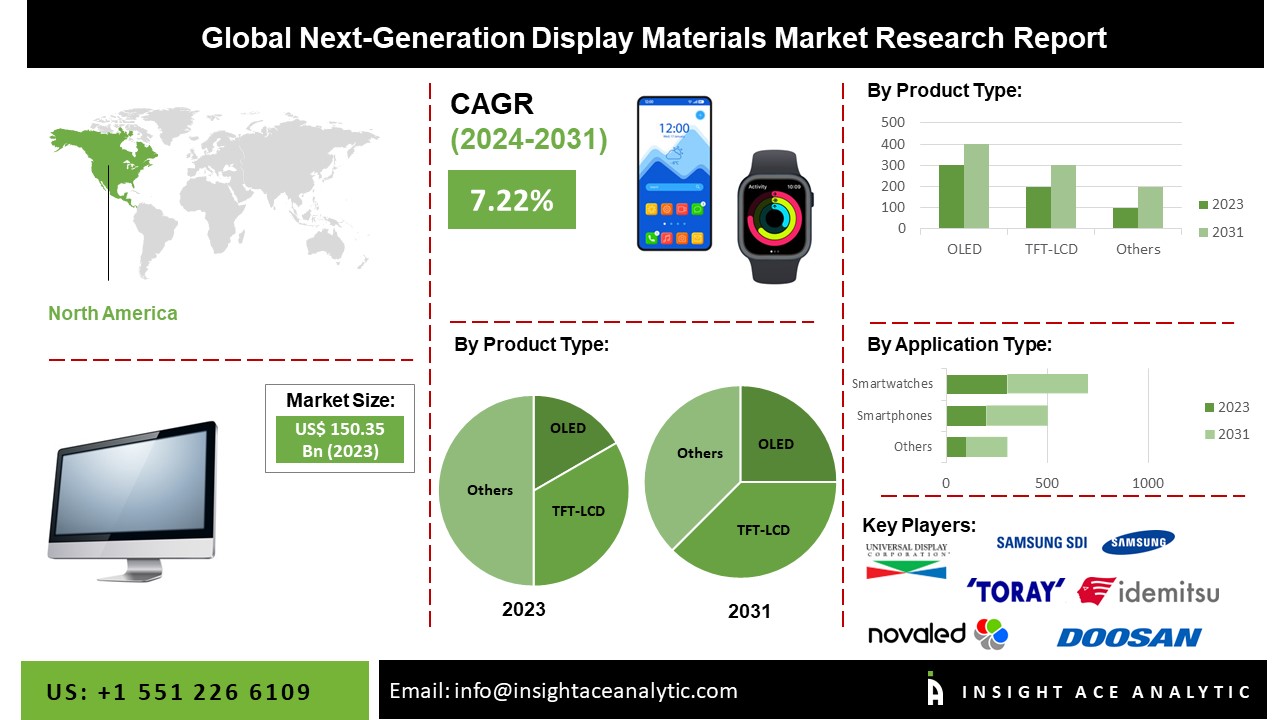
The technology that separates contemporary imaging systems from earlier ones is "next-generation display." Next-generation displays are more sophisticated than LCD and plasma displays while using less energy. Broader viewing angles, changing display market trends, high-resolution smartphones and tablets, displays, video cameras, video screens, set Top boxes, and recorders are some of the 4K technological products that are currently on the market and are anticipated to drive the global next-generation display market's revenue growth.
The market for smart TVs is expected to increase quickly due to the increasing demand for large displays in the TV industry. Governments worldwide are outlawing the use of cadmium because it is dangerous to the environment and is used in the production of display panels. As a result, A large customer base is drawn to gadgets and devices with next-generation display materials for high-resolution & higher picture quality due to ongoing innovations & advancements in display materials linked to the launch of OLEDs.
Advantages like improved image quality also drive the Global Next-Generation Display Materials Market, better contrast, a wider viewing angle, higher brightness, a wide color gamut, and much faster refresh rates, as well as environmental advantages like reduced power consumption of the OLED next-generation displays. The automotive industry is rapidly expanding worldwide and creating technologically cutting-edge vehicles to address growing concerns related to grave environmental difficulties.
Similarly, it is anticipated that major market participants will be motivated to create an Organics Light-Emitting Diode (OLED) display driver embedded system with reduced power consumption due to the demand for next-generation display materials.
Recent Developments:
- In November 2023, Toray Industries, Inc. unveiled LUMIRICATM, a color conversion sheet that utilizes organic fluorescent materials that do not include cadmium and emit light with exceptional color purity. This sheet provides improved dependability for high-luminance liquid crystal displays. It will highlight the new product’s potential uses on televisions and monitors.
- In September 2023, Samsung SDI Co., Ltd., Samsung Electronics Co., Ltd., and Samsung Display Co., Ltd. Announced their intention to work together at the highly anticipated IAA MOBILITY, which will change the game for connected mobility and attract businesses and consumers worldwide.
Competitive Landscape:
Some of the next-generation display materials market player are:
- Idemitsu Kosan Co., Ltd
- Toray Industries, Inc
- Samsung SDI Co
- Universal Display Corporation
- Novaled GmbH
- Nanosys Inc
- Nanoco Group PLC
- Doosan Corporation
- Quantum Materials Corporation
- PPG Industries, Inc
- DuPont Inc
- Optovate
- Plessey
- eLux Inc
- Jade Bird Display Inc
Market Segmentation:
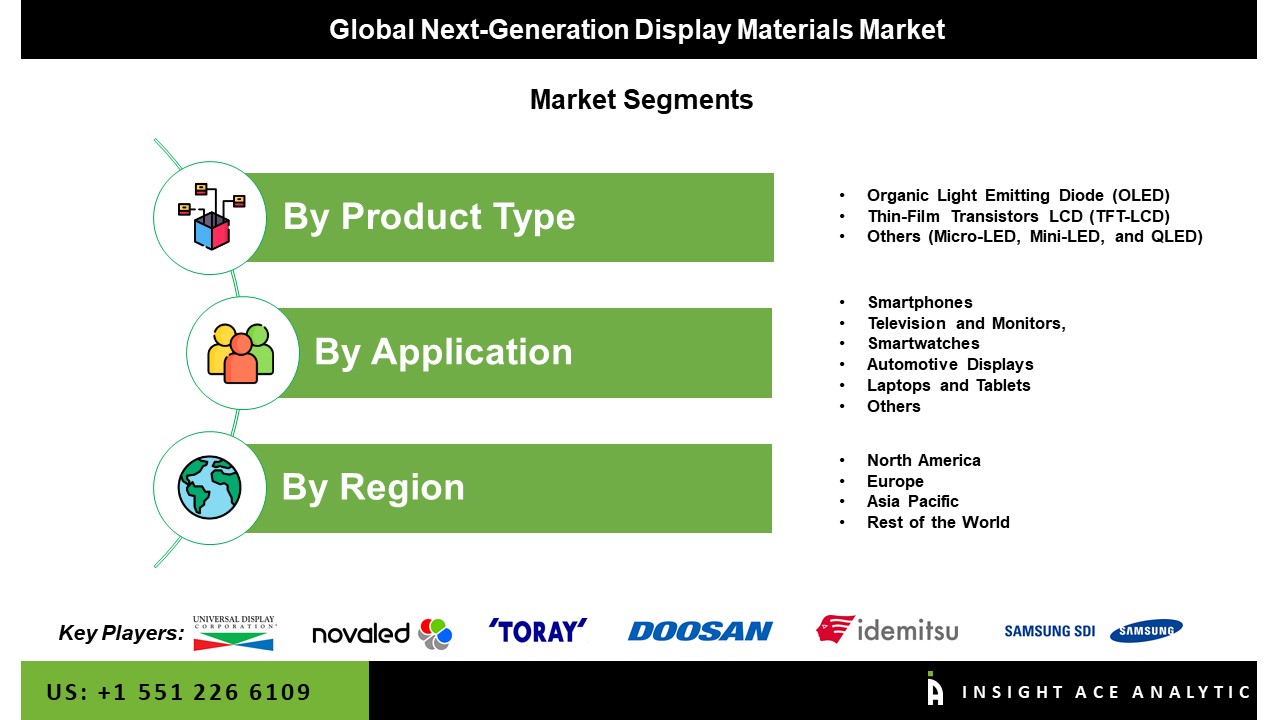
The next-generation display materials market is segmented based on product and application. Based on product, the next-generation display materials market is segmented as an organic light emitting diode (OLED), thin-film transistors LCD (TFT-LCD), and Others (Micro-LED, Mini-LED, and QLED). By application, the market is segmented into smartphones, television and monitors, smartwatches, automotive displays, laptops and tablets, and others.
Based On Product, The OLED Segment Is A Major Contributor To The Next-Generation Display Materials Market.
The OLED category will hold a major share of the global market. OLEDs, which have advantages including a small design, high resolution, larger screens, lighter weight, wide-viewing angle, and multiple folds' quick response time, are largely to blame for the sharp rise in demand for them. Due to the higher flexibility that OLED display materials offer, many smartphone makers are heavily relying on them to launch new products with improved screen resolutions & features for the quickly growing number of users, especially in Asia-Pacific. In addition, the market is being driven by the quick technological development and the trade and usage rights of patented OLED & QLED (Quantum dot light-emitting diode) display materials.
The Television And Monitors Segment Witnessed Growth At A Rapid Rate.
The television and monitors segment is projected to grow rapidly in the global next-generation display materials market. It mostly has to do with the rapidly improving economic conditions of people linked to rising sales and manufacturing of televisions and monitors, i.e., boosting the need for next-generation display materials for high resolution & greater definition. The market development is also significantly fueled by the growing use of large, inexpensive display panels in contemporary televisions, especially in countries such as the US, Germany, the UK, China, and India.
The Asia Pacific Next-Generation Display Materials Market Holds A Significant Revenue Share.
The Asia Pacific next-generation display materials industry is expected to register the highest market share in revenue shortly. The three countries that make the most money in the Asia-Pacific market are China, Japan, and South Korea. This results from a growth in R&D initiatives, funding from public and private sources, and a rise in the number of suppliers and producers of display materials in the area. In addition, North America is projected to grow rapidly in the global Next-Generation Display Materials market. The largest revenue contributors to the North American market were the United States and Canada, and it is anticipated that this pattern will hold during the forecast period. Technological changes and the growing adoption of Lcd screens due to rising disposable cash and shifting lifestyles among consumers throughout the region are driving the growth of the market.
Next-Generation Display Materials Market Report Scope
| Report Attribute | Specifications |
| Market size value in 2023 | USD 150.35 Bn |
| Revenue forecast in 2031 | USD 259.31 Bn |
| Growth rate CAGR | CAGR of 7.22% from 2024 to 2031 |
| Quantitative units | Representation of revenue in US$ Million, and CAGR from 2024 to 2031 |
| Historic Year | 2019 to 2023 |
| Forecast Year | 2024-2031 |
| Report coverage | The forecast of revenue, the position of the company, the competitive market statistics, growth prospects, and trends |
| Segments covered | Product And Application |
| Regional scope | North America; Europe; Asia Pacific; Latin America; Middle East & Africa |
| Country scope | U.S.; Canada; U.K.; Germany; China; India; Japan; Brazil; Mexico; The UK; France; Italy; Spain; China; Japan; India; South Korea; Southeast Asia; South Korea; Southeast Asia |
| Competitive Landscape | Idemitsu Kosan Co., Ltd., Toray Industries, Inc., Samsung SDI Co., Universal Display Corporation, Novaled, Nanosys, Nanoco Group PLC, Doosan Corporation, Quantum Materials Corporation, PPG Industries, Inc., and DuPont Inc.Hydrogen, Air Products Inc.and ACME Group. |
| Customization scope | Free customization report with the procurement of the report, Modifications to the regional and segment scope. Particular Geographic competitive landscape. |
| Pricing and available payment methods | Explore pricing alternatives that are customized to your particular study requirements. |
Segmentation of Next-Generation Display Materials Market:
Next-Generation Display Materials Market By Product-
- Organic Light Emitting Diode (OLED)
- Electron Transport Layer
- Hole Transport Layer
- Emissive Layer
- Substrate
- Electrodes
- Conductive Layer
- Encapsulation
- Thin-Film Transistors LCD (TFT-LCD)
- Backlight Unit
- Color Filters
- Glass Panels
- Polarizers
- Integrated Circuits (ICs)
- Others (Micro-LED, Mini-LED, And QLED).
Next-Generation Display Materials Market By Application-
- Smartphones
- Television And Monitors
- Smartwatches
- Automotive Displays
- Laptops And Tablets
- Others
By Region-
North America-
- The US
- Canada
- Mexico
Europe-
- Germany
- The UK
- France
- Italy
- Spain
- Rest of Europe
Asia-Pacific-
- China
- Japan
- India
- South Korea
- Southeast Asia
- Rest of Asia Pacific
Latin America-
- Brazil
- Argentina
- Rest of Latin America
Middle East & Africa-
- GCC Countries
- South Africa
- Rest of Middle East and Africa
Research Design and Approach
This study employed a multi-step, mixed-method research approach that integrates:
- Secondary research
- Primary research
- Data triangulation
- Hybrid top-down and bottom-up modelling
- Forecasting and scenario analysis
This approach ensures a balanced and validated understanding of both macro- and micro-level market factors influencing the market.
Secondary Research
Secondary research for this study involved the collection, review, and analysis of publicly available and paid data sources to build the initial fact base, understand historical market behaviour, identify data gaps, and refine the hypotheses for primary research.
Sources Consulted
Secondary data for the market study was gathered from multiple credible sources, including:
- Government databases, regulatory bodies, and public institutions
- International organizations (WHO, OECD, IMF, World Bank, etc.)
- Commercial and paid databases
- Industry associations, trade publications, and technical journals
- Company annual reports, investor presentations, press releases, and SEC filings
- Academic research papers, patents, and scientific literature
- Previous market research publications and syndicated reports
These sources were used to compile historical data, market volumes/prices, industry trends, technological developments, and competitive insights.

Primary Research
Primary research was conducted to validate secondary data, understand real-time market dynamics, capture price points and adoption trends, and verify the assumptions used in the market modelling.
Stakeholders Interviewed
Primary interviews for this study involved:
- Manufacturers and suppliers in the market value chain
- Distributors, channel partners, and integrators
- End-users / customers (e.g., hospitals, labs, enterprises, consumers, etc., depending on the market)
- Industry experts, technology specialists, consultants, and regulatory professionals
- Senior executives (CEOs, CTOs, VPs, Directors) and product managers
Interview Process
Interviews were conducted via:
- Structured and semi-structured questionnaires
- Telephonic and video interactions
- Email correspondences
- Expert consultation sessions
Primary insights were incorporated into demand modelling, pricing analysis, technology evaluation, and market share estimation.
Data Processing, Normalization, and Validation
All collected data were processed and normalized to ensure consistency and comparability across regions and time frames.
The data validation process included:
- Standardization of units (currency conversions, volume units, inflation adjustments)
- Cross-verification of data points across multiple secondary sources
- Normalization of inconsistent datasets
- Identification and resolution of data gaps
- Outlier detection and removal through algorithmic and manual checks
- Plausibility and coherence checks across segments and geographies
This ensured that the dataset used for modelling was clean, robust, and reliable.
Market Size Estimation and Data Triangulation
Bottom-Up Approach
The bottom-up approach involved aggregating segment-level data, such as:
- Company revenues
- Product-level sales
- Installed base/usage volumes
- Adoption and penetration rates
- Pricing analysis
This method was primarily used when detailed micro-level market data were available.

Top-Down Approach
The top-down approach used macro-level indicators:
- Parent market benchmarks
- Global/regional industry trends
- Economic indicators (GDP, demographics, spending patterns)
- Penetration and usage ratios
This approach was used for segments where granular data were limited or inconsistent.
Hybrid Triangulation Approach
To ensure accuracy, a triangulated hybrid model was used. This included:
- Reconciling top-down and bottom-up estimates
- Cross-checking revenues, volumes, and pricing assumptions
- Incorporating expert insights to validate segment splits and adoption rates
This multi-angle validation yielded the final market size.
Forecasting Framework and Scenario Modelling
Market forecasts were developed using a combination of time-series modelling, adoption curve analysis, and driver-based forecasting tools.
Forecasting Methods
- Time-series modelling
- S-curve and diffusion models (for emerging technologies)
- Driver-based forecasting (GDP, disposable income, adoption rates, regulatory changes)
- Price elasticity models
- Market maturity and lifecycle-based projections
Scenario Analysis
Given inherent uncertainties, three scenarios were constructed:
- Base-Case Scenario: Expected trajectory under current conditions
- Optimistic Scenario: High adoption, favourable regulation, strong economic tailwinds
- Conservative Scenario: Slow adoption, regulatory delays, economic constraints
Sensitivity testing was conducted on key variables, including pricing, demand elasticity, and regional adoption.
Request Customization
Add countries, segments, company profiles, or extend forecast — free 10% customization with purchase.
Customize This Report →Enquire Before Buying
Speak with our analyst team about scope, methodology, pricing, or deliverable formats.
Enquire Now →Frequently Asked Questions
The Global Next-Generation Display Materials Market Size is valued at 150.35 billion in 2023 and is predicted to reach 259.31 billion by the year 2031
Next-Generation Display Materials Market is expected to grow at 7.22% CAGR during the forecast period for 2024-2031
Idemitsu Kosan Co., Ltd., Toray Industries, Inc., Samsung SDI Co., Universal Display Corporation, Novaled, Nanosys, Nanoco Group PLC, Doosan Corporati