Next Generation Data Storage Market Size, Trend, Revenue Report 2026 to 2035
What is Next Generation Data Storage Market Size?
Next Generation Data Storage Market Size is valued at USD 66.25 Bn in 2025 and is predicted to reach USD 130.25 Bn by the year 2035 at a 7.2% CAGR during the forecast period for 2026 to 2035.
Next Generation Data Storage Market Size, Share & Trends Analysis By Storage System (Direct-attached Storage, Network-attached Storage, and Storage Area Network), Storage Medium (Hard Disk Drives, Solid-state Drives, and Tapes), Storage Architecture (File and Object-Based Storage, and Block Storage), Deployment Mode (On-Premises, Cloud, and Hybrid), End-user (Enterprises, Government Bodies, Vloud Service Providers, Telecom Companies), and Segment Forecasts, 2026 to 2035
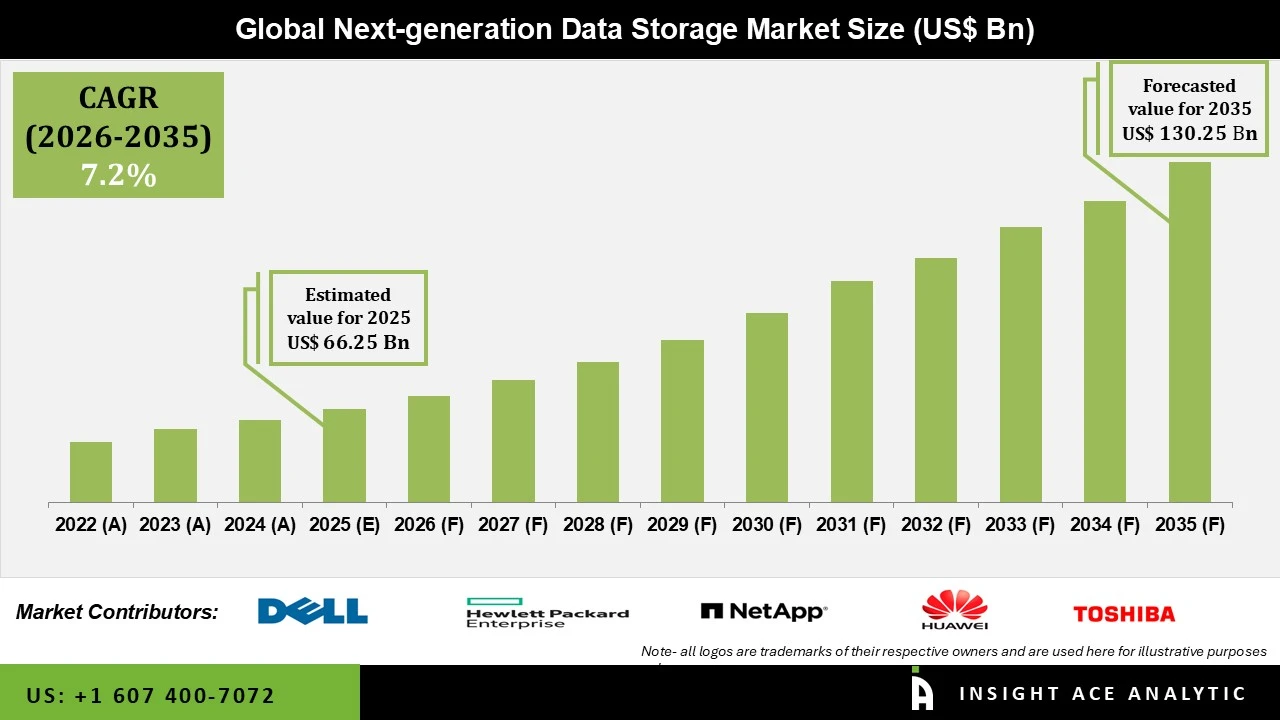
Next generation data storage is described as innovative storage devices or structures which have been developed to cater for the ever-growing needs for storage capacity, speed, scalability, energy efficiency, and reliability. This market includes SSDs, hybrid flash arrays, software-defined storage, high-capacity magnetic storage, storage-class memory and some innovative solutions like DNA storage and holographic storage. The Next Generation Data Storage Market is currently undergoing rapid development due to the increasing amounts of both structured and unstructured data being generated by businesses. The use of AI, cloud computing, IoT, high-performance computing, video content, and digital applications has led to an increase in the demands for data storage infrastructure regarding capacity and speed. Therefore, traditional storage solutions are being substituted or supplemented by more advanced storage infrastructures providing increased throughput, speed, scalability and advanced management of data.
AI is becoming a vital component of storage technology. AI training and inference workloads create huge data sets and require the fast moving of data between compute, memory, and storage. Industry recent data shows that the growing demand for AI servers is already contributing to the robust demand for NAND flash and data center buys helped the NAND flash market to remain tight till 2026. Cloud and hybrid storage architectures are also driving the development of this market. Companies seek storage solutions which can adapt to the workload requirements, offer data protection, cybersecurity and remote access capabilities. Software-defined storage is very useful since it is the separation of storage management from dedicated hardware which enables flexible resource management.
One more important trend in storage technology is the development of high-density and long-living storage solutions. DNA storage is currently being developed for long-term archival storage because DNA can store very large amount of information with very high density during a long period under certain conditions. Recently researchers are also making progress in DNA storage regarding error correction, coding, random access and machine learning methods. Therefore, the market is developing on several levels. Traditional SSD and HDD technologies still cover the major part of the commercial storage deployments, but innovative storage-class memory, DNA storage, holographic storage and computationally optimized architectures are being developed for future specific applications.
Competitive Landscape
Which are the Leading Players in Next-generation Data Storage Market?
• Samsung Electronics Co., Ltd.
• Seagate Technology Holdings plc
• SanDisk Corporation
• Micron Technology, Inc.
• SK hynix Inc.
• Western Digital Corporation
• Solidigm Technology
• Pure Storage, Inc.
• Dell Technologies Inc.
• Hewlett Packard Enterprise
• NetApp, Inc.
• IBM Corporation
• Lenovo Group Limited
• Huawei Technologies Co., Ltd.
• Hitachi Vantara
• Nutanix, Inc.
• DataDirect Networks
• VAST Data
• Quantum Corporation
• Infinidat
• Fujitsu Limited
• Toshiba Corporation
• Microsoft Corporation
• Amazon Web Services
• Google Cloud
Market Dynamics
Driver
Increasing Data Generation from AI, Cloud Computing and IoT
The rise in the creation of data is one of the biggest trends impacting the Next-generation Data Storage Market. Various artificial intelligence models, IoT devices, digital products and services, video apps, and cloud platforms generate massive amounts of data which needs to be stored, analyzed, safeguarded, and accessed. AI plays a critical role in this context since larger models need large amounts of data for training purposes and data accessibility. With increasing AI infrastructure, the requirements are shifting from capacity to high throughput and low latency. This trend can also be understood by looking at some recent activities in the market. There has been significant demand in the NAND flash market for 2026 because of the deployment of AI servers.
Restrain/Challenge
High Cost of Advanced Storage Infrastructure
High-end storage solutions might involve a lot of financial expenditure on hardware, network resources, software, and management tools. High-end solid-state drives (SSDs) and special storage solutions might turn out to be much costlier compared to traditional hard disk drive (HDD)-based solutions. The matter of cost becomes crucial in case of small companies that have huge needs for archiving. That is why companies tend to apply tiered storage systems by using both SSDs and HDDs, as well as cloud and archive storage solutions.
Solid-State Drive Segment is Expected to Drive the Next-generation Data Storage Market
SSDs are forecasted to maintain their status as one of the most prominent technology categories due to their high performance, low latency, small form factor, and better reliability than that provided by mechanical drives. The SSD segment is being driven by enterprise data centers, cloud computing, artificial intelligence, gaming, high-performance computing, and more demanding business applications. Higher density of NAND technology is playing an important role in increasing the capacity of SSDs. QLC and next generation NAND technologies are becoming increasingly significant for capacity-driven applications, whereas high-performance SSDs cater to latency-driven applications.
Software-defined Storage Segment is Growing at a Significant Rate in the Next-generation Data Storage Market
The use of software-defined storage is expected to see impressive growth because it makes it possible to manage storage resources via software and not have any tight connections with hardware that may come from any particular manufacturer. It could lead to enhanced scalability, automation, efficiency, and flexibility. The technology is especially relevant in cloud-native settings and large data centers where storage resources should vary depending on workload. The development of AI technologies makes intelligent storage management even more important. Modern storage systems include such features as automated data placement, workload analysis, predictive maintenance, and other AI-driven features.
Why North America Led the Next-generation Data Storage Market?
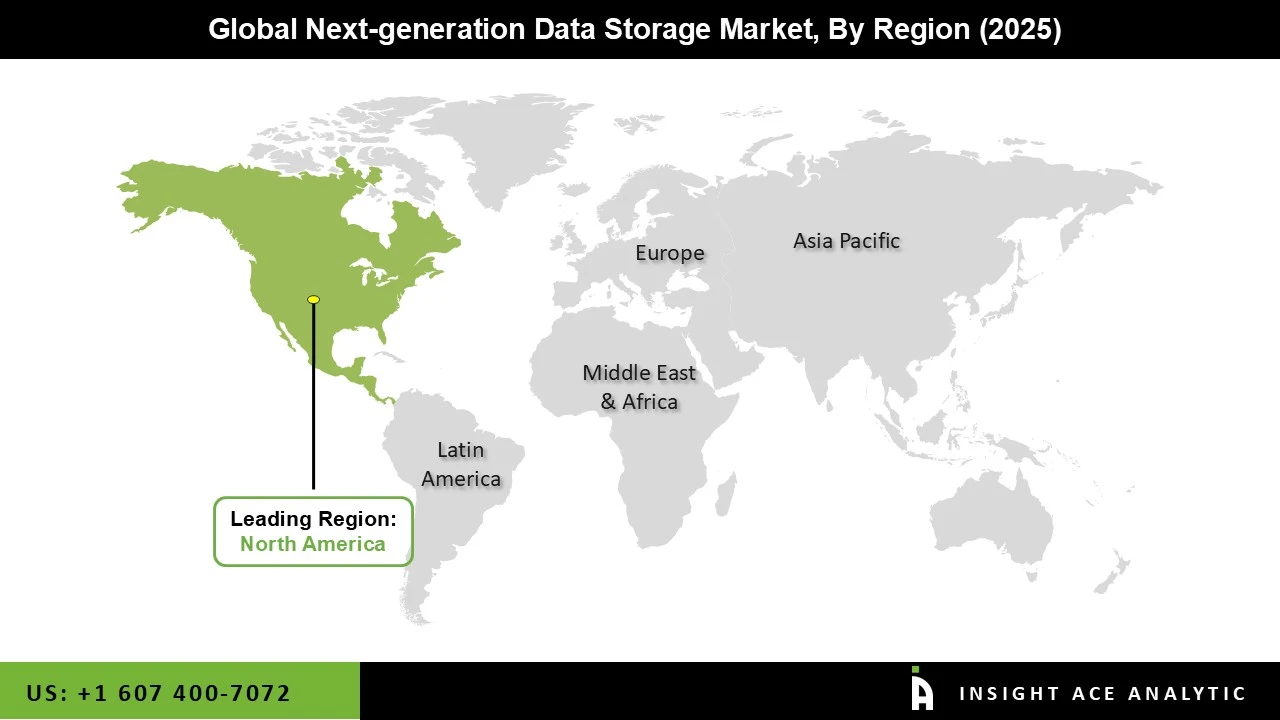
North America dominated the market of Next-generation Data Storage during 2025 owing to the growth of hyperscale cloud infrastructure, artificial intelligence computing facilities, enterprise digitalization, and advanced data center networking. The United States plays the key role in this market because there is a high concentration of cloud service providers, hyperscale data centers, tech companies, banks, hospitals, and governmental agencies.
Infrastructure for artificial intelligence becomes increasingly important in the context under discussion. Large GPU cluster demands high-capacity storage solutions that can deliver data for accelerators in an efficient way without creating any bottlenecks. It stimulates the development of high-performance SSDs, flash arrays, parallel file systems, object storage, and artificial intelligence storage solutions.
Next-generation Data Storage Market Report Scope:
| Report Attribute | Specifications |
| Market size value in 2025 | USD 66.25 Bn |
| Revenue forecast in 2035 | USD 130.25 Bn |
| Growth Rate CAGR | CAGR of 7.2% from 2026 to 2035 |
| Quantitative Units | Representation of revenue in US$ Bn and CAGR from 2026 to 2035 |
| Historic Year | 2022 to 2025 |
| Forecast Year | 2026-2035 |
| Report Coverage | The forecast of revenue, the position of the company, the competitive market structure, growth prospects, and trends |
| Segments Covered | Storage System, Storage Medium, Storage Aarchitecture, Deployment Mode, End-user, and By Region |
| Regional Scope | North America; Europe; Asia Pacific; Latin America; Middle East & Africa |
| Country Scope | U.S.; Canada; U.K.; Germany; China; India; Japan; Brazil; Mexico; France; Italy; Spain; South Korea; Southeast Asia |
| Competitive Landscape | Samsung Electronics, Seagate Technology, SanDisk, Micron Technology, SK hynix, Western Digital, Solidigm, Pure Storage, Dell Technologies, HPE, NetApp, IBM, Lenovo, Huawei, Hitachi Vantara, Nutanix, VAST Data, Quantum, Infinidat, Fujitsu, Toshiba, Microsoft, Amazon Web Services, and Google Cloud. |
| Customization Scope | Free customization report with the procurement of the report, Modifications to the regional and segment scope. Geographic competitive landscape. |
| Pricing and Available Payment Methods | Explore pricing alternatives that are customized to your particular study requirements. |
Market Segmentation:
Next-generation Data Storage Market by Stoagare System -
• Direct-attached Storage
• Network-attached Storage
• Storage Area Network
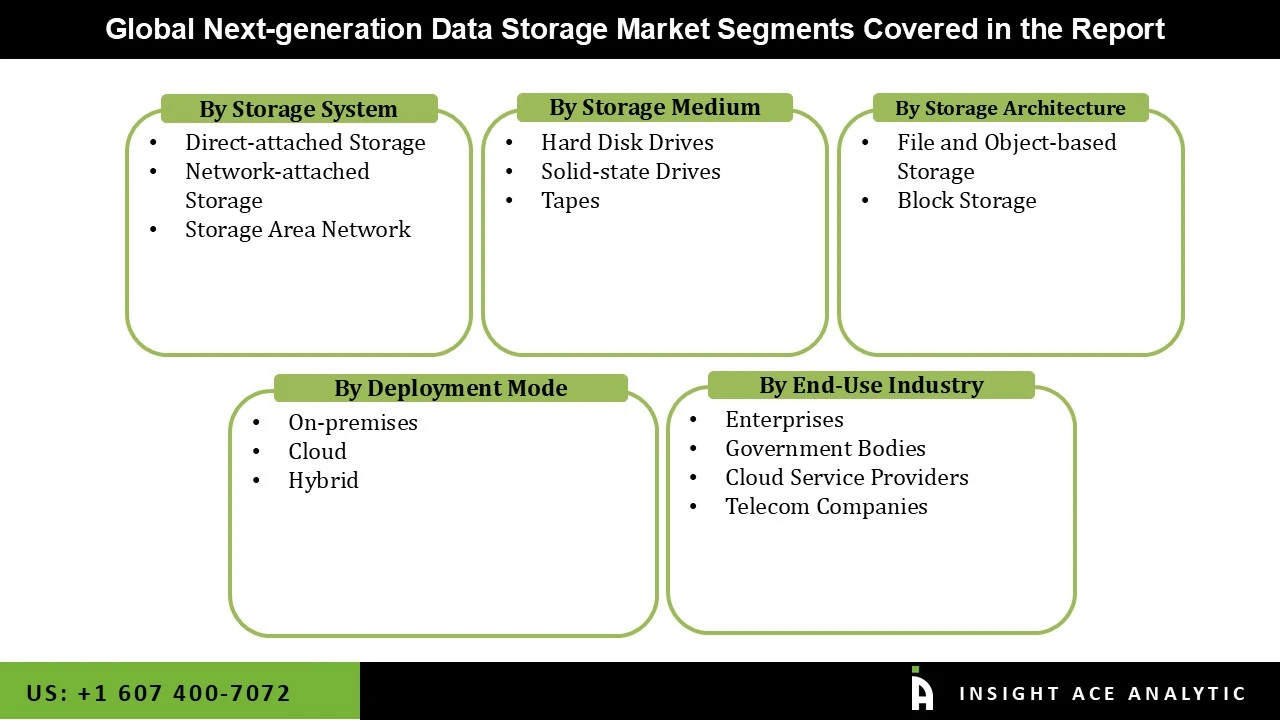
Next-generation Data Storage Market by Storage Medium -
• Hard Disk Drives
• Solid-state Drives
• Tapes
Next-generation Data Storage Market by Storage Architecture -
• File and Object-based Storage
• Block Storage
Next-generation Data Storage Market by Deployment Mode -
• On-Premise
• Cloud
• Hybrid
Next-generation Data Storage Market by End-User-
• Enterprises
• Government Bodies
• Cloud Service Providers
• Telecom Companies
Research Design and Approach
This study employed a multi-step, mixed-method research approach that integrates:
- Secondary research
- Primary research
- Data triangulation
- Hybrid top-down and bottom-up modelling
- Forecasting and scenario analysis
This approach ensures a balanced and validated understanding of both macro- and micro-level market factors influencing the market.
Secondary Research
Secondary research for this study involved the collection, review, and analysis of publicly available and paid data sources to build the initial fact base, understand historical market behaviour, identify data gaps, and refine the hypotheses for primary research.
Sources Consulted
Secondary data for the market study was gathered from multiple credible sources, including:
- Government databases, regulatory bodies, and public institutions
- International organizations (WHO, OECD, IMF, World Bank, etc.)
- Commercial and paid databases
- Industry associations, trade publications, and technical journals
- Company annual reports, investor presentations, press releases, and SEC filings
- Academic research papers, patents, and scientific literature
- Previous market research publications and syndicated reports
These sources were used to compile historical data, market volumes/prices, industry trends, technological developments, and competitive insights.

Primary Research
Primary research was conducted to validate secondary data, understand real-time market dynamics, capture price points and adoption trends, and verify the assumptions used in the market modelling.
Stakeholders Interviewed
Primary interviews for this study involved:
- Manufacturers and suppliers in the market value chain
- Distributors, channel partners, and integrators
- End-users / customers (e.g., hospitals, labs, enterprises, consumers, etc., depending on the market)
- Industry experts, technology specialists, consultants, and regulatory professionals
- Senior executives (CEOs, CTOs, VPs, Directors) and product managers
Interview Process
Interviews were conducted via:
- Structured and semi-structured questionnaires
- Telephonic and video interactions
- Email correspondences
- Expert consultation sessions
Primary insights were incorporated into demand modelling, pricing analysis, technology evaluation, and market share estimation.
Data Processing, Normalization, and Validation
All collected data were processed and normalized to ensure consistency and comparability across regions and time frames.
The data validation process included:
- Standardization of units (currency conversions, volume units, inflation adjustments)
- Cross-verification of data points across multiple secondary sources
- Normalization of inconsistent datasets
- Identification and resolution of data gaps
- Outlier detection and removal through algorithmic and manual checks
- Plausibility and coherence checks across segments and geographies
This ensured that the dataset used for modelling was clean, robust, and reliable.
Market Size Estimation and Data Triangulation
Bottom-Up Approach
The bottom-up approach involved aggregating segment-level data, such as:
- Company revenues
- Product-level sales
- Installed base/usage volumes
- Adoption and penetration rates
- Pricing analysis
This method was primarily used when detailed micro-level market data were available.

Top-Down Approach
The top-down approach used macro-level indicators:
- Parent market benchmarks
- Global/regional industry trends
- Economic indicators (GDP, demographics, spending patterns)
- Penetration and usage ratios
This approach was used for segments where granular data were limited or inconsistent.
Hybrid Triangulation Approach
To ensure accuracy, a triangulated hybrid model was used. This included:
- Reconciling top-down and bottom-up estimates
- Cross-checking revenues, volumes, and pricing assumptions
- Incorporating expert insights to validate segment splits and adoption rates
This multi-angle validation yielded the final market size.
Forecasting Framework and Scenario Modelling
Market forecasts were developed using a combination of time-series modelling, adoption curve analysis, and driver-based forecasting tools.
Forecasting Methods
- Time-series modelling
- S-curve and diffusion models (for emerging technologies)
- Driver-based forecasting (GDP, disposable income, adoption rates, regulatory changes)
- Price elasticity models
- Market maturity and lifecycle-based projections
Scenario Analysis
Given inherent uncertainties, three scenarios were constructed:
- Base-Case Scenario: Expected trajectory under current conditions
- Optimistic Scenario: High adoption, favourable regulation, strong economic tailwinds
- Conservative Scenario: Slow adoption, regulatory delays, economic constraints
Sensitivity testing was conducted on key variables, including pricing, demand elasticity, and regional adoption.
Request Customization
Add countries, segments, company profiles, or extend forecast — free 10% customization with purchase.
Customize This Report →Enquire Before Buying
Speak with our analyst team about scope, methodology, pricing, or deliverable formats.
Enquire Now →Frequently Asked Questions
Next Generation Data Storage Market Size is valued at USD 66.25 Bn in 2025 and is predicted to reach USD 130.25 Bn by the year 2035
Next Generation Data Storage Market is expected to grow at a 7.2% CAGR during the forecast period for 2026 to 2035.
Samsung Electronics, Seagate Technology, SanDisk, Micron Technology, SK hynix, Western Digital, Solidigm, Pure Storage, Dell Technologies, HPE, NetApp, IBM, Lenovo, Huawei, Hitachi Vantara, Nutanix, VAST Data, Quantum, Infinidat, Fujitsu, Toshiba, Microsoft, Amazon Web Services, and Google Cloud.
Next Generation Data Storage Market is segmented into Storage System, Storage Medium, Storage Aarchitecture, Deployment Mode, End-user, and By Region
North America region is leading the Next Generation Data Storage Market.