



Global Metaverse Market Size is valued at USD 144.3 Billion in 2024 and is predicted to reach USD 4071.3 billion by the year 2034 at a 39.8% CAGR during the forecast period for 2025-2034.

The phrase "metaverse" refers to deeply immersive 3D virtual world encounters made possible by combining AR, VR, and MR technologies. The metaverse platform enhances the internet experience by creating a virtual world where users can partake in immersive games, business transactions, social interactions, purchasing and selling virtual properties, and comprehensive entertainment, among other activities.
The rise of mixed reality (MR) and augmented reality (AR)virtual reality (VR), as well as COVID-19's outbreak and its future developments and outcomes, are three major causes that are anticipated to contribute to the metaverse market revenue increase. Another important element is the growing emphasis on fusing the digital and physical worlds through the Internet.
Furthermore, one of the metaverse's bright future promises is that customers in emerging and frontier economies now have far greater access to the market. Access to previously inaccessible goods and services has already been made possible thanks to the Internet. For instance, workers from developing nations may now be able to work in western firms without moving. Due to its low cost and efficiency as a learning tool, virtual reality environments will aid in enhancing educational options. Consumers have been using online games for leisure on the Internet. Because it provides a more user-friendly interface than conventional online gaming platforms, this has aided in the metaverse market expansion.
Additionally, gaming experience has been enhanced using tools and platforms like VR headsets, smart helmets, and MR displays, encouraging game creators to employ metaverse more frequently. As a result, the metaverse market demand has increased.
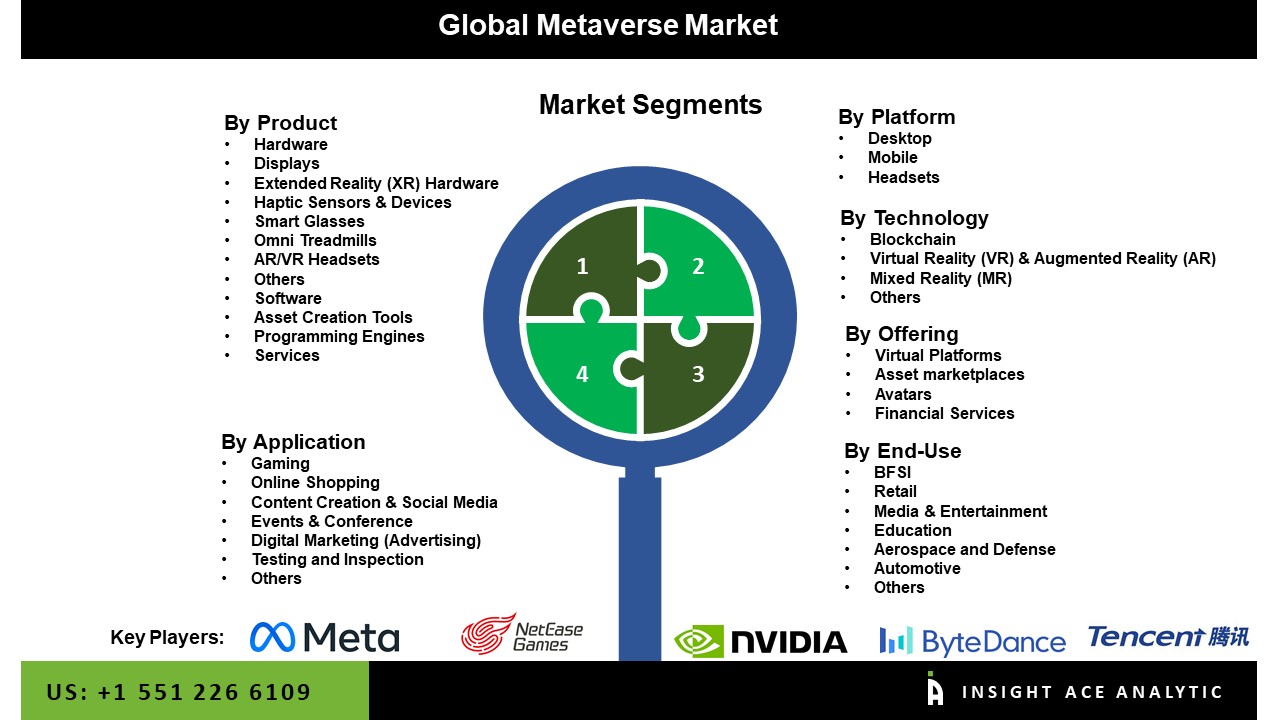
The metaverse market is segmented based on product, platform, technology, application, and end-users. Based on product, the metaverse market is segmented as hardware and software. By platform, the market is segmented as desktop, mobile and headsets. By technology, the market is segmented as blockchain, VR & AR, mixed reality, and others. By offering, the market is segmented as virtual platforms, asset marketplaces, avatars, and financial services. The market is segmented by applications: online shopping, content creation, gaming, social media, and others. By end users, the market is segmented as BSFI, retail, media & entertainment, education, aerospace and defence, automotive and others.
The hardware category is expected to hold a major share of the global Metaverse market in 2024. The hardware sector is anticipated to account for the most substantial revenue share throughout the projected period due to an increasing focus among companies on manufacturing products that give a better user experience and enable more extended user immersion. Companies are also attempting to create more sophisticated gear, such as VR/AR helmets, haptic sensors, and detectors, to enhance the realism of virtual worlds. This market's expected revenue growth will also be fueled by the creation of user interfaces that let users access 3D material on some gadgets, including smartphones, next-generation TVs, and the mixed reality smart glasses known as HoloLens.
The desktop segment is projected to grow rapidly in the global Metaverse market. With the advent of smartphones and wireless networks, workstations are no longer the main entry point into the metaverse. With the HTC Vivi, Facebook Rift / Rift S, WMR headsets, and Valve Index, users can use the computer in virtual reality thanks to the virtual desktop program. Users can play video games, browse the web, and watch Netflix movies on a sizable virtual screen. Virtual machines are becoming more popular for usage with VR equipment. Accessibility to the metaverse is now unmatched and almost constant, thanks to mobile phones and mobile networks. Large-scale data downloading, uploading, and sharing are becoming more frequent in networked cyberspace.
The North American metaverse market is expected to register the highest market share in revenue soon. Because an increasing number of users and clients in the area are embracing new, complicated equipment, another factor anticipated to boost the regional market's revenue growth is the rising number of startups concentrating on creating metaverse infrastructure for monetization. In addition, the Asia Pacific region is expected to increase in the global Metaverse market. This results from the president's quick digitalization ambitions in developing nations like China and India. Additionally, it is anticipated that the economic development of Asian nations will increase the region's use of the metaverse, spurring the market's expansion faster. Public policies supporting technology-driven startups are anticipated to play a big role in the market's expansion.
| Report Attribute | Specifications |
| Market size value in 2024 | USD 144.3 Billion |
| Revenue forecast in 2034 | USD 4071.3 Billion |
| Growth rate CAGR | CAGR of 39.8% from 2025 to 2034 |
| Quantitative units | Representation of revenue in US$ Billion, and CAGR from 2025 to 2034 |
| Historic Year | 2021 to 2024 |
| Forecast Year | 2025-2034 |
| Report coverage | The forecast of revenue, the position of the company, the competitive market statistics, growth prospects, and trends |
| Segments covered | Product, Platform, Technology, Application, And End-Users |
| Regional scope | North America; Europe; Asia Pacific; Latin America; Middle East & Africa |
| Country scope | U.S.; Canada; U.K.; Germany; China; India; Japan; Brazil; Mexico; The UK; France; Italy; Spain; China; Japan; India; South Korea; Southeast Asia; South Korea; Southeast Asia |
| Competitive Landscape | Meta Platforms, Inc.; Tencent Holdings Ltd; Epic Games, Inc.; Nvidia Corporation; Unity Technologies, Inc. |
| Customization scope | Free customization report with the procurement of the report, Modifications to the regional and segment scope. Particular Geographic competitive landscape. |
| Pricing and available payment methods | Explore pricing alternatives that are customized to your particular study requirements. |
Metaverse Market By Metaverse Product
Metaverse Market By Metaverse Platform
Metaverse Market By Metaverse Technology
Metaverse Market By Metaverse Application
Metaverse Market By Metaverse End-use
Metaverse Market By Region-
North America-
Europe-
Asia-Pacific-
Latin America-
Middle East & Africa-
This study employed a multi-step, mixed-method research approach that integrates:
This approach ensures a balanced and validated understanding of both macro- and micro-level market factors influencing the market.
Secondary research for this study involved the collection, review, and analysis of publicly available and paid data sources to build the initial fact base, understand historical market behaviour, identify data gaps, and refine the hypotheses for primary research.
Secondary data for the market study was gathered from multiple credible sources, including:
These sources were used to compile historical data, market volumes/prices, industry trends, technological developments, and competitive insights.

Primary research was conducted to validate secondary data, understand real-time market dynamics, capture price points and adoption trends, and verify the assumptions used in the market modelling.
Primary interviews for this study involved:
Interviews were conducted via:
Primary insights were incorporated into demand modelling, pricing analysis, technology evaluation, and market share estimation.
All collected data were processed and normalized to ensure consistency and comparability across regions and time frames.
The data validation process included:
This ensured that the dataset used for modelling was clean, robust, and reliable.
The bottom-up approach involved aggregating segment-level data, such as:
This method was primarily used when detailed micro-level market data were available.
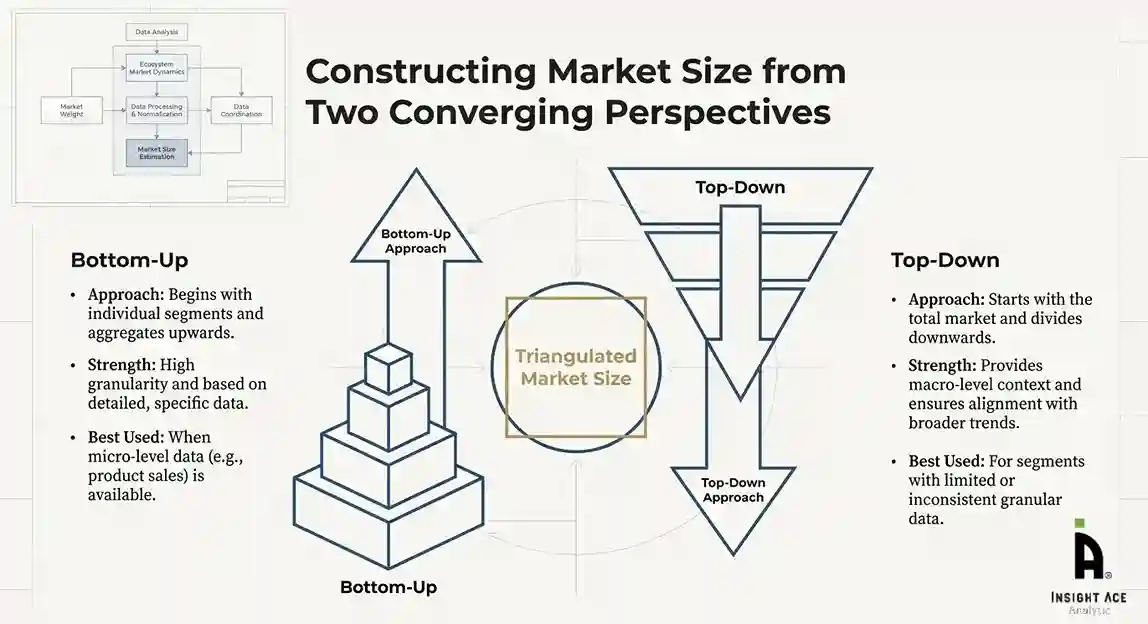
The top-down approach used macro-level indicators:
This approach was used for segments where granular data were limited or inconsistent.
To ensure accuracy, a triangulated hybrid model was used. This included:
This multi-angle validation yielded the final market size.
Market forecasts were developed using a combination of time-series modelling, adoption curve analysis, and driver-based forecasting tools.
Given inherent uncertainties, three scenarios were constructed:
Sensitivity testing was conducted on key variables, including pricing, demand elasticity, and regional adoption.