Metaverse in Healthcare Market Size, Share & Trends Analysis Report By Technology (Augmented Reality (AR), Virtual Reality (VR), Artificial Intelligence (AI), Mixed Reality (MR)) And Device (VR Headsets, AR Devices, Mixed Reality Platforms), By Component, By End-user, By Region, And Segment Forecasts, 2025-2034

Report Id: 1226 Pages: 180 Last Updated: 25 March 2025 Format: PDF / PPT / Excel / Power BI
Share With : linkedin twitter facebook

Metaverse in Healthcare Market Size is valued at  8.7 billion in 2024 and is predicted to reach  205.0 billion by the year 2034 at an 37.8% CAGR during the forecast period for 2025-2034.

Key Industry Insights & Findings from the Report:

  • Increasing adoption and awareness of mixed reality for performing minimally invasive surgeries is driving metaverse in the healthcare market.
  • The use of metaverse in medical training is growing, which is driving the metaverse in the healthcare market.
  • North America dominated the market and accounted for a global revenue share in 2023.
  • The key challenges for the metaverse in the Healthcare Market are data privacy and security concerns.

 Metaverse in Healthcare Market INFO

While the Metaverse evolves, it holds new potential in healthcare by combining technologies such as Artificial Intelligence(AI), Virtual Reality(VR), Augmented Reality(AR), the Internet of Medical Devices, Web 3.0, intelligent cloud, edge, and quantum computing, and robotics, to provide new directions to healthcare. Together, they can open entirely new channels for delivering treatment, lowering costs, and significantly improving patient outcomes in healthcare. Metaverse also represents blockchain technology, which has the potential to address healthcare issues such as data security and health record management. It will also perform an essential role in ensuring data privacy in this industry. Usage of robotics or what is also known as robot-assisted surgeries were already in use to perform complicated procedures with precision and flexibility. 

Increasing the use of AR platforms to perform complex surgical procedures with higher precision and flexibility will boost the Global Metaverse in Healthcare Market growth. Other critical factors expected to contribute to market revenue in the coming years include increased collaborations among foremost companies to develop AR and VR solutions to improve the overall surgical environment and expanding investment to create metaverse platforms to transform the healthcare sector. An increasing number of companies are investing substantially in digital healthcare platforms to improve telemedicine experience, accelerate the transition to virtual reality, and enhance other medical services through augmented reality.

The challenges associated with patient data privacy, the high cost of high-tech devices and hardware, and the rising costs of more advanced digital healthcare infrastructure may limit market growth to some extent over the forecast period.

According to regional analysis, North America is expected to account for the largest revenue share during the forecast period. Due to the region's strong presence of metaverse-focused companies, rapid advancements in healthcare infrastructure, integration of AR and VR devices and platforms in the healthcare sector, increased investment to develop new and more innovative Augmented Reality products and applications, and advancements in software and hardware.

Prominent market players Covered in this Report are: 

  • Intuitive Surgical Inc.
  • CableLabs
  • Microsoft
  • Google LLC
  • Meta Platforms, Inc.
  • 8chilli, Inc.
  • Global Healthcare Academy
  • 3D Systems Corp.
  • AccuVein Inc.
  • BioflightVR
  • CAE Inc.
  • Devden Creative Solutions Pvt. Ltd.
  • Dhi Tattva Solutions Pvt. Ltd.
  • Eon Reality Inc.
  • ImmersiveTouch Inc.
  • Intuitive Surgical Inc.
  • Koninklijke Philips NV
  • Medical Realities Ltd.
  • MindMaze SA
  • Oodles Technologies
  • Siemens AG
  • Sky gate
  • UnitedHealth Group Inc.
  • Wipro Ltd.
  • WorldViz Inc.
  • Nvidia Corporation
  • Novarad Corporation
  • Xrhealth
  • Augmedics
  • Medtronic Plc
  • Brainlab Ag
  • Merative
  • Ge Healthcare
  • Surgical Theater
  • Osso VR
  • Medical Realities
  • Firsthand Technology
  • Vuzix
  • Magic Leap
  • zSpace Inc
  • VirtaMed
  • Virtually Better
  • EchoPixel Inc
  • InfiVR
  • Other Prominant Players

Market Segmentation

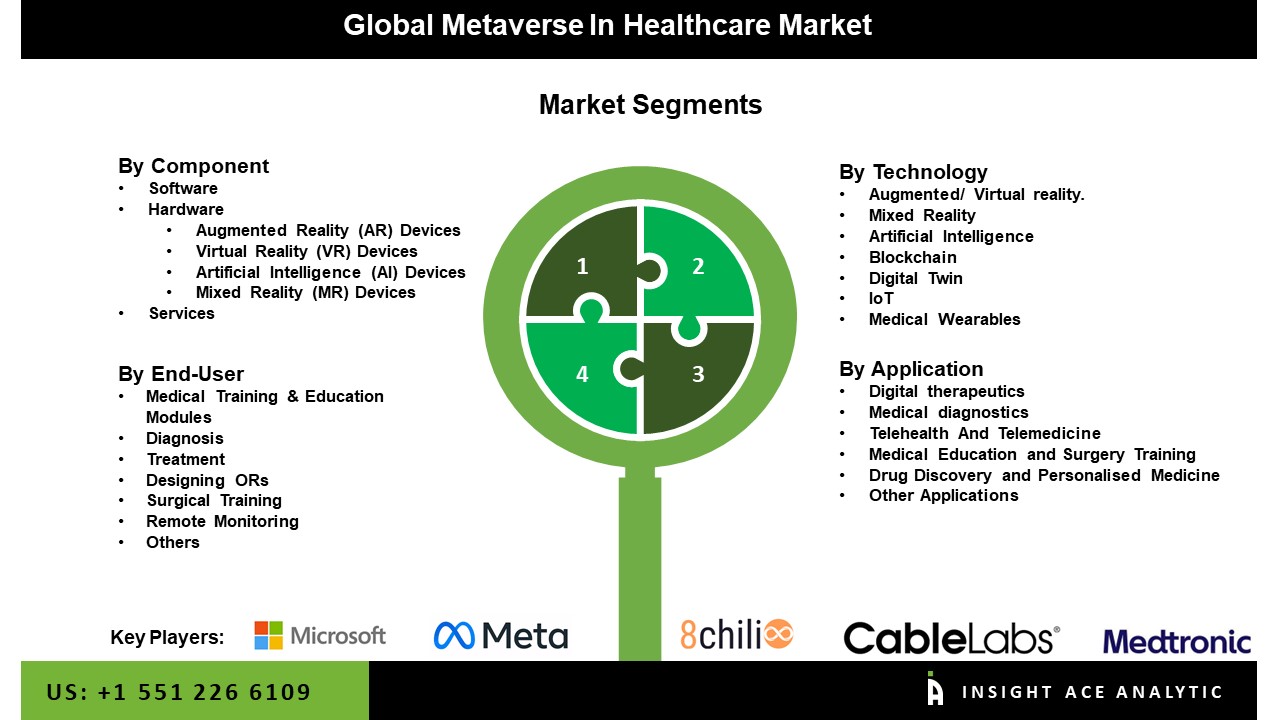
Global Metaverse in Healthcare Market is segmented By Component which comprises Software, Hardware, and Services. The Hardware consists of Augmented Reality (AR) Devices, Virtual Reality (VR) Devices, Artificial Intelligence (AI) Devices, Mixed Reality (MR) Devices. Among All the components, software division will contribute more market revenue than the hardware in the forecasting period. Secondly, the Technology segment is divided into Augmented/ Virtual reality, Mixed Reality, Artificial Intelligence, Blockchain, Digital Twin, IoT, Medical Wearables, which are futuristic technologies human beings use for ease of lifestyle. The third segment is Application having Digital therapeutics, Medical diagnostics, Telehealth And Telemedicine, Medical Education and Surgery Training, Drug Discovery and Personalized Medicine, Other Applications as the subsegments. At last, the market is segmented By End-User, which has Medical Training & Education Modules, Diagnosis, Designing ORs, Treatment, Surgical Training, Remote Monitoring, and Others as the important subsegments to contribute in the market.

Recent Developments

  • In July 2023, Philips and CoxHealth collaborated on a virtual care solution. With the intention of improving clinical care, the solution led to enhanced patient outcomes and increased staff satisfaction. The press release noted that Philips Capsule Surveillance software and Philips eCareManager telehealth software were integrated into the solution. By utilizing artificial intelligence and clinical algorithms, the system synthesized patient data and generated valuable insights to identify patients who were at risk.
  • In Nov 2022, CAE, a preeminent authority in simulation-based education, and HealthStream, Inc. formed a new strategic alliance. hStream-Certified CAE Healthcare manikins are now available for healthcare organizations that previously utilized the American Red Cross Resuscitation Suite™ curriculum via HealthStream to finish their resuscitation certification.

Metaverse in Healthcare Market Report Scope:

Report Attribute Specifications
Market size value in 2024 USD 8.7 Bn
Revenue forecast in 2034 USD 205.0 Bn
Growth rate CAGR CAGR of 37.8% from 2025 to 2034
Quantitative units Representation of revenue in US$ Million, and CAGR from 2025 to 2034
Historic Year 2021 to 2024
Forecast Year 2025-2034
Report coverage The forecast of revenue, the position of the company, the competitive market structure, growth prospects, and trends
Segments covered Component, Technology, Devices and End-user
Regional scope North America; Europe; Asia Pacific; Latin America; Middle East & Africa
Country scope U.S.; Canada; U.K.; Germany; Japan; Brazil; Mexico; The UK; France; Italy; Spain; China; Japan; India; South Korea; Southeast Asia
Competitive Landscape Intuitive Surgical Inc., CableLabs, Microsoft, Google LLC, Meta Platforms, Inc., 8chilli, Inc., Global Healthcare Academy, 3D Systems Corp., AccuVein Inc., BioflightVR, CAE Inc., Devden Creative Solutions Pvt. Ltd., Dhi Tattva Solutions Pvt. Ltd., Eon Reality Inc., ImmersiveTouch Inc., Intuitive Surgical Inc., Koninklijke Philips NV, Medical Realities Ltd., MindMaze SA, Oodles Technologies, Siemens AG, Sky gate, UnitedHealth Group Inc., Wipro Ltd., WorldViz Inc., Nvidia Corporation, Novarad Corporation, Xrhealth, Augmedics, Medtronic Plc, Brainlab Ag, Merative, Ge Healthcare, Surgical Theater, Osso VR, Medical Realities, Firsthand Technology, Vuzix, Magic Leap, zSpace Inc, VirtaMed, Virtually Better, EchoPixel Inc, InfiVR, Other Prominant Players
Customization scope Free customization report with the procurement of the report, Modifications to the regional and segment scope. Particular Geographic competitive landscape.
Pricing and available payment methods Explore pricing alternatives that are customized to your particular study requirements.

Segmenents in the Metaverse in Healthcare Market:

Global Metaverse in Healthcare Market , by Component, 2025-2034 (Value US$ Mn)

  • Software
  • Hardware
    • AR Devices
    • VR Devices
    • MR Devices
    • Displays
  • Services

Metaverse in healthcare market

Global Metaverse in Healthcare Market , by Technology, 2025-2034 (Value US$ Mn)

  • Augmented/ Virtual reality.
  • Mixed Reality
  • Artificial Intelligence
  • Blockchain
  • Digital Twin
  • IoT
  • Medical Wearables

Global Metaverse in Healthcare Market  by Application, 2025-2034  (Value US$ Mn)

  • Digital therapeutics
  • Medical diagnostics
  • Telehealth And Telemedicine
  • Medical Education and Surgery Training
  • Drug Discovery and Personalised Medicine
  • Other Applications

Global Metaverse in Healthcare Market  by End-User, 2025-2034  (Value US$ Mn)

  • Medical Training & Education Modules
  • Diagnosis
  • Treatment
  • Designing ORs
  • Surgical Training
  • Remote Monitoring
  • Others

Global Metaverse in Healthcare Market , by Region, 2025-2034  (Value US$ Mn)

  • North America
  • Europe
  • Asia Pacific
  • Latin America
  • Middle East & Africa

North America Metaverse in Healthcare Market , by Country, 2025-2034  (Value US$ Mn)

  • U.S.
  • Canada

Europe Metaverse in Healthcare Market , by Country, 2025-2034  (Value US$ Mn)

  • Germany
  • France
  • Italy
  • Spain
  • Russia
  • Rest of Europe

Asia Pacific Metaverse in Healthcare Market , by Country, 2025-2034  (Value US$ Mn)

  • India
  • China
  • Japan
  • South Korea
  • Australia & New Zealand

Latin America Metaverse in Healthcare Market , by Country, 2025-2034  (Value US$ Mn)

  • Brazil
  • Mexico
  • Rest of Latin America

Middle East & Africa Metaverse in Healthcare Market , by Country, 2025-2034  (Value US$ Mn)

  • GCC Countries
  • South Africa
  • Rest of Middle East & Africa

Competitive Landscape

  • Company Overview
  • Financial Performance
  • Key Development

Latest Strategic Development

Need specific information/chapter from the report of the custom data table, graph or complete report? Tell us more.

Research Design and Approach

This study employed a multi-step, mixed-method research approach that integrates:

  • Secondary research
  • Primary research
  • Data triangulation
  • Hybrid top-down and bottom-up modelling
  • Forecasting and scenario analysis

This approach ensures a balanced and validated understanding of both macro- and micro-level market factors influencing the market.

Secondary Research

Secondary research for this study involved the collection, review, and analysis of publicly available and paid data sources to build the initial fact base, understand historical market behaviour, identify data gaps, and refine the hypotheses for primary research.

Sources Consulted

Secondary data for the market study was gathered from multiple credible sources, including:

  • Government databases, regulatory bodies, and public institutions
  • International organizations (WHO, OECD, IMF, World Bank, etc.)
  • Commercial and paid databases
  • Industry associations, trade publications, and technical journals
  • Company annual reports, investor presentations, press releases, and SEC filings
  • Academic research papers, patents, and scientific literature
  • Previous market research publications and syndicated reports

These sources were used to compile historical data, market volumes/prices, industry trends, technological developments, and competitive insights.

Secondary Research

Primary Research

Primary research was conducted to validate secondary data, understand real-time market dynamics, capture price points and adoption trends, and verify the assumptions used in the market modelling.

Stakeholders Interviewed

Primary interviews for this study involved:

  • Manufacturers and suppliers in the market value chain
  • Distributors, channel partners, and integrators
  • End-users / customers (e.g., hospitals, labs, enterprises, consumers, etc., depending on the market)
  • Industry experts, technology specialists, consultants, and regulatory professionals
  • Senior executives (CEOs, CTOs, VPs, Directors) and product managers

Interview Process

Interviews were conducted via:

  • Structured and semi-structured questionnaires
  • Telephonic and video interactions
  • Email correspondences
  • Expert consultation sessions

Primary insights were incorporated into demand modelling, pricing analysis, technology evaluation, and market share estimation.

Data Processing, Normalization, and Validation

All collected data were processed and normalized to ensure consistency and comparability across regions and time frames.

The data validation process included:

  • Standardization of units (currency conversions, volume units, inflation adjustments)
  • Cross-verification of data points across multiple secondary sources
  • Normalization of inconsistent datasets
  • Identification and resolution of data gaps
  • Outlier detection and removal through algorithmic and manual checks
  • Plausibility and coherence checks across segments and geographies

This ensured that the dataset used for modelling was clean, robust, and reliable.

Market Size Estimation and Data Triangulation

Bottom-Up Approach

The bottom-up approach involved aggregating segment-level data, such as:

  • Company revenues
  • Product-level sales
  • Installed base/usage volumes
  • Adoption and penetration rates
  • Pricing analysis

This method was primarily used when detailed micro-level market data were available.

Bottom Up Approach

Top-Down Approach

The top-down approach used macro-level indicators:

  • Parent market benchmarks
  • Global/regional industry trends
  • Economic indicators (GDP, demographics, spending patterns)
  • Penetration and usage ratios

This approach was used for segments where granular data were limited or inconsistent.

Hybrid Triangulation Approach

To ensure accuracy, a triangulated hybrid model was used. This included:

  • Reconciling top-down and bottom-up estimates
  • Cross-checking revenues, volumes, and pricing assumptions
  • Incorporating expert insights to validate segment splits and adoption rates

This multi-angle validation yielded the final market size.

Forecasting Framework and Scenario Modelling

Market forecasts were developed using a combination of time-series modelling, adoption curve analysis, and driver-based forecasting tools.

Forecasting Methods

  • Time-series modelling
  • S-curve and diffusion models (for emerging technologies)
  • Driver-based forecasting (GDP, disposable income, adoption rates, regulatory changes)
  • Price elasticity models
  • Market maturity and lifecycle-based projections

Scenario Analysis

Given inherent uncertainties, three scenarios were constructed:

  • Base-Case Scenario: Expected trajectory under current conditions
  • Optimistic Scenario: High adoption, favourable regulation, strong economic tailwinds
  • Conservative Scenario: Slow adoption, regulatory delays, economic constraints

Sensitivity testing was conducted on key variables, including pricing, demand elasticity, and regional adoption.


Name field cannot be blank!
Email field cannot be blank!(Use email format)
Designation field cannot be blank!
Company field cannot be blank!
Contact No field cannot be blank!
Message field cannot be blank!
9798
Security Code field cannot be blank!

Frequently Asked Questions

Intuitive Surgical Inc., CableLabs, Microsoft, Google LLC, Meta Platforms, Inc., 8chilli, Inc., Global Healthcare Academy, 3D Systems Corp., AccuVein

Metaverse in Healthcare Market Size is valued at 8.7 billion in 2024 and is predicted to reach 205.0 billion by the year 2034

Metaverse in Healthcare Market expected to grow at a 37.8% CAGR during the forecast period for 2025-2034

Metaverse in Healthcare Market is segmented By Component which comprises Software, Hardware, and Services.

North American region is leading the Metaverse in Healthcare Market.
Get Sample Report Enquiry Before Buying