Healthcare Interoperability Solutions Market Report with Forecast 2026 to 2035
What is Healthcare Interoperability Solutions Market Size?
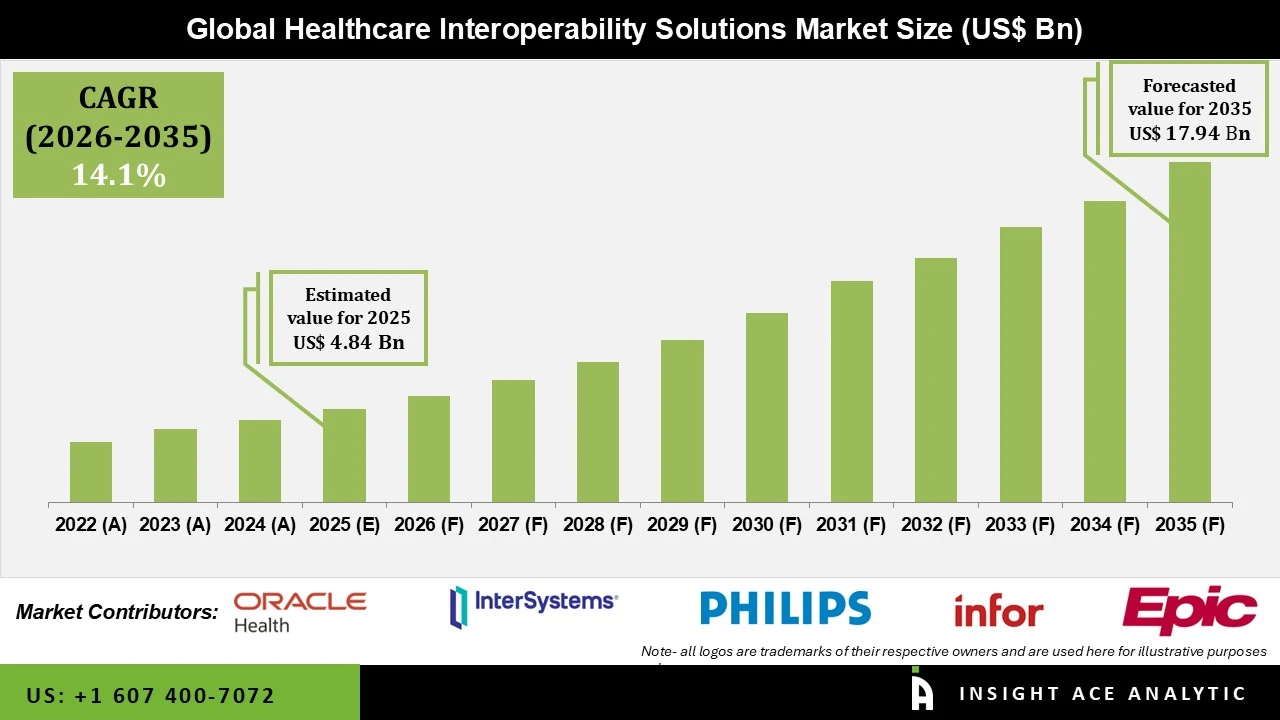
Healthcare Interoperability Solutions Market Size is valued at USD 4.84 Bn in 2025 and is predicted to reach USD 17.94 Bn by the year 2035 at a 14.1% CAGR during the forecast period for 2026 to 2035.
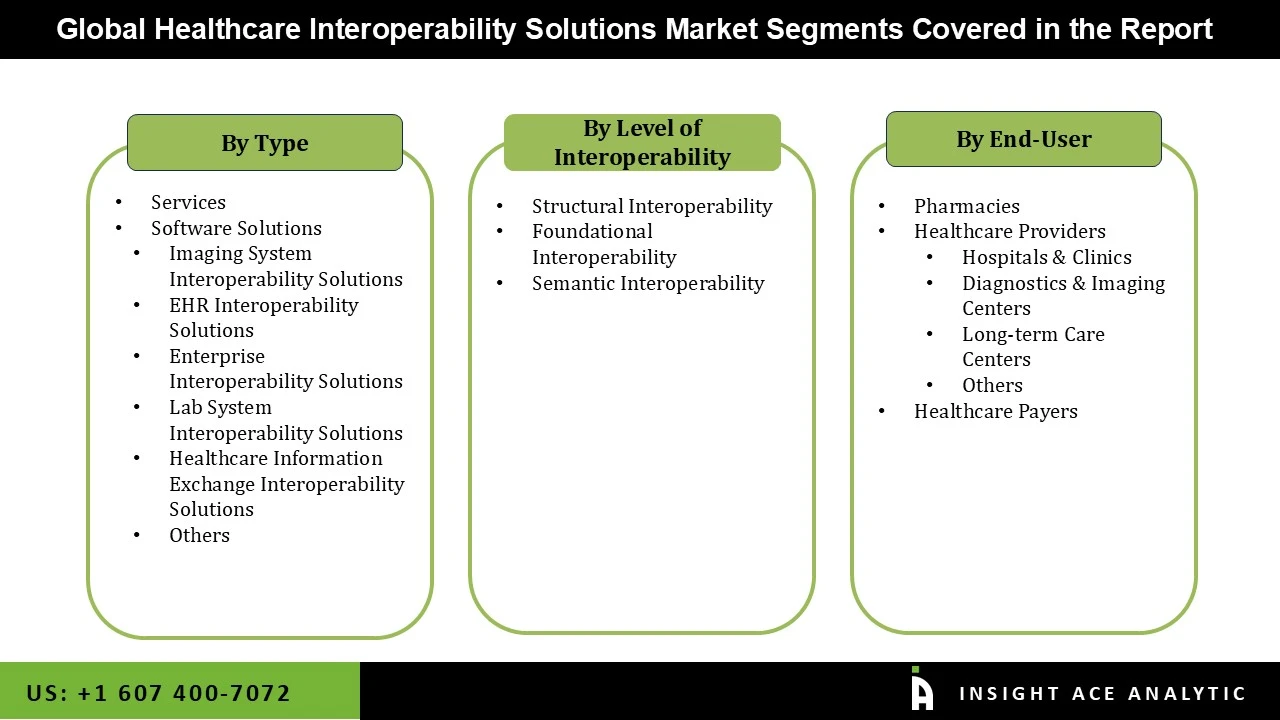
Healthcare Interoperability Solutions Market Size, Share & Trends Analysis Distribution by Type Service, Software solution (Imaging System Interoperability Solutions, EHR Interoperability Solutions, Enterprise Interoperability Solutions, Lab System Interoperability Solutions) ,By Level of Interoperability (Structural Interoperability, Foundational Interoperability, and Semantic Interoperability), End-user (Pharmacies, Healthcare Providers, and Healthcare Payers), Healthcare Providers (Hospitals & Clinics, Diagnostics & Imaging Centers, Long-term Care Centers, and Others), By Region and Segment Forecasts, 2026 to 2035
Healthcare Interoperability Solutions Market Key Takeaways:
|
The healthcare interoperability solutions improves care coordination and operational efficiency by enabling smooth and efficient data interchange and communication across the many stakeholders in the health sector, including patients, payers, and providers. To obtain rich and precise patient data across several interfaces, they facilitate the unification of medical devices, applications, and electronic health records. The healthcare interoperability solutions market is expanding rapidly due to the growing need for better patient care coordination, the implementation of stricter regulatory requirements for data interchange, and the growing need for integrated healthcare systems.
The healthcare interoperability solutions market is expanding rapidly due to high investments made to improve healthcare infrastructure and growing acceptance across healthcare systems. The interoperability solutions make it easier for data to flow between different healthcare systems, improving patient outcomes and expediting the delivery of healthcare. Furthermore, favorable government efforts, substantial funding, and an increasing focus on patient-centric care are further important elements driving this rise.
In addition, the healthcare interoperability solutions market is expanding steadily and significantly on a global scale due to the growing need for technologically sophisticated solutions that facilitate smooth data transfer and communication between different healthcare systems in order to improve patient outcomes, care coordination, and administrative procedures. Furthermore, the existence of major players concentrating on incorporating AI into the software is anticipated to accelerate market expansion. For instance, in November 2025, InterSystems introduced InterSystems HealthShare AI Assistant, a new generative AI feature that helps administrators, case managers, and physicians access and comprehend patient data more quickly and easily. Additionally, a number of significant industry participants are concentrating on providing cutting-edge healthcare interoperability solutions by fortifying their market position through strategic initiatives.
Competitive Landscape
Which are the Leading Players in Healthcare Interoperability Solutions Market?
- Oracle Health
- Epic Systems Corporation
- Infor, Inc.
- InterSystems Corporation
- Koninklijke Philips N.V.
- Veradigm LLC
- Cognizant
- Change Healthcare
- NextGen Healthcare, Inc.
- Merative
- Medical Information Technology, Inc.
- Lyniate
- OSP Labs
- Orion Health Group of Companies
- Onyx Technology LLC
- ViSolve
- Jitterbit
- INTERFACEWARE Inc.
- Virtusa Corp.
- Consensus Cloud Solutions Inc.
- MphRx
- Wipro
- eMids
- Nalashaa
- Deevita LLC
- Other Prominent Players
Market Dynamics
Driver
Increasing Adoption of Electronic Health Record (EHR)
The healthcare interoperability solutions market is expanding significantly as a result of the extensive use of Electronic Health Records (EHRs). EHR systems are being used by healthcare providers more frequently in an effort to enhance patient care and expedite processes. Strong interoperability solutions are required for this transition in order to enable smooth data transfer between various systems. For instance, according to the Office of the National Coordinator for Health Information Technology (ONC), the percentage of office-based physicians who had implemented EHR systems increased from 78% in 2019 to over 86% in 2023. This rise emphasizes how important interoperability is to guaranteeing patient data accessibility in a variety of healthcare environments. Additionally, the real-time access to patient data is made possible via interoperable technologies, which lowers errors and improves clinical judgment. The need for efficient interoperability solutions is anticipated to increase in tandem with the ongoing growth in EHR usage.
Restrain/Challenge
Growing Concerns about Data Privacy and the Complexity of Integration
The healthcare interoperability solutions market is severely hampered by growing worries about cybersecurity, patient data privacy, and compliance with laws like HIPAA. For instance, some providers are reluctant to fully integrate connected interoperability systems without sophisticated security mechanisms due to recorded instances of healthcare data breaches. While the high complexity of connecting diverse legacy systems can hinder adoption, addressing these privacy and security concerns through secure authentication, strong encryption, and frequent system audits is essential for fostering confidence between patients and providers. Additionally, for smaller healthcare facilities or clinics on a tight budget, the comparatively high upfront costs of advanced interoperability platforms in comparison to basic EHR systems may be a deterrent, especially in developing nations.
Structural Interoperability Segment is Expected to Drive the Healthcare Interoperability Solutions Market
The structural interoperability category held the largest share in the Healthcare Interoperability Solutions market in 2025 because data standardization is becoming more and more important in the healthcare industry. The adoption of structural interoperability solutions is anticipated to be fueled by the growing demand for standardized healthcare data interchange across various systems. In order to guarantee smooth data flow, healthcare companies are expected to place a greater emphasis on structural interoperability as electronic health records (EHR) and the integration of heterogeneous healthcare systems grow in popularity. Additionally, regulatory incentives including the drive for standardized coding and reporting systems are anticipated to promote this segment's growth. Furthermore, the adoption of structural interoperability is anticipated to boost patient outcomes, lower administrative expenses, and improve care coordination—all of which will propel its growth in the healthcare interoperability solutions market.
EHR Interoperability Solutions Segment is Growing at the Highest Rate in the Healthcare Interoperability Solutions Market
In 2025, the EHR Interoperability Solutions category dominated the Healthcare Interoperability Solutions market. The electronic exchange of patient data between various EHR systems and healthcare providers is made possible by interoperable electronic health records (EHRs), which facilitates doctors' care of patients and their movement between various care facilities. Health care systems may decide to employ particular EHR systems based on state laws and other variables, like the size of the care institution. But healthcare facilities often have to communicate with each other to exchange patient data. Currently, a large number of healthcare facilities and providers employ eHRs. The capacity of a system to integrate with another system and readily exchange important data is known as interoperability. Additionally, in the context of an EHR, interoperability is the ease with which health information and medical records can be moved between systems or providers. The EHR is generally considered to be one of the most straightforward and secure choices that do not lead to information blockage, even if health care systems can communicate in a variety of ways.
Why North America Led the Healthcare Interoperability Solutions Market?
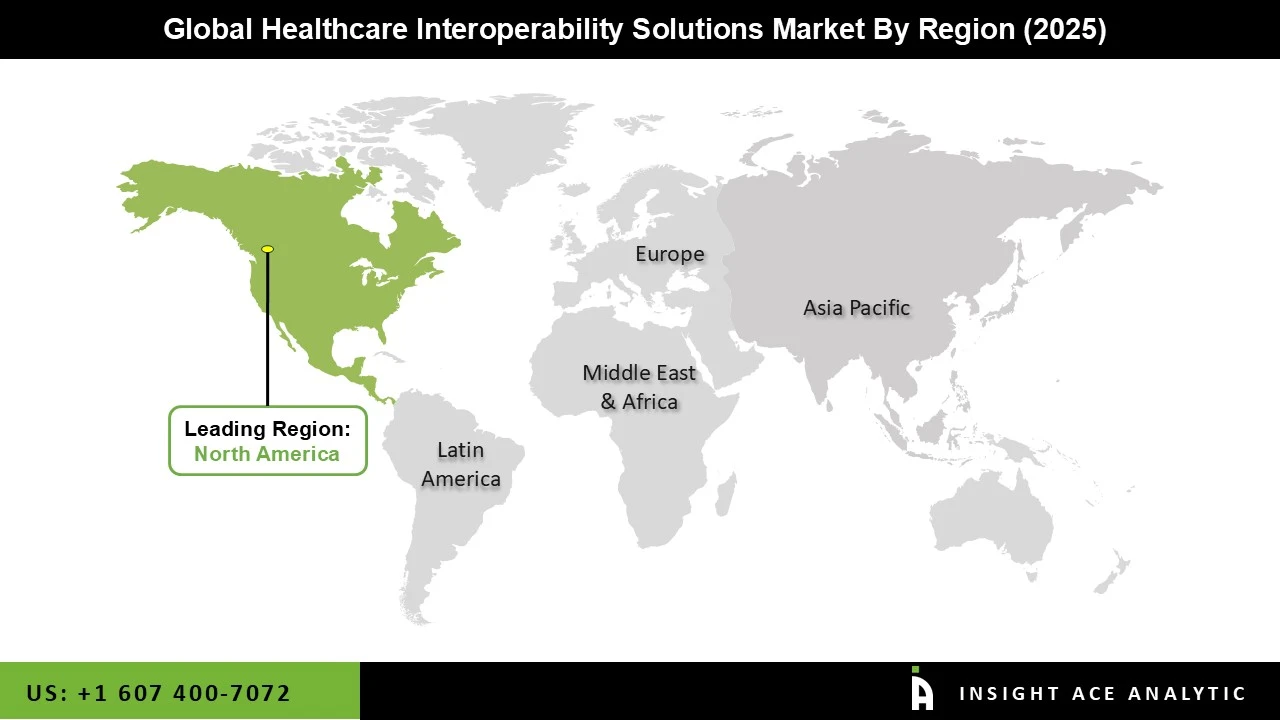
The Healthcare Interoperability Solutions market was dominated by North America region in 2025 due to the growing use of health information exchanges (HIEs) and electronic health records (EHRs), which improved data sharing between healthcare providers. According to data from the US Food and Drug Administration (FDA), over 50% of all Americans manage their healthcare using software programs that have been approved by the FDA.
Additionally, in an effort to save costs and enhance patient care, the Centers for Medicare & Medicaid Services (CMS) persisted in supporting interoperability programs.Interoperable systems are crucial to maintaining virtual healthcare services, as evidenced by the American Telemedicine Association's (ATA) assessment that telehealth consumption is still 38 times higher than it was before to the pandemic. The market's expansion was fueled by the need for seamless data sharing in North America as a result of the region's increasing reliance on digital health tools and move toward value-based care.
Key Development
• In August 2025, Oracle Clinical One Data Collection was introduced by Oracle. These additional features improved data gathering at trial locations and allowed for smooth interaction with Electronic Health Record (EHR) systems.
Healthcare Interoperability Solutions Market Report Scope:
| Report Attribute | Specifications |
| Market size value in 2025 | USD 4.84 Bn |
| Revenue forecast in 2035 | USD 17.94 Bn |
| Growth Rate CAGR | CAGR of 14.1% from 2026 to 2035 |
| Quantitative Units | Representation of revenue in US$ Bn and CAGR from 2026 to 2035 |
| Historic Year | 2022 to 2025 |
| Forecast Year | 2026-2035 |
| Report Coverage | The forecast of revenue, the position of the company, the competitive market structure, growth prospects, and trends |
| Segments Covered | Type, Level of Interoperability, Software Solutions, End-user, Healthcare Providers, and By Region |
| Regional Scope | North America; Europe; Asia Pacific; Latin America; Middle East & Africa |
| Country Scope | U.S.; Canada; U.K.; Germany; China; India; Japan; Brazil; Mexico; The UK; France; Italy; Spain; China; Japan; India; South Korea; Southeast Asia; South Korea; Southeast Asia |
| Competitive Landscape | Oracle Health, Epic Systems Corporation, Infor, Inc., InterSystems Corporation, Koninklijke Philips N.V., Veradigm LLC, Cognizant, Change Healthcare, NextGen Healthcare, Inc., Merative, Medical Information Technology, Inc., Lyniate, OSP Labs, Orion Health Group of Companies, Onyx Technology LLC, ViSolve, Jitterbit, INTERFACEWARE Inc., Virtusa Corp., Consensus Cloud Solutions Inc., MphRx, Wipro, eMids, Nalashaa, and Deevita LLC |
| Customization Scope | Free customization report with the procurement of the report, Modifications to the regional and segment scope. Geographic competitive landscape. |
| Pricing and Available Payment Methods | Explore pricing alternatives that are customized to your particular study requirements. |
Segmentation of Healthcare Interoperability Solutions Market:
Healthcare Interoperability Solutions Market by Type-
- Services
- Software Solutions
-
- Imaging System Interoperability Solutions
- EHR Interoperability Solutions
- Enterprise Interoperability Solutions
- Lab System Interoperability Solutions
- Healthcare Information Exchange Interoperability Solutions
- Others
Healthcare Interoperability Solutions Market by Level of Interoperability-
- Structural Interoperability
- Foundational Interoperability
- Semantic Interoperability
Healthcare Interoperability Solutions Market by End-user-
- Pharmacies
- Healthcare Providers
-
- Hospitals & Clinics
- Diagnostics & Imaging Centers
- Long-term Care Centers
- Others
- Healthcare Payers
Healthcare Interoperability Solutions Market, By Region-
- North America-
- The US
- Canada
- Europe-
- Germany
- The UK
- France
- Italy
- Spain
- Rest of Europe
- Asia-Pacific-
- China
- Japan
- India
- South Korea
- South East Asia
- Rest of Asia Pacific
- Latin America-
- Brazil
- Argentina
- Mexico
- Rest of Latin America
- Middle East & Africa-
- GCC Countries
- South Africa
- Rest of Middle East and Africa
Research Design and Approach
This study employed a multi-step, mixed-method research approach that integrates:
- Secondary research
- Primary research
- Data triangulation
- Hybrid top-down and bottom-up modelling
- Forecasting and scenario analysis
This approach ensures a balanced and validated understanding of both macro- and micro-level market factors influencing the market.
Secondary Research
Secondary research for this study involved the collection, review, and analysis of publicly available and paid data sources to build the initial fact base, understand historical market behaviour, identify data gaps, and refine the hypotheses for primary research.
Sources Consulted
Secondary data for the market study was gathered from multiple credible sources, including:
- Government databases, regulatory bodies, and public institutions
- International organizations (WHO, OECD, IMF, World Bank, etc.)
- Commercial and paid databases
- Industry associations, trade publications, and technical journals
- Company annual reports, investor presentations, press releases, and SEC filings
- Academic research papers, patents, and scientific literature
- Previous market research publications and syndicated reports
These sources were used to compile historical data, market volumes/prices, industry trends, technological developments, and competitive insights.

Primary Research
Primary research was conducted to validate secondary data, understand real-time market dynamics, capture price points and adoption trends, and verify the assumptions used in the market modelling.
Stakeholders Interviewed
Primary interviews for this study involved:
- Manufacturers and suppliers in the market value chain
- Distributors, channel partners, and integrators
- End-users / customers (e.g., hospitals, labs, enterprises, consumers, etc., depending on the market)
- Industry experts, technology specialists, consultants, and regulatory professionals
- Senior executives (CEOs, CTOs, VPs, Directors) and product managers
Interview Process
Interviews were conducted via:
- Structured and semi-structured questionnaires
- Telephonic and video interactions
- Email correspondences
- Expert consultation sessions
Primary insights were incorporated into demand modelling, pricing analysis, technology evaluation, and market share estimation.
Data Processing, Normalization, and Validation
All collected data were processed and normalized to ensure consistency and comparability across regions and time frames.
The data validation process included:
- Standardization of units (currency conversions, volume units, inflation adjustments)
- Cross-verification of data points across multiple secondary sources
- Normalization of inconsistent datasets
- Identification and resolution of data gaps
- Outlier detection and removal through algorithmic and manual checks
- Plausibility and coherence checks across segments and geographies
This ensured that the dataset used for modelling was clean, robust, and reliable.
Market Size Estimation and Data Triangulation
Bottom-Up Approach
The bottom-up approach involved aggregating segment-level data, such as:
- Company revenues
- Product-level sales
- Installed base/usage volumes
- Adoption and penetration rates
- Pricing analysis
This method was primarily used when detailed micro-level market data were available.

Top-Down Approach
The top-down approach used macro-level indicators:
- Parent market benchmarks
- Global/regional industry trends
- Economic indicators (GDP, demographics, spending patterns)
- Penetration and usage ratios
This approach was used for segments where granular data were limited or inconsistent.
Hybrid Triangulation Approach
To ensure accuracy, a triangulated hybrid model was used. This included:
- Reconciling top-down and bottom-up estimates
- Cross-checking revenues, volumes, and pricing assumptions
- Incorporating expert insights to validate segment splits and adoption rates
This multi-angle validation yielded the final market size.
Forecasting Framework and Scenario Modelling
Market forecasts were developed using a combination of time-series modelling, adoption curve analysis, and driver-based forecasting tools.
Forecasting Methods
- Time-series modelling
- S-curve and diffusion models (for emerging technologies)
- Driver-based forecasting (GDP, disposable income, adoption rates, regulatory changes)
- Price elasticity models
- Market maturity and lifecycle-based projections
Scenario Analysis
Given inherent uncertainties, three scenarios were constructed:
- Base-Case Scenario: Expected trajectory under current conditions
- Optimistic Scenario: High adoption, favourable regulation, strong economic tailwinds
- Conservative Scenario: Slow adoption, regulatory delays, economic constraints
Sensitivity testing was conducted on key variables, including pricing, demand elasticity, and regional adoption.
Request Customization
Add countries, segments, company profiles, or extend forecast — free 10% customization with purchase.
Customize This Report →Enquire Before Buying
Speak with our analyst team about scope, methodology, pricing, or deliverable formats.
Enquire Now →Frequently Asked Questions
Healthcare Interoperability Solutions Market Size is valued at USD 4.84 Bn in 2025 and is predicted to reach USD 17.94 Bn by the year 2035
Healthcare Interoperability Solutions Market is expected to grow at a 14.1% CAGR during the forecast period for 2026 to 2035
Oracle Health, Epic Systems Corporation, Infor, Inc., InterSystems Corporation, Koninklijke Philips N.V., Veradigm LLC, Cognizant, Change Healthcare, NextGen Healthcare, Inc., Merative, Medical Information Technology, Inc., Lyniate, OSP Labs, Orion Health Group of Companies, Onyx Technology LLC, ViSolve, Jitterbit, INTERFACEWARE Inc., Virtusa Corp., Consensus Cloud Solutions Inc., MphRx, Wipro, eMids, Nalashaa, Deevita LLC and Others.
Healthcare Interoperability Solutions Market is segmented into by Type (Services and Software Solutions), Level of Interoperability (Structural Interoperability, Foundational Interoperability, and Semantic Interoperability), Software Solutions (Imaging System Interoperability Solutions, EHR Interoperability Solutions, Enterprise Interoperability Solutions, Lab System Interoperability Solutions, Healthcare Information Exchange Interoperability Solutions, and Others), End-user (Pharmacies, Healthcare Providers, and Healthcare Payers), Healthcare Providers (Hospitals & Clinics, Diagnostics & Imaging Centers, Long-term Care Centers, and Others), and Other.
North America region is leading the Healthcare Interoperability Solutions Market.