Machine Vision Market Size, Share, Scope Report 2026 to 2035
What is Machine Vision Market Size?
Machine Vision Market Size is valued at USD 14.51 Bn in 2025 and is predicted to reach USD 34.33 Bn by the year 2035 at a 9.2% CAGR during the forecast period for 2026 to 2035.
Machine Vision Market Size, Share & Trends Analysis By Component (Hardware, Software,), Vision Type (1D Vision Systems, 2D Vision Systems, 3D Vision Systems), Deployment (General Machine Vision Systems, Robotic Cell Vision Systems), System Type (PC-Based Machine Vision Systems, Smart Camera-Based Machine Vision Systems), Application, End-user Industry, and Segment Forecasts, 2026 to 2035
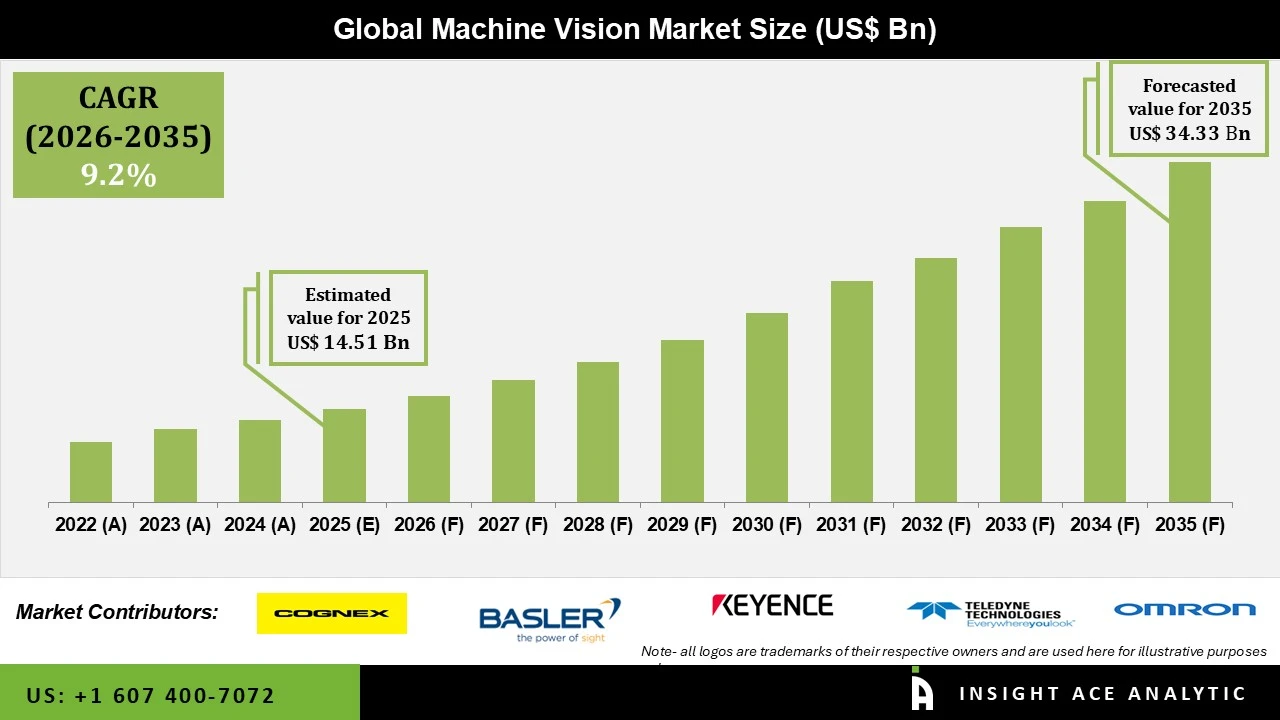
The technology of machine vision means the ability of machines and automated systems to perform the tasks related to capturing and processing images. A machine vision system includes cameras, light sources, optics, processors for images, software and AI solutions to recognize objects, inspect for faults, measure dimensions, control the movement of robots and monitor production processes. The Machine Vision Market is developing because of manufacturers' increasing automation and transition to smart production environments. Machine vision is an alternative for human operators which allows for the same level of precision inspection and measurements.
Artificial Intelligence (AI) and Deep Learning solutions are making changes in machine vision abilities. The traditional vision systems work according to predefined rules and settings for inspection and identification, whereas the AI solutions can identify and learn more complicated patterns and defects. This solution works well for applications with varying appearance of products, surface defects and unclassified components. The development of semiconductor, electronics, automotive, pharmaceutical, food, and packaging industries is driving the market growth as they need precise and fast inspection and measurements, traceability and automated quality control.
One more important trend is the combination of machine vision and robots. Vision solutions allow robots to locate components, identify products, pick and place and confirm completion of the process. Machine vision systems expand their functionality from simple inspection. Moreover, there is a shift from cloud- and server-based vision processing to edge processing. In the last case all the images are not transferred to computers or cloud platforms but smart camera can process the image and the AI model on the spot.
Competitive Landscape
Which are the Leading Players in Machine Vision Market?
• Cognex Corporation
• Keyence Corporation
• Teledyne Technologies Inc.
• SICK AG
• Omron Corporation
• Basler AG
• Zebra Technologies Corporation
• Hikrobot Co., Ltd.
• National Instruments Corporation
• LUCID Vision Labs Inc.
• Allied Vision Technologies GmbH
• Datalogic S.p.A.
• JAI A/S
• Matrox Imaging
• IDS Imaging Development Systems GmbH
• LMI Technologies Inc.
• ISRA VISION AG
• Canon Inc.
• Stemmer Imaging AG
• FLIR Systems
Market Dynamics
Driver
Increasing Automation in Manufacturing
The rising trend of automated manufacturing is one of the leading factors fueling the growth of the Machine Vision Market. The manufacturers are increasingly employing automated inspections to ensure consistent and error-free production along with faster processes. The machine vision has the capability of inspecting the product at the production line speed and immediately providing data to the manufacturing systems. This technology is particularly helpful in automotive, electronic, semiconductor, pharmaceutical, and packaging industries. According to Global Market Insights, the global industrial machine vision market rose from around USD 5.5 Bn in 2022 to USD 6.8 Bn in 2025, backed by factory automation, digitalization, and demand for automated inspections.
Restrain/Challenge
System Integration Complexity
The performance of machine vision is dependent upon a number of things such as lighting, the placement of the camera, choice of lenses, object motion, image quality, processing power, and software setup. A system that works perfectly in one production environment may need lots of tuning before it becomes efficient in another environment. Working with robotics, PLCs, and other production machinery may need some engineering skills.
Hardware Segment is Expected to Drive the Machine Vision Market
It is believed that the hardware will continue to dominate as the largest component segment since cameras, illumination, optics, processors, sensors, and frame grabbers constitute the material building blocks of machine vision.
The industrial machine vision industry saw hardware constitute about 63.4% of the total market in 2025. Both imaging and image processing hardware will continue to play important roles in various applications such as automobiles, electronics, semiconductors, foods, medicines, and packaging.
Software is gaining importance as well due to the presence of AI-driven inspection, image analysis, deep learning, and automatic decision making in machines.
2D Vision Segment is Expected to Remain a Major Technology Segment
The reason why 2D vision retains significance in the machine vision domain is due to its simplicity and low costs. Also, it has the versatility for a range of inspection applications. In terms of machine vision in the industry, the market share for 2D vision was very large in 2025 due to applications like detection of object presence, surface inspection, bar code reading, and simple measurements.
On the other hand, applications that necessitate depth information require a more sophisticated 3D vision, which determines the height, volume, shape, object orientation, and position. This technology can be used in robotization, logistics, automotive assembly line and inspection, among others.
Hyperspectral and multispectral vision is another new technology, and it is capable of providing information not available with ordinary imaging based on the visible light spectrum. Applications include food sorting, pharmaceuticals, inspection of materials and manufacturing.
Why Asia Pacific Led the Machine Vision Market?
Asia Pacific dominated the global Machine Vision Market in 2025, capturing around 32.1%, states Fortune Business Insights. The region has gained an advantage due to the presence of a huge manufacturing base, electronics and semiconductor industry, automotive manufacturing operations, as well as investments in factory automation technology.
China, Japan, South Korea, Taiwan, and others manufacturing sites located in the region drive regional consumption. Electronics and semiconductor industry is demanding machine vision solutions in various production process steps that requires high-resolution cameras and imaging technologies. China also invests in the development of its own machine vision industry. Hikrobot company, for example, develops industrial inspection, logistics, robotics, and automation systems.
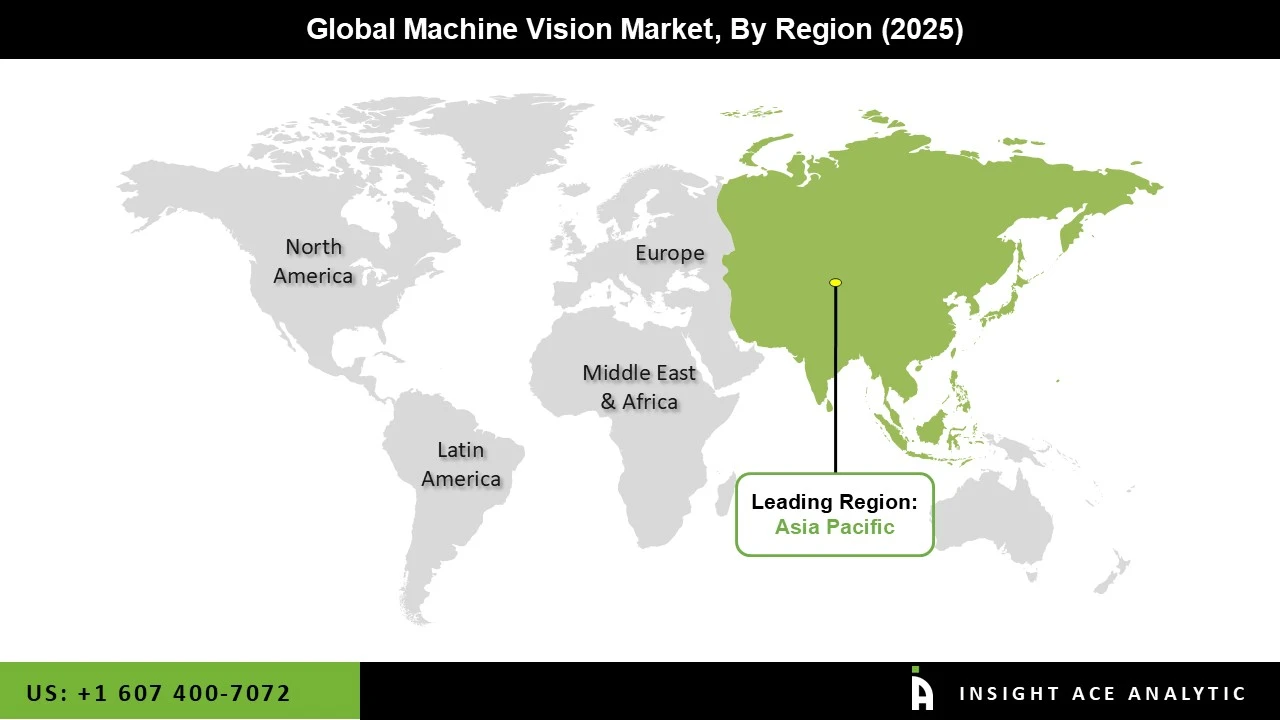
Japan is an important market due to the presence of established robotics and factory automation industry. Keyence and Omron companies provide a wide portfolio consisting of sensors, cameras, inspection systems, and automation machines.
India is considered as an upcoming growth market as it experiences growth of electronics manufacturing, automotive manufacturing, semiconductor manufacturing, EV production, packaging automation, and various manufacturing programs funded by the government. Global Market Insights claims that India industrial machine vision market will experience substantial growth in Asia Pacific.
Key Development:
In May 2026, Cognex introduced In-Sight 3900 Vision System, an AI vision system based on Qualcomm Dragonwing platforms, to be more precise in providing AI processing close to the inspection point and suitable for applications like battery inspection and production inspection.
Machine Vision Market Report Scope:
| Report Attribute | Specifications |
| Market size value in 2025 | USD 14.51 Bn |
| Revenue forecast in 2035 | USD 34.33 Bn |
| Growth Rate CAGR | CAGR of 9.2% from 2026 to 2035 |
| Quantitative Units | Representation of revenue in US$ Bn and CAGR from 2026 to 2035 |
| Historic Year | 2022 to 2025 |
| Forecast Year | 2026-2035 |
| Report Coverage | The forecast of revenue, the position of the company, the competitive market structure, growth prospects, and trends |
| Segments Covered | Component, Vision Type, System Type, Deployment, Application, End-user Industry, and By Region |
| Regional Scope | North America; Europe; Asia Pacific; Latin America; Middle East & Africa |
| Country Scope | U.S.; Canada; U.K.; Germany; China; India; Japan; Brazil; Mexico; France; Italy; Spain; South Korea; Southeast Asia |
| Competitive Landscape | Cognex Corporation, Keyence Corporation, Teledyne Technologies, SICK AG, Omron Corporation, Basler AG, Zebra Technologies, Hikrobot, National Instruments, LUCID Vision Labs, Allied Vision, Datalogic, JAI, Matrox Imaging, IDS Imaging, LMI Technologies, ISRA VISION, and Canon. |
| Customization Scope | Free customization report with the procurement of the report, Modifications to the regional and segment scope. Geographic competitive landscape. |
| Pricing and Available Payment Methods | Explore pricing alternatives that are customized to your particular study requirements. |
Market Segmentation:
Machine Vision Market by Component
• Hardware
o Cameras
o Frame Grabbers
o LED Lighting
o Optics
o Processors
o Other Hardware Components
• Software
o Traditional Machine Vision Software
o AI-Based Machine Vision Software
o Image Processing Software
o Vision System Management Software
o Data Analytics & Reporting Software
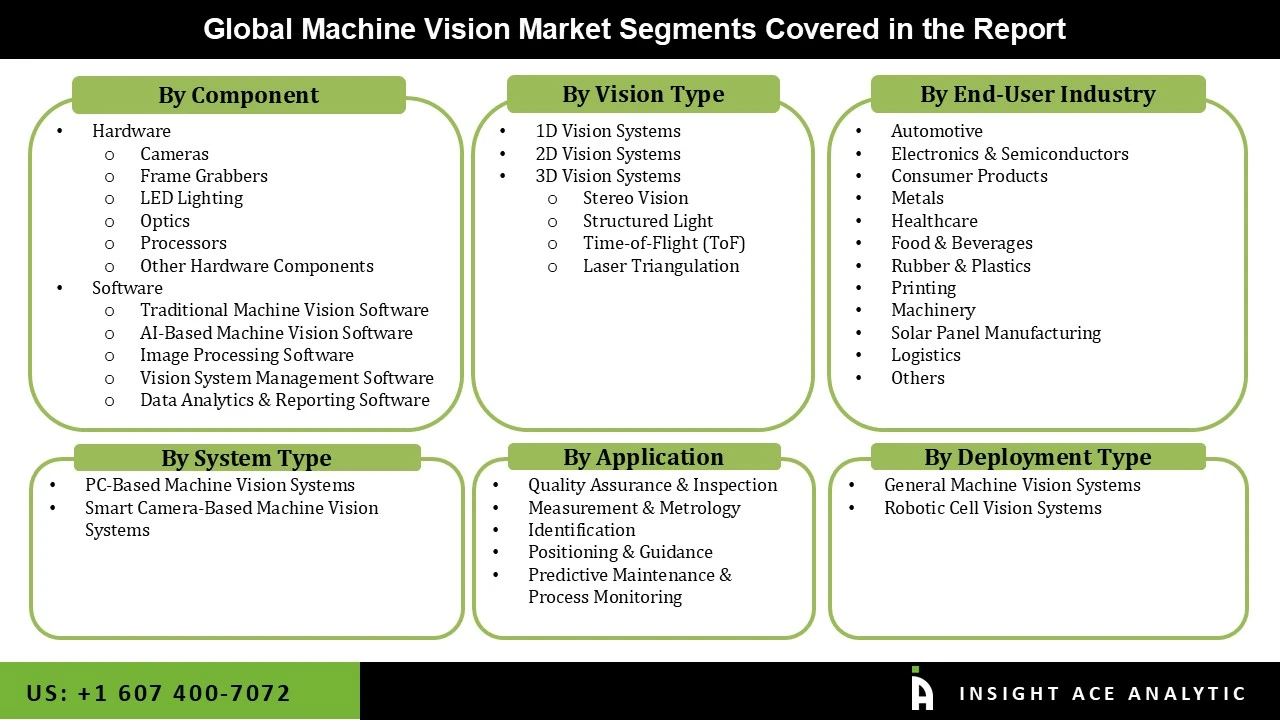
Machine Vision Market by Vision Type
• 1D Vision Systems
• 2D Vision Systems
• 3D Vision Systems
o Stereo Vision
o Structured Light
o Time-of-Flight (ToF)
o Laser Triangulation
Machine Vision Market by Deployment
• General Machine Vision Systems
• Robotic Cell Vision Systems
Machine Vision Market by System Type
• PC-Based Machine Vision Systems
• Smart Camera-Based Machine Vision Systems
Machine Vision Market by Application
• Quality Assurance & Inspection
• Measurement & Metrology
• Identification
• Positioning & Guidance
• Predictive Maintenance & Process Monitoring
Machine Vision Market by Industry
• Automotive
• Electronics & Semiconductors
• Consumer Products
• Metals
• Healthcare
• Food & Beverages
• Rubber & Plastics
• Printing
• Machinery
• Solar Panel Manufacturing
• Logistics
• Others
Machine Vision Market By Region-
North America-
• The US
• Canada
Europe-
• Germany
• The UK
• France
• Italy
• Spain
• Rest of Europe
Asia-Pacific-
• China
• Japan
• India
• South Korea
• South East Asia
• Rest of Asia Pacific
Latin America-
• Brazil
• Argentina
• Mexico
• Rest of Latin America
Middle East & Africa-
• GCC Countries
• South Africa
• Rest of Middle East and Africa
Research Design and Approach
This study employed a multi-step, mixed-method research approach that integrates:
- Secondary research
- Primary research
- Data triangulation
- Hybrid top-down and bottom-up modelling
- Forecasting and scenario analysis
This approach ensures a balanced and validated understanding of both macro- and micro-level market factors influencing the market.
Secondary Research
Secondary research for this study involved the collection, review, and analysis of publicly available and paid data sources to build the initial fact base, understand historical market behaviour, identify data gaps, and refine the hypotheses for primary research.
Sources Consulted
Secondary data for the market study was gathered from multiple credible sources, including:
- Government databases, regulatory bodies, and public institutions
- International organizations (WHO, OECD, IMF, World Bank, etc.)
- Commercial and paid databases
- Industry associations, trade publications, and technical journals
- Company annual reports, investor presentations, press releases, and SEC filings
- Academic research papers, patents, and scientific literature
- Previous market research publications and syndicated reports
These sources were used to compile historical data, market volumes/prices, industry trends, technological developments, and competitive insights.

Primary Research
Primary research was conducted to validate secondary data, understand real-time market dynamics, capture price points and adoption trends, and verify the assumptions used in the market modelling.
Stakeholders Interviewed
Primary interviews for this study involved:
- Manufacturers and suppliers in the market value chain
- Distributors, channel partners, and integrators
- End-users / customers (e.g., hospitals, labs, enterprises, consumers, etc., depending on the market)
- Industry experts, technology specialists, consultants, and regulatory professionals
- Senior executives (CEOs, CTOs, VPs, Directors) and product managers
Interview Process
Interviews were conducted via:
- Structured and semi-structured questionnaires
- Telephonic and video interactions
- Email correspondences
- Expert consultation sessions
Primary insights were incorporated into demand modelling, pricing analysis, technology evaluation, and market share estimation.
Data Processing, Normalization, and Validation
All collected data were processed and normalized to ensure consistency and comparability across regions and time frames.
The data validation process included:
- Standardization of units (currency conversions, volume units, inflation adjustments)
- Cross-verification of data points across multiple secondary sources
- Normalization of inconsistent datasets
- Identification and resolution of data gaps
- Outlier detection and removal through algorithmic and manual checks
- Plausibility and coherence checks across segments and geographies
This ensured that the dataset used for modelling was clean, robust, and reliable.
Market Size Estimation and Data Triangulation
Bottom-Up Approach
The bottom-up approach involved aggregating segment-level data, such as:
- Company revenues
- Product-level sales
- Installed base/usage volumes
- Adoption and penetration rates
- Pricing analysis
This method was primarily used when detailed micro-level market data were available.

Top-Down Approach
The top-down approach used macro-level indicators:
- Parent market benchmarks
- Global/regional industry trends
- Economic indicators (GDP, demographics, spending patterns)
- Penetration and usage ratios
This approach was used for segments where granular data were limited or inconsistent.
Hybrid Triangulation Approach
To ensure accuracy, a triangulated hybrid model was used. This included:
- Reconciling top-down and bottom-up estimates
- Cross-checking revenues, volumes, and pricing assumptions
- Incorporating expert insights to validate segment splits and adoption rates
This multi-angle validation yielded the final market size.
Forecasting Framework and Scenario Modelling
Market forecasts were developed using a combination of time-series modelling, adoption curve analysis, and driver-based forecasting tools.
Forecasting Methods
- Time-series modelling
- S-curve and diffusion models (for emerging technologies)
- Driver-based forecasting (GDP, disposable income, adoption rates, regulatory changes)
- Price elasticity models
- Market maturity and lifecycle-based projections
Scenario Analysis
Given inherent uncertainties, three scenarios were constructed:
- Base-Case Scenario: Expected trajectory under current conditions
- Optimistic Scenario: High adoption, favourable regulation, strong economic tailwinds
- Conservative Scenario: Slow adoption, regulatory delays, economic constraints
Sensitivity testing was conducted on key variables, including pricing, demand elasticity, and regional adoption.
Request Customization
Add countries, segments, company profiles, or extend forecast — free 10% customization with purchase.
Customize This Report →Enquire Before Buying
Speak with our analyst team about scope, methodology, pricing, or deliverable formats.
Enquire Now →Frequently Asked Questions
Machine Vision Market Size is valued at USD 14.51 Bn in 2025 and is predicted to reach USD 34.33 Bn by the year 2035
Machine Vision Market is expected to grow at a 9.2% CAGR during the forecast period for 2026 to 2035.
Cognex Corporation, Keyence Corporation, Teledyne Technologies, SICK AG, Omron Corporation, Basler AG, Zebra Technologies, Hikrobot, National Instruments, LUCID Vision Labs, Allied Vision, Datalogic, JAI, Matrox Imaging, IDS Imaging, LMI Technologies, ISRA VISION, and Canon.
Machine Vision Market is segmented into Component, Vision Type, System Type, Deployment, Application, End-user Industry, and By Region
Asia Pacific region is leading the Machine Vision Market.