Luxury Authentication Service Market Size, Share & Trends Analysis Report by Type (Appraiser Appraisal, Algorithm Technology Identification), Application (Handbags, Jewelry, Watches, Clothing, Others), Services (Pro Online Authentication, Mail-in Authentication, In-person Authentication, Customer Service Hotline), By Region, And By Segment Forecasts, 2024-2031.
Luxury Authentication Service Market Size is predicted to grow at a 10.2% CAGR during the forecast period for 2024-2031.
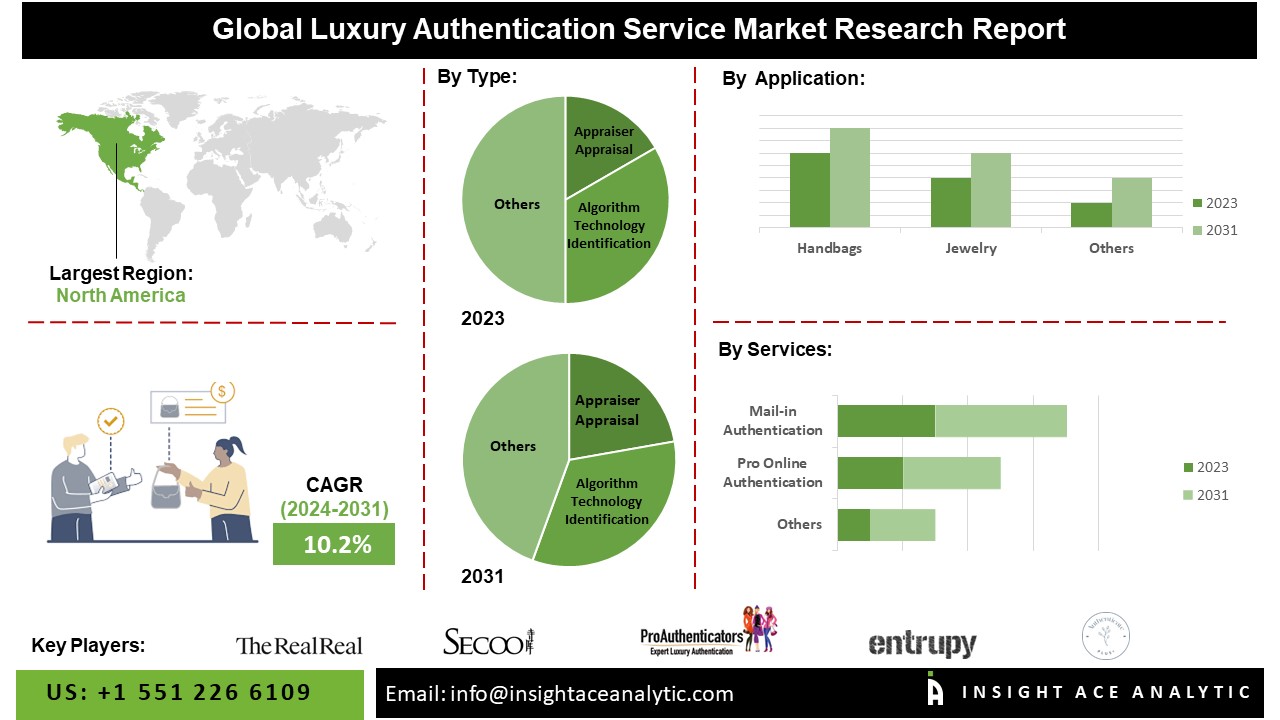
High-end and designer goods can be thoroughly verified by a luxury authentication service to be sure they are authentic and not fake. These services authenticate products like handbags, watches, jewellery, and clothes by using in-depth knowledge and careful inspection techniques to look for specifics like materials, craftsmanship, serial numbers, and brand-specific traits. They provide comfort to buyers, sellers, collectors, and companies engaged in luxury transactions by providing certifications or reports verifying authenticity. This protects against fake goods and upholds the integrity and worth of premium brands in the market.
Technological advancements like blockchain and AI enhance authentication accuracy, though the sector faces challenges from sophisticated counterfeiters and the high costs of implementing and maintaining authentication systems. Complex supply chains and varying consumer awareness also pose hurdles, alongside ethical considerations regarding data privacy and consumer rights. Overcoming these challenges requires ongoing innovation, collaboration across borders, and effective adaptation to market dynamics in the luxury goods sector. Innovations such as blockchain and AI-driven authentication technologies are enhancing the accuracy and efficiency of authentication processes, attracting both consumers and brands. The proliferation of online shopping platforms has heightened concerns about counterfeit products. Authentication services are crucial in reassuring online buyers about the authenticity of their purchases. Additionally, increasing global regulations and anti-counterfeiting laws compel brands and retailers to invest in robust authentication services to comply with legal requirements as well as protect their market presence.
Competitive Landscape
Some Major Key Players In The Luxury Authentication Service Market:
- Real Authentication
- Vestiaire Collective
- TheRealReal
- Secoo Holdings Inc.
- ProAuthenticators
- Komehyo
- Entrupy
- Authenticate Plus
- Authenticate First
- Authenticate 4 U
- Other Market Players
Market Segmentation
The Luxury Authentication Service market is segmented on the basis of type, application and services. According to the type, the market is segmented as Appraiser Appraisal and algorithm Technology Identification. By application, the market is segmented into Handbags, Jewelry, Watches, Clothing, and Others. The services market is segmented into Pro Online Authentication, Mail-in Authentication, In-person Authentication, and Customer Service Hotline.
Based On Product, The Algorithm Technology Identification Segment Is Accounted As A Major Contributor In The Luxury Authentication Service Market.
Algorithm technology identification indeed holds a significant segment within the luxury authentication service market. This technology utilizes advanced algorithms, often powered by artificial intelligence and machine learning, to authenticate luxury goods accurately. It analyzes various aspects of the product, such as materials, construction, stitching, logos, and other identifying features, comparing them against a database of authentic items to determine their legitimacy. Algorithm technology identification offers several advantages in the luxury authentication process. Firstly, it provides a fast & efficient means of verification, allowing for quick assessments of authenticity, which is crucial in environments like online marketplaces where transactions occur swiftly. Additionally, these algorithms can continuously learn & adapt, improving their accuracy over time as they encounter more diverse sets of data and counterfeit tactics.
The Pro Online Authentication Segment Witnessed Rapid Growth.
Pro Online Authentication holds the largest segment in the Luxury Authentication Service Market due to several key factors driving its prominence. As more luxury goods are bought and sold online, the need for reliable and efficient authentication services has grown exponentially. Pro Online Authentication specializes in leveraging cutting-edge technologies like machine learning (ML), artificial intelligence, and blockchain to verify the authenticity of luxury items swiftly and accurately. Their comprehensive databases and algorithms can detect even the most sophisticated counterfeit attempts, providing peace of mind to both sellers and buyers in the digital marketplace. Moreover, Pro Online Authentication's services cater not only to individual consumers but also to e-commerce platforms and resellers, ensuring that all parties involved in the transaction chain can trust the authenticity of the goods. Their consistent dependability has garnered them an outstanding standing in the business, solidifying their position as the foremost authority in online luxury authentication services.
In The Region, The North American Luxury Authentication Service Market Holds A Significant Revenue Share.
The North American Luxury Authentication Service market is expected to register the highest market share. Furthermore, the rise of third-party authentication services and certification programs is instilling trust in consumers regarding the authenticity of their purchases. Additionally, the increasing focus on sustainable and ethical consumption is fueling interest in pre-owned luxury goods verified by reputable experts. With the continuous expansion of the online luxury resale market, there is a projected increase in demand for authentication services, creating opportunities for industry players to innovate and further distinguish their services. In addition, Asia Pacific is estimated to grow at a rapid rate. In the Asia-Pacific (APAC) region, the Luxury Authentication Service sector is gaining prominence due to several factors. The increasing affluence and consumer spending power in countries like China, Japan, South Korea have fueled the demand for luxury goods, consequently raising concerns about counterfeit products. Authentication services play a critical role in ensuring the authenticity of high-end items sold in these markets, bolstering consumer trust, and protecting brand reputation. Moreover, the rapid and continuous growth of e-commerce platforms in APAC has amplified the need for reliable authentication solutions to combat the proliferation of counterfeit goods online.
Recent Developments
- In Oct 2023, Entrupy expanded its luxury authentication services to social media by establishing an official collaboration with TikTok. As an official TikTok Shop authenticator in the U.S., Entrupy will provide authentication services for premium items. Entrupy's verification procedure has an accuracy rate over 99 percent, offering robust protection to businesses, customers, and sellers against counterfeit and fraudulent merchandise.
Luxury Authentication Service Market Report Scope
| Report Attribute | Specifications |
| Growth Rate CAGR | CAGR of 10.2% from 2024 to 2031 |
| Quantitative Units | Representation of revenue in US$ Million and CAGR from 2024 to 2031 |
| Historic Year | 2019 to 2023 |
| Forecast Year | 2024-2031 |
| Report Coverage | The forecast of revenue, the position of the company, the competitive market structure, growth prospects, and trends |
| Segments Covered | By Type, Application, Services |
| Regional Scope | North America; Europe; Asia Pacific; Latin America; Middle East & Africa |
| Country Scope | U.S.; Canada; U.K.; Germany; China; India; Japan; Brazil; Mexico; France; Italy; Spain; South East Asia; South Korea |
| Competitive Landscape | Real Authentication (United States), Vestiaire Collective (France), TheRealReal (United States), Secoo Holdings Inc. (China), ProAuthenticators (United States), Komehyo (Japan), Entrupy (United States), Authenticate Plus (United States), and Authenticate First (India)and Other Market Players |
| Customization Scope | Free customization report with the procurement of the report and modifications to the regional and segment scope. Particular Geographic competitive landscape. |
| Pricing And Available Payment Methods | Explore pricing alternatives that are customized to your particular study requirements. |
Segmentation of Luxury Authentication Service Market-
Luxury Authentication Service Market By Type
- Appraiser Appraisal
- Algorithm Technology Identification
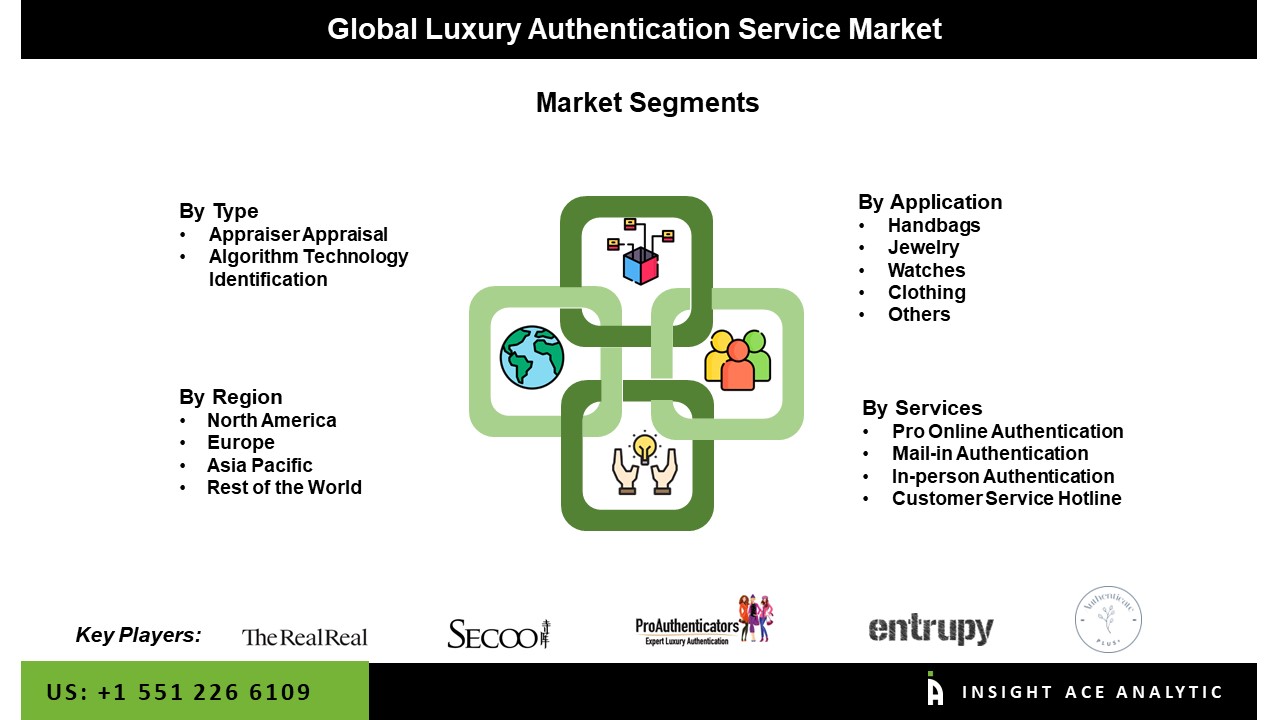
Luxury Authentication Service Market By Application
- Handbags
- Jewelry
- Watches
- Clothing
- Others
Luxury Authentication Service Market By Services
- Pro Online Authentication
- Mail-in Authentication
- In-person Authentication
- Customer Service Hotline
Luxury Authentication Service Market By Region-
North America-
- The US
- Canada
- Mexico
Europe-
- Germany
- The UK
- France
- Italy
- Spain
- Rest of Europe
Asia-Pacific-
- China
- Japan
- India
- South Korea
- Southeast Asia
- Rest of Asia Pacific
Latin America-
- Brazil
- Argentina
- Rest of Latin America
Middle East & Africa-
- GCC Countries
- South Africa
- Rest of Middle East and Africa
Research Design and Approach
This study employed a multi-step, mixed-method research approach that integrates:
- Secondary research
- Primary research
- Data triangulation
- Hybrid top-down and bottom-up modelling
- Forecasting and scenario analysis
This approach ensures a balanced and validated understanding of both macro- and micro-level market factors influencing the market.
Secondary Research
Secondary research for this study involved the collection, review, and analysis of publicly available and paid data sources to build the initial fact base, understand historical market behaviour, identify data gaps, and refine the hypotheses for primary research.
Sources Consulted
Secondary data for the market study was gathered from multiple credible sources, including:
- Government databases, regulatory bodies, and public institutions
- International organizations (WHO, OECD, IMF, World Bank, etc.)
- Commercial and paid databases
- Industry associations, trade publications, and technical journals
- Company annual reports, investor presentations, press releases, and SEC filings
- Academic research papers, patents, and scientific literature
- Previous market research publications and syndicated reports
These sources were used to compile historical data, market volumes/prices, industry trends, technological developments, and competitive insights.

Primary Research
Primary research was conducted to validate secondary data, understand real-time market dynamics, capture price points and adoption trends, and verify the assumptions used in the market modelling.
Stakeholders Interviewed
Primary interviews for this study involved:
- Manufacturers and suppliers in the market value chain
- Distributors, channel partners, and integrators
- End-users / customers (e.g., hospitals, labs, enterprises, consumers, etc., depending on the market)
- Industry experts, technology specialists, consultants, and regulatory professionals
- Senior executives (CEOs, CTOs, VPs, Directors) and product managers
Interview Process
Interviews were conducted via:
- Structured and semi-structured questionnaires
- Telephonic and video interactions
- Email correspondences
- Expert consultation sessions
Primary insights were incorporated into demand modelling, pricing analysis, technology evaluation, and market share estimation.
Data Processing, Normalization, and Validation
All collected data were processed and normalized to ensure consistency and comparability across regions and time frames.
The data validation process included:
- Standardization of units (currency conversions, volume units, inflation adjustments)
- Cross-verification of data points across multiple secondary sources
- Normalization of inconsistent datasets
- Identification and resolution of data gaps
- Outlier detection and removal through algorithmic and manual checks
- Plausibility and coherence checks across segments and geographies
This ensured that the dataset used for modelling was clean, robust, and reliable.
Market Size Estimation and Data Triangulation
Bottom-Up Approach
The bottom-up approach involved aggregating segment-level data, such as:
- Company revenues
- Product-level sales
- Installed base/usage volumes
- Adoption and penetration rates
- Pricing analysis
This method was primarily used when detailed micro-level market data were available.

Top-Down Approach
The top-down approach used macro-level indicators:
- Parent market benchmarks
- Global/regional industry trends
- Economic indicators (GDP, demographics, spending patterns)
- Penetration and usage ratios
This approach was used for segments where granular data were limited or inconsistent.
Hybrid Triangulation Approach
To ensure accuracy, a triangulated hybrid model was used. This included:
- Reconciling top-down and bottom-up estimates
- Cross-checking revenues, volumes, and pricing assumptions
- Incorporating expert insights to validate segment splits and adoption rates
This multi-angle validation yielded the final market size.
Forecasting Framework and Scenario Modelling
Market forecasts were developed using a combination of time-series modelling, adoption curve analysis, and driver-based forecasting tools.
Forecasting Methods
- Time-series modelling
- S-curve and diffusion models (for emerging technologies)
- Driver-based forecasting (GDP, disposable income, adoption rates, regulatory changes)
- Price elasticity models
- Market maturity and lifecycle-based projections
Scenario Analysis
Given inherent uncertainties, three scenarios were constructed:
- Base-Case Scenario: Expected trajectory under current conditions
- Optimistic Scenario: High adoption, favourable regulation, strong economic tailwinds
- Conservative Scenario: Slow adoption, regulatory delays, economic constraints
Sensitivity testing was conducted on key variables, including pricing, demand elasticity, and regional adoption.
Request Customization
Add countries, segments, company profiles, or extend forecast — free 10% customization with purchase.
Customize This Report →Enquire Before Buying
Speak with our analyst team about scope, methodology, pricing, or deliverable formats.
Enquire Now →Frequently Asked Questions
Luxury Authentication Service Market Size is predicted to grow at a 10.2% CAGR during the forecast period for 2024-2031.
Secoo Holdings Inc. (China), ProAuthenticators (United States), Komehyo (Japan), Entrupy (United States), Authenticate Plus (United States), and Authe