



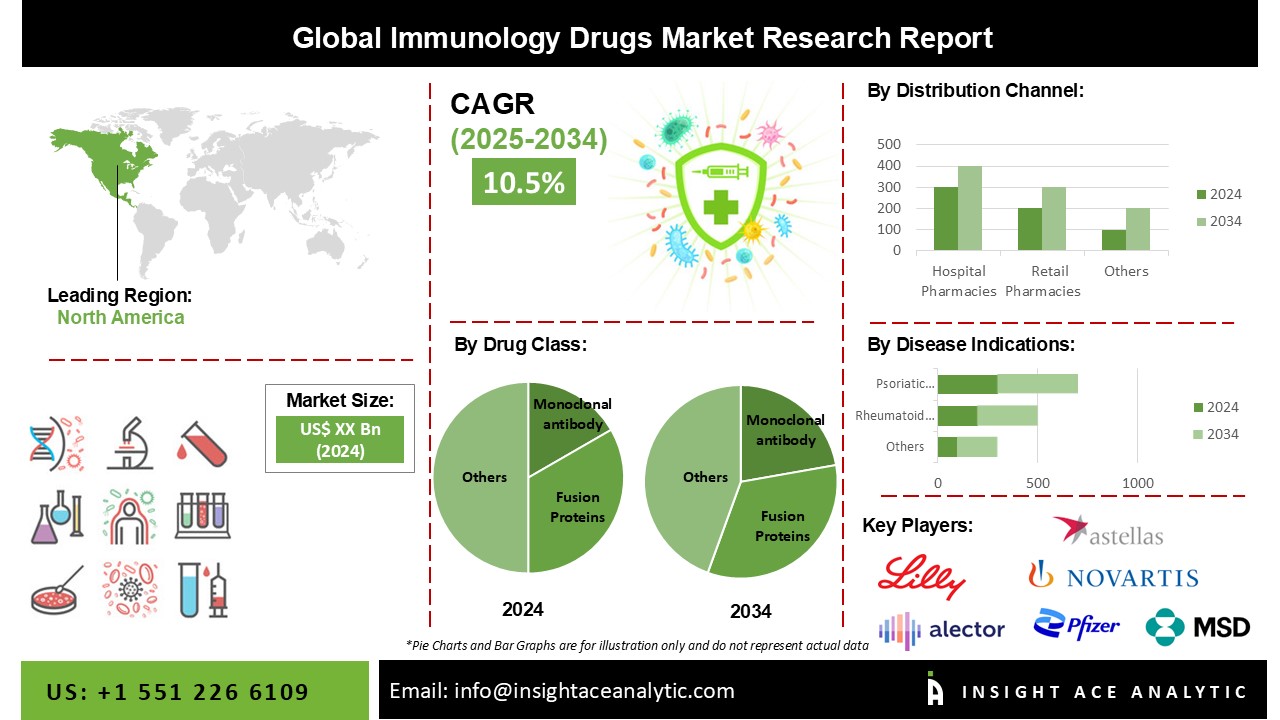
Global Immunology Drugs Market Size is estimated to grow at a 10.5% CAGR during the forecast period for 2025-2034.
The medical and biological research field known as Immunology Drugs focuses on the immune system. Autoimmune disorders develop when the immune system assaults the body that it is supposed to defend. People with autoimmune disorders have a deficiency in their immune system that prevents them from telling "self" molecules apart from "non-self" or "foreign" molecules. Numerous laboratory tests are available in Immunology Drugs to identify autoimmune disorders. The increased frequency of immunological illnesses brought on by environmental changes and changing lifestyles, as well as the increased awareness of immunological disease in both developed and developing nations, are the driving forces behind the market's expansion.
Some of the major market participants are continually emphasizing innovation and expanding their product lines to improve patient treatment outcomes. It is anticipated that this will expand even further during the projection period. There is a growing patient population with autoimmune illnesses as a result of many environmental variables such as stress, infection, exposure to hazardous chemicals, and nutritional components.
The worldwide Immunology Drugs industry is likely to experience growth restraints over the forecast period due to a lack of technological advancements and expensive treatment costs. Additionally, many negative effects are associated with these treatments, such as fever, irregular or pounding heartbeat, muscle aches, allergic reactions, infections, etc. Therefore, the aforementioned limitations and the stringent reimbursement practices in emerging countries hinder market expansion throughout the projection period.
The immunology drugs market is segmented on the basis of drug class, distribution channel, and disease indications. Based on drug class, the market is segmented into monoclonal antibodies, fusion proteins, immunosuppressants, polyclonal antibodies, and other drug classes. Based on distribution channel, the market is segmented as hospital pharmacies, retail pharmacies, online pharmacies, and other distribution channels. Based on disease indications, the market is segmented as rheumatoid arthritis, psoriatic arthritis, plaque psoriasis, ankylosing spondylitis, inflammatory bowel disease, and other disease indication.
During the projection period, the immunosuppressants segment is anticipated to expand at a faster rate. Leading market participants' intense focus on R&D to establish the rising number of regulatory approvals for these pharmaceuticals is credited with this segment's quick expansion. Additionally, immunosuppressants are becoming more widely used in developing countries because of their superior therapeutic efficacy, which contributes to their rapid growth rate. The main driver of immunosuppressants is the rise in autoimmune diseases such as multiple sclerosis, alopecia areata, and arthritis. An increase in organ transplant procedures like kidney and liver transplants due to the rise in cases of organ failure fuels the development of immunosuppressants.
In the forecast period, the market will be dominated by the segment for inflammatory bowel disease. Over the forecast period, market growth is anticipated to be fuelled by the increasing prevalence of Crohn's disease and ulcerative illness worldwide. The escalating rates of Crohn's disease and ulcerative colitis are caused by a number of factors, including immune system instability, environmental triggers, and genetic predisposition. Most people with Crohn's disease or ulcerative colitis have a family history of the condition. The market for treating inflammatory bowel illness is anticipated to develop as a result of this. Additionally, it is predicted that the market will rise in the next years due to the rising use of biologics for therapy and the availability of potent pipeline medications like upadacitinib, risankizumab, tofacitinib, ustekinumab, and others.
Due to the availability of superior reimbursement laws, the huge potential to invest substantial funds in creating Immunology Drugs treatments, and the advancement of technology, North America dominates the worldwide market for Immunology Drugs pharmaceuticals. The larger patient pool in the regions, rising economies, increased government activities and increased awareness all point to the growing demand for Immunology Drugs drugs. The United States now dominates the global market due to its well-developed healthcare infrastructure, higher prevalence of chronic illnesses, and higher rates of diagnosis and treatment among patient populations.
| Report Attribute | Specifications |
| Market Size Value In 2024 | USD XX Billion |
| Revenue Forecast In 2034 | USD XX Billion |
| Growth Rate CAGR | CAGR of 10.5% from 2025 to 2034 |
| Quantitative Units | Representation of revenue in US$ Bn, and CAGR from 2025 to 2034 |
| Historic Year | 2021 to 2024 |
| Forecast Year | 2025-2034 |
| Report Coverage | The forecast of revenue, the position of the company, the competitive market structure, growth prospects, and trends |
| Segments Covered | Drug Class, Distribution Channel, Disease Indications |
| Regional Scope | North America; Europe; Asia Pacific; Latin America; Middle East & Africa |
| Country Scope | U.S.; Canada; U.K.; Germany; China; India; Japan; Brazil; Mexico ;The UK; France; Italy; Spain; China; Japan; India; South Korea; South East Asia; South Korea; South East Asia |
| Competitive Landscape | Eli Lilly, AbbVie Inc, F.Hoffmann-La roche Ltd, Amgen Inc, Pfizer, Novartis, Astellas, Alector, ImmuNext, Merck sharp & Dohme Corp, and UCB S. |
| Customization Scope | Free customization report with the procurement of the report, Modifications to the regional and segment scope. Particular Geographic competitive landscape. |
| Pricing And Available Payment Methods | Explore pricing alternatives that are customized to your particular study requirements. |
By Drug Class:

By Distribution Channel
By Disease Indications
By Region-
North America-
Europe-
Asia-Pacific-
Latin America-
Middle East & Africa-
This study employed a multi-step, mixed-method research approach that integrates:
This approach ensures a balanced and validated understanding of both macro- and micro-level market factors influencing the market.
Secondary research for this study involved the collection, review, and analysis of publicly available and paid data sources to build the initial fact base, understand historical market behaviour, identify data gaps, and refine the hypotheses for primary research.
Secondary data for the market study was gathered from multiple credible sources, including:
These sources were used to compile historical data, market volumes/prices, industry trends, technological developments, and competitive insights.

Primary research was conducted to validate secondary data, understand real-time market dynamics, capture price points and adoption trends, and verify the assumptions used in the market modelling.
Primary interviews for this study involved:
Interviews were conducted via:
Primary insights were incorporated into demand modelling, pricing analysis, technology evaluation, and market share estimation.
All collected data were processed and normalized to ensure consistency and comparability across regions and time frames.
The data validation process included:
This ensured that the dataset used for modelling was clean, robust, and reliable.
The bottom-up approach involved aggregating segment-level data, such as:
This method was primarily used when detailed micro-level market data were available.

The top-down approach used macro-level indicators:
This approach was used for segments where granular data were limited or inconsistent.
To ensure accuracy, a triangulated hybrid model was used. This included:
This multi-angle validation yielded the final market size.
Market forecasts were developed using a combination of time-series modelling, adoption curve analysis, and driver-based forecasting tools.
Given inherent uncertainties, three scenarios were constructed:
Sensitivity testing was conducted on key variables, including pricing, demand elasticity, and regional adoption.