Healthcare Management Service Organization (MSO) Market Size, Share, Scope, Forecast Report 2026 to 2035
What is Healthcare Management Service Organization (MSO) Market Size?
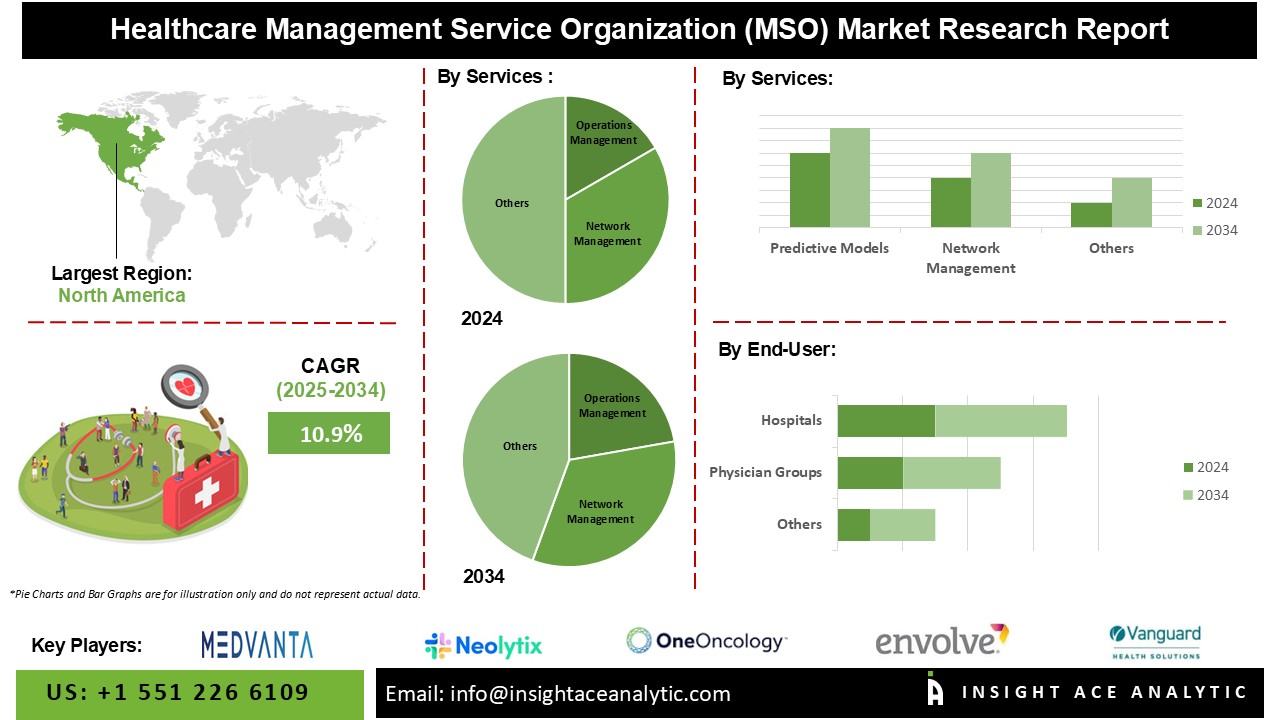
Healthcare Management Service Organization (MSO) Market Size is valued at USD 125.3 Bn in 2025 and is predicted to reach USD 351.78 Bn by the year 2035 at a 11.0% CAGR during the forecast period for 2026 to 2035.
Healthcare Management Service Organization (MSO) Market Share & Trends Analysis Report, By Services (Operations Management, Network Management, Quality Management, Care Management, Other Services), By Ownership (Hospitals, Physician Groups, Investors, Others), By Region, and Segment Forecasts, 2026 to 2035
Healthcare Management Service Organization (MSO) Market Key Takeaways:
|
Management services organizations (MSOs) are administrative and management entities that provide a range of services to healthcare providers. They offer different types of governance, structure, and function tailored to the needs of individual practice associations (IPAs) or medical groups. Healthcare providers can outsource to an MSO for specific functions or a suite of services, depending on their requirements. By maintaining strong relationships with regulators and third-party contractors, MSOs help providers focus on improving medical outcomes and controlling practice expenses. MSOs operate under strict guidelines to ensure a clear separation between financial incentives and patient care decisions.
They can only receive fair market value (FMV) compensation directly from the physician, clinician, or their professional corporation, reinforcing this division. Additionally, the MSO is prohibited from directly hiring or firing clinical staff such as nurses, physician assistants, and medical assistants, as these roles require supervision by qualified medical personnel. This delineation ensures that medical decisions remain in the hands of healthcare professionals, preventing any overreach by the MSO. While the MSO can manage the patient experience and serve as the face of the practice, it cannot influence or dictate a patient's treatment plan, maintaining the integrity of medical decisions and prioritizing patient well-being above all else.
Management Services Organizations (MSOs) play a crucial role in optimizing healthcare systems. By standardizing care management across the network, MSOs ensure consistent delivery of high-quality healthcare while streamlining administrative burdens. This not only improves patient outcomes but also reduces overall costs. Additionally, MSOs are a boon for healthcare systems seeking to expand their network. By taking care of administrative tasks, MSOs free up doctors' time to focus on patient care, making the practice a more attractive option for potential partners. This creates a win-win situation for both patients and healthcare providers
Competitive Landscape
- Advanced Medical Management
- AmerisourceBergen Corporation
- Argusmso
- Conifer Health Solutions, LLC.
- Envolve Health
- Healthsmart MSO Inc.
- MedPOINT Management, Inc.
- MedVanta
- Neolytix
- Network Medical Management
- OneOncology
- Pacific Partners Management Services, Inc.
- Vanguard Health Solutions
- Other Player
Market Segmentation:
The Care Management Segment is Expected to have the highest growth rate during the forecast period
Based on the by-services segment, The market is divided into Operations Management, Network Management, Quality Management, Care Management, and Other Services. Among these, the care management segment is expected to have the highest growth during the forecast period. Care Management involves coordinating and managing the care of patients, ensuring they receive the appropriate services and resources to meet their healthcare needs. Care Management strategies are integral to population health management initiatives, which aim to improve the health outcomes of entire patient populations by addressing preventive care, chronic disease management, and care coordination. By standardizing care delivery, improving population health management, and reducing costs, care management services contribute significantly to the overall value proposition of MSOs.
The Hospitals Segment Dominate the Market
Based on the by ownership, the market is categorized into hospitals, physician groups, investors, and others. The hospital segment dominates the market. Hospitals are increasingly looking to MSOs as a way to expand their networks and improve operational efficiency. They may either acquire existing MSOs or create their own. Hospitals often partner with MSOs to outsource certain administrative functions, such as revenue cycle management, billing, and coding. By collaborating with MSOs, hospitals can streamline operations, reduce administrative burden, and focus more on delivering quality patient care.
North America Led the Healthcare Management Service Organization (MSO) Market
The regulatory environment in North America, while complex, provides a framework that incentivizes the adoption of MSO services. Healthcare providers are increasingly under pressure to comply with regulations such as HIPAA (Health Insurance Portability and Accountability Act) and MACRA (Medicare Access and CHIP Reauthorization Act), driving the demand for MSO services to ensure compliance and mitigate regulatory risks.
Recent Developments:
- In February 2024, MedVanta, Reshaping the healthcare landscape and innovating orthopedic care in the next-generation healthcare MSO market.
- In April 2023, TPG and AmerisourceBergen Corporation decided and purchase OneOncology. One of the oncology MSOs in the US with the quickest rate of growth is OneOncology.
Healthcare Management Service Organization (MSO) Market Report Scope
| Report Attribute | Specifications |
| Market size value in 2025 | USD 125.3 Bn |
| Revenue forecast in 2035 | USD 351.78 Bn |
| Growth Rate CAGR | CAGR of 11.0% from 2026 to 2035 |
| Quantitative Units | Representation of revenue in US$ Bn and CAGR from 2026 to 2035 |
| Historic Year | 2022 to 2025 |
| Forecast Year | 2026-2035 |
| Report Coverage | The forecast of revenue, the position of the company, the competitive market structure, growth prospects, and trends |
| Segments Covered | By Services, By Ownership |
| Regional Scope | North America; Europe; Asia Pacific; Latin America; Middle East & Africa |
| Country Scope | U.S.; Canada; U.K.; Germany; China; India; Japan; Brazil; Mexico; The UK; France; Italy; Spain; South Korea; Southeast Asia |
| Competitive Landscape | MedVanta, Envolve Health, OneOncology, Vanguard Health Solutions, Neolytix, Argusmso, AmerisourceBergen Corporation, Other Player. |
| Customization Scope | Free customization report with the procurement of the report and modifications to the regional and segment scope. Particular Geographic competitive landscape. |
| Pricing and Available Payment Methods | Explore pricing alternatives that are customized to your particular study requirements. |
Segmentation of Healthcare Management Service Organization (MSO) Market
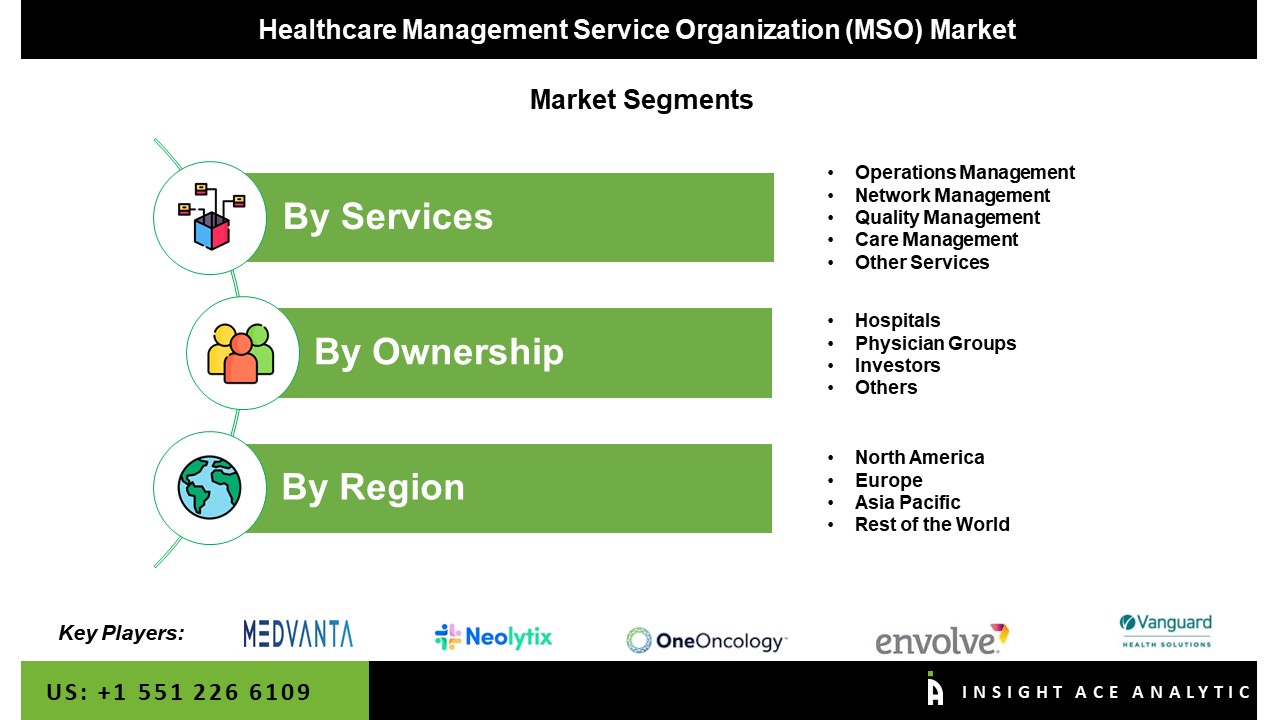
Global Healthcare Management Service Organization (MSO) Market – By Services
- Operations Management
- Network Management
- Quality Management
- Care Management
- Other Services
Global Healthcare Management Service Organization (MSO) Market – By Ownership
- Hospitals
- Physician Groups
- Investors
- Others
Global Healthcare Management Service Organization (MSO) Market – By Region
North America-
- The US
- Canada
Europe-
- Germany
- The UK
- France
- Italy
- Spain
- Rest of Europe
Asia-Pacific-
- China
- Japan
- India
- South Korea
- Southeast Asia
- Rest of Asia Pacific
Latin America-
- Brazil
- Argentina
- Mexico
- Rest of Latin America
Middle East & Africa-
- GCC Countries
- South Africa
- Rest of the Middle East and Africa
Research Design and Approach
This study employed a multi-step, mixed-method research approach that integrates:
- Secondary research
- Primary research
- Data triangulation
- Hybrid top-down and bottom-up modelling
- Forecasting and scenario analysis
This approach ensures a balanced and validated understanding of both macro- and micro-level market factors influencing the market.
Secondary Research
Secondary research for this study involved the collection, review, and analysis of publicly available and paid data sources to build the initial fact base, understand historical market behaviour, identify data gaps, and refine the hypotheses for primary research.
Sources Consulted
Secondary data for the market study was gathered from multiple credible sources, including:
- Government databases, regulatory bodies, and public institutions
- International organizations (WHO, OECD, IMF, World Bank, etc.)
- Commercial and paid databases
- Industry associations, trade publications, and technical journals
- Company annual reports, investor presentations, press releases, and SEC filings
- Academic research papers, patents, and scientific literature
- Previous market research publications and syndicated reports
These sources were used to compile historical data, market volumes/prices, industry trends, technological developments, and competitive insights.

Primary Research
Primary research was conducted to validate secondary data, understand real-time market dynamics, capture price points and adoption trends, and verify the assumptions used in the market modelling.
Stakeholders Interviewed
Primary interviews for this study involved:
- Manufacturers and suppliers in the market value chain
- Distributors, channel partners, and integrators
- End-users / customers (e.g., hospitals, labs, enterprises, consumers, etc., depending on the market)
- Industry experts, technology specialists, consultants, and regulatory professionals
- Senior executives (CEOs, CTOs, VPs, Directors) and product managers
Interview Process
Interviews were conducted via:
- Structured and semi-structured questionnaires
- Telephonic and video interactions
- Email correspondences
- Expert consultation sessions
Primary insights were incorporated into demand modelling, pricing analysis, technology evaluation, and market share estimation.
Data Processing, Normalization, and Validation
All collected data were processed and normalized to ensure consistency and comparability across regions and time frames.
The data validation process included:
- Standardization of units (currency conversions, volume units, inflation adjustments)
- Cross-verification of data points across multiple secondary sources
- Normalization of inconsistent datasets
- Identification and resolution of data gaps
- Outlier detection and removal through algorithmic and manual checks
- Plausibility and coherence checks across segments and geographies
This ensured that the dataset used for modelling was clean, robust, and reliable.
Market Size Estimation and Data Triangulation
Bottom-Up Approach
The bottom-up approach involved aggregating segment-level data, such as:
- Company revenues
- Product-level sales
- Installed base/usage volumes
- Adoption and penetration rates
- Pricing analysis
This method was primarily used when detailed micro-level market data were available.

Top-Down Approach
The top-down approach used macro-level indicators:
- Parent market benchmarks
- Global/regional industry trends
- Economic indicators (GDP, demographics, spending patterns)
- Penetration and usage ratios
This approach was used for segments where granular data were limited or inconsistent.
Hybrid Triangulation Approach
To ensure accuracy, a triangulated hybrid model was used. This included:
- Reconciling top-down and bottom-up estimates
- Cross-checking revenues, volumes, and pricing assumptions
- Incorporating expert insights to validate segment splits and adoption rates
This multi-angle validation yielded the final market size.
Forecasting Framework and Scenario Modelling
Market forecasts were developed using a combination of time-series modelling, adoption curve analysis, and driver-based forecasting tools.
Forecasting Methods
- Time-series modelling
- S-curve and diffusion models (for emerging technologies)
- Driver-based forecasting (GDP, disposable income, adoption rates, regulatory changes)
- Price elasticity models
- Market maturity and lifecycle-based projections
Scenario Analysis
Given inherent uncertainties, three scenarios were constructed:
- Base-Case Scenario: Expected trajectory under current conditions
- Optimistic Scenario: High adoption, favourable regulation, strong economic tailwinds
- Conservative Scenario: Slow adoption, regulatory delays, economic constraints
Sensitivity testing was conducted on key variables, including pricing, demand elasticity, and regional adoption.
Request Customization
Add countries, segments, company profiles, or extend forecast — free 10% customization with purchase.
Customize This Report →Enquire Before Buying
Speak with our analyst team about scope, methodology, pricing, or deliverable formats.
Enquire Now →Frequently Asked Questions
MedVanta, Envolve Health, OneOncology, Vanguard Health Solutions, Neolytix, Argusmso, AmerisourceBergen Corporation, Other Player.
Healthcare Management Service Organization (MSO) Market is divided into Operations Management, Network Management, Quality Management, Care Management
North American region is leading the Healthcare Management Service Organization (MSO) Market.
Healthcare Management Service Organization (MSO) Market Size is valued at USD 125.3 Bn in 2025 and is predicted to reach USD 351.78 Bn by the year 2035
Healthcare Management Service Organization (MSO) Market expected to grow at a 11.0% CAGR during the forecast period for 2026-2035