Healthcare Cold Chain Logistics Market Size, Trend, Forecast Report 2026 to 2035
What is Healthcare Cold Chain Logistics Market Size?
Global Healthcare Cold Chain Logistics Market Size is valued at USD 64.63 billion in 2025 and is predicted to reach USD 149.65 billion by the year 2035 at a 8.8% CAGR during the forecast period for 2026 to 2035.
Healthcare Cold Chain Logistics Market Size, Share & Trends Analysis Report by Type (Biopharmaceuticals, Vaccines, Clinical Trial Materials, Others), Services (Storage, Transportation, Packaging, Others), Storage Techniques (Electrical refrigeration, Dry Ice, Gel Packs, Liquid Nitrogen, Others), By Product Type, By Application, By Temperature Range, By Mode Of Transport, By Region and Segment Forecasts, 2026 to 2035.
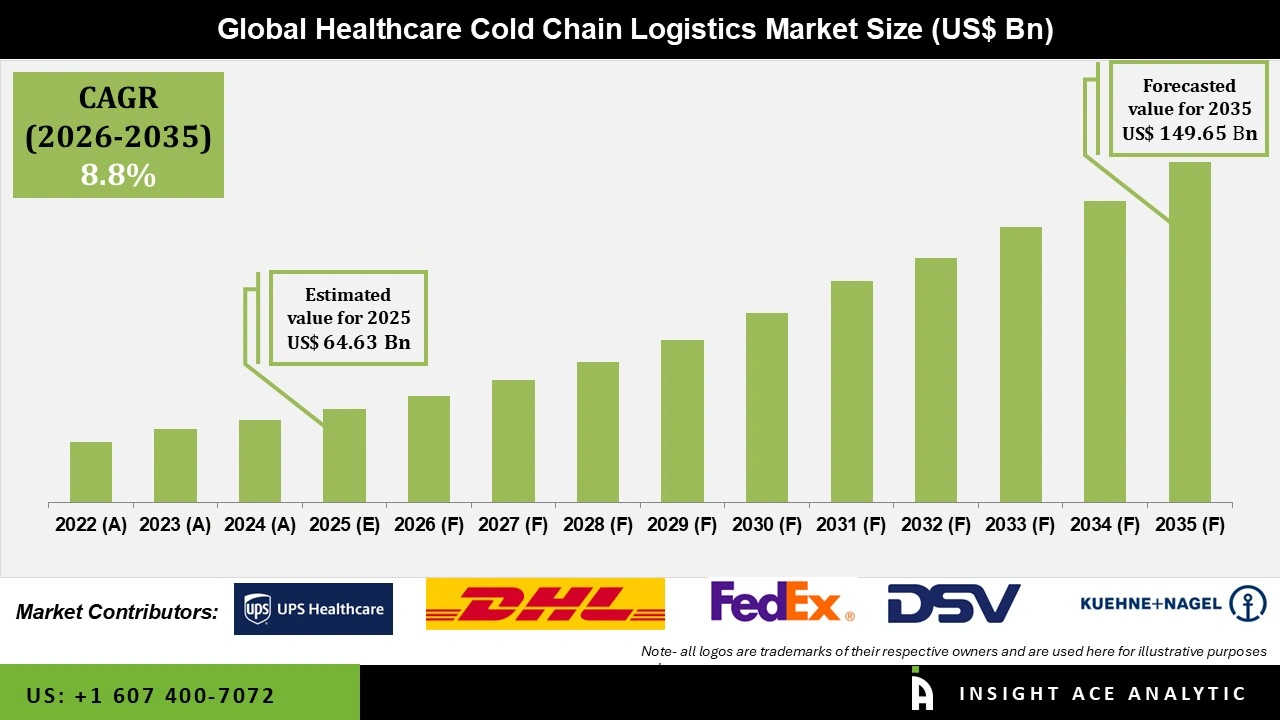
Healthcare Cold Chain Logistics Market Key Takeaways:
|
The development of numerous cutting-edge therapies using human cells has prompted a rise in the demand for temperature-controlled items, particularly pharmaceutical ones, which has fueled the expansion of the healthcare cold chain logistics industry. The prevalence of chronic diseases has increased demand for modern healthcare goods and services and better medical care, particularly in rural areas. The need for the secure transportation of pharmaceutical products has resulted from this.
Healthcare manufacturers increasingly need specialized cold chain logistics services to provide hospitals, home care patients, labs, and other healthcare facilities with large volumes of pharmaceuticals in an efficient manner, which spurs the market's expansion.
However, the quality and adaptability of available cold warehouse space are significant difficulties for the cold chain sector due to a lack of standards and accreditations. Globally, there is an increase in healthcare cold chain logistics used to preserve medical supplies. This is one of the main factors influencing the market, coupled with the growing pharmaceutical industry. Additionally, the necessity for safe medicine transportation and storage has increased in the healthcare industry without affecting the effectiveness of the drugs.
The market is expanding as a result of this as well as other advantages offered by healthcare cold chain logistics, such as the seamless integration of operations throughout shipping and distribution.
Recent Developments:
- In Nov 2022, FedEx Express, a subsidiary of FedEx Corp, has announced the seventh edition of 'SME Connect' on 'Emerging Possibilities for SME's in Pharma, Healthcare, and Life Science.This installment of the FedEx SME Connect series concentrates on business insights from industry leaders on pharma and healthcare trends, opportunities, and challenges.
Competitive Landscape:
Some of the Healthcare Cold Chain Logistics market players are:
- DHL
- UPS Healthcare
- FedEx
- Kuehne+Nagel
- DB Schenker
- DSV
- CEVA Logistics
- Bolloré Logistics
- Nippon Express
- Yusen Logistics
- Kerry Logistics
- SF Express
- World Courier
- Marken
- QuickSTAT
- Cryoport
- Envirotainer
- CSafe Global
- DoKaSch Temperature Solutions
- SkyCell
- Sonoco ThermoSafe
- Tower Cold Chain
- va-Q-tec
- Peli BioThermal
- Softbox
- Thermo Fisher Scientific
- AeroSafe Global
- Intelsius
- Cold Chain Technologies
- Sensitech
- ELPRO
- Berlinger
- Controlant
- Tive
- PHCbi
- Haier Biomedical
- Helmer Scientific
- Azenta Life Sciences
Market Segmentation:
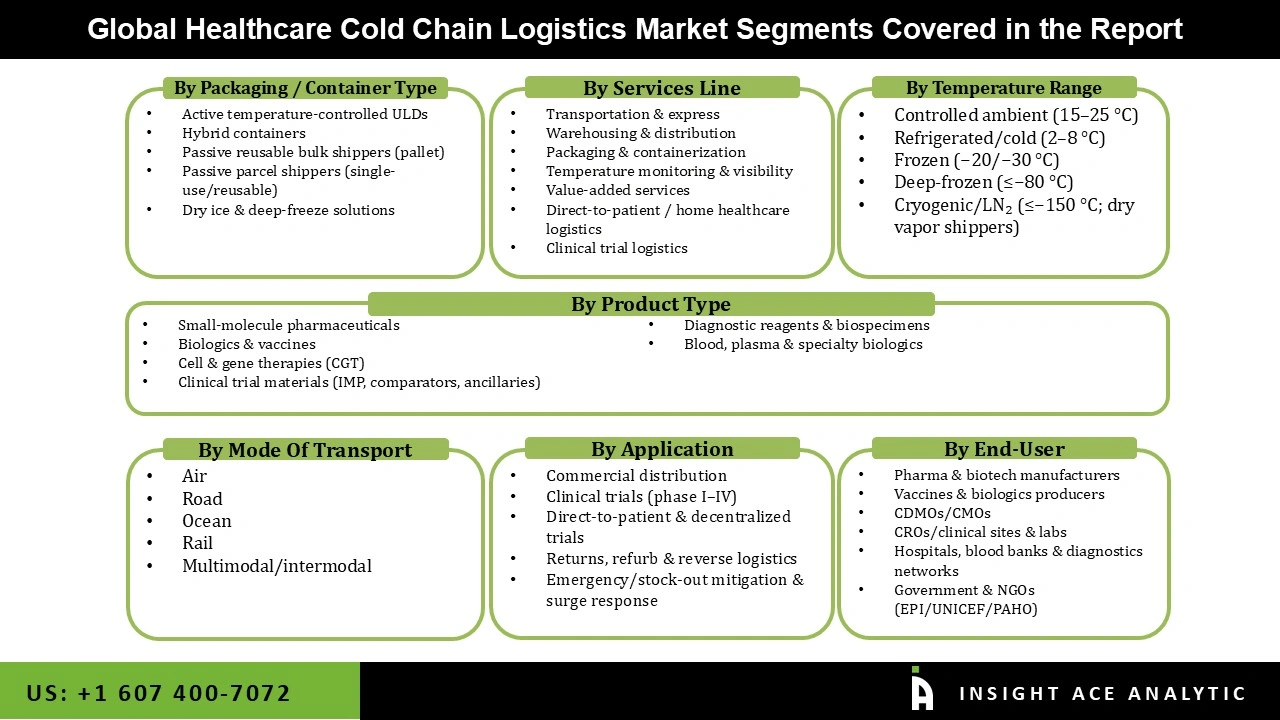
The healthcare cold chain logistics market is segmented based on type, services and storage techniques. The market is segmented based on type as biopharmaceuticals, vaccines, clinical trial materials, and others. The market is segmented by application into storage, transportation, packaging and others. The market is segmented by storage as electrical refrigeration, dry ice, gel packs, liquid nitrogen, and others.
The Biopharmaceutical Segment Is A Major Contributor To The Healthcare Cold Chain Logistics Market Based On Type
The biopharmaceuticals category will hold a major global market share in 2022. Because this sector is the primary manufacturer of temperature-sensitive healthcare products and requires cold chain logistics to ensure effective and timely delivery of medications to patients as well as to receive raw materials like APIs to develop various biopharmaceutical products, biopharmaceutical/biotech companies predominate the end-user segment. It has been noted recently that cold chain logistics investment is rising and is helping the market expand.
The Transportation Segment Witnessed Growth At A Rapid Rate
The transportation segment is projected to grow rapidly in the global market. The logistics chain depends heavily on transportation. Hence it accounted for the largest revenue share of the market. Because the products must be carried to the final consumer, transportation is the most important component of cold chain logistics. There is an increasing demand for temperature-controlled transportation to preserve the quality of goods.
The North American Healthcare Cold Chain Logistics Market Holds A Significant Revenue Share
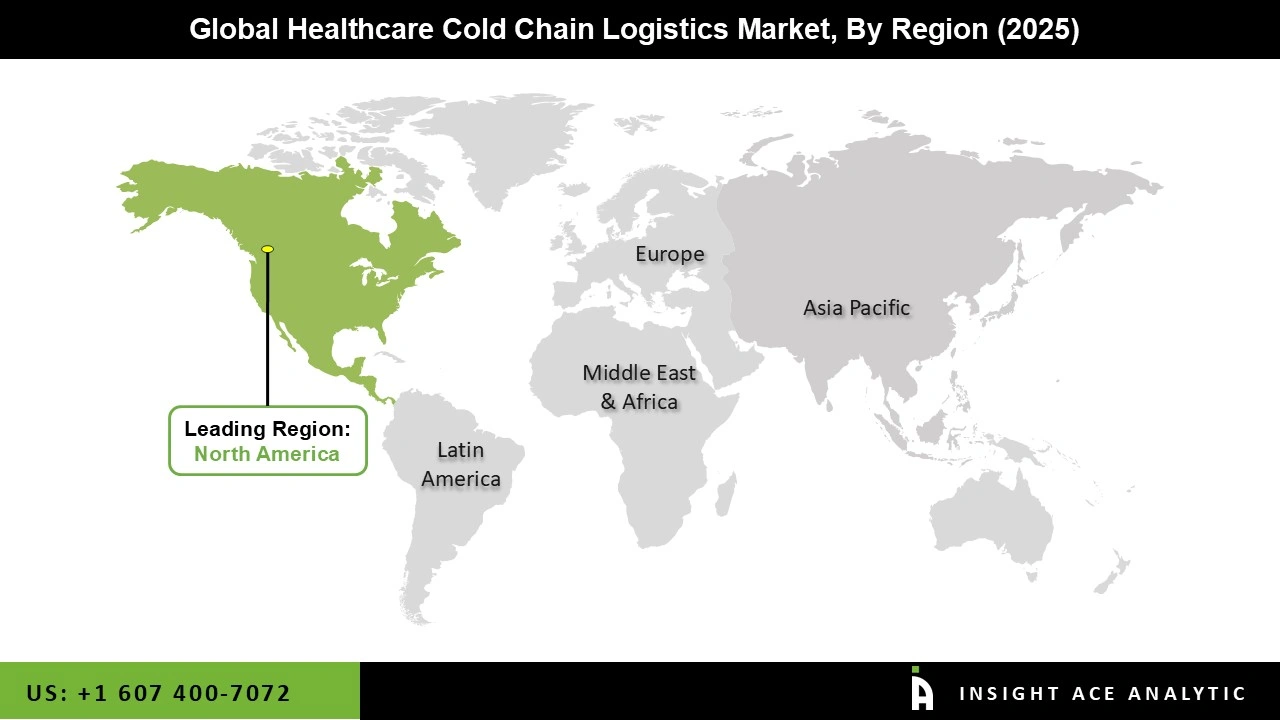
The North American market is expected to register a tremendous market share in revenue soon due to the nation's cutting-edge healthcare system and significant pharmaceutical businesses. The healthcare cold chain logistics market has expanded due to the rising demand for biopharmaceutical products, including gene and cell therapies. In addition, the Asia Pacific region is expected to grow rapidly in the global healthcare cold chain logistics market.
The market is fueled by top pharmaceutical firms like Novartis, Roche, and Sanofi in the area. To preserve the effectiveness and integrity of their products, these businesses demand effective and secure storage and transportation solutions. Moreover, the market expansion for healthcare cold chain logistics in Europe is anticipated to be further fueled by the rising demand for personalized medications and the expanding use of gene and cell therapies.
Healthcare Cold Chain Logistics Market Report Scope :
| Report Attribute | Specifications |
| Market Size Value In 2025 | USD 64.63 billion |
| Revenue Forecast In 2035 | USD 149.65 billion |
| Growth Rate CAGR | CAGR of 8.8% from 2026 to 2035 |
| Quantitative Units | Representation of revenue in US$ Bn and CAGR from 2026 to 2035 |
| Historic Year | 2022 to 2024 |
| Forecast Year | 2026-2035 |
| Report Coverage | The forecast of revenue, the position of the company, the competitive market structure, growth prospects, and trends |
| Segments Covered | Product Type, Application, Service Line, Temperature Range, Mode Of Transport, Packaging |
| Regional Scope | North America; Europe; Asia Pacific; Latin America; Middle East & Africa |
| Country Scope | U.S.; Canada; U.K.; Germany; China; Japan; Brazil; Mexico; The UK; France; Italy; Spain; India; South Korea; Southeast Asia |
| Competitive Landscape | AmerisourceBergen Corporation (U.S.), CAVALIER LOGISITICS (U.S.), Continental Carbon Company (U.S.), DHL International GmbH (Germany), FedEx (U.S.), Kuehne+Nagel (Germany), Deutsche Post AG (Germany), LifeConEx (U.S.), American Airlines Inc. (U.S.) Air Charter Service (India), Agility Public Warehousing Company (U.S.), VersaCold Logistics Services (Canada), Delhivery Limited (India), YUSEN LOGISTICS CO., LTD. (India), V-Xpress (India), FulfillmentHubUSA (U.S.), Prompt Brazil Logistics (Brazil) |
| Customization Scope | Free customization report with the procurement of the report, Modifications to the regional and segment scope. Particular Geographic competitive landscape. |
| Pricing and Available Payment Methods | Explore pricing alternatives that are customized to your particular study requirements. |
Segmentation of Healthcare Cold Chain Logistics Market :
Healthcare Cold Chain Logistics Market By Packaging / Container Type-
- Active temperature-controlled ULDs
- Hybrid containers
- Passive reusable bulk shippers (pallet)
- Passive parcel shippers (single-use/reusable)
- Dry ice & deep-freeze solutions
- LN₂ dry vapor shippers & cryo dewars
- Refrigerants (PCM, gel packs) & payload conditioning
Healthcare Cold Chain Logistics Market By Services Line-
- Transportation & express
- Warehousing & distribution
- Packaging & containerization
- Temperature monitoring & visibility
- Value-added services
- Direct-to-patient / home healthcare logistics
- Clinical trial logistics
Healthcare Cold Chain Logistics Market By Temperature Range-
- Controlled ambient (15–25 °C)
- Refrigerated/cold (2–8 °C)
- Frozen (−20/−30 °C)
- Deep-frozen (≤−80 °C)
- Cryogenic/LN₂ (≤−150 °C; dry vapor shippers)
Healthcare Cold Chain Logistics Market By Product Type-
- Small-molecule pharmaceuticals
- Biologics & vaccines
- Cell & gene therapies (CGT)
- Clinical trial materials (IMP, comparators, ancillaries)
- Diagnostic reagents & biospecimens
- Blood, plasma & specialty biologics
Healthcare Cold Chain Logistics Market By Mode Of Transport-
- Air
- Road
- Ocean
- Rail
- Multimodal/intermodal
Healthcare Cold Chain Logistics Market By Application-
- Commercial distribution
- Clinical trials (phase I–IV)
- Direct-to-patient & decentralized trials
- Returns, refurb & reverse logistics
- Emergency/stock-out mitigation & surge response
Healthcare Cold Chain Logistics Market By End User-
- Pharma & biotech manufacturers
- Vaccines & biologics producers
- CDMOs/CMOs
- CROs/clinical sites & labs
- Hospitals, blood banks & diagnostics networks
- Government & NGOs (EPI/UNICEF/PAHO)
Healthcare Cold Chain Logistics Market By Region-
- North America-
- The US
- Canada
- Europe-
- Germany
- The UK
- France
- Italy
- Spain
- Rest of Europe
- Asia-Pacific-
- China
- Japan
- India
- South Korea
- South East Asia
- Rest of Asia Pacific
- Latin America-
- Brazil
- Argentina
- Mexico
- Rest of Latin America
- Middle East & Africa-
- GCC Countries
- South Africa
- Rest of Middle East and Africa
Research Design and Approach
This study employed a multi-step, mixed-method research approach that integrates:
- Secondary research
- Primary research
- Data triangulation
- Hybrid top-down and bottom-up modelling
- Forecasting and scenario analysis
This approach ensures a balanced and validated understanding of both macro- and micro-level market factors influencing the market.
Secondary Research
Secondary research for this study involved the collection, review, and analysis of publicly available and paid data sources to build the initial fact base, understand historical market behaviour, identify data gaps, and refine the hypotheses for primary research.
Sources Consulted
Secondary data for the market study was gathered from multiple credible sources, including:
- Government databases, regulatory bodies, and public institutions
- International organizations (WHO, OECD, IMF, World Bank, etc.)
- Commercial and paid databases
- Industry associations, trade publications, and technical journals
- Company annual reports, investor presentations, press releases, and SEC filings
- Academic research papers, patents, and scientific literature
- Previous market research publications and syndicated reports
These sources were used to compile historical data, market volumes/prices, industry trends, technological developments, and competitive insights.
Primary Research
Primary research was conducted to validate secondary data, understand real-time market dynamics, capture price points and adoption trends, and verify the assumptions used in the market modelling.
Stakeholders Interviewed
Primary interviews for this study involved:
- Manufacturers and suppliers in the market value chain
- Distributors, channel partners, and integrators
- End-users / customers (e.g., hospitals, labs, enterprises, consumers, etc., depending on the market)
- Industry experts, technology specialists, consultants, and regulatory professionals
- Senior executives (CEOs, CTOs, VPs, Directors) and product managers
Interview Process
Interviews were conducted via:
- Structured and semi-structured questionnaires
- Telephonic and video interactions
- Email correspondences
- Expert consultation sessions
Primary insights were incorporated into demand modelling, pricing analysis, technology evaluation, and market share estimation.
Data Processing, Normalization, and Validation
All collected data were processed and normalized to ensure consistency and comparability across regions and time frames.
The data validation process included:
- Standardization of units (currency conversions, volume units, inflation adjustments)
- Cross-verification of data points across multiple secondary sources
- Normalization of inconsistent datasets
- Identification and resolution of data gaps
- Outlier detection and removal through algorithmic and manual checks
- Plausibility and coherence checks across segments and geographies
This ensured that the dataset used for modelling was clean, robust, and reliable.
Market Size Estimation and Data Triangulation
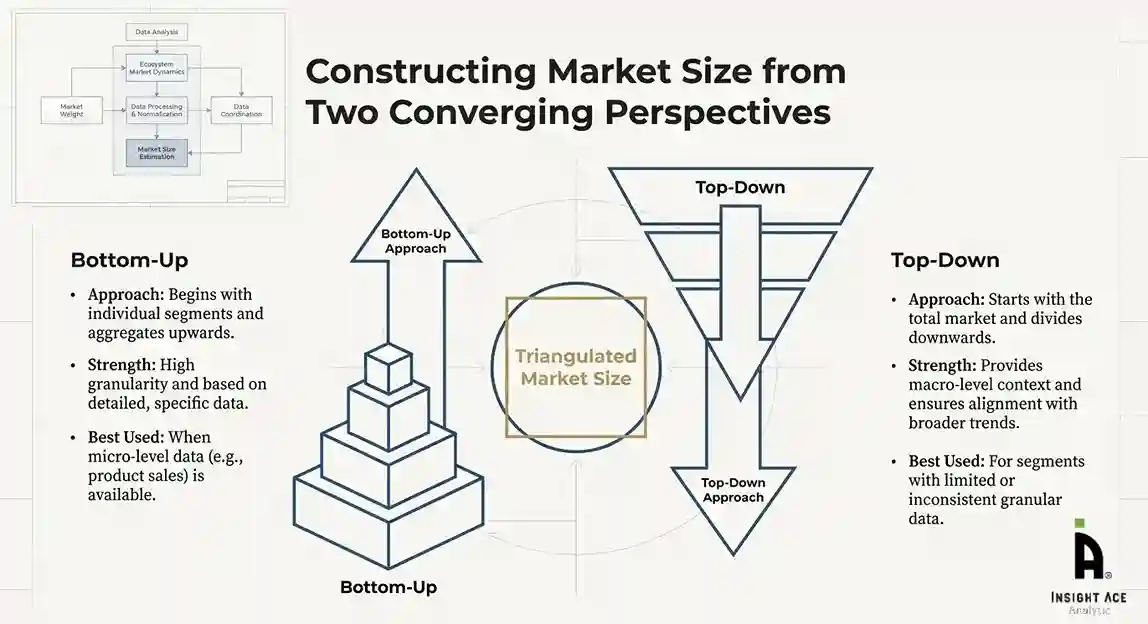
Bottom-Up Approach
The bottom-up approach involved aggregating segment-level data, such as:
- Company revenues
- Product-level sales
- Installed base/usage volumes
- Adoption and penetration rates
- Pricing analysis
This method was primarily used when detailed micro-level market data were available.
Top-Down Approach
The top-down approach used macro-level indicators:
- Parent market benchmarks
- Global/regional industry trends
- Economic indicators (GDP, demographics, spending patterns)
- Penetration and usage ratios
This approach was used for segments where granular data were limited or inconsistent.
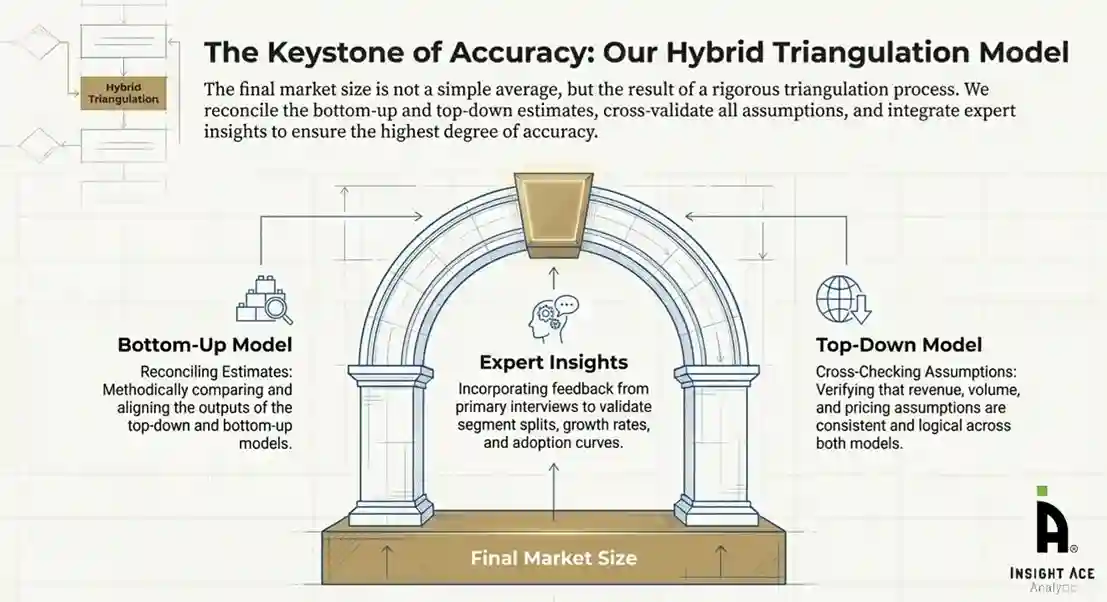
Hybrid Triangulation Approach
To ensure accuracy, a triangulated hybrid model was used. This included:
- Reconciling top-down and bottom-up estimates
- Cross-checking revenues, volumes, and pricing assumptions
- Incorporating expert insights to validate segment splits and adoption rates
This multi-angle validation yielded the final market size.
Forecasting Framework and Scenario Modelling
Market forecasts were developed using a combination of time-series modelling, adoption curve analysis, and driver-based forecasting tools.
Forecasting Methods
- Time-series modelling
- S-curve and diffusion models (for emerging technologies)
- Driver-based forecasting (GDP, disposable income, adoption rates, regulatory changes)
- Price elasticity models
- Market maturity and lifecycle-based projections
Scenario Analysis
Given inherent uncertainties, three scenarios were constructed:
- Base-Case Scenario: Expected trajectory under current conditions
- Optimistic Scenario: High adoption, favourable regulation, strong economic tailwinds
- Conservative Scenario: Slow adoption, regulatory delays, economic constraints
Sensitivity testing was conducted on key variables, including pricing, demand elasticity, and regional adoption.
Request Customization
Add countries, segments, company profiles, or extend forecast — free 10% customization with purchase.
Customize This Report →Enquire Before Buying
Speak with our analyst team about scope, methodology, pricing, or deliverable formats.
Enquire Now →Frequently Asked Questions
Healthcare Cold Chain Logistics Market Size is valued at USD 64.63 billion in 2025 and is predicted to reach USD 149.65 billion by the year 2035
Healthcare Cold Chain Logistics Market expected to grow at a 8.8% CAGR during the forecast period for 2026 to 2035.
AmerisourceBergen Corporation (U.S.), CAVALIER LOGISITICS (U.S.), Continental Carbon Company (U.S.), DHL International GmbH (Germany), FedEx (U.S.), Kuehne+Nagel (Germany), Deutsche Post AG (Germany), LifeConEx (U.S.), American Airlines Inc. (U.S.) Air Charter Service (India), Agility Public Warehousing Company (U.S.), VersaCold Logistics Services (Canada), Delhivery Limited (India), YUSEN LOGISTICS CO., LTD. (India), V-Xpress (India), FulfillmentHubUSA (U.S.), Prompt Brazil Logistics (Brazil) and Others.
Healthcare Cold Chain Logistics Market is Segmented in Type (Biopharmaceuticals, Vaccines, Clinical Trial Materials, Others), Services (Storage, Transportation, Packaging, Others), Storage Techniques (Electrical refrigeration, Dry Ice, Gel Packs, Liquid Nitrogen, Others), Product Type, Application, Temperature Range, Mode Of Transport and other.
North American region is leading the Healthcare Cold Chain Logistics Market.