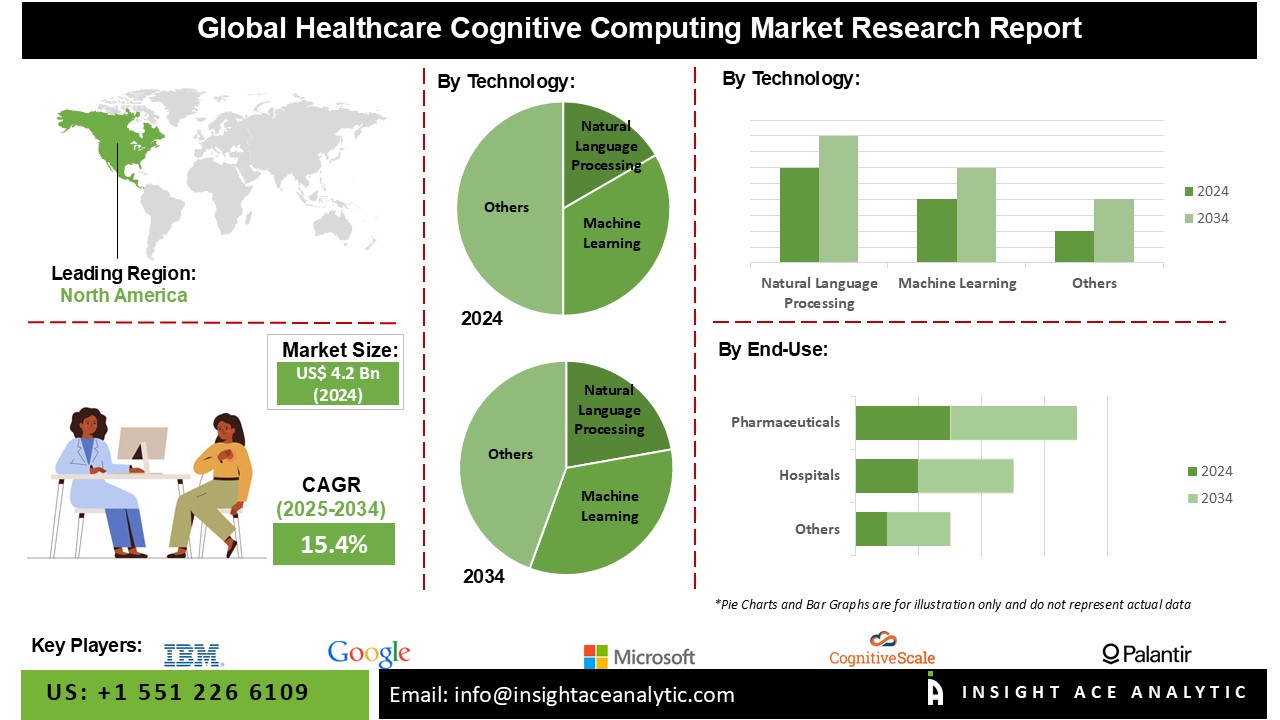
Global Healthcare Cognitive Computing Market Size is valued at USD 4.28 Bn in 2024 and is predicted to reach USD 17.62 Bn by the year 2034 at a 15.4% CAGR during the forecast period for 2025-2034.
Key Industry Insights & Findings from the Report:
- The healthcare cognitive computing market is projected to witness significant growth fueled by the increasing adoption of AI-driven solutions across healthcare facilities.
- North America holds the largest market share due to the presence of established healthcare infrastructure and early adoption of cognitive computing technologies
- Healthcare providers are increasingly investing in cognitive computing solutions to enhance patient care, optimize clinical workflows, and improve operational efficiency.
Cognitive computing, which involves emulating human thought processes electronically, offers significant advantages, particularly threat detection and fraud prevention. In the healthcare sector, cognitive computing assists medical professionals in making treatment decisions based on previous evidence and managing complex and extensive datasets. The widespread adoption of cloud services globally plays a pivotal role in propelling the healthcare cognitive computing market. Furthermore, the increasing rapid cases of chronic diseases such as diabetes, cardiovascular disorders, and cancer, among others, have raised concerns for governments and healthcare providers, driving market growth. The exponential growth in patient data generation fuels the demand for big data as well as cognitive computing analytics.
Additionally, the healthcare industry is witnessing the extensive application of cognitive computing technology, further bolstering market expansion. Other contributing factors include a population with high disposable income, advancements in healthcare infrastructure, a surge in healthcare spending, the rise of direct digital manufacturing, and the proliferation of structured and unstructured data. Furthermore, the growing demand for personalized healthcare services and ongoing technological advancements in data mining and analytics offer lucrative opportunities for market players.
Competitive Landscape
Some Major Key Players In The Healthcare Cognitive Computing Market:
- IBM,
- Microsoft,
- Google
- Apple
- PTC
- Palantir
- CognitiveScale,
- Numenta,
- Vicarious,
- Enterra Solutions,
- Numenta,
- Vicarious,
- Deepmind,
- SparkCognition,
- TIBCO Software Inc,
- NakaTech,
- Wipro Limited,
- Marlabs,
- SAP SE,
- Apixio,
- Healthcare X.0,
- Enterra Solutions,
- Nuance Communications, Inc,
- Intel Corporation,
- MEDWHAT
- Others
Market Segmentation:
The market is segmented on the basis of technology and end users. Based on technology, the healthcare cognitive computing market is segmented as NL, ML, automated reasoning and others. By end users, the healthcare cognitive computing market is segmented into hospitals, medical devices, insurance pharmaceuticals, and clinical research organizations.
Based On Product, The NLP Segment Is Accounted As A Major Contributor In The Healthcare Cognitive Computing Market.
The NLP category is expected to hold a major share of the global Healthcare Cognitive Computing market in 2022. Natural language processing (NLP) plays a pivotal role in cognitive computing, empowering machines to comprehend and handle human language. NLP technologies can scrutinize and make sense of human language, encompassing spoken and written forms, while generating responses that humans can comprehend. The adoption of NLP is rising across diverse sectors, including expanding healthcare, retail, and finance, where it finds application in functions like virtual assistants, chatbots, and voice-activated devices.
The Hospital Category Witnessed Growth At A Rapid Rate.
The hospital segment is projected to develop at a rapid rate in the global healthcare cognitive computing market. The significant utilization of cognitive computing can be ascribed to several pivotal factors, which encompass a rising need for tailored medical approaches, treatments tailored to specific genes, oncological care, and the management of patient health records. Initially, cognitive computing solutions were introduced through pilot programs in oncology, patient data management, and gene-targeted treatments. As a result, they have played a vital role in achieving widespread adoption.
In The Region, The North American Healthcare Cognitive Computing Market Holds A Significant Revenue Share.
The North American healthcare cognitive computing market is expected to register a tremendous market share in terms of revenue in the near future. The region's sizable population has spurred growth in the construction and infrastructure industries, generating a heightened demand for cognitive computing solutions in various applications, including coatings, plastics, and construction materials. Additionally, the escalating desire for consumer electronics and appliances in the region is fueling the proliferation of speciality deployment cognitive computing, which is crucial for the production of these goods.
Attributed to the strong presence of advanced technology firms and continuous regional investments in research and development. The market's dominance in this region can be attributed to several key factors, including the presence of advanced technology companies, sustained investments in research and development, more favourable reimbursement policies, and extensive utilization of information technology to reduce healthcare expenses and improve the quality of patient care.
Recent Developments:
- In April 2023, Cognizant and Microsoft have recently announced an extension of their established healthcare partnership. This development aims to provide healthcare payers and providers with convenient access to state-of-the-art technological solutions, enhance the efficiency of claims management, and optimise business operations and member experiences through improved interoperability.
- In July 2019, Nestlé USA and Enterra Solutions entered into a multi-year solution-as-a-service agreement for the next generation's business applications and analytics and insights platform.
Healthcare Cognitive Computing Market Report Scope
|
Report Attribute
|
Specifications
|
|
Market Size Value In 2024
|
USD 4.28 Bn
|
|
Revenue Forecast In 2034
|
USD 17.62 Bn
|
|
Growth Rate CAGR
|
CAGR of 15.4% from 2025 to 2034
|
|
Quantitative Units
|
Representation of revenue in US$ Bn and CAGR from 2025 to 2034
|
|
Historic Year
|
2021 to 2024
|
|
Forecast Year
|
2025-2034
|
|
Report Coverage
|
The forecast of revenue, the position of the company, the competitive market structure, growth prospects, and trends
|
|
Segments Covered
|
By Technology, By End-User
|
|
Regional Scope
|
North America; Europe; Asia Pacific; Latin America; Middle East & Africa
|
|
Country Scope
|
U.S.; Canada; U.K.; Germany; China; India; Japan; Brazil; Mexico ;The UK; France; Italy; Spain; South Korea; South East Asia
|
|
Competitive Landscape
|
IBM, Microsoft, Google, Apple, PTC, Palantir, ognitiveScale, Numenta, Vicarious, Enterra Solutions, Numenta, Vicarious, Deepmind, SparkCognition, TIBCO Software Inc, NakaTech, Wipro Limited, Marlabs, SAP SE, Apixio, Healthcare X.0, Enterra Solutions, Nuance Communications, Inc, Intel Corporation, MEDWHAT, Others
|
|
Customization Scope
|
Free customization report with the procurement of the report and modifications to the regional and segment scope. Particular Geographic competitive landscape.
|
|
Pricing And Available Payment Methods
|
Explore pricing alternatives that are customized to your particular study requirements.
|
Segmentation of Healthcare Cognitive Computing Market-
By Technology-
- Natural Language Processing
- Machine Learning
- Automated Reasoning
- Others
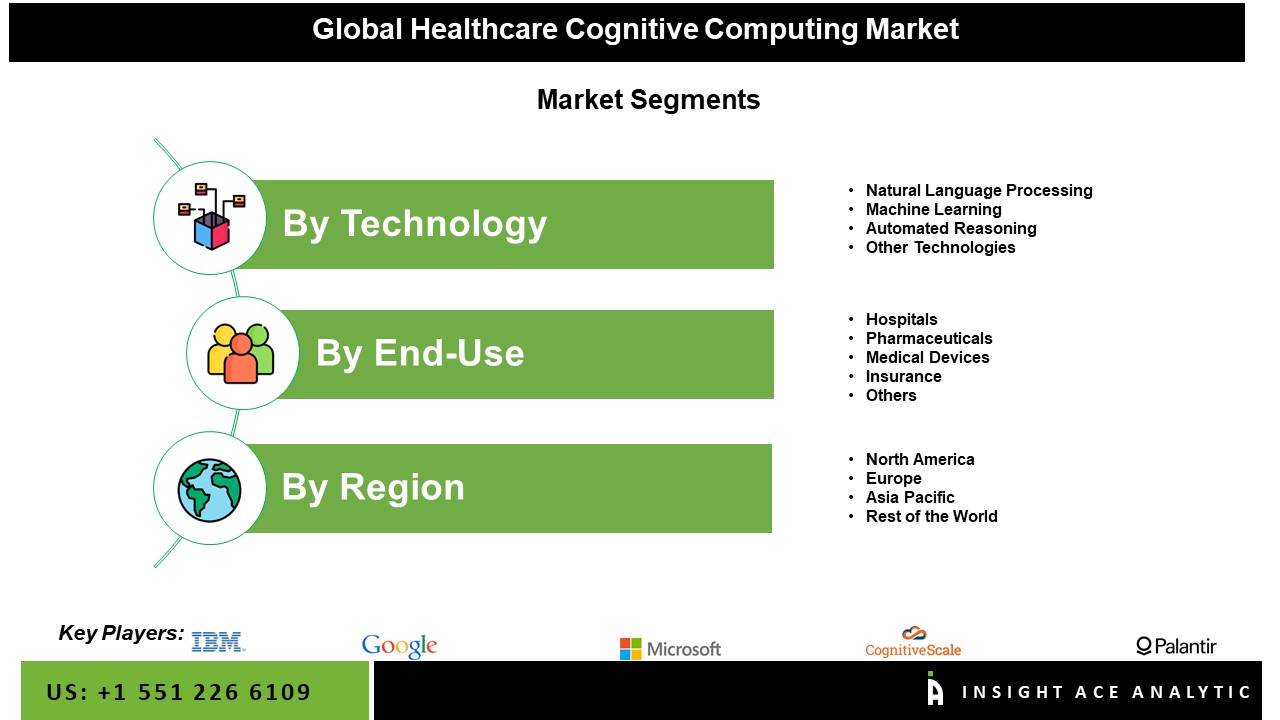
By End Users -
- Hospitals
- Pharmaceuticals
- Medical Devices
- Insurance
- Clinical Research Organizations
By Region-
North America-
Europe-
- Germany
- The UK
- France
- Italy
- Spain
- Rest of Europe
Asia-Pacific-
- China
- Japan
- India
- South Korea
- Southeast Asia
- Rest of Asia Pacific
Latin America-
- Brazil
- Argentina
- Mexico
- Rest of Latin America
Middle East & Africa-
- GCC Countries
- South Africa
- Rest of Middle East and Africa