Green Fertilizer Market Size, Scope, Revenue Report 2026 to 2035
What is Green Fertilizer Market Size?
Global Green Fertilizer Market Size is valued at USD 2.3 Billion in 2025 and is predicted to reach USD 4.27 Billion by the year 2035 at an 6.5% CAGR during the forecast period for 2026 to 2035.
Green Fertilizer Market Size, Share & Trends Analysis Report By Technology (Alkaline Water Electrolysis, Proton Exchange Membrane And Solid Oxide Electrolysis) And Fertilizers (Packaging, Ammonium Nitrate (AN) And Calcium Ammonium Nitrate (CAN)), By Region, And Segment Forecasts, 2026 to 2035
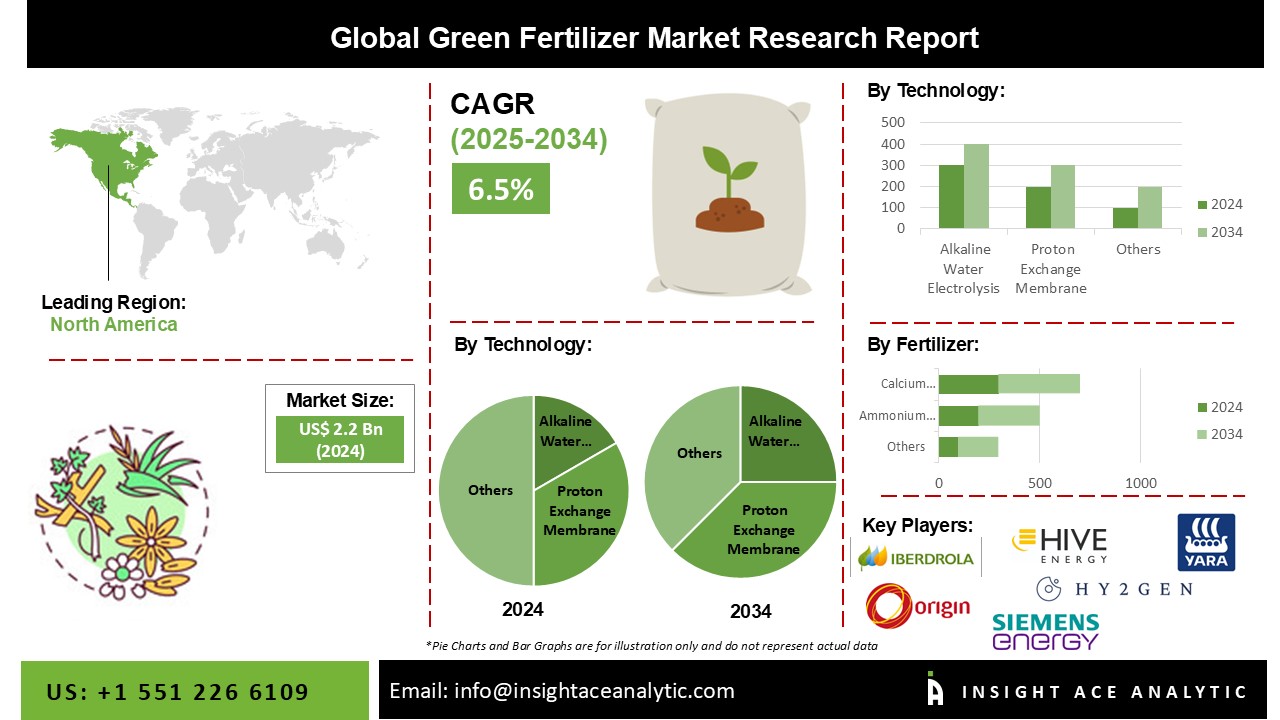
Green Fertilizer Market Key Takeaways:
|
Key Industry Insights & Findings from the Report:
- The increasing number of people and cutting-edge technology has led to market growth.
- Nitrate-based fertilizers are in high demand because they work well in various climates and soil types. The high nitrogen content and low price contribute to its attractiveness, fueling the demand for green fertilizers and propelling the market forward.
- North America dominated the market and accounted for a global revenue share in 2024.
- The market for green fertilizers is expected to be hindered by the high manufacturing costs of environmentally friendly fertilizers and the availability of cheaper synthetic fertilizers.
Green fertilizers are safer for humans, animals, and any other organisms that come into contact with them since they decompose rapidly and have no harmful impact on the surface or groundwater. These fertilizers have a lengthy shelf life, enhance soil, and increase soil's ability to retain nutrients and water. They are preferred for creating agricultural output free of residues since they are non-toxic, slow-releasing fertilizers that do not leave any residues in the food. As a result, factors including the growing need to boost agricultural output and knowledge of green fertilizer's advantages over chemical inputs also contribute to the market's rapid expansion. Growing organic farms, global acreage, and consumer demand for organic food due to its multiple health and fitness benefits are the main factors driving the market.
Additionally, the overall market for these materials' suppliers is growing as a result of increased accessibility to animal and vegetable waste as well as advancements in the method used to produce green fertilizer. The market is further gaining momentum due to various factors including an increase in the area used for organic farming, improvements in the production of green fertilizer, a larger pool of potential customers, and rising demand from the organic food business.
On the other side, the market demand is struggling to reach its full potential due to high costs and continuous reliance on inorganic cultivation methods.
Recent Developments:
- In Jan 2022, Hive Hydrogen will open South Africa's first green ammonia plant, ushering in a new era of hydrogen development that will position the country as a net hydrogen exporter. BuiltAfrica and Hive Energy from the United Kingdom are the primary development partners. Companies joined together to establish Hive Hydrogen South Africa - the development firm.
Competitive Landscape:
Some of the major green fertilizer market players are:
- Yara International ASA
- Siemens Energy
- Origin Energy Limited
- Iberdrola, S.A.
- HY2GEN AG
- Hive Energy
- Haldor Topsor A/S
- H2U Technologies, Inc.
- Fusion-Fuel
- Fertiglobe
- Eneus Energy Limited
- Enaex Energy
- Dyno Nobel
- CF Industries Holdings, Inc.
- Ballance Agri-Nutrients
- Aker Clean Hydrogen
- Air Products Inc.
- ACME Group
Market Segmentation:
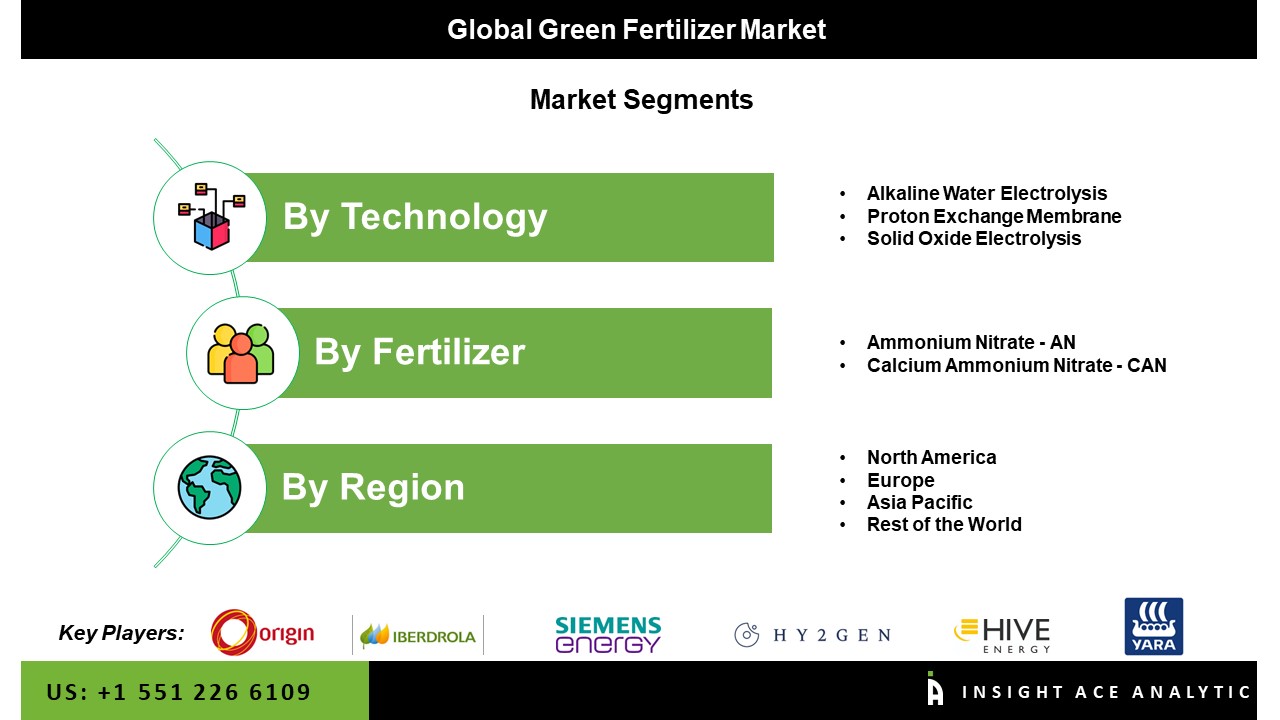
The green fertilizer market is segmented based on technology and fertilizers. The market is segmented on technology such as alkaline water electrolysis, proton exchange membrane and solid oxide electrolysis. By fertilizers, the market is segmented into Ammonium nitrate (AN) and Calcium ammonium nitrate (CAN).
Based On The Technology, The Alkaline Water Electrolysis Segment Is A Major Contributor To The Green Fertilizer Market
The alkaline water electrolysis category will hold a major share of the global green fertilizer market in 2024. A process known as alkaline water electrolysis uses two poles and a liquid alkaline solution of potassium or sodium hydroxide. It is increasingly used in creating green ammonia due to the reduced cost of catalysis and improved gas purity. Alkaline water electrolysis provides improved durability due to an interchangeable electrolyte and less corrosion potential catalyst dissolution, predicted to fuel industry expansion. Comparing the total energy cost and energy requirements for the ammonia electrolytic and water electrolyzers at various hydrogen production rates reveals that the water electrolyzer requires up to 65% more energy and power overall than the ammonia electrolytic cell.
The Ammonium Nitrate Segment Witnessed Growth At A Rapid Rate
The ammonium nitrate segment is projected to grow rapidly in the global green fertilizer industry. As plants take ammonium (NH4 +) directly at modest rates, the demand for ammonium nitrate fertilizer will increase. The positively charged ion binds to plant nutrients and is less mobile than nitrate (NO3). As a result, plant roots must point toward nitrogen. The majority of the ammonium is converted to nitrate by soil bacteria. Temperature influences the nitrification process, which might take one to several weeks. Soil bacteria adsorb an additional portion of the ammonia and grade released it, increasing the amount of organic matter in the soil., especially in countries such as the US, Germany, the UK, China, and India.
In North America, The Green Fertilizer Market Holds A Significant Regional Revenue Share
The North American green fertilizer market is expected to register the highest market share in revenue soon. The demand for organic food increases along with per capita income, which fuels this region's organic fertilizer industry. Additionally, improvements in telecommunication technology have made it possible for customers to learn more about growth and wellness dynamics, strengthening this industry globally and in developing countries. In addition, Europe is projected to grow rapidly in the global market for Green Fertilizer. The expansion of the industry in the area has been aided by rising public and private investments, the incorporation of technology into farming operations, and government policies and programs to increase agricultural income.
Green Fertilizer Market Report Scope:
| Report Attribute | Specifications |
| Market size value in 2025 | USD 2.3 Billion |
| Revenue forecast in 2035 | USD 4.27 Billion |
| Growth rate CAGR | CAGR of 6.5% from 2026 to 2035 |
| Quantitative units | Representation of revenue in US$ Mn, CAGR from 2026 to 2035 |
| Historic Year | 2022 to 2025 |
| Forecast Year | 2026-2035 |
| Report coverage | The forecast of revenue, the position of the company, the competitive market statistics, growth prospects, and trends |
| Segments covered | Technology And Fertilizers |
| Regional scope | North America; Europe; Asia Pacific; Latin America; Middle East & Africa |
| Country scope | U.S.; Canada; U.K.; Germany; China; India; Japan; Brazil; Mexico; The UK; France; Italy; Spain; China; Japan; India; South Korea; Southeast Asia; South Korea; Southeast Asia |
| Competitive Landscape | Yara International ASA, Siemens Energy, Origin Energy Limited, Iberdrola, S.A., HY2GEN AG, Hive Energy,, Haldor Topsor A/S, H2U Technologies, Inc., Fusion-Fuel, Fertiglobe, Eneus Energy Limited, Enaex Energy, Dyno Nobel, CF Industries Holdings, Inc., Ballance Agri-Nutrients, Aker, Clean Hydrogen, Air Products Inc.and ACME Group. |
| Customization scope | Free customization report with the procurement of the report, Modifications to the regional and segment scope. Particular Geographic competitive landscape. |
| Pricing and available payment methods | Explore pricing alternatives that are customized to your particular study requirements. |
Segmentation of Green Fertilizer Market-
Green Fertilizer Market By Technology:
- Alkaline water electrolysis
- Proton Exchange Membrane
- Solid Oxide Electrolysis
Green Fertilizer Market By Fertilizer:
- Ammonium nitrate (AN)
- Calcium ammonium nitrate (CAN)
Green Fertilizer Market By Region-
North America-
- The US
- Canada
- Mexico
Europe-
- Germany
- The UK
- France
- Italy
- Spain
- Rest of Europe
Asia-Pacific-
- China
- Japan
- India
- South Korea
- South East Asia
- Rest of Asia Pacific
Latin America-
- Brazil
- Argentina
- Rest of Latin America
Middle East & Africa-
- GCC Countries
- South Africa
- Rest of Middle East and Africa
Research Design and Approach
This study employed a multi-step, mixed-method research approach that integrates:
- Secondary research
- Primary research
- Data triangulation
- Hybrid top-down and bottom-up modelling
- Forecasting and scenario analysis
This approach ensures a balanced and validated understanding of both macro- and micro-level market factors influencing the market.
Secondary Research
Secondary research for this study involved the collection, review, and analysis of publicly available and paid data sources to build the initial fact base, understand historical market behaviour, identify data gaps, and refine the hypotheses for primary research.
Sources Consulted
Secondary data for the market study was gathered from multiple credible sources, including:
- Government databases, regulatory bodies, and public institutions
- International organizations (WHO, OECD, IMF, World Bank, etc.)
- Commercial and paid databases
- Industry associations, trade publications, and technical journals
- Company annual reports, investor presentations, press releases, and SEC filings
- Academic research papers, patents, and scientific literature
- Previous market research publications and syndicated reports
These sources were used to compile historical data, market volumes/prices, industry trends, technological developments, and competitive insights.
Primary Research
Primary research was conducted to validate secondary data, understand real-time market dynamics, capture price points and adoption trends, and verify the assumptions used in the market modelling.
Stakeholders Interviewed
Primary interviews for this study involved:
- Manufacturers and suppliers in the market value chain
- Distributors, channel partners, and integrators
- End-users / customers (e.g., hospitals, labs, enterprises, consumers, etc., depending on the market)
- Industry experts, technology specialists, consultants, and regulatory professionals
- Senior executives (CEOs, CTOs, VPs, Directors) and product managers
Interview Process
Interviews were conducted via:
- Structured and semi-structured questionnaires
- Telephonic and video interactions
- Email correspondences
- Expert consultation sessions
Primary insights were incorporated into demand modelling, pricing analysis, technology evaluation, and market share estimation.
Data Processing, Normalization, and Validation
All collected data were processed and normalized to ensure consistency and comparability across regions and time frames.
The data validation process included:
- Standardization of units (currency conversions, volume units, inflation adjustments)
- Cross-verification of data points across multiple secondary sources
- Normalization of inconsistent datasets
- Identification and resolution of data gaps
- Outlier detection and removal through algorithmic and manual checks
- Plausibility and coherence checks across segments and geographies
This ensured that the dataset used for modelling was clean, robust, and reliable.
Market Size Estimation and Data Triangulation
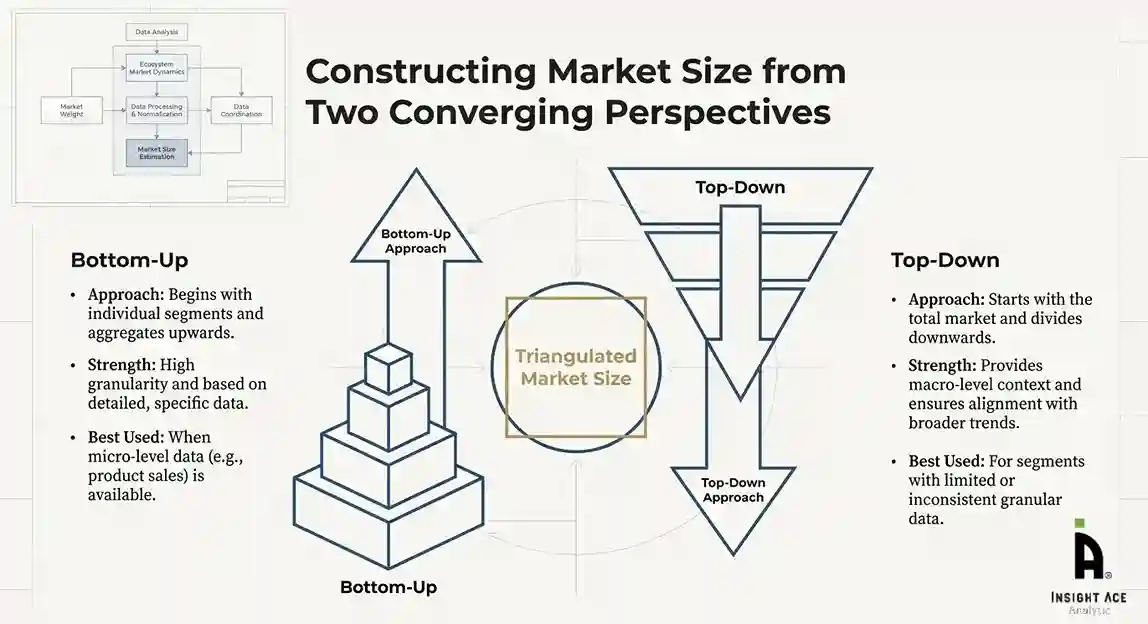
Bottom-Up Approach
The bottom-up approach involved aggregating segment-level data, such as:
- Company revenues
- Product-level sales
- Installed base/usage volumes
- Adoption and penetration rates
- Pricing analysis
This method was primarily used when detailed micro-level market data were available.
Top-Down Approach
The top-down approach used macro-level indicators:
- Parent market benchmarks
- Global/regional industry trends
- Economic indicators (GDP, demographics, spending patterns)
- Penetration and usage ratios
This approach was used for segments where granular data were limited or inconsistent.
Hybrid Triangulation Approach
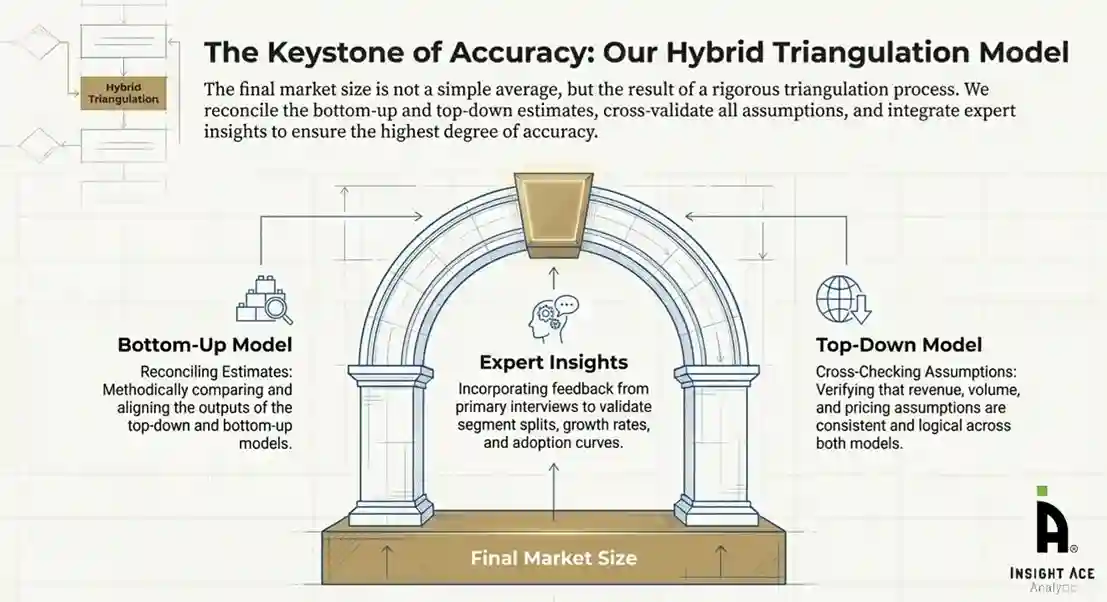
To ensure accuracy, a triangulated hybrid model was used. This included:
- Reconciling top-down and bottom-up estimates
- Cross-checking revenues, volumes, and pricing assumptions
- Incorporating expert insights to validate segment splits and adoption rates
This multi-angle validation yielded the final market size.
Forecasting Framework and Scenario Modelling
Market forecasts were developed using a combination of time-series modelling, adoption curve analysis, and driver-based forecasting tools.
Forecasting Methods
- Time-series modelling
- S-curve and diffusion models (for emerging technologies)
- Driver-based forecasting (GDP, disposable income, adoption rates, regulatory changes)
- Price elasticity models
- Market maturity and lifecycle-based projections
Scenario Analysis
Given inherent uncertainties, three scenarios were constructed:
- Base-Case Scenario: Expected trajectory under current conditions
- Optimistic Scenario: High adoption, favourable regulation, strong economic tailwinds
- Conservative Scenario: Slow adoption, regulatory delays, economic constraints
Sensitivity testing was conducted on key variables, including pricing, demand elasticity, and regional adoption.
Request Customization
Add countries, segments, company profiles, or extend forecast — free 10% customization with purchase.
Customize This Report →Enquire Before Buying
Speak with our analyst team about scope, methodology, pricing, or deliverable formats.
Enquire Now →Frequently Asked Questions
Green Fertilizer Market Size is valued at USD 2.3 Billion in 2025 and is predicted to reach USD 4.27 Billion by the year 2035
Green Fertilizer Market expected to grow at 6.5% CAGR during the forecast period for 2026-2035
Yara International ASA, Siemens Energy, Origin Energy Limited, Iberdrola, S.A., HY2GEN AG, Hive Energy,, Haldor Topsor A/S, H2U Technologies, Inc.,
Technology and Fertilizers are the key segments of the Green Fertilizer Market.
North America region is leading the Green Fertilizer Market.