Ethanol 2.0 Market Forecast with Size and Share Analysis 2025 to 2034
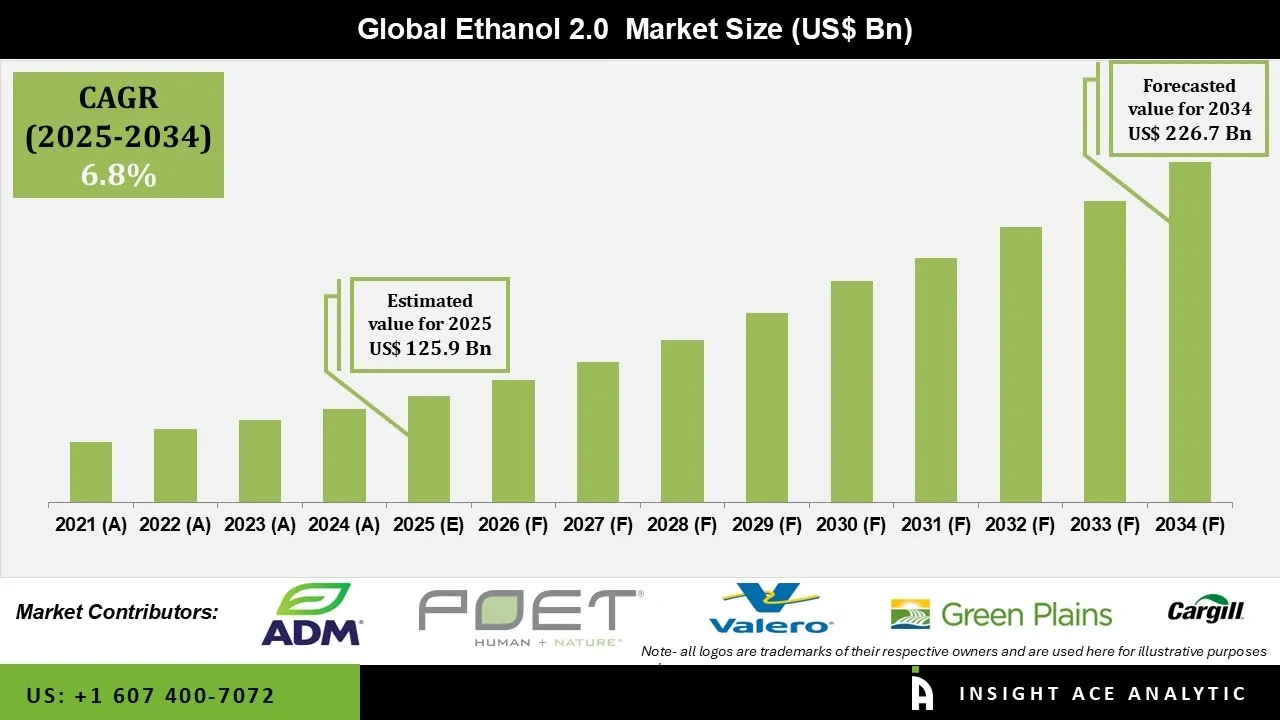
Ethanol 2.0 Market Size is valued at USD 125.9 Bn in 2025 and is predicted to reach USD 226.7 Bn by the year 2034 at a 6.8% CAGR during the forecast period for 2025 to 2034.
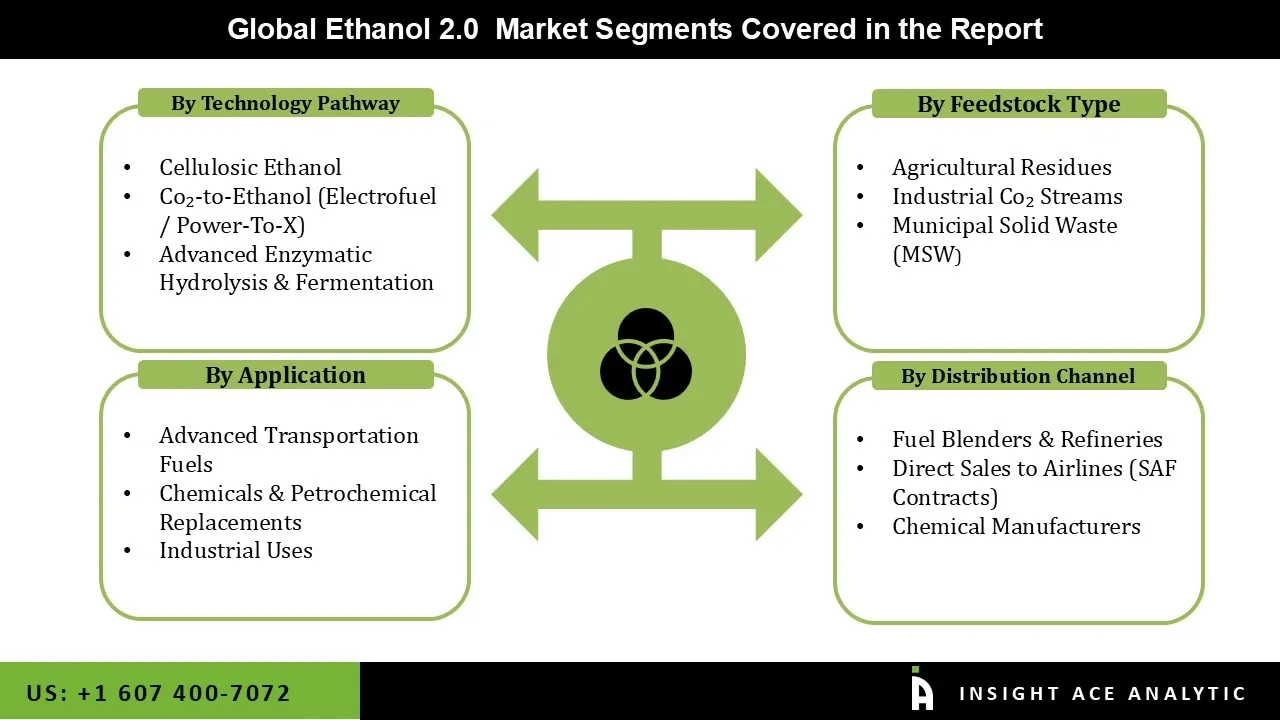
Ethanol 2.0 Market Size, Share & Trends Analysis Distribution by Feedstock Type (Industrial Co₂ Streams, Agricultural Residues, and Municipal Solid Waste (MSW)), Technology Pathway (Cellulosic Ethanol, Advanced Enzymatic Hydrolysis & Fermentation, and Co₂-to-Ethanol (Electrofuel / Power-To-X)), Application (Advanced Transportation Fuels, Industrial Uses, and Chemicals & Petrochemical Replacements), Distribution Channel (Fuel Blenders & Refineries, Chemical Manufacturers, and Direct Sales to Airlines (SAF Contracts)), and Segment Forecasts, 2025 to 2034
The next stage of ethanol production, termed as "ethanol 2.0," goes beyond traditional first-generation ethanol produced from food-based feedstocks like corn, sugarcane juice, or molasses. It mainly concentrates on cutting-edge and second-generation technologies that make use of renewable biomass that isn't used for food, such as forestry waste, agricultural wastes (rice straw, wheat straw, maize stover), and other lignocellulosic materials.
In order to transform complex biomass into fuel ethanol more effectively and with a smaller carbon impact, Ethanol 2.0 incorporates enhanced biochemical and thermochemical processes, such as advanced enzymatic hydrolysis and fermentation. The increased investments in cutting-edge biofuel technology, worldwide efforts to achieve carbon neutrality, and the expanding use of non-food feedstocks such as industrial byproducts, forestry waste, and agricultural leftovers are driving the ethanol 2.0 market's growth.
The ethanol 2.0 market has been continuously expanding due to the increased demand for gasoline ethanol substitutes as well as the global shift toward cleaner and renewable energy sources. Furthermore, there will be substantial growth prospects for more sustainable ethyl alcohol production methods in the near future due to technological advancements like improvements in distillation and fermentation techniques to make ethyl alcohol more efficient and quick developments in cellulosic ethanol produced from plant residues rather than food crops.
Moreover, the investments in advanced ethanol plants are being drawn by financial incentives such as carbon credits, tax breaks, and biofuel grants. Large-scale 2G ethanol deployment is made possible by initiatives like Brazil's RenovaBio program and the U.S. DOE's BETO program, which also promote collaborations with energy and technology firms. This is anticipated to boost the ethanol 2.0 market growth over the forecast period.
In addition to increasing operational efficiency and sustainability in production and application, the ethanol 2.0 market is implementing cutting-edge technologies like digital twins and artificial intelligence automation. The main technological developments in the ethanol 2.0 market are centred on enhancing the sustainability and efficiency of production from non-food biomass, mainly through the use of cutting-edge biomass conversion techniques, genetic engineering of microorganisms, and the incorporation of contemporary digital technologies like AI and IoT for process optimisation.
However, the ethanol 2.0 market's growth would be constrained by the high initial investment and upkeep costs. Ethanol 2.0 and sophisticated smart meters may result in significant, ongoing installation and operating costs. Managing these costs can be quite challenging for small businesses and economically struggling areas.
Competitive Landscape
Which are the Leading Players in the Ethanol 2.0 Market?
• Archer Daniels Midland (ADM)
• Green Plains Inc
• Cargill BP
• Praj Industries
• Alto Ingredients
• POET LLC
• LiYF 2G Bioethanol
• Universal Fuel Technologies
• Springbok Energy
• EthanBiofuel
• altM
• Valero Energy Corporation
• LanzaJet
• EVES ENERGY
• Green Energy Chemicals
• Triti
• Inovelsa Algae Tech
• Cheranna Energy
Market Dynamics
Driver
Growing Environmental Concerns and the Possibility of Ethanol 2.0 to Use a Wide Range of Non-food Feedstocks
The ethanol 2.0 market's capacity to use a wide variety of non-food feedstocks is one of the main drivers of its positive revenue trajectory. Utilizing forest biomass, agricultural leftovers, and other waste products, the market guarantees a more varied and safe supply chain. This flexibility reduces the risks connected to traditional crop-based ethanol production, which supports steady revenue growth. Additionally, the increasing income in the ethanol 2.0 market is also largely driven by the urgent need to combat climate change and the strong global focus on environmental preservation. The demand for greener as well as more sustainable fuel substitutes, like ethanol 2.0, increases as societies realize how important it is to cut carbon emissions, increasing the market’s revenue growth.
Restrain/Challenge
High Production Costs of the Ethanol 2.0 Manufacturing
The high production costs of the ethanol 2.0 manufacturing method are one of the major obstacles to the market's expansion. It is produced from non-food biomass, such as wood, agricultural waste, and grasses, as opposed to conventional ethanol, which is manufactured from food crops like corn or sugarcane. Even if the feedstocks are plentiful and renewable, the cost of turning them into ethanol is significantly greater because of the intricate and energy-intensive procedures required. Furthermore, ethanol 2.0 production necessitates sophisticated technologies like fermentation and enzymatic hydrolysis, which are currently less economical than conventional ethanol production techniques.
The Agricultural Residues Segment is Expected to Drive the Ethanol 2.0 Market
The Agricultural Residues category held the largest share in the Ethanol 2.0 market in 2025. Rice straw, rice husk, wheat straw, and maize stover are examples of agricultural wastes that are typically burned in many locations or left on the fields after harvests for use as fodder and landfill material. Branches, leaves, bark, and other parts of wood make up forestry wastes. The production of agricultural leftovers is inexpensive and widely accessible worldwide. Additionally, processing agricultural residue results in comparatively fewer greenhouse gas emissions, which is why it is becoming more and more well-liked as a very accessible and efficient feedstock segment.
Cellulosic Ethanol Segment is Growing at the Highest Rate in the Ethanol 2.0 Market
In 2025, the cellulosic ethanol category dominated the Ethanol 2.0 market. In order to lessen the country's reliance on imported oil, cellulosic ethanol is being heavily promoted in a number of nations. The significant growth in the agricultural sec tor in a number of developing countries, including China, India, Brazil, and Indonesia, along with the growing prevalence of setting up large-scale commercial plants to produce these kinds of ethanol, are major factors anticipated to strengthen the growth of the global ethanol 2.0 market.
Furthermore, growing worry over anthropogenic climate change—which is further accelerated by the evidence of rising temperatures and their human causes—is driving a number of initiatives for cellulosic ethanol. The ethanol 2.0 market's growth was positively impacted by the usage of cellulosic ethanol, which is seen as a unique source of emissions reduction as compared to petroleum-based fuels used for transportation, heat, and electricity.
Why North America Led the Ethanol 2.0 Market?
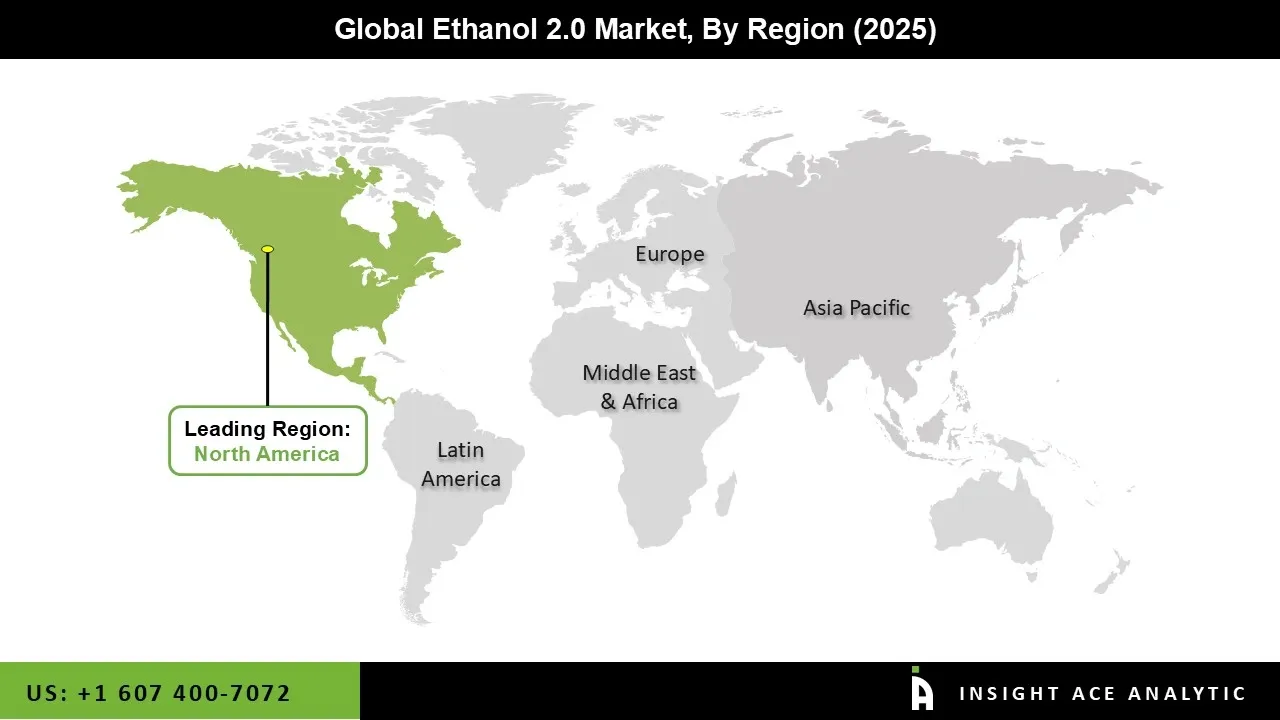
The Ethanol 2.0 market was dominated by the North America region in 2025, ascribed to the significant increase in the product's user base, the existence of a robust automobile industry, and stringent particulate emission regulations in nations like the US and Canada. Additionally, the area gains from government subsidies for low-carbon fuels, quick advancements in cellulosic ethanol, and active involvement by significant biofuel companies.
Furthermore, there has been a notable increase in ethanol 2.0 production throughout the region, primarily as a result of higher renewable fuel standard targets and a notable increase in motor gasoline consumption. These factors are likely to have a positive effect on the product's development and demand in the upcoming years.
Key Development
In April 2025, The government of India expedited its ethanol blending initiative, successfully reaching a 20% national blend and establishing a new goal of 30% blending by 2030. Although reaching the 30% objective may include vehicle compatibility considerations, possible engine changes, or the development of new flex-fuel vehicles, this project intends to reduce oil imports, save foreign exchange, minimize emissions, and benefit farmers.
Ethanol 2.0 Market Report Scope:
| Report Attribute | Specifications |
| Market size value in 2025 | USD 125.9 Bn |
| Revenue forecast in 2034 | USD 226.7 Bn |
| Growth Rate CAGR | CAGR of 6.8% from 2025 to 2034 |
| Quantitative Units | Representation of revenue in US$ Bn and CAGR from 2025 to 2034 |
| Historic Year | 2021 to 2024 |
| Forecast Year | 2025-2034 |
| Report Coverage | The forecast of revenue, the position of the company, the competitive market structure, growth prospects, and trends |
| Segments Covered | Feedstock Type, Technology Pathway, Application, Distribution Channel, and By Region |
| Regional Scope | North America; Europe; Asia Pacific; Latin America; Middle East & Africa |
| Country Scope | U.S.; Canada; U.K.; Germany; China; India; Japan; Brazil; Mexico; The UK; France; Italy; Spain; China; Japan; India; South Korea; Southeast Asia; South Korea; Southeast Asia |
| Competitive Landscape | Archer Daniels Midland (ADM), Green Plains Inc, Cargill BP, Praj Industries, Alto Ingredients, POET LLC, LiYF 2G Bioethanol, Universal Fuel Technologies, Springbok Energy, EthanBiofuel, altM, Valero Energy Corporation, LanzaJet, EVES ENERGY, Green Energy Chemicals, Triti, Inovelsa Algae Tech, and Cheranna Energy. |
| Customization Scope | Free customization report with the procurement of the report, Modifications to the regional and segment scope. Geographic competitive landscape. |
| Pricing and Available Payment Methods | Explore pricing alternatives that are customized to your particular study requirements. |
Market Segmentation:
Ethanol 2.0 Market by Feedstock Type-
• Industrial Co₂ Streams
• Agricultural Residues
• Municipal Solid Waste (MSW)
Ethanol 2.0 Market by Technology Pathway-
• Cellulosic Ethanol
• Advanced Enzymatic Hydrolysis & Fermentation
• Co₂-to-Ethanol (Electrofuel / Power-To-X)
Ethanol 2.0 Market by Application-
• Advanced Transportation Fuels
• Industrial Uses
• Chemicals & Petrochemical Replacements
Ethanol 2.0 Market by Distribution Channel-
• Fuel Blenders & Refineries
• Chemical Manufacturers
• Direct Sales to Airlines (SAF Contracts)
By Region-
North America-
• The US
• Canada
Europe-
• Germany
• The UK
• France
• Italy
• Spain
• Rest of Europe
Asia-Pacific-
• China
• Japan
• India
• South Korea
• South East Asia
• Rest of Asia Pacific
Latin America-
• Brazil
• Argentina
• Mexico
• Rest of Latin America
Middle East & Africa-
• GCC Countries
• South Africa
• Rest of Middle East and Africa
Research Design and Approach
This study employed a multi-step, mixed-method research approach that integrates:
- Secondary research
- Primary research
- Data triangulation
- Hybrid top-down and bottom-up modelling
- Forecasting and scenario analysis
This approach ensures a balanced and validated understanding of both macro- and micro-level market factors influencing the market.
Secondary Research
Secondary research for this study involved the collection, review, and analysis of publicly available and paid data sources to build the initial fact base, understand historical market behaviour, identify data gaps, and refine the hypotheses for primary research.
Sources Consulted
Secondary data for the market study was gathered from multiple credible sources, including:
- Government databases, regulatory bodies, and public institutions
- International organizations (WHO, OECD, IMF, World Bank, etc.)
- Commercial and paid databases
- Industry associations, trade publications, and technical journals
- Company annual reports, investor presentations, press releases, and SEC filings
- Academic research papers, patents, and scientific literature
- Previous market research publications and syndicated reports
These sources were used to compile historical data, market volumes/prices, industry trends, technological developments, and competitive insights.

Primary Research
Primary research was conducted to validate secondary data, understand real-time market dynamics, capture price points and adoption trends, and verify the assumptions used in the market modelling.
Stakeholders Interviewed
Primary interviews for this study involved:
- Manufacturers and suppliers in the market value chain
- Distributors, channel partners, and integrators
- End-users / customers (e.g., hospitals, labs, enterprises, consumers, etc., depending on the market)
- Industry experts, technology specialists, consultants, and regulatory professionals
- Senior executives (CEOs, CTOs, VPs, Directors) and product managers
Interview Process
Interviews were conducted via:
- Structured and semi-structured questionnaires
- Telephonic and video interactions
- Email correspondences
- Expert consultation sessions
Primary insights were incorporated into demand modelling, pricing analysis, technology evaluation, and market share estimation.
Data Processing, Normalization, and Validation
All collected data were processed and normalized to ensure consistency and comparability across regions and time frames.
The data validation process included:
- Standardization of units (currency conversions, volume units, inflation adjustments)
- Cross-verification of data points across multiple secondary sources
- Normalization of inconsistent datasets
- Identification and resolution of data gaps
- Outlier detection and removal through algorithmic and manual checks
- Plausibility and coherence checks across segments and geographies
This ensured that the dataset used for modelling was clean, robust, and reliable.
Market Size Estimation and Data Triangulation
Bottom-Up Approach
The bottom-up approach involved aggregating segment-level data, such as:
- Company revenues
- Product-level sales
- Installed base/usage volumes
- Adoption and penetration rates
- Pricing analysis
This method was primarily used when detailed micro-level market data were available.

Top-Down Approach
The top-down approach used macro-level indicators:
- Parent market benchmarks
- Global/regional industry trends
- Economic indicators (GDP, demographics, spending patterns)
- Penetration and usage ratios
This approach was used for segments where granular data were limited or inconsistent.
Hybrid Triangulation Approach
To ensure accuracy, a triangulated hybrid model was used. This included:
- Reconciling top-down and bottom-up estimates
- Cross-checking revenues, volumes, and pricing assumptions
- Incorporating expert insights to validate segment splits and adoption rates
This multi-angle validation yielded the final market size.
Forecasting Framework and Scenario Modelling
Market forecasts were developed using a combination of time-series modelling, adoption curve analysis, and driver-based forecasting tools.
Forecasting Methods
- Time-series modelling
- S-curve and diffusion models (for emerging technologies)
- Driver-based forecasting (GDP, disposable income, adoption rates, regulatory changes)
- Price elasticity models
- Market maturity and lifecycle-based projections
Scenario Analysis
Given inherent uncertainties, three scenarios were constructed:
- Base-Case Scenario: Expected trajectory under current conditions
- Optimistic Scenario: High adoption, favourable regulation, strong economic tailwinds
- Conservative Scenario: Slow adoption, regulatory delays, economic constraints
Sensitivity testing was conducted on key variables, including pricing, demand elasticity, and regional adoption.
Request Customization
Add countries, segments, company profiles, or extend forecast — free 10% customization with purchase.
Customize This Report →Enquire Before Buying
Speak with our analyst team about scope, methodology, pricing, or deliverable formats.
Enquire Now →Frequently Asked Questions
Ethanol 2.0 Market Size is valued at USD 125.9 Bn in 2025 and is predicted to reach USD 226.7 Bn by the year 2034 at a 6.8% CAGR during the forecast period for 2025-2034.
Archer Daniels Midland (ADM), Green Plains Inc, Cargill BP, Praj Industries, Alto Ingredients, POET LLC, LiYF 2G Bioethanol, Universal Fuel Technologies, Springbok Energy, EthanBiofuel, altM, Valero Energy Corporation, LanzaJet, EVES ENERGY, Green Energy Chemicals, Triti, Inovelsa Algae Tech, and Cheranna Energy.
Feedstock Type, Technology Pathway, Application, Distribution Channel, and By Region are the key segments of the Ethanol 2.0 Market.
North America region is leading the Ethanol 2.0 Market