Patient Recruitment and Retention Services Market Size, Share & Trends Analysis Report By Type (Patient Recruitment Services, Patient Retention Services), By Disease (Oncology, Infectious Disease, Cardiovascular Disease, CNS/Neurology, Endocrine/Metabolic, Hematological Disorders, Others), By Trial Phases (Phase I, Phase II, Phase III, Phase IV), By Age Group (Pediatric, Adult, Geriatrics), By End User, By Region, And By Segment Forecasts, 2025-2034.
The Patient Recruitment and Retention Services Market Size is valued at USD 4.1 Billion in 2024 and is predicted to reach USD 6.7 Billion by the year 2034 at a 5.3% CAGR during the forecast period for 2025-2034.

Patient recruitment and retention is an essential service for the clinical research industry, and certain developments are expected to play a significant role in the future. Patient recruitment is one of the rate-limiting stages in bringing medications to market. In addition, given the typical clinical research dropout rate, keeping patients on board is challenging. Utilizing contract service providers has been shown to hasten the patient recruiting process. In order to effectively conduct clinical research, these service providers employ a variety of outreach strategies, such as social media, mobile technologies, electronic health records (EHRs), and real-world evidence (RWE).
Retention service providers make use of different strategies such as in-house call center to address patient concerns, educational materials to keep sites engaged and study branding to encourage compliance and patient responses, creation of online and in-person support groups, electronic data capture systems, video conferencing platforms, and telemedicine tools to reduce the need for in-person visits and improve participant convenience among others
Over time, they have become increasingly significant in this process. Clinical research is conducted to learn more about the effectiveness and safety of creating new medications and medical equipment. As more people are needed for clinical trials because of regulatory and safety concerns, which are pushing trends toward longer and larger studies, the demand for patient recruiting services is increasing. The global industry has grown significantly as a result of the increasing number of clinical studies and the expanding pharmaceutical and medical industries.
With the increased complexity of clinical trials and the need for specialized patient populations for studies evaluating orphan medications and tailored therapies, several big pharma companies have outsourced their patient recruiting operations, leading to increased clinical trial costs. Delays in product release brought on by sponsors' inability to draw in and keep patients are relatively common and are considered to result in an average loss. The short suspension due to Covid-19 has significantly impacted clinical studies, especially in the area of patient recruiting.
Competitive Landscape
Some major key players in the Patient Recruitment and Retention Services Market:
- Acurian
- BBK Worldwide
- Bright Pharmaceutical Services
- Elligo Health Research
- CSSi
- Clinical Trial Media
- Evolution Research Group (ERG)
- Integrated Clinical Trial Services (ICTS)
- MMG
- Veristat
- Altasciences Clinical Los Angeles Inc.
- Antidote
- Clinical Accelerator
- Fidelis Research
- Ignite Data
- Polaris BioPharma Consulting
- Clinrol
- TrialWire Platform
- Other Prominent Players
Market Segmentation:
The Patient Recruitment and Retention Services Market is segmented on the Type, Phases, Disease, Patient Age Group, and End-User. Based on Type, the market is segmented into Patient Recruitment (Recruitment Services, Patient Retention Services, and Others. Based on Disease, the market is segmented into Oncology, Infectious Disease, Endocrine/Metabolic, CNS/Neurology, Cardiovascular Disease, Hematological Disorders, and Others. Based on Trial Phases, the market is segmented into Phase I, Phase II, Phase III, and Phase IV. Patient Age group segment is divided into Pediatric, Adult, and Geriatrics. Whereas End-user segments consists of Hospitals, CROs, Pharma and Biotech Companies, Others.
Based on Disease, the oncology segment is accounted as a major contributor to the Patient Recruitment and Retention Services Market
The market for patient recruiting services linked to oncology is predicted to grow at a rapid pace over the forecast period. The upsurge in incidence and prevalence of various cancer disorders, the popularity of advanced therapies (such as biological and targeted pharmacological therapies), and the rising global elderly population are the main factors driving the growth of the oncology/cancer pharmaceuticals market. Additionally, the market for oncology medications is growing due to increased cancer awareness and early cancer detection. During the foreseeable period, profitable opportunities should be available due to the great potential of rising economies and the increased number of potential medications in development. The rate of advancement in cancer treatment is quickening. Emerging from the research and development pipeline are a number of novel therapies that are frequently combined with other brand-new or current medications. Numerous pharmaceutical companies are funding these revolutionary medication development projects for the treatment of cancer.
Based On Trial Phases, The Phase III Segment Is Accounted As A Major Contributor To The Patient Recruitment And Retention Services Market
The phase III category will lead the market in the forecast period with a major revenue share due to the high cost of phase III research. Complicated clinical trials need both clinical resources and potent technology for effective patient recruitment, timely deployment of trial locations, and high-quality study management. The vast majority of pharmaceutical, biopharmaceutical, and medical device companies worldwide use clinical trial service providers to conduct Phase III clinical trials. The market will expand as a result of the several medicines and vaccines that are currently in Phase III and are indicated for the treatment of COVID-19.
In The Region, The North America Patient Recruitment And Retention Services Market Holds A Significant Revenue Share.
North America had the greatest revenue share in the worldwide market. This market is projected to grow given the numerous clinical research being conducted in the region. Government support for clinical trials and significant R&D expenditures are fostering the market's growth. The presence of significant CROs offering support services like patient recruitment and multinational pharmaceutical and biopharmaceutical companies making sizable investments in clinical research have both been credited with the growth of the North American clinical trial patient recruitment services market. The region has become a hub for conducting clinical trials due to the low cost of research, straightforward regulatory compliance, rising patient population, and availability of a few elite clinical institutions functioning as sites.
Recent Developments:
- In Feb 2023, BBK Worldwide, the dominant force in optimizing the clinical trial experience for patients and providers, has introduced TCN® Engage, an innovative engagement system designed to offer comprehensive visit support services. This ecosystem covers the entire process, from when patients express enthusiasm for a clinical trial opportunity to their successful study completion.
- In Oct 2023, Elligo Health Research®, the leading healthcare-facilitating research organization, has formed a collaboration with Avallano, a company specializing in data privacy and healthcare technology. They have introduced myTrialsConnectSM, an expandable research community driven by artificial intelligence (AI). This platform is designed to cater to the needs of patients, healthcare providers, research sites, and the biopharmaceutical industry.
Patient Recruitment and Retention Services Market Report Scope
| Report Attribute | Specifications |
| Market Size Value In 2024 | USD 4.1 Bn |
| Revenue Forecast In 2034 | USD 6.7 Bn |
| Growth Rate CAGR | CAGR of 5.3 % from 2025 to 2034 |
| Quantitative Units | Representation of revenue in US$ Billion and CAGR from 2025 to 2034 |
| Historic Year | 2021 to 2024 |
| Forecast Year | 2025-2034 |
| Report Coverage | The forecast of revenue, the position of the company, the competitive market structure, growth prospects, and trends |
| Segments Covered | By Type, By Phases, By Disease, By Patient Age Group, By End-User |
| Regional Scope | North America; Europe; Asia Pacific; Latin America; Middle East & Africa |
| Country Scope | U.S.; Canada; U.K.; Germany; China; India; Japan; Brazil; Mexico; France; Italy; Spain; South Korea; Southeast Asia |
| Competitive Landscape | Acurian, BBK Worldwide, Bright Pharmaceutical Services, ClinEdge, CSSi, CTM, Evolution Research Group (ERG), Integrated Clinical Trial Services (ICTS), MMG, Veristat, WCCT Global, Antidote, Clinical Accelerator, Fidelis Research, Ignite Data, Polaris BioPharma Consulting, Raremark, Clinrol, CROee, Gitzo Medical Technology, Pacific Grove, and TrialWire. |
| Customization Scope | Free customization report with the procurement of the report, Modifications to the regional and segment scope. Particular Geographic competitive landscape. |
| Pricing And Available Payment Methods | Explore pricing alternatives that are customized to your particular study requirements. |
Segmentation of Patient Recruitment and Retention Services Market-
Patient Recruitment and Retention Services Market By Type
- Patient Recruitment Services
- Patient Retention Services
- Others

Patient Recruitment and Retention Services Market By Disease
- Oncology
- Infectious Disease
- Endocrine/Metabolic
- CNS/Neurology
- Cardiovascular Disease
- Hematological Disorders
- Others
Patient Recruitment and Retention Services Market By Phases
- Phase I
- Phase II
- Phase III
- Phase IV
Patient Recruitment and Retention Services Market By Patient Age Group
- Pediatric
- Adult
- Geriatrics
Patient Recruitment and Retention Services Market By End-User
- Hospitals
- CROs
- Pharma and Biotech Companies
- Others
Patient Recruitment and Retention Services Market By Region-
North America-
- The US
- Canada
- Mexico
Europe-
- Germany
- The UK
- France
- Italy
- Spain
- Rest of Europe
Asia-Pacific-
- China
- Japan
- India
- South Korea
- South East Asia
- Rest of Asia Pacific
Latin America-
- Brazil
- Argentina
- Rest of Latin America
Middle East & Africa-
- GCC Countries
- South Africa
- Rest of Middle East and Africa
Research Design and Approach
This study employed a multi-step, mixed-method research approach that integrates:
- Secondary research
- Primary research
- Data triangulation
- Hybrid top-down and bottom-up modelling
- Forecasting and scenario analysis
This approach ensures a balanced and validated understanding of both macro- and micro-level market factors influencing the market.
Secondary Research
Secondary research for this study involved the collection, review, and analysis of publicly available and paid data sources to build the initial fact base, understand historical market behaviour, identify data gaps, and refine the hypotheses for primary research.
Sources Consulted
Secondary data for the market study was gathered from multiple credible sources, including:
- Government databases, regulatory bodies, and public institutions
- International organizations (WHO, OECD, IMF, World Bank, etc.)
- Commercial and paid databases
- Industry associations, trade publications, and technical journals
- Company annual reports, investor presentations, press releases, and SEC filings
- Academic research papers, patents, and scientific literature
- Previous market research publications and syndicated reports
These sources were used to compile historical data, market volumes/prices, industry trends, technological developments, and competitive insights.
Primary Research
Primary research was conducted to validate secondary data, understand real-time market dynamics, capture price points and adoption trends, and verify the assumptions used in the market modelling.
Stakeholders Interviewed
Primary interviews for this study involved:
- Manufacturers and suppliers in the market value chain
- Distributors, channel partners, and integrators
- End-users / customers (e.g., hospitals, labs, enterprises, consumers, etc., depending on the market)
- Industry experts, technology specialists, consultants, and regulatory professionals
- Senior executives (CEOs, CTOs, VPs, Directors) and product managers
Interview Process
Interviews were conducted via:
- Structured and semi-structured questionnaires
- Telephonic and video interactions
- Email correspondences
- Expert consultation sessions
Primary insights were incorporated into demand modelling, pricing analysis, technology evaluation, and market share estimation.
Data Processing, Normalization, and Validation
All collected data were processed and normalized to ensure consistency and comparability across regions and time frames.
The data validation process included:
- Standardization of units (currency conversions, volume units, inflation adjustments)
- Cross-verification of data points across multiple secondary sources
- Normalization of inconsistent datasets
- Identification and resolution of data gaps
- Outlier detection and removal through algorithmic and manual checks
- Plausibility and coherence checks across segments and geographies
This ensured that the dataset used for modelling was clean, robust, and reliable.
Market Size Estimation and Data Triangulation
Bottom-Up Approach
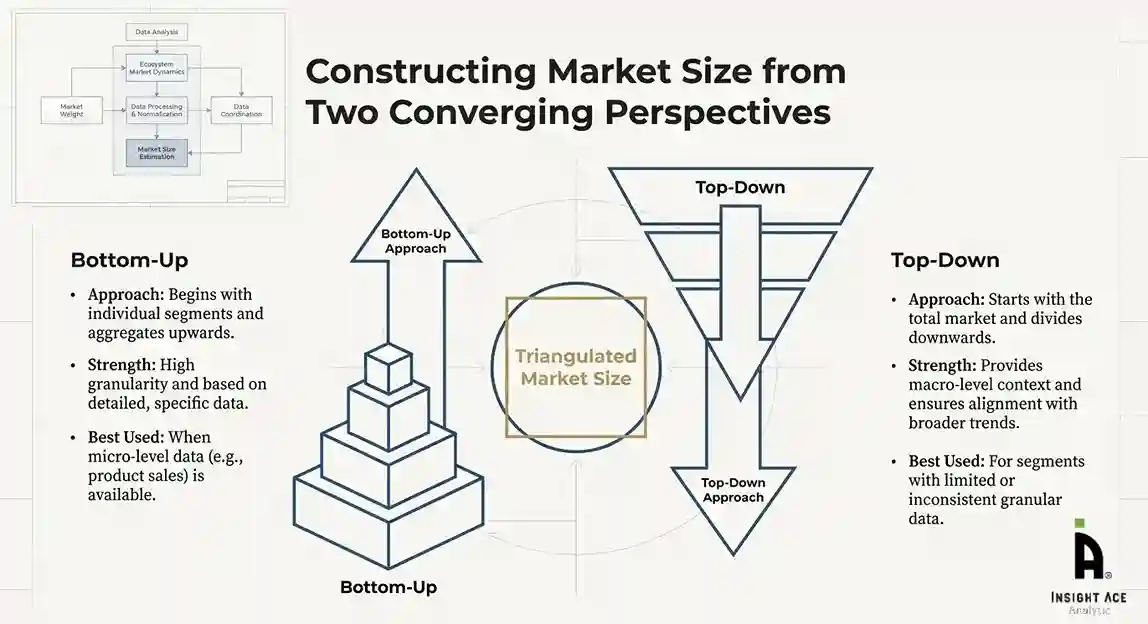
The bottom-up approach involved aggregating segment-level data, such as:
- Company revenues
- Product-level sales
- Installed base/usage volumes
- Adoption and penetration rates
- Pricing analysis
This method was primarily used when detailed micro-level market data were available.
Top-Down Approach
The top-down approach used macro-level indicators:
- Parent market benchmarks
- Global/regional industry trends
- Economic indicators (GDP, demographics, spending patterns)
- Penetration and usage ratios
This approach was used for segments where granular data were limited or inconsistent.
Hybrid Triangulation Approach
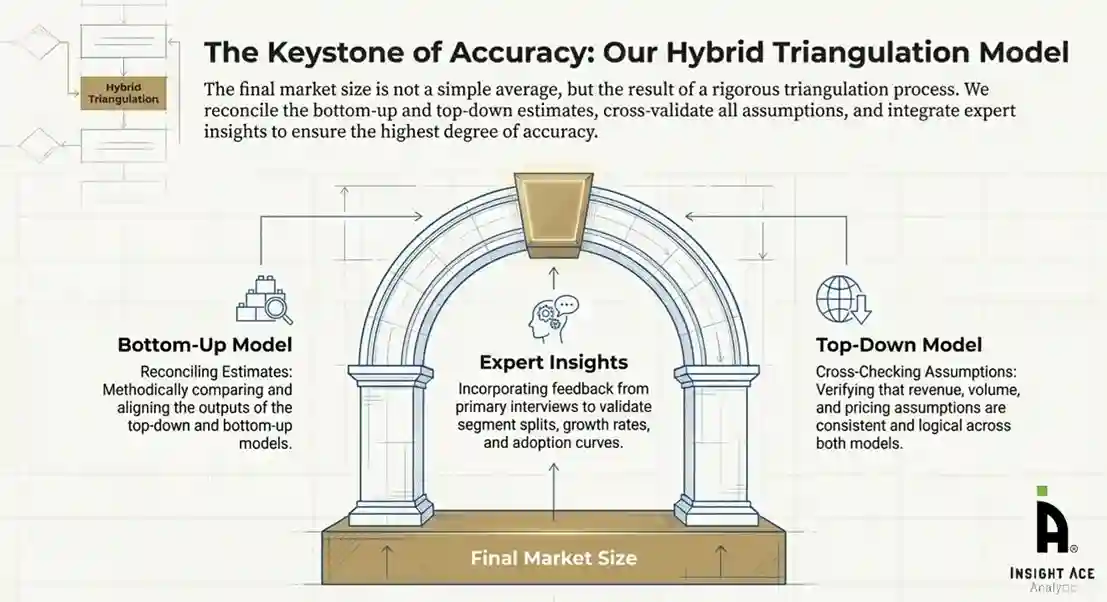
To ensure accuracy, a triangulated hybrid model was used. This included:
- Reconciling top-down and bottom-up estimates
- Cross-checking revenues, volumes, and pricing assumptions
- Incorporating expert insights to validate segment splits and adoption rates
This multi-angle validation yielded the final market size.
Forecasting Framework and Scenario Modelling
Market forecasts were developed using a combination of time-series modelling, adoption curve analysis, and driver-based forecasting tools.
Forecasting Methods
- Time-series modelling
- S-curve and diffusion models (for emerging technologies)
- Driver-based forecasting (GDP, disposable income, adoption rates, regulatory changes)
- Price elasticity models
- Market maturity and lifecycle-based projections
Scenario Analysis
Given inherent uncertainties, three scenarios were constructed:
- Base-Case Scenario: Expected trajectory under current conditions
- Optimistic Scenario: High adoption, favourable regulation, strong economic tailwinds
- Conservative Scenario: Slow adoption, regulatory delays, economic constraints
Sensitivity testing was conducted on key variables, including pricing, demand elasticity, and regional adoption.
Request Customization
Add countries, segments, company profiles, or extend forecast — free 10% customization with purchase.
Customize This Report →Enquire Before Buying
Speak with our analyst team about scope, methodology, pricing, or deliverable formats.
Enquire Now →Frequently Asked Questions
Integrated Clinical Trial Services (ICTS), MMG, Veristat, WCCT Global, Antidote, Clinical Accelerator, Fidelis Research, Ignite Data, Polaris BioPharm
The Patient Recruitment and Retention Services Market Size is valued at USD 4.1 Billion in 2024 & is predicted to reach USD 6.7 Billion by the year 20
The Patient Recruitment and Retention Services Market is expected to grow at a 5.3 % CAGR during the forecast period for 2025-2034.
Patient Recruitment and Retention Services Market is segmented on the Type, Phases, Disease, Patient Age Group, and End-User.
North American region is leading the Patient Recruitment and Retention Services market.