



The Global Foreign Exchange Services Market Size is valued at 9.67 billion in 2023 and is predicted to reach 18.27 billion by the year 2031 at a 8.31% CAGR during the forecast period for 2024-2031.
Key Industry Insights & Findings from the Report:
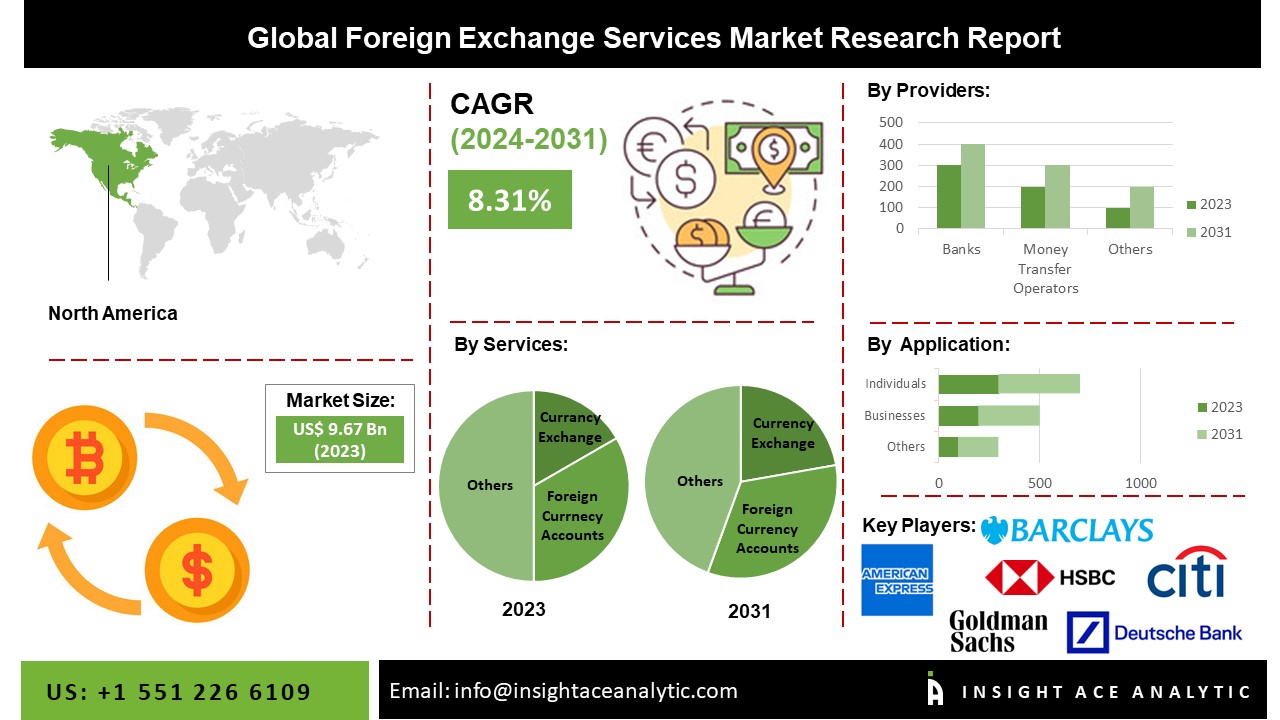
Increasing urbanization and rising disposable income levels among people are major factors favoring the industry. Therefore, a substantial increase in international trade operations is driving up demand for foreign exchange (FX), which provides several benefits, such as low trading costs, strong liquidity and transactional transparency, round-the-clock trading opportunities, and significant trading volumes. In addition, there has been considerable growth in the number of international trade operations in recent years. In addition, the market is developing due to the growing trend of digitalization and the introduction of outright forward and currency options.
A positive market picture is also being produced by the development of improved electronics and numerous internet-based platforms that enable customers to exchange currencies effortlessly between nations while guaranteeing the delivery of products and services in a secure and controlled environment. Additionally, the advent of automated conversion technologies that allow stronger flexibility and comfort during currency swaps is driving the market. This is one of the factors that is driving the market.
However, businesses are concentrating on building the complete infrastructure to offer better security solutions for trading, fueling market expansion.
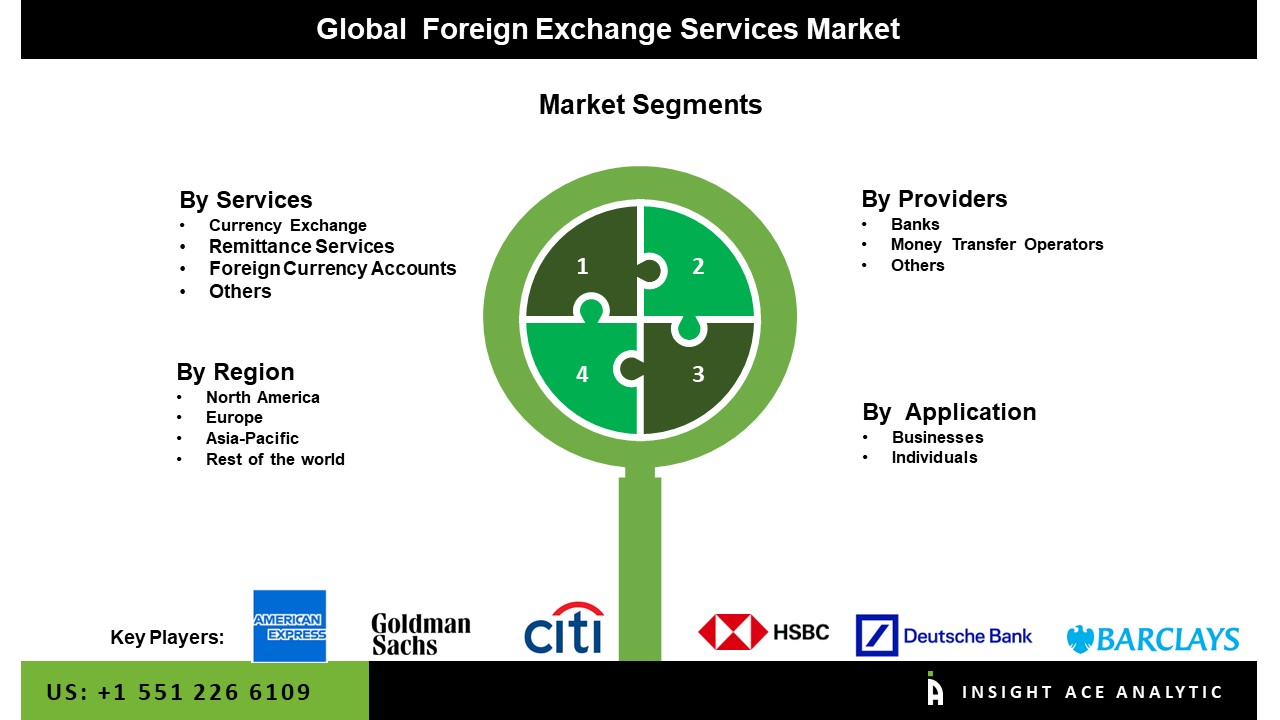
The Foreign Exchange Services market is segmented by services, providers, and applications. The market is segmented based on services: Currency Exchange, Remittance Services, Foreign Currency Accounts, and Others. By the providers, the market is segmented into Banks, Money Transfer Operators, and Others. By application, the market is segmented into Businesses and Individuals.
The remittance services segment experienced the most significant growth in terms of services. The need for remittance services has increased as a result of the growing population of migrant workers and their need to transfer money back to their home countries. Furthermore, the development of digital technology has made it simpler and more practical for people to move money across international borders through the internet and mobile platforms.
The sector for foreign currency accounts is anticipated to increase the fastest during the projection period, nevertheless. This is explained by the fact that there is a growing demand for practical foreign currency management solutions due to the rise in the number of international travelers and the expansion of the travel and tourism sector.
The increased use of digital technology has changed how foreign exchange services are provided and used, making them quicker, more practical, and available to a wider range of clients, which has contributed to the market's expansion. Furthermore, modern web platforms have made it simpler for companies to obtain foreign currency services, enabling them to compare exchange rates, start transactions, and follow the progress of payments in real time. Moreover, technology has advanced to the point that smartphone apps for using currency exchange services have been released. For instance, TransferWise is a smartphone app for currency conversion services. A mobile app from the fintech business TransferWise enables users to send money abroad swiftly and easily.
The market for foreign exchange services in North America, a crucial component of the financial services industry that offers solutions for risk management and currency exchange to both enterprises and people, experienced the largest increase in 2022.
Large banks, other financial institutions, and specialized foreign exchange service providers dominate the industry in North America. However, Asia-Pacific is anticipated to experience the quickest growth over the forecast period. This is due to the fact that the market is becoming more comfortable and accessible for both individuals and businesses to participate in, due to the shift towards electronic and online foreign exchange services.
| Report Attribute | Specifications |
| Market size value in 2023 | USD 9.67 Bn |
| Revenue forecast in 2031 | USD 18.27 Bn |
| Growth rate CAGR | CAGR of 8.31% from 2024 to 2031 |
| Quantitative units | Representation of revenue in US$ Billion, and CAGR from 2024 to 2031 |
| Historic Year | 2019 to 2023 |
| Forecast Year | 2024-2031 |
| Report coverage | The forecast of revenue, the position of the company, the competitive market statistics, growth prospects, and trends |
| Segments covered | Services, Providers, And Applications |
| Regional scope | North America; Europe; Asia Pacific; Latin America; Middle East & Africa |
| Country scope | U.S.; Canada; U.K.; Germany; China; India; Japan; Brazil; Mexico; The UK; France; Italy; Spain; China; Japan; India; South Korea; Southeast Asia; South Korea; Southeast Asia |
| Competitive Landscape | Barclays, Citigroup Inc., American Express Company, Standard Chartered, Deutsche Bank AG, JPMorgan Chase & Co., Wells Fargo, Goldman Sachs, HSBC Group, Western Union Holdings. |
| Customization scope | Free customization report with the procurement of the report, Modifications to the regional and segment scope. Particular Geographic competitive landscape. |
| Pricing and available payment methods | Explore pricing alternatives that are customized to your particular study requirements. |
Foreign Exchange Services Market By Services-
Foreign Exchange Services Market By Providers-
Foreign Exchange Services Market By Application-
Foreign Exchange Services Market By Region-
North America-
Europe-
Asia-Pacific-
Latin America-
Middle East & Africa-
This study employed a multi-step, mixed-method research approach that integrates:
This approach ensures a balanced and validated understanding of both macro- and micro-level market factors influencing the market.
Secondary research for this study involved the collection, review, and analysis of publicly available and paid data sources to build the initial fact base, understand historical market behaviour, identify data gaps, and refine the hypotheses for primary research.
Secondary data for the market study was gathered from multiple credible sources, including:
These sources were used to compile historical data, market volumes/prices, industry trends, technological developments, and competitive insights.

Primary research was conducted to validate secondary data, understand real-time market dynamics, capture price points and adoption trends, and verify the assumptions used in the market modelling.
Primary interviews for this study involved:
Interviews were conducted via:
Primary insights were incorporated into demand modelling, pricing analysis, technology evaluation, and market share estimation.
All collected data were processed and normalized to ensure consistency and comparability across regions and time frames.
The data validation process included:
This ensured that the dataset used for modelling was clean, robust, and reliable.
The bottom-up approach involved aggregating segment-level data, such as:
This method was primarily used when detailed micro-level market data were available.

The top-down approach used macro-level indicators:
This approach was used for segments where granular data were limited or inconsistent.
To ensure accuracy, a triangulated hybrid model was used. This included:
This multi-angle validation yielded the final market size.
Market forecasts were developed using a combination of time-series modelling, adoption curve analysis, and driver-based forecasting tools.
Given inherent uncertainties, three scenarios were constructed:
Sensitivity testing was conducted on key variables, including pricing, demand elasticity, and regional adoption.