Educational Tourism Market Size and Revenue Impact Study 2026 to 2035
What is Educational Tourism Market Size?
Educational Tourism Market Size is valued at USD 521.12 Bn in 2025 and is predicted to reach USD 1858.34 Bn by the year 2035 at a 13.6% CAGR during the forecast period for 2026 to 2035.
Educational Tourism Market Size, Share & Trends Analysis Report By Age Group (Less Than 15 Years, 16-25 Years, 26-40 Years, 41-55 Years), By Education Type (Primary, Secondary, College, Post-graduation), By Occupation, By Region, And By Segment Forecasts, 2026 to 2035
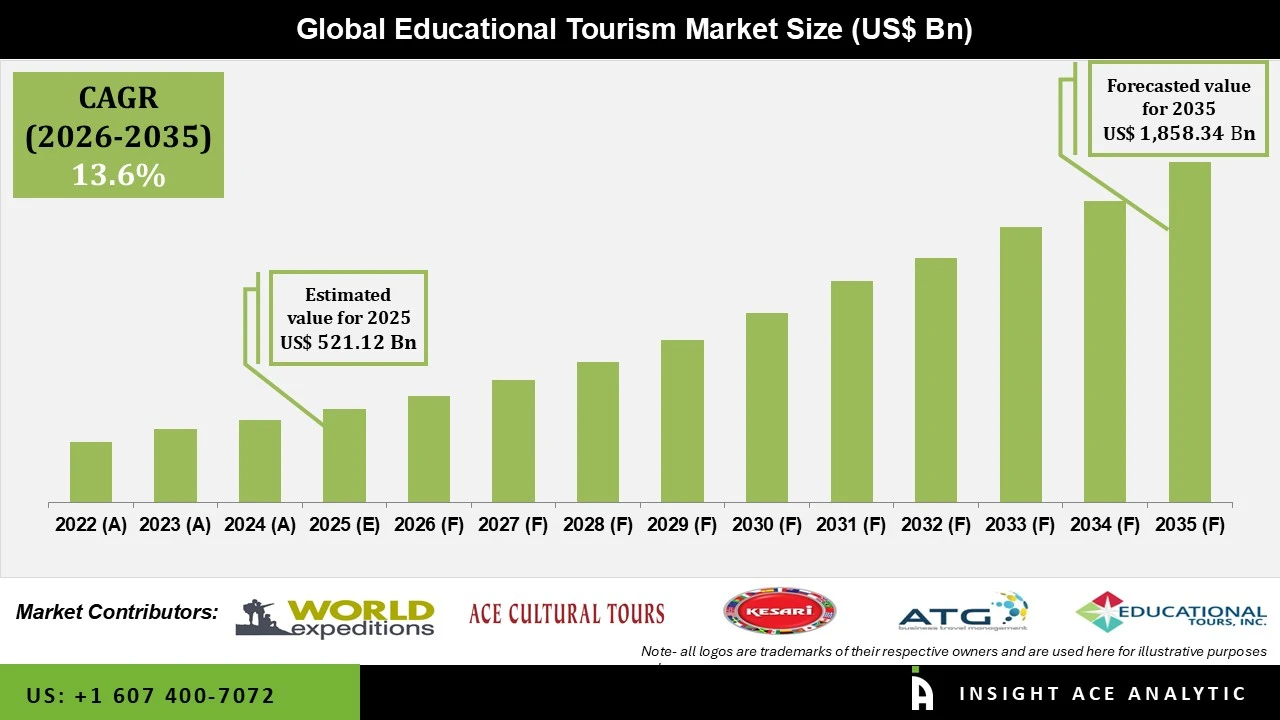
Educational Tourism Market Key Takeaways:
|
Educational Tourism refers to a type of tourism in which persons visit a different site with the main objective of acquiring educational experiences. This form of tourism combines education with travel, enabling individuals to discover new locations while participating in educational activities such as attending lectures, seminars, cultural exchanges, language acquisition, or partaking in academic programs. These activities, which can be tailored to the requirements and interests of anyone involved, include teaching languages, holding historical meetings, and running fundraising initiatives.
The potential for increased employment options, skill development, cross-cultural exposure, and self-sufficiency is driving learners to educational tourism and contributing to the industry's expansion. Furthermore, the market is offering lucrative growth potential due to authorities' and enterprises' substantial investments in education and training, which has increased the need for instructional travel for learning purposes. Additionally, the industry is expected to grow favourably due to the instruction sector's robust growth, the spread of digital reservation systems, technological and facilities innovations in transport, higher education institutions' effective advertising efforts, and the emergence of innovative attractions for educational travel.
However, the biggest obstacle in the educational tourism market is a lack of awareness. Educational tourism initiatives must be mindful of regional customs and traditions and attentive to regional differences. Legal issues and unfavorable encounters with local populations result from misunderstandings or an absence of ethnic consciousness, which has an impact on the industry development of the education tourism sector. There is a considerable environmental impact associated with tourism-related operations, such as lodging and transportation. Conscientious tourists are alarmed by the carbon emissions that come with transportation. Students are unable to commit enough time to their education or extended courses due to time limitations.
Competitive Landscape
Some Major Key Players In The Educational Tourism Market:
- WorldStrides
- ACIS Educational Tours
- Meridean Overseas
- CIEE (Council on International Educational Exchange)
- API (Academic Programs International)
- AIFS (American Institute for Foreign Study)
- Contiki (Young Adventurer Tours)
- TravelBound
- SGI (Study Group International)
- BUNTE Reiseburo (BUNTE Educational Tours)
- EF Education First Ltd.
- ACIS Educational Tours
- Explorica, Inc.
- WorldStrides
- Rustic Pathways
- Walking Tree Travel
- Travel For Teens
- School Tours of America
- EST
- World Expeditions Travel Group Pty Ltd
- ACE CULTURAL TOURS
- Atlantis Erudition &Travel Services
- Kesari Tours Pvt. Ltd.
- ATG Travel
- Global Educational Travel
- Educational Tours, Inc.
- AAI EDUTOURZ
- Capital Tours, Inc
- Other Market Players
Market Segmentation:
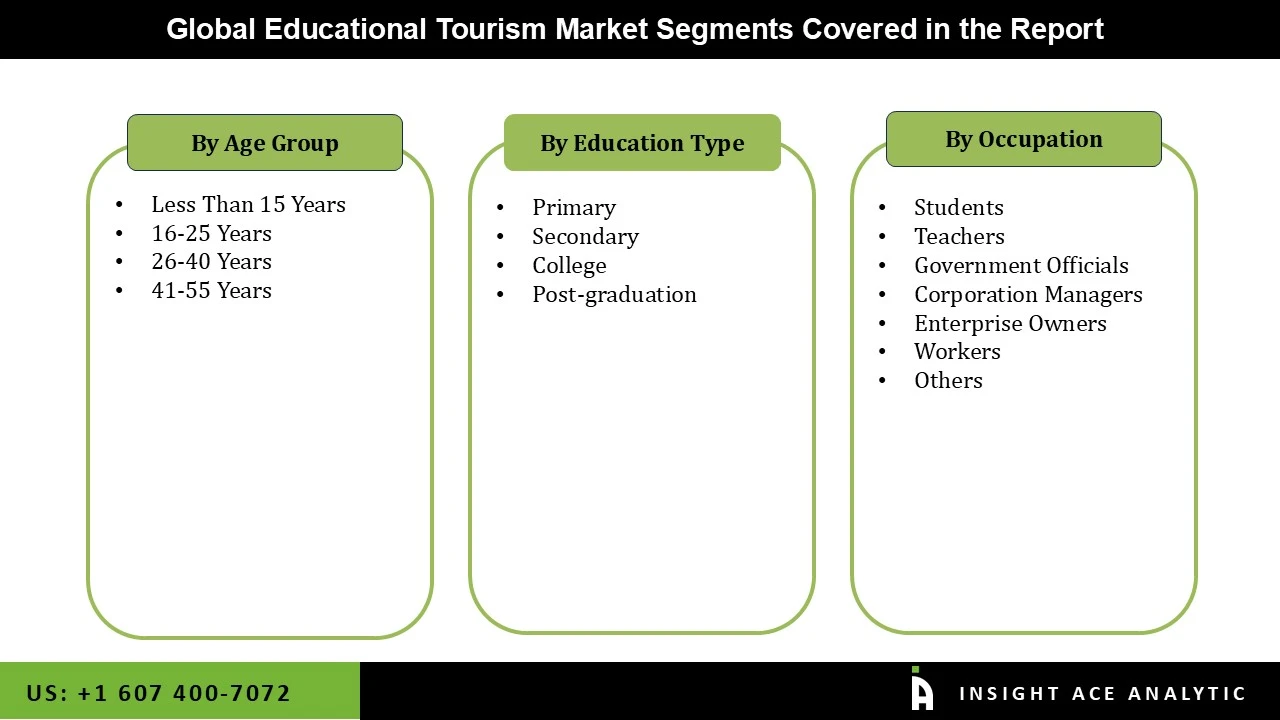
The global educational tourism market is segmented based on age group, education type, and occupation. Based on the age group, the market is segmented into less than 15 years, 16-25 years, 26-40 years, and 41-55 years. Based on education type, the market is segmented into primary, secondary, college, and post-graduation. By occupation, the market is segmented into students, teachers, government officials, corporation managers, enterprise owners, workers, and others.
Based On The Education Type, The College Segment Accounts A Major Contributor To The Global Educational Tourism Market
The global college educational tourism market is expected to lead with a large global market share in 2023. The elevated degree of openness surrounding speciality certificates, the ease of immigration laws, and the affordability of college programs make many customers decide to relocate for education because there aren't many possibilities close enough. Having a highly esteemed undergraduate degree increases the chances of landing a respectable career or an excellent post-graduate initiative.
In The Region, The North American Global Educational Tourism Market Holds A Significant Revenue Share.
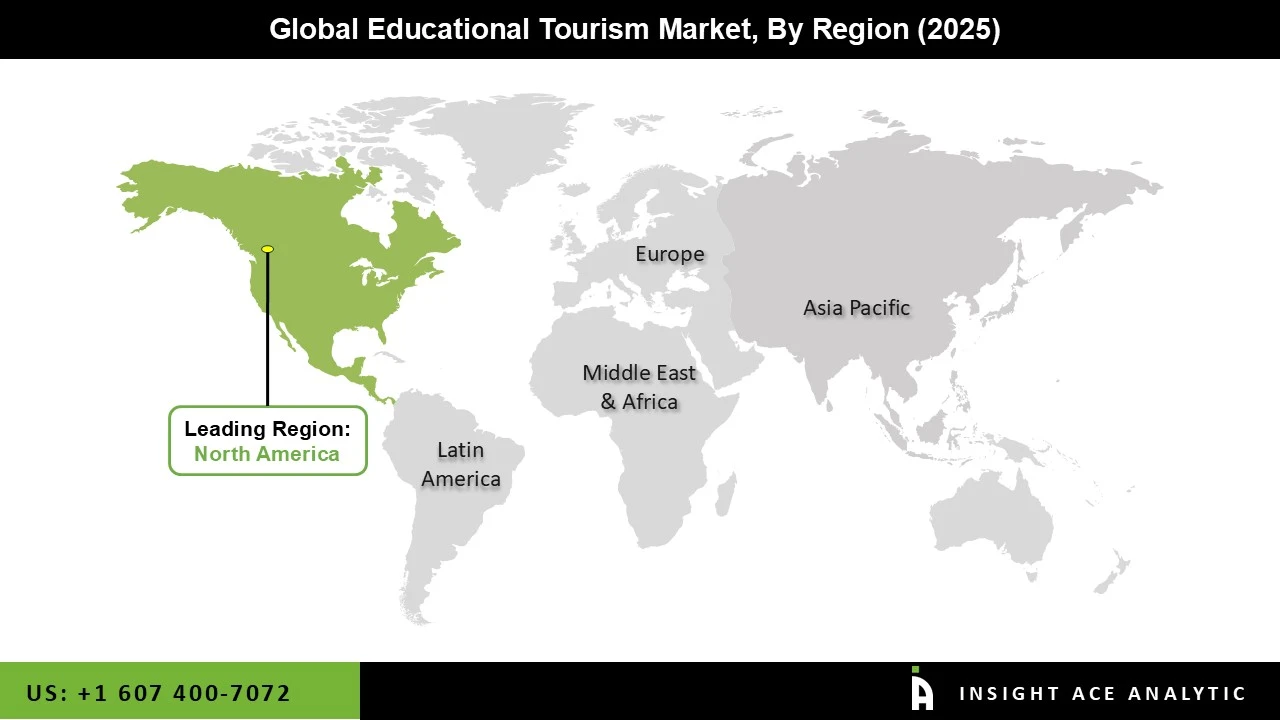
The North American global educational tourism market is expected to report the largest market share in revenue in the near future. This can be attributed to the fact that it funds top-notch studies and instruction, hosts instructive trips, and offers excellent resources for instruction. In addition, Asia Pacific is likely to grow rapidly in the global educational tourism market because of the economic growth of its contemporary settlements, heritage sites, and different religions. Learners, experts, and tourists looking to further their knowledge while discovering new places are drawn to the area by its extensive legacy, linguistic educational institutions, and possibilities for career growth.
Recent Developments:
- In Oct 2023, The World Tourism Organisation (UNWTO) has introduced an educational toolbox to promote the inclusion of tourism as a subject in high schools globally, acknowledging its significance as a fundamental driver of economic and social progress. The toolkit comprised modules designed to provide comprehensive support and empowerment to Ministries of Education, parents, school directors, and teachers involved in this undertaking.
Educational Tourism Market Report Scope
| Report Attribute | Specifications |
| Market Size Value In 2025 | USD 521.12 Bn |
| Revenue Forecast In 2035 | USD 1858.34 Bn |
| Growth Rate CAGR | CAGR of 13.6% from 2026 to 2035 |
| Quantitative Units | Representation of revenue in US$ Bn and CAGR from 2026 to 2035 |
| Historic Year | 2022 to 2025 |
| Forecast Year | 2026-2035 |
| Report Coverage | The forecast of revenue, the position of the company, the competitive market structure, growth prospects, and trends |
| Segments Covered | By Age Group, Education Type, Occupation |
| Regional Scope | North America; Europe; Asia Pacific; Latin America; Middle East & Africa |
| Country Scope | U.S.; Canada; U.K.; Germany; China; India; Japan; Brazil; Mexico; France; Italy; Spain; South East Asia; South Korea |
| Competitive Landscape | WorldStrides, ACIS Educational Tours, CIEE (Council on International Educational Exchange), API (Academic Programs International), AIFS (American Institute for Foreign Study), Contiki (Young Adventurer Tours), TravelBound, SGI (Study Group International), BUNTE Reiseburo (BUNTE Educational Tours), EF Education First Ltd., ACIS Educational Tours, Explorica, Inc., WorldStrides, Rustic Pathways, Walking Tree Travel, Travel For Teens, School Tours of America, EST , World Expeditions Travel Group Pty Ltd, ACE CULTURAL TOURS, Atlantis Erudition &Travel Services, Kesari Tours Pvt. Ltd., ATG Travel, Global Educational Travel, Educational Tours, Inc., AAI EDUTOURZ, Capital Tours, Inc and Other market players. |
| Customization Scope | Free customization report with the procurement of the report and modifications to the regional and segment scope. Particular Geographic competitive landscape. |
| Pricing And Available Payment Methods | Explore pricing alternatives that are customized to your particular study requirements. |
Segmentation of Global Educational Tourism Market -
Educational Tourism Market By Age Group-
- Less Than 15 Years
- 16-25 Years
- 26-40 Years
- 41-55 Years
Educational Tourism Market By Education Type-
- Primary
- Secondary
- College
- Post-graduation
Educational Tourism Market By Occupation-
- Students
- Teacher
- Government Officials
- Corporation Managers
- Enterprise Owners
- Workers
- Others
Educational Tourism Market By Region-
North America-
- The US
- Canada
- Mexico
Europe-
- Germany
- The UK
- France
- Italy
- Spain
- Rest of Europe
Asia-Pacific-
- China
- Japan
- India
- South Korea
- South East Asia
- Rest of Asia Pacific
Latin America-
- Brazil
- Argentina
- Rest of Latin America
Middle East & Africa-
- GCC Countries
- South Africa
- Rest of the Middle East and Africa
Research Design and Approach
This study employed a multi-step, mixed-method research approach that integrates:
- Secondary research
- Primary research
- Data triangulation
- Hybrid top-down and bottom-up modelling
- Forecasting and scenario analysis
This approach ensures a balanced and validated understanding of both macro- and micro-level market factors influencing the market.
Secondary Research
Secondary research for this study involved the collection, review, and analysis of publicly available and paid data sources to build the initial fact base, understand historical market behaviour, identify data gaps, and refine the hypotheses for primary research.
Sources Consulted
Secondary data for the market study was gathered from multiple credible sources, including:
- Government databases, regulatory bodies, and public institutions
- International organizations (WHO, OECD, IMF, World Bank, etc.)
- Commercial and paid databases
- Industry associations, trade publications, and technical journals
- Company annual reports, investor presentations, press releases, and SEC filings
- Academic research papers, patents, and scientific literature
- Previous market research publications and syndicated reports
These sources were used to compile historical data, market volumes/prices, industry trends, technological developments, and competitive insights.

Primary Research
Primary research was conducted to validate secondary data, understand real-time market dynamics, capture price points and adoption trends, and verify the assumptions used in the market modelling.
Stakeholders Interviewed
Primary interviews for this study involved:
- Manufacturers and suppliers in the market value chain
- Distributors, channel partners, and integrators
- End-users / customers (e.g., hospitals, labs, enterprises, consumers, etc., depending on the market)
- Industry experts, technology specialists, consultants, and regulatory professionals
- Senior executives (CEOs, CTOs, VPs, Directors) and product managers
Interview Process
Interviews were conducted via:
- Structured and semi-structured questionnaires
- Telephonic and video interactions
- Email correspondences
- Expert consultation sessions
Primary insights were incorporated into demand modelling, pricing analysis, technology evaluation, and market share estimation.
Data Processing, Normalization, and Validation
All collected data were processed and normalized to ensure consistency and comparability across regions and time frames.
The data validation process included:
- Standardization of units (currency conversions, volume units, inflation adjustments)
- Cross-verification of data points across multiple secondary sources
- Normalization of inconsistent datasets
- Identification and resolution of data gaps
- Outlier detection and removal through algorithmic and manual checks
- Plausibility and coherence checks across segments and geographies
This ensured that the dataset used for modelling was clean, robust, and reliable.
Market Size Estimation and Data Triangulation
Bottom-Up Approach
The bottom-up approach involved aggregating segment-level data, such as:
- Company revenues
- Product-level sales
- Installed base/usage volumes
- Adoption and penetration rates
- Pricing analysis
This method was primarily used when detailed micro-level market data were available.

Top-Down Approach
The top-down approach used macro-level indicators:
- Parent market benchmarks
- Global/regional industry trends
- Economic indicators (GDP, demographics, spending patterns)
- Penetration and usage ratios
This approach was used for segments where granular data were limited or inconsistent.
Hybrid Triangulation Approach
To ensure accuracy, a triangulated hybrid model was used. This included:
- Reconciling top-down and bottom-up estimates
- Cross-checking revenues, volumes, and pricing assumptions
- Incorporating expert insights to validate segment splits and adoption rates
This multi-angle validation yielded the final market size.
Forecasting Framework and Scenario Modelling
Market forecasts were developed using a combination of time-series modelling, adoption curve analysis, and driver-based forecasting tools.
Forecasting Methods
- Time-series modelling
- S-curve and diffusion models (for emerging technologies)
- Driver-based forecasting (GDP, disposable income, adoption rates, regulatory changes)
- Price elasticity models
- Market maturity and lifecycle-based projections
Scenario Analysis
Given inherent uncertainties, three scenarios were constructed:
- Base-Case Scenario: Expected trajectory under current conditions
- Optimistic Scenario: High adoption, favourable regulation, strong economic tailwinds
- Conservative Scenario: Slow adoption, regulatory delays, economic constraints
Sensitivity testing was conducted on key variables, including pricing, demand elasticity, and regional adoption.
Request Customization
Add countries, segments, company profiles, or extend forecast — free 10% customization with purchase.
Customize This Report →Enquire Before Buying
Speak with our analyst team about scope, methodology, pricing, or deliverable formats.
Enquire Now →Frequently Asked Questions
Educational Tourism Market Size is valued at USD 521.12 Bn in 2025 and is predicted to reach USD 1858.34 Bn by the year 2035
The Educational Tourism Market is expected to grow at a 13.6% CAGR during the forecast period for 2026 to 2035.
WorldStrides, ACIS Educational Tours, CIEE (Council on International Educational Exchange), API (Academic Programs International), AIFS (American Inst