Durable Medical Equipment Market Size, Share & Trends Analysis Report By Product (Personal Mobility Devices (Wheelchairs, Scooters, Walkers and Rollators, Cranes and Crutches, Door Openers, and Others), Bathroom Safety Devices & Medical Furniture (Commodes and Toilets and Mattress & Bedding Devices), and Monitoring & Therapeutic Devices), By End User, By Region, And By Segment Forecasts, 2025-2034
Global Durable Medical Equipment Market Size is valued at USD 241.5 Billion in 2024 and is predicted to reach USD 436.5 Billion by the year 2034 at a 6.2% CAGR during the forecast period for 2025-2034.

Durable medical equipment is a type of medical utility equipment that is made to be used for long-time in-patient care and treatment. These are different from single-use gadgets because they are made to be used for long-term therapy. The need for help with basic bodily processes and everyday motions increases as people age. There is a continual need for durable medical equipment such as wheelchairs, dialysis machines, breathing equipment, and more due to the increase in senior care and nursing homes.
The prevalence of long-term health problems is also rising. While becoming older certainly plays a role, other lifestyle factors, such as insufficient exercise, worsen the situation. Accidents and poor eating habits also contribute to the need for long-term medical devices. Furthermore, the global rise in cardiovascular illness, necessitating continuous monitoring of patient vital signs, is expected to expand the durable medical equipment market.
The market growth is hampered by the high-cost criteria for the safety and health of the durable medical equipment market and the product's inability to prevent fog in environments with dramatic temperature fluctuations or highly durable medical equipment because making, buying, and maintaining long-lasting medical equipment can be quite costly. Healthcare providers and people may be hesitant to engage in cutting-edge technology due to its high initial cost, even if it has the potential to enhance patient final outcomes and overall quality of life.
Global events, such as pandemics or supply chain disruptions, can greatly affect the availability of long-term medical equipment. The government-imposed shutdown caused by the COVID-19 epidemic also interrupted the supply chain of DME. Products, including nebulizers, oxygen concentrators, CPAP machines, and RADs, have experienced disruptions in their supply chains. Complications for high-risk patients caused by storage have contributed to strong market demand for the products.
Competitive Landscape
Some Major Key Players In The Durable Medical Equipment Market:
- Invacare Corporation
- ArjoHuntleigh
- Stryker Corporation
- Drive Medical
- GF Health Products, Inc.
- Sunrise Medical
- Medline Industries
- Hill Rom, Inc.
- Carex Health Brands
- Becton, Dickinson and Company
- General Electric Company
- Medtronic PLC
- Compass Health Brands
- Getinge AB
- Resmed Inc.
- Koninklijke Philips NV,
- Medical Device Depot Inc.,
- Others
Market Segmentation:
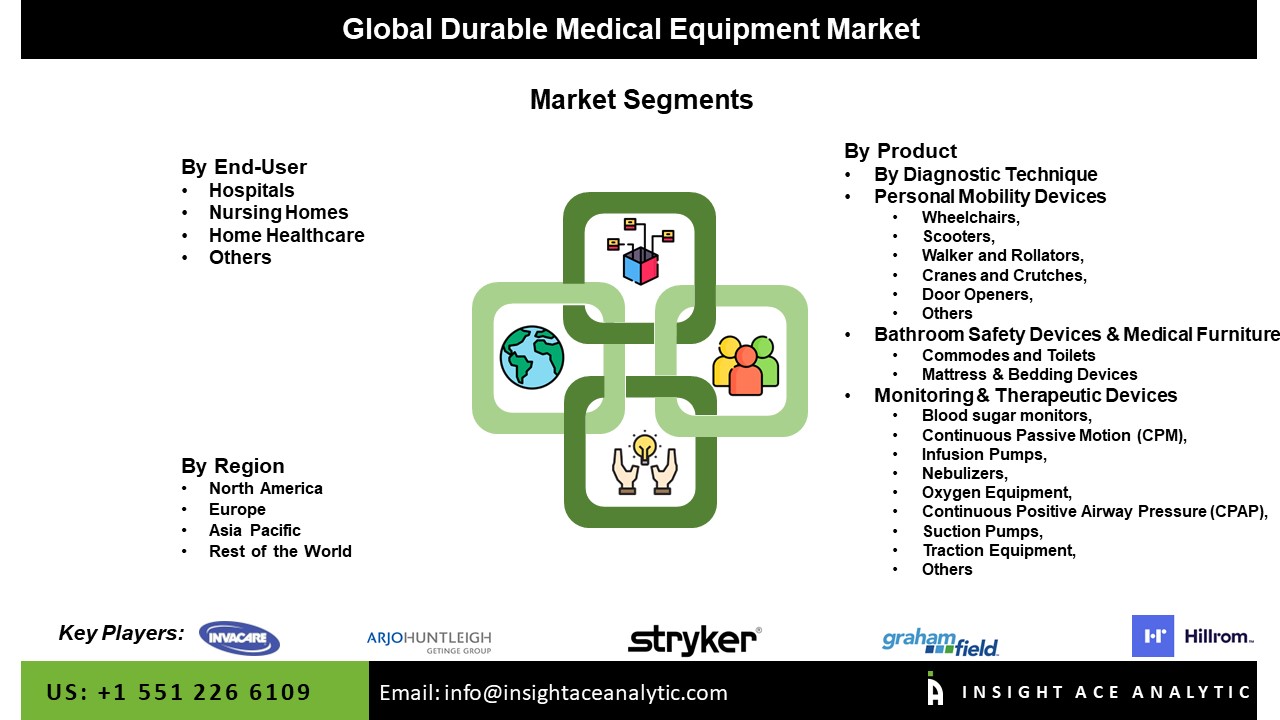
The durable medical equipment market is segmented based on product and end user. As per the product segment, the market is divided into personal mobility devices, bathroom safety devices & medical furniture and monitoring & therapeutic devices. By end user, the market is segmented into hospitals, nursing homes, home healthcare, and others.
Based On The Product, The Monitoring & Therapeutic Devices Durable Medical Equipment Market Segment Is A Major Contributor To The Durable Medical Equipment Market.
The monitoring and therapeutic devices segment in durable medical equipment market is expected to hold a major global market share in 2022 because of the increasing demand for wireless monitoring devices and the number of lifestyle-related disorders that require health record analysis. There will likely be an increase in the demand for health and fitness monitoring apps and devices like smart glasses, fitness bands, and wristwatches that can track vitals like temperature, heart rate, and oxygen levels and give important health analyses to help people stay safe.
Home Healthcare Segment To Witness Growth At A Rapid Rate.
The home healthcare industry makes up the bulk of durable medical equipment because family members can keep tabs on health using equipment and tracking devices. Home healthcare is a cost-effective alternative to hiring medical professionals. Additionally, being in a familiar setting, such as one's own house, might be helpful for a patient's mental health., especially in countries like the US, Germany, the UK, China, and India.
In The Region, The North American Durable Medical Equipment Market Holds A Significant Revenue Share.
The North American durable medical equipment market is expected to record the maximum revenue share in the near future. It can be attributed to the rapid advancement of cutting-edge medical technology and the concentration of key regional players. The medical and biological sciences are fields that are constantly evolving technologically. Patients must have access to affordable equipment if the market is to accommodate the greatest potential population. In addition, Asia Pacific is estimated to grow rapidly in the global durable medical equipment market because there is a growing number of chronic diseases among the target population, a surge in demand for medical equipment among patients, and several government initiatives and financial schemes focused on expanding healthcare access.
Recent Developments:
- In Oct 2023, Sunrise Medical completed the acquisition of Ride Designs, a business renowned for its expertise in developing personalized seating solutions for those using wheelchairs. The acquisition indicated a broadening of Sunrise Medical's range of bespoke seating options, clinical knowledge, and service capacities. Ride Designs bolstered Sunrise Medical's track record in mergers and acquisitions, which was deemed a crucial component of its business strategy.
- In Feb 2022, Invacare Corporation unveiled a more compact iteration of the Invacare AVIVA STORM RX rear-wheel drive electric wheelchair. The narrow base variant of the AVIVA STORM RX, a cutting-edge chair introduced in August 2021, presented various novel enhancements in contrast to the conventional version. The AVIVA STORM RX series represented a significant advancement in the company's rear-wheel-drive power wheelchairs, aiming to enhance the end-user's experience by incorporating cutting-edge design, technology, and performance.
Durable Medical Equipment Market Report Scope
| Report Attribute | Specifications |
| Market size value in 2024 | USD 241.5 Billion |
| Revenue forecast in 2034 | USD 436.5 Billion |
| Growth Rate CAGR | CAGR of 6.2% from 2025 to 2034 |
| Quantitative Units | Representation of revenue in US$ Million and CAGR from 2025 to 2034 |
| Historic Year | 2021 to 2024 |
| Forecast Year | 2025-2034 |
| Report Coverage | The forecast of revenue, the position of the company, the competitive market structure, growth prospects, and trends |
| Segments Covered | By Product, End-User |
| Regional Scope | North America; Europe; Asia Pacific; Latin America; Middle East & Africa |
| Country Scope | U.S.; Canada; U.K.; Germany; China; India; Japan; Brazil; Mexico; France; Italy; Spain; South East Asia; South Korea |
| Competitive Landscape | Invacare Corporation, ArjoHuntleigh, Stryker Corporation, Drive Medical, GF Health Products, Inc., Sunrise Medical, Medline Industries, Hill Rom, Inc., Carex Health Brands, Becton, Dickinson and Company, General Electric Company, Medtronic PLC, Compass Health Brands, Getinge AB, Resmed Inc., Koninklijke Philips NV, Medical Device Depot Inc., and Others |
| Customization Scope | Free customization report with the procurement of the report and modifications to the regional and segment scope. Particular Geographic competitive landscape. |
| Pricing And Available Payment Methods | Explore pricing alternatives that are customized to your particular study requirements. |
Segmentation of Durable Medical Equipment Market -
Durable Medical Equipment Market By Product-
- Personal Mobility Devices
- Wheelchairs,
- Scooters,
- Walker and Rollators,
- Cranes and Crutches,
- Door Openers,
- Others
- Bathroom Safety Devices & Medical Furniture
- Commodes and Toilets
- Mattress & Bedding Devices
- Monitoring & Therapeutic Devices
- Blood sugar monitors,
- Continuous Passive Motion (CPM),
- Infusion Pumps,
- Nebulizers,
- Oxygen Equipment,
- Continuous Positive Airway Pressure (CPAP),
- Suction Pumps,
- Traction Equipment,
- Others
Durable Medical Equipment Market By End User-
- Hospitals
- Nursing Homes
- Home Healthcare
- Others
Durable Medical Equipment Market By Region-
North America-
- The US
- Canada
- Mexico
Europe-
- Germany
- The UK
- France
- Italy
- Spain
- Rest of Europe
Asia-Pacific-
- China
- Japan
- India
- South Korea
- South East Asia
- Rest of Asia Pacific
Latin America-
- Brazil
- Argentina
- Rest of Latin America
Middle East & Africa-
- GCC Countries
- South Africa
- Rest of the Middle East and Africa
Research Design and Approach
This study employed a multi-step, mixed-method research approach that integrates:
- Secondary research
- Primary research
- Data triangulation
- Hybrid top-down and bottom-up modelling
- Forecasting and scenario analysis
This approach ensures a balanced and validated understanding of both macro- and micro-level market factors influencing the market.
Secondary Research
Secondary research for this study involved the collection, review, and analysis of publicly available and paid data sources to build the initial fact base, understand historical market behaviour, identify data gaps, and refine the hypotheses for primary research.
Sources Consulted
Secondary data for the market study was gathered from multiple credible sources, including:
- Government databases, regulatory bodies, and public institutions
- International organizations (WHO, OECD, IMF, World Bank, etc.)
- Commercial and paid databases
- Industry associations, trade publications, and technical journals
- Company annual reports, investor presentations, press releases, and SEC filings
- Academic research papers, patents, and scientific literature
- Previous market research publications and syndicated reports
These sources were used to compile historical data, market volumes/prices, industry trends, technological developments, and competitive insights.

Primary Research
Primary research was conducted to validate secondary data, understand real-time market dynamics, capture price points and adoption trends, and verify the assumptions used in the market modelling.
Stakeholders Interviewed
Primary interviews for this study involved:
- Manufacturers and suppliers in the market value chain
- Distributors, channel partners, and integrators
- End-users / customers (e.g., hospitals, labs, enterprises, consumers, etc., depending on the market)
- Industry experts, technology specialists, consultants, and regulatory professionals
- Senior executives (CEOs, CTOs, VPs, Directors) and product managers
Interview Process
Interviews were conducted via:
- Structured and semi-structured questionnaires
- Telephonic and video interactions
- Email correspondences
- Expert consultation sessions
Primary insights were incorporated into demand modelling, pricing analysis, technology evaluation, and market share estimation.
Data Processing, Normalization, and Validation
All collected data were processed and normalized to ensure consistency and comparability across regions and time frames.
The data validation process included:
- Standardization of units (currency conversions, volume units, inflation adjustments)
- Cross-verification of data points across multiple secondary sources
- Normalization of inconsistent datasets
- Identification and resolution of data gaps
- Outlier detection and removal through algorithmic and manual checks
- Plausibility and coherence checks across segments and geographies
This ensured that the dataset used for modelling was clean, robust, and reliable.
Market Size Estimation and Data Triangulation
Bottom-Up Approach
The bottom-up approach involved aggregating segment-level data, such as:
- Company revenues
- Product-level sales
- Installed base/usage volumes
- Adoption and penetration rates
- Pricing analysis
This method was primarily used when detailed micro-level market data were available.

Top-Down Approach
The top-down approach used macro-level indicators:
- Parent market benchmarks
- Global/regional industry trends
- Economic indicators (GDP, demographics, spending patterns)
- Penetration and usage ratios
This approach was used for segments where granular data were limited or inconsistent.
Hybrid Triangulation Approach
To ensure accuracy, a triangulated hybrid model was used. This included:
- Reconciling top-down and bottom-up estimates
- Cross-checking revenues, volumes, and pricing assumptions
- Incorporating expert insights to validate segment splits and adoption rates
This multi-angle validation yielded the final market size.
Forecasting Framework and Scenario Modelling
Market forecasts were developed using a combination of time-series modelling, adoption curve analysis, and driver-based forecasting tools.
Forecasting Methods
- Time-series modelling
- S-curve and diffusion models (for emerging technologies)
- Driver-based forecasting (GDP, disposable income, adoption rates, regulatory changes)
- Price elasticity models
- Market maturity and lifecycle-based projections
Scenario Analysis
Given inherent uncertainties, three scenarios were constructed:
- Base-Case Scenario: Expected trajectory under current conditions
- Optimistic Scenario: High adoption, favourable regulation, strong economic tailwinds
- Conservative Scenario: Slow adoption, regulatory delays, economic constraints
Sensitivity testing was conducted on key variables, including pricing, demand elasticity, and regional adoption.
Request Customization
Add countries, segments, company profiles, or extend forecast — free 10% customization with purchase.
Customize This Report →Enquire Before Buying
Speak with our analyst team about scope, methodology, pricing, or deliverable formats.
Enquire Now →Frequently Asked Questions
Durable Medical Equipment Market Size is expected to grow at a 6.2% CAGR during the forecast period for 2025-2034
Medtronic PLC, Compass Health Brands, Getinge AB, Resmed Inc., Koninklijke Philips NV, Medical Device Depot Inc., and Others
Durable Medical Equipment Market Size is valued at USD 241.5 Billion in 2024 and is predicted to reach USD 436.5 Billion by the year 2034
Product and End-User are the key segments of the Durable Medical Equipment Market.
North American region is leading the Durable Medical Equipment Market.