Customized Probiotics Market Size and Revenue Impact Study 2026 to 2035
What is Customized Probiotics Market Size?
Customized Probiotics Market Size is valued at USD 6.28 Bn in 2025 and is predicted to reach USD 12.47 Bn by the year 2035 at a 7.2% CAGR during the forecast period for 2026 to 2035.
Customized Probiotics Market Size, Share & Trends Analysis Report By Product Type (Food and Beverage, Dietary Supplements), Consumer Group (Adult, Pediatric), Distribution Channel (Online Stores, Retail Pharmacies), By Region, And By Segment Forecasts, 2026 to 2035
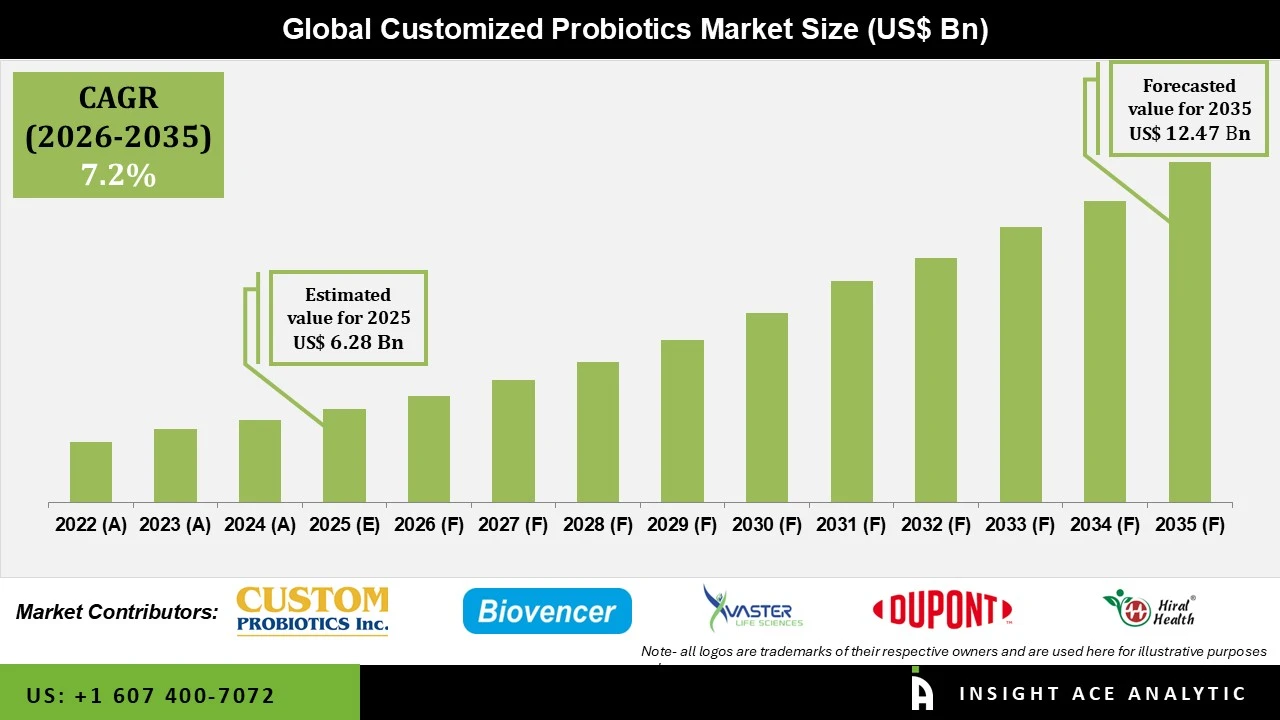
Customized Probiotics Market Key Takeaways:
|
Customized probiotic product category aims to optimize gut health and address specific conditions more effectively by selecting beneficial bacterial strains targeted to individual requirements. It represents a move towards precision medicine in gut health, promising more precise health benefits. However, the field is emerging, and challenges such as accurately assessing the microbiome and regulatory hurdles remain. These formulations are crafted based on an individual's distinct microbiome, which encompasses the diverse array of microorganisms residing within and on the body. A rising awareness regarding the health advantages of probiotics and an escalating demand for personalized health interventions propels the market revenue for tailored probiotics.
In recent times, there has been a notable surge in the utilization of probiotics as dietary supplements, with consumers seeking products that offer a spectrum of health benefits. The expanding recognition of probiotics' health advantages, such as enhanced gut health and overall digestive function, is expected to drive market growth globally. As more individuals adopt a proactive stance towards their well-being, they are seeking natural, non-pharmaceutical remedies to support their gut microbiome. The market penetration of dairy products is forecasted to be substantial due to increased consumption of functional dairy items geared towards digestive wellness.
Competitive Landscape
Some Major Key Players In The Customized Probiotics Market:
- Custom Probiotics Inc.
- Hiral Health
- DuPont Health and Nutrition
- Vaster Life Sciences
- Biovencer Healthcare
- Unique Biotech
- Probi AB
- DSM Nutritional Products AG
- Creative Biogeny
- Sun Genomics
- Sauber USA
- Nutrascience Labs
- Glac Biotech Co., Ltd
- Creative Enzymes
- Other Prominent Players
Market Segmentation:
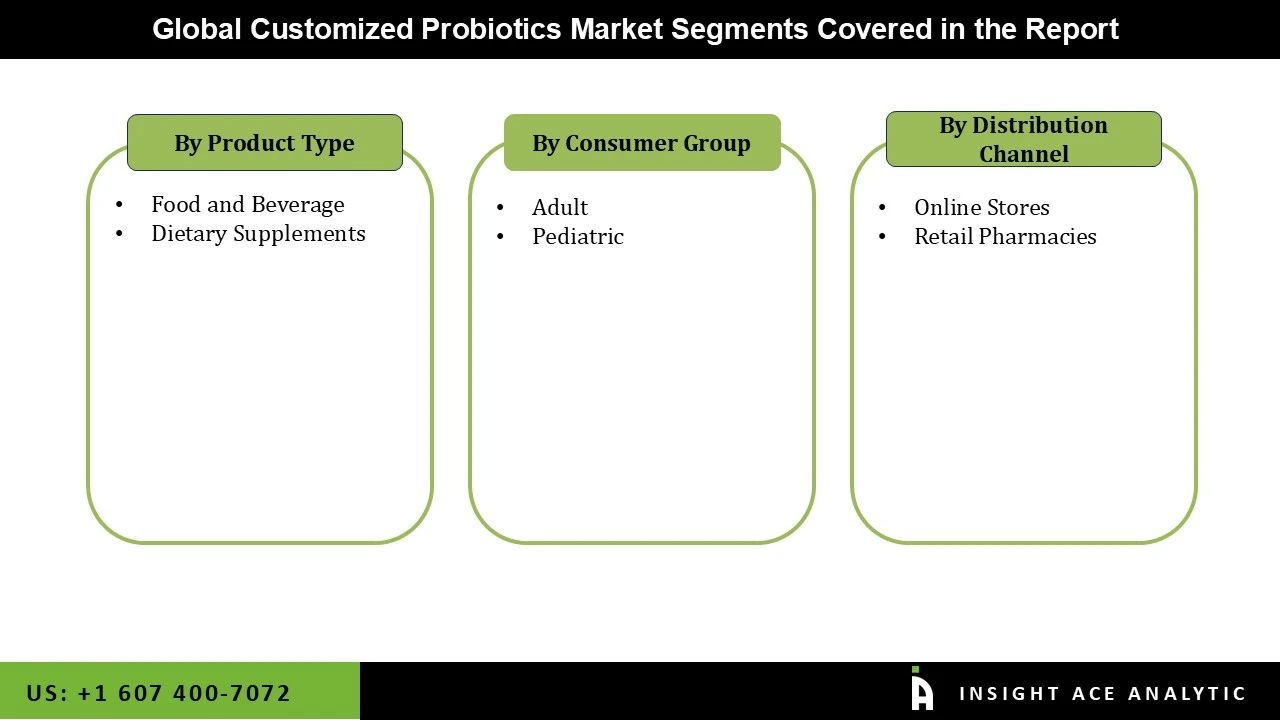
The Customized Probiotics market is segmented on the basis of product type, customer group and distribution channel. The product type segment consists of Food and Beverage and dietary Supplements. By consumer group, the market is segmented into adult and pediatric). As per the distribution channel segment, the market is categorized into online and offline.
As Per The Distribution Channel, The Online Segment Is Accounted As A Major Contributor In The Customized Probiotics Market.
The category is expected to hold a major share of the global Customized Probiotics market in 2022. The Customized Probiotics Market is witnessing a significant surge in the online sector, driven by various factors contributing to its growth. Firstly, the increasing digitalization and accessibility of the Internet have made online shopping more convenient and accessible to consumers worldwide.
Secondly, the COVID-19 pandemic has accelerated the adoption of online shopping, with lockdowns and social distancing measures prompting consumers to rely more heavily on e-commerce channels for their shopping needs. This shift in consumer behavior has particularly benefited the customized probiotics market, as individuals prioritize their health and seek personalized solutions conveniently delivered to their doorstep. Moreover, the online sector offers a wider range of product options and the opportunity for consumers to compare prices and read reviews, facilitating informed decision-making.
The Dietary Supplements Segment Witnessed Growth At A Rapid Rate.
The dietary supplements segment likely to witness a rapid growth rate in the global Customized Probiotics market. The dietary supplements sector is anticipated to emerge as the leader in terms of market revenue share. This is attributed to the focus of several dietary supplement manufacturers on incorporating a specific type of dietary fiber containing probiotics and prebiotics (FOS and Sun fiber). These nutrients combat yeast infections, eczema, diarrhea, and flatulence. Probiotic dietary supplements have gained popularity among consumers seeking natural solutions for various health issues.
Probiotics, in contrast to pharmaceutical remedies, offer a natural approach to treating various ailments related to gut health, gastrointestinal conditions, and immune system enhancement. The development of new delivery systems, such as effervescent powders, gummies, and chewable products, is expected to drive growth further.
In The Region, The North America Customized Probiotics Market Holds A Significant Revenue Share.
The North America Customized Probiotics market is expected to register highest market share. The expected increase in investments from food and beverage and pharmaceutical manufacturers is poised to stimulate regional expansion. Local players are channeling their investments into research and development endeavors aimed at introducing novel products customized to cater to a variety of consumers across different age groups and genders. These dynamics are forecasted to expedite market growth over the forecast period.
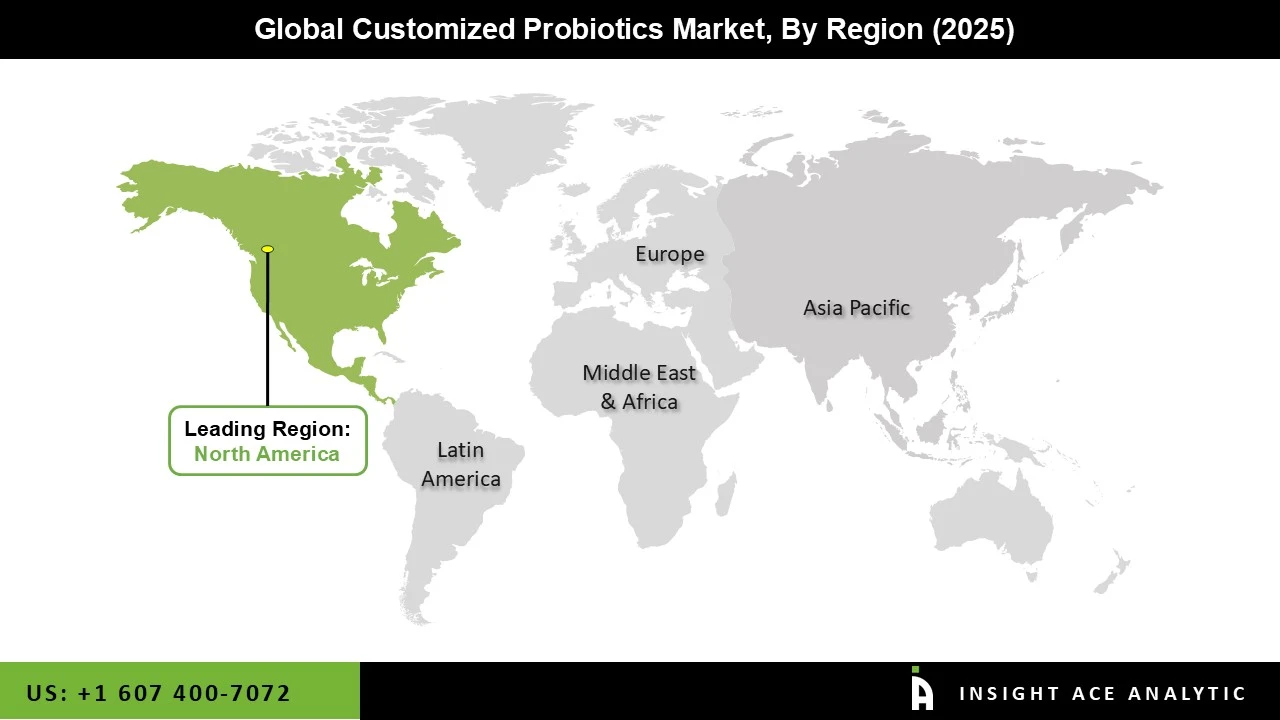
In addition, the Asia Pacific region is anticipated to develop at a tremendous rate in the global Customized Probiotics market due to the rising awareness and enthusiasm for emerging technologies, extensive media coverage, and escalating consumer demand. The increasing consciousness regarding probiotics in countries like China and India is anticipated to provide further impetus to market expansion in the region. Notably, in China, there has been a significant surge in demand for probiotics incorporated into infant formula, a trend expected to continue gaining momentum in the foreseeable future.
Recent Developments:
- In June 2023, ADM revealed plans to inaugurate a cutting-edge manufacturing plant in Spain, investing USD 30 million to address the underserved market for probiotics and postbiotics.
- In April 2023, the FDA approved Seers Therapeutics' live oral microbiome capsule, Vows. Nestle will market it through its gastroenterology sales team.
- In Jan 2023, Sun Genomics personalized probiotics brand Floré collaborated with DSM Venturing to enhance the scientific research and global commercial distribution of precision probiotics.
Customized Probiotics Market Report Scope
| Report Attribute | Specifications |
| Market Size Value In 2025 | USD 6.28 Bn |
| Revenue Forecast In 2035 | USD 12.47 Bn |
| Growth Rate CAGR | CAGR of 7.2% from 2026 to 2035 |
| Quantitative Units | Representation of revenue in US$ Bn and CAGR from 2026 to 2035 |
| Historic Year | 2022 to 2025 |
| Forecast Year | 2026-2035 |
| Report Coverage | The forecast of revenue, the position of the company, the competitive market structure, growth prospects, and trends |
| Segments Covered | By Product Type, Customer Group And Distribution Channel. |
| Regional Scope | North America; Europe; Asia Pacific; Latin America; Middle East & Africa |
| Country Scope | U.S.; Canada; U.K.; Germany; China; India; Japan; Brazil; Mexico; France; Italy; Spain; Southeast Asia; South Korea |
| Competitive Landscape | Custom Probiotics Inc., Hiral Health, DuPont Health and Nutrition, Vaster Life Sciences, Biovencer Healthcare, Unique Biotech, biome, Inc., Biome Life Sciences, Probe AB, Quant biome, Inc., DSM Nutritional Products AG, Creative Biogeny, Sun Genomics, Sauber USA, Nutrascience Labs, Glac Biotech Co., Ltd, Creative Enzymes and Other Prominent Players |
| Customization Scope | Free customization report with the procurement of the report and modifications to the regional and segment scope. Particular Geographic competitive landscape. |
| Pricing And Available Payment Methods | Explore pricing alternatives that are customized to your particular study requirements. |
Segmentation of Customized Probiotics Market-
Customized Probiotics Market By Product Type
- Food and Beverage
- Dietary Supplements
Customized Probiotics Market By Consumer Group
- Adult
- Pediatric
Customized Probiotics Market By Distribution Channel
- Online Stores
- Retail Pharmacies
Customized Probiotics Market By Region-
North America-
- The US
- Canada
Europe-
- Germany
- The UK
- France
- Italy
- Spain
- Rest of Europe
Asia-Pacific-
- China
- Japan
- India
- South Korea
- Southeast Asia
- Rest of Asia Pacific
Latin America-
- Brazil
- Mexico
- Argentina
- Rest of Latin America
Middle East & Africa-
- GCC Countries
- South Africa
- Rest of Middle East and Africa
Research Design and Approach
This study employed a multi-step, mixed-method research approach that integrates:
- Secondary research
- Primary research
- Data triangulation
- Hybrid top-down and bottom-up modelling
- Forecasting and scenario analysis
This approach ensures a balanced and validated understanding of both macro- and micro-level market factors influencing the market.
Secondary Research
Secondary research for this study involved the collection, review, and analysis of publicly available and paid data sources to build the initial fact base, understand historical market behaviour, identify data gaps, and refine the hypotheses for primary research.
Sources Consulted
Secondary data for the market study was gathered from multiple credible sources, including:
- Government databases, regulatory bodies, and public institutions
- International organizations (WHO, OECD, IMF, World Bank, etc.)
- Commercial and paid databases
- Industry associations, trade publications, and technical journals
- Company annual reports, investor presentations, press releases, and SEC filings
- Academic research papers, patents, and scientific literature
- Previous market research publications and syndicated reports
These sources were used to compile historical data, market volumes/prices, industry trends, technological developments, and competitive insights.

Primary Research
Primary research was conducted to validate secondary data, understand real-time market dynamics, capture price points and adoption trends, and verify the assumptions used in the market modelling.
Stakeholders Interviewed
Primary interviews for this study involved:
- Manufacturers and suppliers in the market value chain
- Distributors, channel partners, and integrators
- End-users / customers (e.g., hospitals, labs, enterprises, consumers, etc., depending on the market)
- Industry experts, technology specialists, consultants, and regulatory professionals
- Senior executives (CEOs, CTOs, VPs, Directors) and product managers
Interview Process
Interviews were conducted via:
- Structured and semi-structured questionnaires
- Telephonic and video interactions
- Email correspondences
- Expert consultation sessions
Primary insights were incorporated into demand modelling, pricing analysis, technology evaluation, and market share estimation.
Data Processing, Normalization, and Validation
All collected data were processed and normalized to ensure consistency and comparability across regions and time frames.
The data validation process included:
- Standardization of units (currency conversions, volume units, inflation adjustments)
- Cross-verification of data points across multiple secondary sources
- Normalization of inconsistent datasets
- Identification and resolution of data gaps
- Outlier detection and removal through algorithmic and manual checks
- Plausibility and coherence checks across segments and geographies
This ensured that the dataset used for modelling was clean, robust, and reliable.
Market Size Estimation and Data Triangulation
Bottom-Up Approach
The bottom-up approach involved aggregating segment-level data, such as:
- Company revenues
- Product-level sales
- Installed base/usage volumes
- Adoption and penetration rates
- Pricing analysis
This method was primarily used when detailed micro-level market data were available.

Top-Down Approach
The top-down approach used macro-level indicators:
- Parent market benchmarks
- Global/regional industry trends
- Economic indicators (GDP, demographics, spending patterns)
- Penetration and usage ratios
This approach was used for segments where granular data were limited or inconsistent.
Hybrid Triangulation Approach
To ensure accuracy, a triangulated hybrid model was used. This included:
- Reconciling top-down and bottom-up estimates
- Cross-checking revenues, volumes, and pricing assumptions
- Incorporating expert insights to validate segment splits and adoption rates
This multi-angle validation yielded the final market size.
Forecasting Framework and Scenario Modelling
Market forecasts were developed using a combination of time-series modelling, adoption curve analysis, and driver-based forecasting tools.
Forecasting Methods
- Time-series modelling
- S-curve and diffusion models (for emerging technologies)
- Driver-based forecasting (GDP, disposable income, adoption rates, regulatory changes)
- Price elasticity models
- Market maturity and lifecycle-based projections
Scenario Analysis
Given inherent uncertainties, three scenarios were constructed:
- Base-Case Scenario: Expected trajectory under current conditions
- Optimistic Scenario: High adoption, favourable regulation, strong economic tailwinds
- Conservative Scenario: Slow adoption, regulatory delays, economic constraints
Sensitivity testing was conducted on key variables, including pricing, demand elasticity, and regional adoption.
Request Customization
Add countries, segments, company profiles, or extend forecast — free 10% customization with purchase.
Customize This Report →Enquire Before Buying
Speak with our analyst team about scope, methodology, pricing, or deliverable formats.
Enquire Now →Frequently Asked Questions
Customized Probiotics Market Size is valued at USD 6.28 Bn in 2025 and is predicted to reach USD 12.47 Bn by the year 2035
Customized Probiotics Market is expected to grow at a 7.2% CAGR during the forecast period for 2026 to 2035
Probe AB, Quant biome, Inc., DSM Nutritional Products AG, Creative Biogeny, Sun Genomics, Sauber USA, Nutrascience Labs, Glac Biotech Co., Ltd, Creati
Product Type, Customer Group and Distribution Channel are the key segments of the Customized Probiotics Market.
North America region is leading the Customized Probiotics Market.