Control Knobs for Panel Potentiometer Market Size, Share, Scope, Forecast Report 2026 to 2035
What is Control Knobs for Panel Potentiometer Market Size?
Control Knobs for Panel Potentiometer Market Size is valued at USD 451.51 Mn in 2025 and is predicted to reach USD 694.40 Mn by the year 2035 at a 4.5% CAGR during the forecast period for 2026 to 2035.
Control Knobs for Panel Potentiometer Market Size, Share & Trends Analysis Distribution by Material Type (ABS Plastic, Aluminum, and Others), End-user (Medical Devices, Industrial Control Panels, and Others), and Segment Forecasts, 2026 to 2035
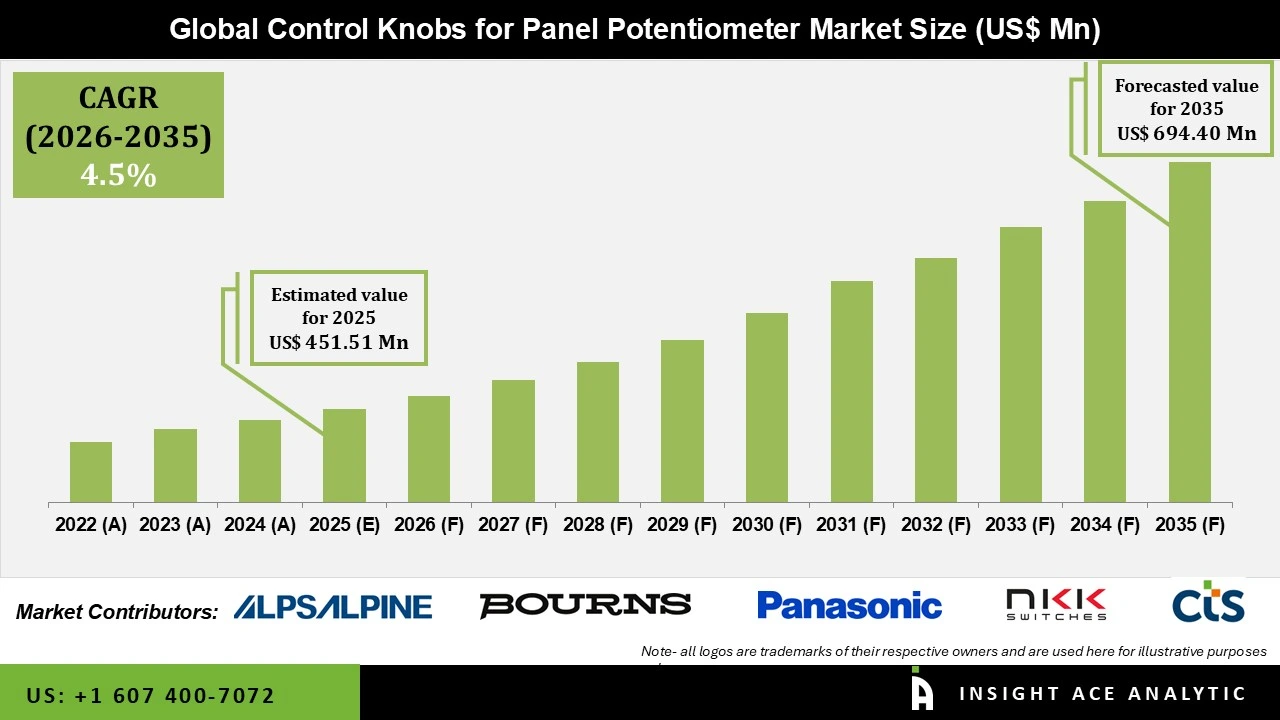
Control knobs for panel potentiometers are mechanical interface parts that are fastened to a potentiometer's shaft and allow users to easily and precisely change the electrical resistance in a circuit by hand. These knobs, which are usually composed of rubberized compounds, plastic, or metal, are meant to be long-lasting, easy to handle, and provide a clear visual indication of position through scales, markers, or pointers. They are frequently utilized in electronic devices that require fine-tuning of parameters such as volume, voltage, current, or signal levels, such as audio systems, industrial control panels, laboratory instruments, and consumer electronics. The control knobs for panel potentiometer market is expanding as a result of increased consumer electronics, the adoption of cutting-edge technologies, and the growing need for user-friendly electronic device interfaces.
The control knobs for panel potentiometer market is steadily expanding since manual control interfaces are widely used in consumer, commercial, and industrial electronic applications. These knobs are essential in devices such as industrial control panels, lab equipment, and professional audio systems because they allow for the precise adjustment of factors like voltage, current, speed, and audio levels. Another main factor sustaining the control knobs for panel potentiometer market demand is the ongoing reliance on tactile controls in critical areas where precision and quick response are crucial. Additionally, the use of robust and ergonomic control knobs is rising due to the expansion of industrial automation and the growing installation of machinery in manufacturing industries.
In addition, material advances, technology integration, and changing design preferences are all influencing the control knobs for panel potentiometer market growth. Increasingly, manufacturers are concentrating on creating knobs that are more resilient to adverse environmental factors such as heat, dust, and moisture, as well as more durable and grippy. Customization and branding have also grown in popularity as consumers seek distinctive designs that complement the utility and attractiveness of products. However, by lowering reliance on physical components, the increasing trend toward digital interfaces, such as touchscreens and software-based controllers, presents a threat to the control knobs for panel potentiometer market expansion. Furthermore, growth in some applications may be constrained by the availability of alternative input methods such as membrane switches and rotary encoders.
Competitive Landscape
Which are the Leading Players in Control Knobs for Panel Potentiometer Market?
• Panasonic Corporation
• TT Electronics plc
• Alps Alpine Co., Ltd.
• NKK Switches
• CTS Corporation
• Bourns Inc.
• Honeywell International Inc.
• Nidec Copal Electronics Inc.
• ELESA + GANTER
• Davies Molding
• Vishay Intertechnology
• E-Switch Grayhill Inc.
• SIKO Global
• MEGATRON Elektronik GmbH & Co. KG
• Others
Market Dynamics
Driver
Growing Need for Tactile Control in Professional and Industrial Equipment
The control knobs for panel potentiometer market are driven by the ongoing need for accurate and tactile manual control in high-reliability, professional, and industrial applications. Physical knobs, in contrast to digital touch interfaces, offer instantaneous feedback, enabling users to precisely make fine changes even in difficult circumstances such as factories, labs, and medical facilities. This is especially crucial for devices like music mixing consoles, measuring tools, and machinery control panels where accuracy and security are vital. Furthermore, tactile controls continue to work in situations such as gloves, wetness, or dust where touchscreens can malfunction. The need for robust, ergonomic control knobs for panel potentiometer is still high as businesses continue to place a high priority on dependability and human-machine interface.
Restrain/Challenge
Growing Uptake of Touch-Based and Digital Interfaces
The control knobs for panel potentiometer market are significantly constrained by the quick uptake of touch-based and digital interfaces in contemporary electronics. Manufacturers are including touchscreens, membrane buttons, and software-driven controls that eliminate the need for physical knobs as a result of developments in embedded systems and user interface technology. These substitutes include benefits including multifunctionality, space efficiency, and contemporary aesthetics that appeal to both makers and final consumers. As a result, numerous consumer electronics and small gadgets are gradually being rid of conventional mechanical parts such as controls. The growth is severely hampered by this change, which also restricts the control knobs for panel potentiometer market demand and compels manufacturers to diversify or adapt.
Aluminum Segment is Expected to Drive the Control Knobs for Panel Potentiometer Market
The aluminum category held the largest share in the Control Knobs for Panel Potentiometer market in 2025 because of its better material qualities and the growing need for high-end, long-lasting parts in both professional and industrial settings. Aluminum knobs are perfect for usage in demanding situations such as industrial control panels, aerospace equipment, and high-end audio systems because of their high strength-to-weight ratio, outstanding temperature stability, and corrosion resistance. In addition to increasing surface durability and wear resistance, their capacity to be anodized in a variety of colors and finishes improves aesthetic appeal. Moreover, the aluminum knob adoption is also being fueled by industries including medical devices, instrumentation, and automotive electronics, which are increasingly choosing sturdy and long-lasting components.
Industrial Control Panels Segment is Growing at the Highest Rate in the Control Knobs for Panel Potentiometer Market
In 2025, the Industrial Control Panels category dominated the Control Knobs for Panel Potentiometer market propelled by the continuous global demand for process improvement and industrial automation. Control panels are crucial for monitoring and controlling machinery in industries including manufacturing, oil and gas, power production, and food processing. Potentiometer knobs allow for accurate, real-time manual changes. Additionally, the growing use of Industry 4.0 technologies and smart factories still includes hybrid systems, which combine digital monitoring with physical controls for improved operator control and safety. Furthermore, the use of high-quality, long-lasting knobs has increased due to the desire for ergonomically designed and personalized control panels.
Why North America Led the Control Knobs for Panel Potentiometer Market?
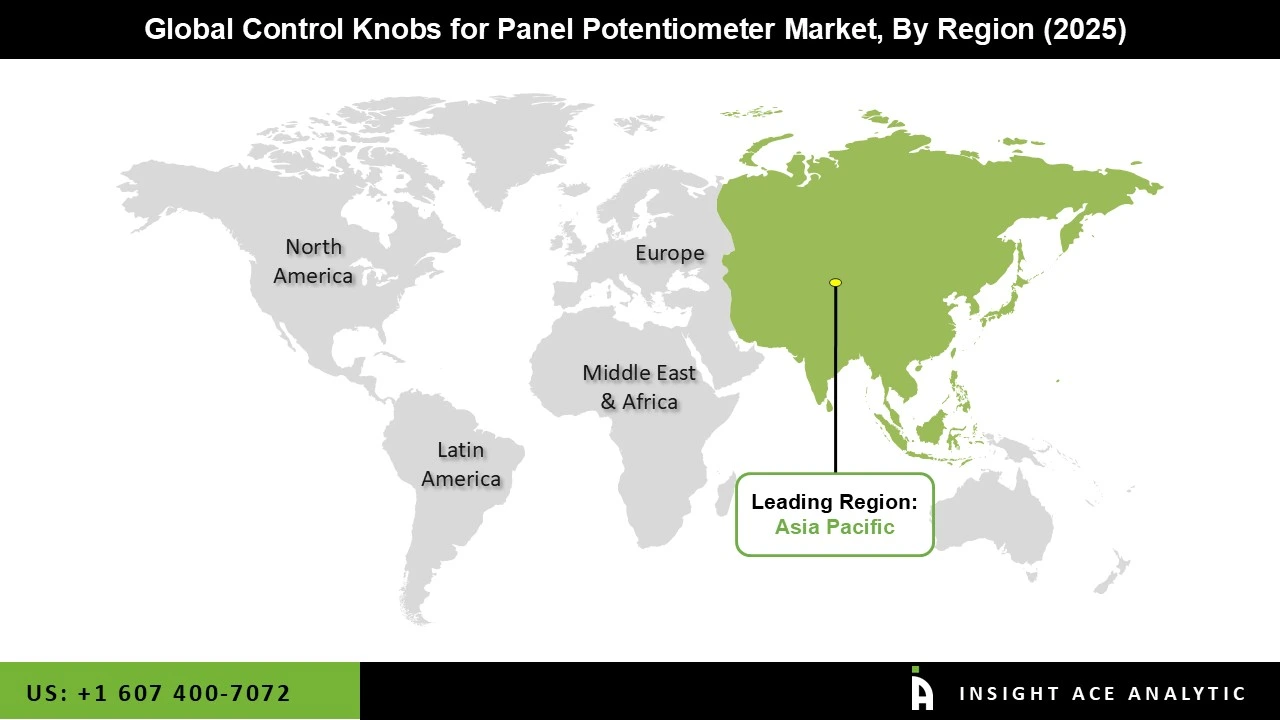
The Control Knobs for Panel Potentiometer market was dominated by North America region in 2025 propelled by the robust existence of cutting-edge industrial sectors, entrenched electronics manufacturing, and ongoing technological innovation. Precision equipment utilized in industries including aerospace, defense, healthcare, and industrial automation is in great demand throughout the region, especially in the United States and Canada. Furthermore, tactile and dependable control interfaces are still crucial for operational precision and safety in these applications. The need for high-end control knobs with improved durability and design has also been bolstered by the comeback of professional sound systems and high-end audio equipment. Additionally, the region's continued use of high-performance potentiometer knobs is ensured by growing investments in testing facilities and research labs, as well as stringent quality standards.
Control Knobs for Panel Potentiometer Market Report Scope:
| Report Attribute | Specifications |
| Market size value in 2025 | USD 451.51 Mn |
| Revenue forecast in 2035 | USD 694.40 Mn |
| Growth Rate CAGR | CAGR of 4.5% from 2026 to 2035 |
| Quantitative Units | Representation of revenue in US$ Mn and CAGR from 2026 to 2035 |
| Historic Year | 2022 to 2025 |
| Forecast Year | 2026-2035 |
| Report Coverage | The forecast of revenue, the position of the company, the competitive market structure, growth prospects, and trends |
| Segments Covered | Material Type, End-user, and By Region |
| Regional Scope | North America; Europe; Asia Pacific; Latin America; Middle East & Africa |
| Country Scope | U.S.; Canada; U.K.; Germany; China; India; Japan; Brazil; Mexico; The UK; France; Italy; Spain; China; Japan; India; South Korea; Southeast Asia; South Korea; Southeast Asia |
| Competitive Landscape | Panasonic Corporation, TT Electronics plc, Alps Alpine Co., Ltd., NKK Switches, CTS Corporation, Bourns Inc., Honeywell International Inc., Nidec Copal Electronics Inc., ELESA + GANTER, Davies Molding, Vishay Intertechnology, E-Switch Grayhill Inc., SIKO Global, MEGATRON Elektronik GmbH & Co. KG, and Others. |
| Customization Scope | Free customization report with the procurement of the report, Modifications to the regional and segment scope. Geographic competitive landscape. |
| Pricing and Available Payment Methods | Explore pricing alternatives that are customized to your particular study requirements. |
Market Segmentation:
Control Knobs for Panel Potentiometer Market by Material Type-
• ABS Plastic
• Aluminum
• Others
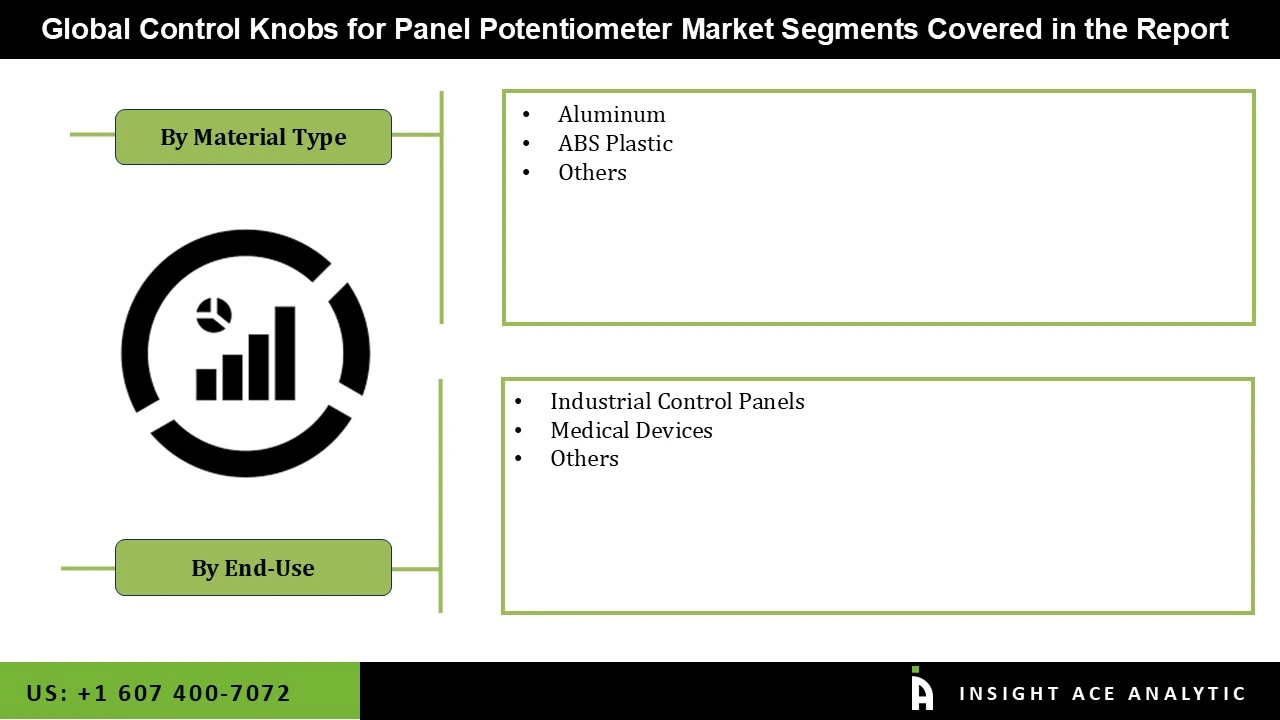
Control Knobs for Panel Potentiometer Market by End-user-
• Medical Devices
• Industrial Control Panels
• Others
By Region-
North America-
• The US
• Canada
Europe-
• Germany
• The UK
• France
• Italy
• Spain
• Rest of Europe
Asia-Pacific-
• China
• Japan
• India
• South Korea
• South East Asia
• Rest of Asia Pacific
Latin America-
• Brazil
• Argentina
• Mexico
• Rest of Latin America
Middle East & Africa-
• GCC Countries
• South Africa
• Rest of Middle East and Africa
Research Design and Approach
This study employed a multi-step, mixed-method research approach that integrates:
- Secondary research
- Primary research
- Data triangulation
- Hybrid top-down and bottom-up modelling
- Forecasting and scenario analysis
This approach ensures a balanced and validated understanding of both macro- and micro-level market factors influencing the market.
Secondary Research
Secondary research for this study involved the collection, review, and analysis of publicly available and paid data sources to build the initial fact base, understand historical market behaviour, identify data gaps, and refine the hypotheses for primary research.
Sources Consulted
Secondary data for the market study was gathered from multiple credible sources, including:
- Government databases, regulatory bodies, and public institutions
- International organizations (WHO, OECD, IMF, World Bank, etc.)
- Commercial and paid databases
- Industry associations, trade publications, and technical journals
- Company annual reports, investor presentations, press releases, and SEC filings
- Academic research papers, patents, and scientific literature
- Previous market research publications and syndicated reports
These sources were used to compile historical data, market volumes/prices, industry trends, technological developments, and competitive insights.

Primary Research
Primary research was conducted to validate secondary data, understand real-time market dynamics, capture price points and adoption trends, and verify the assumptions used in the market modelling.
Stakeholders Interviewed
Primary interviews for this study involved:
- Manufacturers and suppliers in the market value chain
- Distributors, channel partners, and integrators
- End-users / customers (e.g., hospitals, labs, enterprises, consumers, etc., depending on the market)
- Industry experts, technology specialists, consultants, and regulatory professionals
- Senior executives (CEOs, CTOs, VPs, Directors) and product managers
Interview Process
Interviews were conducted via:
- Structured and semi-structured questionnaires
- Telephonic and video interactions
- Email correspondences
- Expert consultation sessions
Primary insights were incorporated into demand modelling, pricing analysis, technology evaluation, and market share estimation.
Data Processing, Normalization, and Validation
All collected data were processed and normalized to ensure consistency and comparability across regions and time frames.
The data validation process included:
- Standardization of units (currency conversions, volume units, inflation adjustments)
- Cross-verification of data points across multiple secondary sources
- Normalization of inconsistent datasets
- Identification and resolution of data gaps
- Outlier detection and removal through algorithmic and manual checks
- Plausibility and coherence checks across segments and geographies
This ensured that the dataset used for modelling was clean, robust, and reliable.
Market Size Estimation and Data Triangulation
Bottom-Up Approach
The bottom-up approach involved aggregating segment-level data, such as:
- Company revenues
- Product-level sales
- Installed base/usage volumes
- Adoption and penetration rates
- Pricing analysis
This method was primarily used when detailed micro-level market data were available.

Top-Down Approach
The top-down approach used macro-level indicators:
- Parent market benchmarks
- Global/regional industry trends
- Economic indicators (GDP, demographics, spending patterns)
- Penetration and usage ratios
This approach was used for segments where granular data were limited or inconsistent.
Hybrid Triangulation Approach
To ensure accuracy, a triangulated hybrid model was used. This included:
- Reconciling top-down and bottom-up estimates
- Cross-checking revenues, volumes, and pricing assumptions
- Incorporating expert insights to validate segment splits and adoption rates
This multi-angle validation yielded the final market size.
Forecasting Framework and Scenario Modelling
Market forecasts were developed using a combination of time-series modelling, adoption curve analysis, and driver-based forecasting tools.
Forecasting Methods
- Time-series modelling
- S-curve and diffusion models (for emerging technologies)
- Driver-based forecasting (GDP, disposable income, adoption rates, regulatory changes)
- Price elasticity models
- Market maturity and lifecycle-based projections
Scenario Analysis
Given inherent uncertainties, three scenarios were constructed:
- Base-Case Scenario: Expected trajectory under current conditions
- Optimistic Scenario: High adoption, favourable regulation, strong economic tailwinds
- Conservative Scenario: Slow adoption, regulatory delays, economic constraints
Sensitivity testing was conducted on key variables, including pricing, demand elasticity, and regional adoption.
Request Customization
Add countries, segments, company profiles, or extend forecast — free 10% customization with purchase.
Customize This Report →Enquire Before Buying
Speak with our analyst team about scope, methodology, pricing, or deliverable formats.
Enquire Now →Frequently Asked Questions
Control Knobs for Panel Potentiometer Market Size is valued at USD 451.51 Mn in 2025 and is predicted to reach USD 694.40 Mn by the year 2035
Control Knobs for Panel Potentiometer Market Size is predicted to grow at a 4.5% CAGR during the forecast period for 2026 to 2035.
Panasonic Corporation, TT Electronics plc, Alps Alpine Co., Ltd., NKK Switches, CTS Corporation, Bourns Inc., Honeywell International Inc., Nidec Copal Electronics Inc., ELESA + GANTER, Davies Molding, Vishay Intertechnology, E-Switch Grayhill Inc., SIKO Global, MEGATRON Elektronik GmbH & Co. KG, and Others.
Control Knobs for Panel Potentiometer Market is segmented into Material Type, End-user, and By Region.
North America region is leading the Control Knobs for Panel Potentiometer Market.