Combo IVD Market Size, Share & Trends Analysis Report By Test Type (SARS-CoV-2 Flu A/B Combo Test, COVID-19, Influenza A/B, RSV Combo test, COVID-19 IgM/IgG Combo Test, HIV-1/2 Ag/Ab Combo Test, HIV/Syphilis Ab Combo Test, HIV, HBsAg, HCV & Syphilis Combo, hCG Combo Test, Thrombophilia Detection Combo Test, Other Test Types), By Testing, By End-User, By Channel, By Sample Type, By Region, And By Segment Forecasts, 2024-2031
Combo IVD Market Size is valued at USD 550.12 Mn in 2023 and is predicted to reach USD 920.86 Mn by the year 2031 at a 6.84% CAGR during the forecast period for 2024-2031.
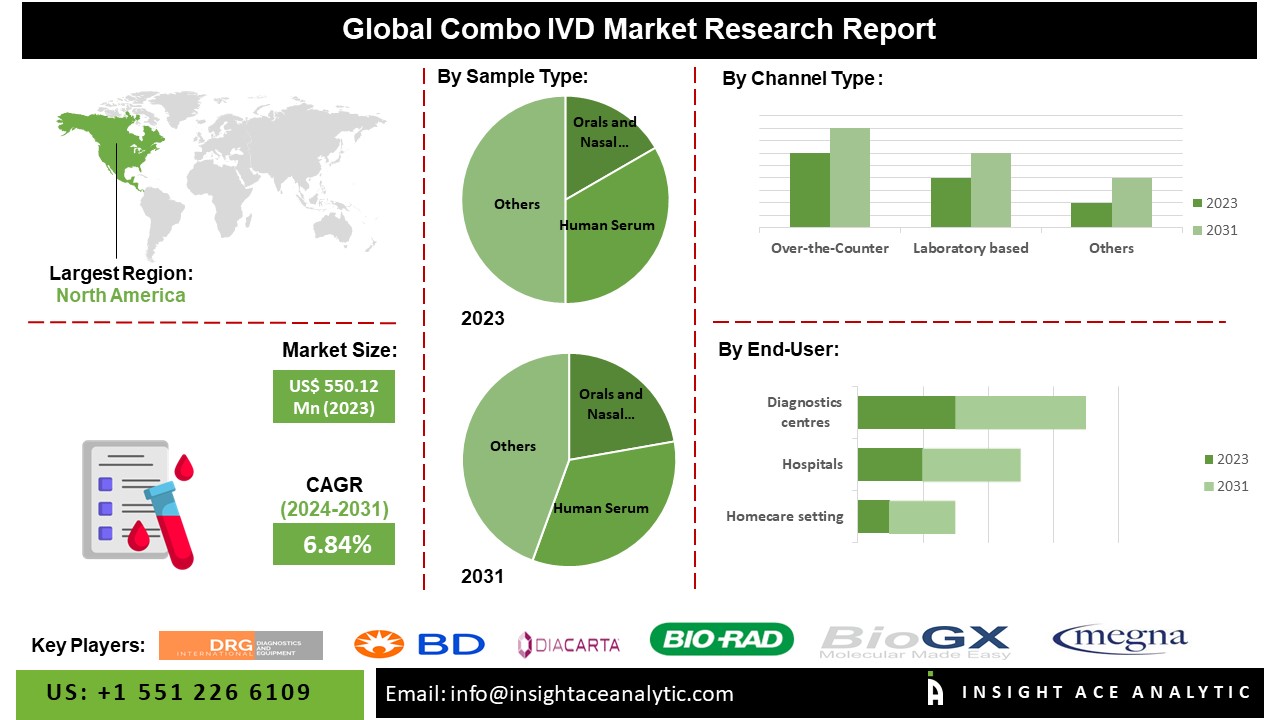
Combo in vitro diagnostics (IVDs) refers to medical tools that measure and analyze biological samples in a controlled environment. These tests are useful for detecting and monitoring a wide range of medical illnesses, including infectious disorders and autoimmune diseases. They are also sometimes used to look for changes in medication treatment. Growing numbers of people afflicted with infectious and chronic diseases are propelling the in vitro diagnostics industry forward. Modern workplaces are witnessing an alarming rising incidence of long-term health problems, including diabetes, cancer, heart disease, and tuberculosis. Infectious diseases, respiratory illnesses, and gastrointestinal issues have all seen significant increases in the number of people affected.
The increasing prevalence of these disorders is expected to fuel the demand for diagnostic equipment, which drives the IVD market. With better healthcare infrastructure, increased frequency of long-term health conditions, unmet healthcare needs, and the surge in demand for advanced in vitro diagnostic testing, the in vitro diagnostics market is anticipated to experience significant growth in untapped emerging markets. Furthermore, innovations in in vitro diagnostics are driving the market forward.
However, the market growth is hampered by the high-cost criteria for the safety and health of the combo IVD market and the product's inability to prevent fog in environments with dramatic temperature fluctuations or high combo IVD because of these equipment's high maintenance and operation costs. Professionals with the necessary training must also use in vitro diagnostic software. A further consequence is that the devices become more expensive to maintain, which slows down overall market expansion. The market for in-vitro diagnostics has been affected in different ways by the COVID-19 epidemic. Even though the pandemic immediately hampered research and laboratory operations, it ultimately brought attention to the need for RNA-based research and therapies.
Competitive Landscape
Some Major Key Players In The Combo IVD Market:
- DRG International Inc.
- Becton, Dickinson and Company
- DiaCarta Inc
- Abbott Laboratories
- bioMérieux SA4
- Bio-Rad Laboratories
- Alpha IVD Srl
- BioGX BV
- Thermo Fisher Scientific Inc.
- Megna Health Inc
- CTK Biotech, Inc.
- Biopanda Reagents Ltd
- Hoffmann-La Roche Ltd
- Hologic Inc
- Siemens AG
- Other Prominent Players
Market Segmentation:
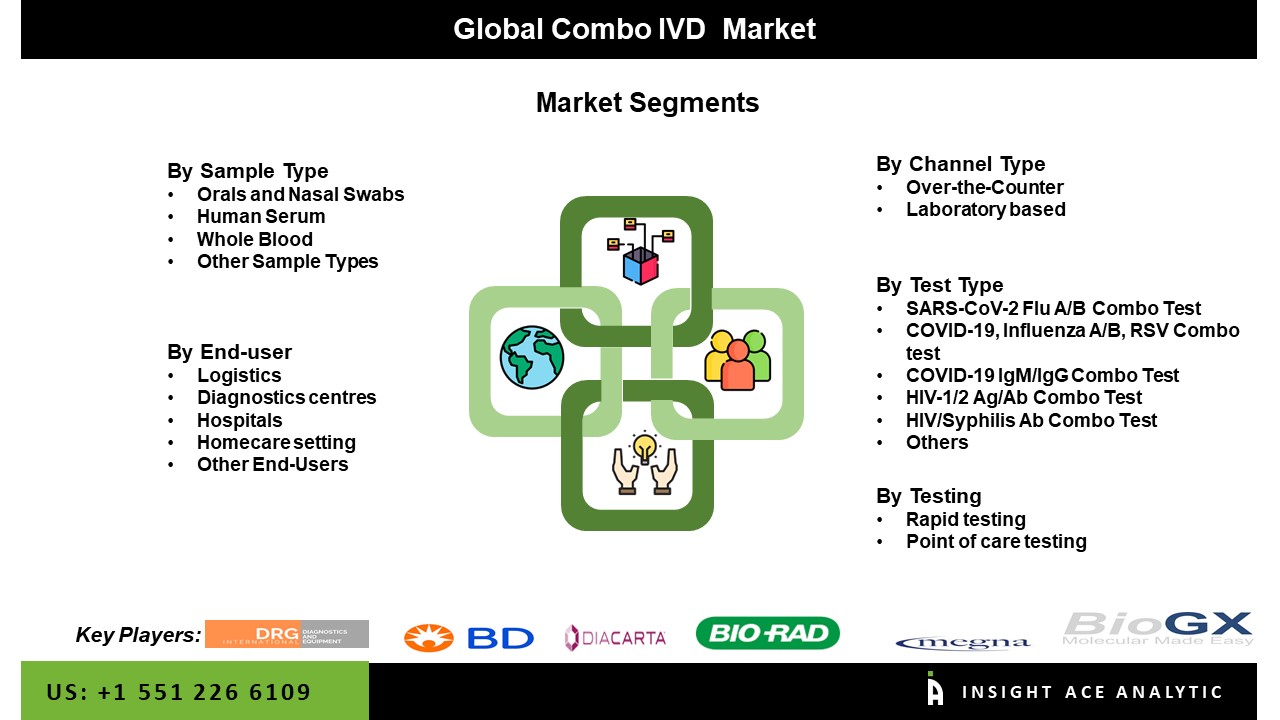
The combo IVD market is segmented based on test type, testing, end-user, channel, and sample type. According to test type segment, the market comprises SARS-CoV-2 Flu A/B Combo Test, COVID-19, Influenza A/B, RSV Combo test, COVID-19 IgM/IgG Combo Test, HIV-1/2 Ag/Ab Combo Test, HIV/Syphilis Ab Combo Test, HIV, HBsAg, HCV & Syphilis Combo, hCG Combo Test, Thrombophilia Detection Combo Test, and Other Test Types. Based on testing, the market is divided into rapid testing and point-of-care testing. By end-user segment, the market is categorised into diagnostic centres, hospitals, homecare settings, and other end-users. By channel, the market is segmented into over-the-counter and laboratory-based. By sample type, the market is segmented into oral and nasal swabs, human serum, whole blood, and other sample types.
Based On The Testing, The Point Of Care Testing Segment Is Accounted As A Major Contributor To The Combo IVD Market.
The point-of-care testing combo IVD market is expected to hold a major global market share. The rapid generation of results at the point of care testing can increase clinical or economic outcomes, allowing for the implementation of appropriate treatment. By utilizing point-of-care testing, the interdisciplinary team is able to acquire the most current and accurate data, resulting in an improved and practical medical portrait.
Hospital Segment To Witness Growth At A Rapid Rate.
In 2023, the hospital sector accounted for the highest proportion of income due to an increase in the number of hospitalizations that necessitate assistance from more efficient diagnostic methods. In addition, the ongoing growth of healthcare infrastructure and the positive actions taken by the government are expected to improve the current hospital facilities. This means that more people want IVD tests to be done in hospitals. Most IVD devices are bought and used by hospitals in large numbers.
In The Region, The North American Combo IVD Market Holds A Significant Revenue Share.
The North American combo IVD market is expected to lead with the highest market revenue share in the near future. It can be attributed to increasing supportive government policies and a robust diagnostic system. In addition, Asia Pacific is projected to grow rapidly in the global combo IVD market because of the improvement of healthcare facilities and the increasing presence of many target groups in this region.
Recent Developments:
- In Jan 2023, Bio-Rad Laboratories introduced the CFX Opus Deepwell Dx Real-Time PCR System. This system is a real-time PCR system that officially granted approval by the U.S. Food & Drug Administration (FDA) for in vitro diagnostic (IVD) testing. It has also been developed in compliance with the European Union's regulations for in vitro diagnostic medical devices.
- In June 2022, BD (Becton, Dickinson and Company) has notified the IVD directive 98/79/EC of the CE marking of the BD MAX™ Respiratory Viral Panel (RVP), a novel molecular diagnostic combination test that detects Respiratory Syncytial Virus (RSV), SARS-CoV-2, and Influenza A + B. A solitary nasal or nasopharyngeal biopsy sample was utilized in the test to ascertain whether a patient was infected with COVID-19, influenza, or RSV. This facilitated the prompt implementation of the appropriate treatment plan by clinicians and reduced the necessity for numerous tests or medical visits.
Combo IVD Market Report Scope
| Report Attribute | Specifications |
| Market Size Value In 2023 | USD 550.12 Mn |
| Revenue Forecast In 2031 | USD 920.86 Mn |
| Growth Rate CAGR | CAGR of 6.84% from 2024 to 2031 |
| Quantitative Units | Representation of revenue in US$ Mn and CAGR from 2024 to 2031 |
| Historic Year | 2019 to 2023 |
| Forecast Year | 2024-2031 |
| Report Coverage | The forecast of revenue, the position of the company, the competitive market structure, growth prospects, and trends |
| Segments Covered | By Test Type, By Testing, By End-User, By Channel, By Sample Type |
| Regional Scope | North America; Europe; Asia Pacific; Latin America; Middle East & Africa |
| Country Scope | U.S.; Canada; U.K.; Germany; China; India; Japan; Brazil; Mexico; France; Italy; Spain; South East Asia; South Korea |
| Competitive Landscape | DRG International Inc., Becton, Dickinson and Company, DiaCarta Inc, Abbott, bioMérieux SA4, Bio-Rad Laboratories, Alpha IVD Srl, BioGX BV, Thermo Fisher Scientific Inc., Megna Health Inc, CTK Biotech, Inc., Biopanda Reagents Ltd., F. Hoffmann-La Roche Ltd, Hologic Inc, Siemens AG and other prominent players. |
| Customization Scope | Free customization report with the procurement of the report and modifications to the regional and segment scope. Particular Geographic competitive landscape. |
| Pricing And Available Payment Methods | Explore pricing alternatives that are customized to your particular study requirements. |
Segmentation of Combo IVD Market-
Combo IVD Market By Sample Type-
- Orals and Nasal Swabs
- Human Serum
- Whole Blood
- Other Sample Types
Combo IVD Market By Channel-
- Over the Counter
- Laboratory based.
Combo IVD Market By Test Type-
- SARS-CoV-2 Flu A/B Combo Test
- COVID-19, Influenza A/B, RSV Combo test
- COVID-19 IgM/IgG Combo Test
- HIV-1/2 Ag/Ab Combo Test
- HIV/Syphilis Ab Combo Test
- HIV, HBsAg, HCV & Syphilis Combo
- hCG Combo Test
- Thrombophilia Detection Combo Test
- Other Test Types
Combo IVD Market By Testing -
- Rapid Testing
- Point Of Care Testing
Combo IVD Market By End-User-
- Diagnostics centres
- Hospitals
- Homecare setting
- Other End-Users
Combo IVD Market By Region-
North America-
- The US
- Canada
- Mexico
Europe-
- Germany
- The UK
- France
- Italy
- Spain
- Rest of Europe
Asia-Pacific-
- China
- Japan
- India
- South Korea
- Southeast Asia
- Rest of Asia Pacific
Latin America-
- Brazil
- Argentina
- Rest of Latin America
Middle East & Africa-
- GCC Countries
- South Africa
- Rest of the Middle East and Africa
Research Design and Approach
This study employed a multi-step, mixed-method research approach that integrates:
- Secondary research
- Primary research
- Data triangulation
- Hybrid top-down and bottom-up modelling
- Forecasting and scenario analysis
This approach ensures a balanced and validated understanding of both macro- and micro-level market factors influencing the market.
Secondary Research
Secondary research for this study involved the collection, review, and analysis of publicly available and paid data sources to build the initial fact base, understand historical market behaviour, identify data gaps, and refine the hypotheses for primary research.
Sources Consulted
Secondary data for the market study was gathered from multiple credible sources, including:
- Government databases, regulatory bodies, and public institutions
- International organizations (WHO, OECD, IMF, World Bank, etc.)
- Commercial and paid databases
- Industry associations, trade publications, and technical journals
- Company annual reports, investor presentations, press releases, and SEC filings
- Academic research papers, patents, and scientific literature
- Previous market research publications and syndicated reports
These sources were used to compile historical data, market volumes/prices, industry trends, technological developments, and competitive insights.

Primary Research
Primary research was conducted to validate secondary data, understand real-time market dynamics, capture price points and adoption trends, and verify the assumptions used in the market modelling.
Stakeholders Interviewed
Primary interviews for this study involved:
- Manufacturers and suppliers in the market value chain
- Distributors, channel partners, and integrators
- End-users / customers (e.g., hospitals, labs, enterprises, consumers, etc., depending on the market)
- Industry experts, technology specialists, consultants, and regulatory professionals
- Senior executives (CEOs, CTOs, VPs, Directors) and product managers
Interview Process
Interviews were conducted via:
- Structured and semi-structured questionnaires
- Telephonic and video interactions
- Email correspondences
- Expert consultation sessions
Primary insights were incorporated into demand modelling, pricing analysis, technology evaluation, and market share estimation.
Data Processing, Normalization, and Validation
All collected data were processed and normalized to ensure consistency and comparability across regions and time frames.
The data validation process included:
- Standardization of units (currency conversions, volume units, inflation adjustments)
- Cross-verification of data points across multiple secondary sources
- Normalization of inconsistent datasets
- Identification and resolution of data gaps
- Outlier detection and removal through algorithmic and manual checks
- Plausibility and coherence checks across segments and geographies
This ensured that the dataset used for modelling was clean, robust, and reliable.
Market Size Estimation and Data Triangulation
Bottom-Up Approach
The bottom-up approach involved aggregating segment-level data, such as:
- Company revenues
- Product-level sales
- Installed base/usage volumes
- Adoption and penetration rates
- Pricing analysis
This method was primarily used when detailed micro-level market data were available.

Top-Down Approach
The top-down approach used macro-level indicators:
- Parent market benchmarks
- Global/regional industry trends
- Economic indicators (GDP, demographics, spending patterns)
- Penetration and usage ratios
This approach was used for segments where granular data were limited or inconsistent.
Hybrid Triangulation Approach
To ensure accuracy, a triangulated hybrid model was used. This included:
- Reconciling top-down and bottom-up estimates
- Cross-checking revenues, volumes, and pricing assumptions
- Incorporating expert insights to validate segment splits and adoption rates
This multi-angle validation yielded the final market size.
Forecasting Framework and Scenario Modelling
Market forecasts were developed using a combination of time-series modelling, adoption curve analysis, and driver-based forecasting tools.
Forecasting Methods
- Time-series modelling
- S-curve and diffusion models (for emerging technologies)
- Driver-based forecasting (GDP, disposable income, adoption rates, regulatory changes)
- Price elasticity models
- Market maturity and lifecycle-based projections
Scenario Analysis
Given inherent uncertainties, three scenarios were constructed:
- Base-Case Scenario: Expected trajectory under current conditions
- Optimistic Scenario: High adoption, favourable regulation, strong economic tailwinds
- Conservative Scenario: Slow adoption, regulatory delays, economic constraints
Sensitivity testing was conducted on key variables, including pricing, demand elasticity, and regional adoption.
Request Customization
Add countries, segments, company profiles, or extend forecast — free 10% customization with purchase.
Customize This Report →Enquire Before Buying
Speak with our analyst team about scope, methodology, pricing, or deliverable formats.
Enquire Now →Frequently Asked Questions
Combo IVD Market Size is valued at USD 550.12 Mn in 2023 and is predicted to reach USD 920.86 Mn by the year 2031
Combo IVD Market is expected to grow at a 6.84% CAGR during the forecast period for 2024-2031.
CTK Biotech, Inc., Biopanda Reagents Ltd., F. Hoffmann-La Roche Ltd, Hologic Inc, Siemens AG and other prominent players.