Cancer Diagnostics Market Size, Share, Forecast Report 2026 to 2035
What is Cancer Diagnostics Market Size?
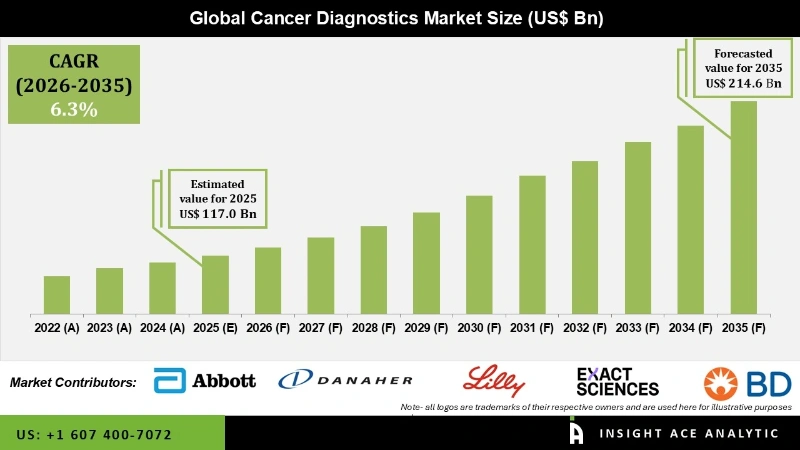
Global Cancer Diagnostics market Size is valued at 1USD 117.0 billion in 2025 and is predicted to reach USD 214.6 billion by the year 2035 at a 6.3% CAGR during the forecast period for 2026 to 2035.
Cancer Diagnostics Market Size, Share & Trends Analysis Report By Product (Consumables (Antibodies, Probes), Instruments (Pathology Instruments, Imaging Instruments, Biopsy), Technology (IVD Testing, imaging, and biopsy technology), Application (Breast Cancer, Lung Cancer), End User (Hospitals), By Region, And Segment Forecasts, 2026 to 2035.
Cancer Diagnostics Market Key Takeaways:
|
One of the essential factors of the Cancer Diagnostics market growth throughout the anticipated period is the rise in cancer cases worldwide. Diagnostic test technological developments are also anticipated to support industry expansion. Additionally, it is projected that supportive government measures and growing awareness will contribute to growth during the forecast period. For instance, the Biden-Harris administration has established a goal to improve the understanding of people living with and surviving cancers and reduce the cancer mortality rate by 50% over the next 25 years.
The prevalence of cancer has been rising at an alarming pace, making it one of the major causes of death worldwide. Healthcare professionals are concentrating on creating efficient screening and treatment solutions to monitor prevalence levels. The success of treatment plans is increased by early screening. As a result, healthcare organizations and industry participants are pushing regular checkups and screenings through various awareness campaigns. For instance, the HHS announced financing of USD 5 million in March 2022 to enhance equity in cancer screening at health centers.
Recent Developments:
- In November 2021, Magnetom Free was introduced by Siemens Healthineers. The Star whole-body MRI scanner was created to dramatically improve access to magnetic resonance imaging on a global scale.
Competitive Landscape:
Major key players in the Cancer Diagnostics market are:
- Abbott Laboratories,
- Agilent Technologies Inc.,
- AMOY Diagnostics Co Ltd.,
- Astellas Pharma Inc. (Japan)
- BD
- BiocartisNV,
- bioMérieux SA (France)
- Bristol-Myers Squibb Company (U.S.)
- Cancer Diagnostics Inc.,
- Danaher Corporation,
- DiagnoCure Inc. (Canada)
- DiaSorin S.P.A.,
- Excat Science
- Hoffmann-La Roche Ltd.
- FUJIFILM Corporation,
- GE Healthcare
- Genomic Health, Inc. (U.S.)
- GSK plc. (U.K.)
- Hologic, Inc.
- Illumina, Inc.
- Koninklijke Philips N.V. (Philips)
- Lilly (U.S.)
- Merck KGaA, (Germany)
- Myriad Genetics Inc.,
- Novartis AG (Switzerland)
- Pfizer, Inc. (U.S.)
- Qiagen N.V.
- Quest Diagnostics Incorporated. (U.S.)
- Quidel Corporation,
- Roche Diagnostics,
- Siemens Healthcare GmbH
- Thermo Fisher Scientific, Inc.
Market Segmentation:
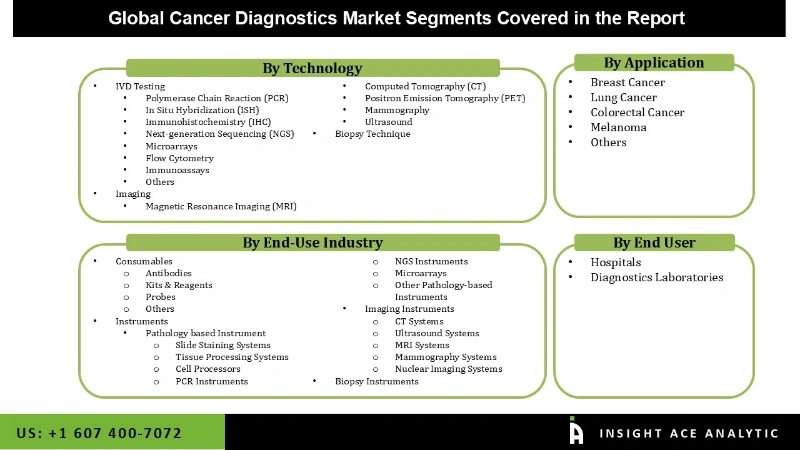
The Cancer Diagnostics market is segmented by product, technology, application, and end-user. Based on product, the market is segregated into consumables, instruments, imaging instruments, and biopsy instruments. By the technology, the market is segmented into IVD Testing, imaging, and biopsy technology. By application, the market is segmented as breast cancer, lung cancer, colorectal cancer, melanoma, and others. By end user, the market is further segmented into hospitals and diagnostics laboratories.
Based On Product, The Consumables Segment Is A Major Contributor To The Cancer Diagnostics Market
The consumables section held the largest share, and it is projected that it will remain in this position for the duration of the forecast. The segment is developing as a result of rising consumable usage, rising R&D costs, an increase in the number of elderly people, and the introduction of technologically sophisticated diagnostic kits and reagents.
IVD Testing Segment Witnessed Growth At A Rapid Rate
Due to reasons like the growing use of in-vitro diagnostics, IVD testing held the greatest proportion. The market is extending as a result of an increasing number of in vitro diagnostics products being introduced by key industry participants. For instance, Invitae introduced LiquidPlex Dx and FusionPlex Dx in Europe in February 2022. In Europe, patients will have easier access to cancer diagnostics thanks to the product launch. In addition, the completely automated Idylla GeneFusion Panel for non-small cell lung cancer was introduced by Biocartis Group NV in June 2022. Unlike more current testing procedures, which typically require days or even weeks to get findings, the panel is intended for use in clinical laboratories and delivers comprehensive test results in 180 minutes.
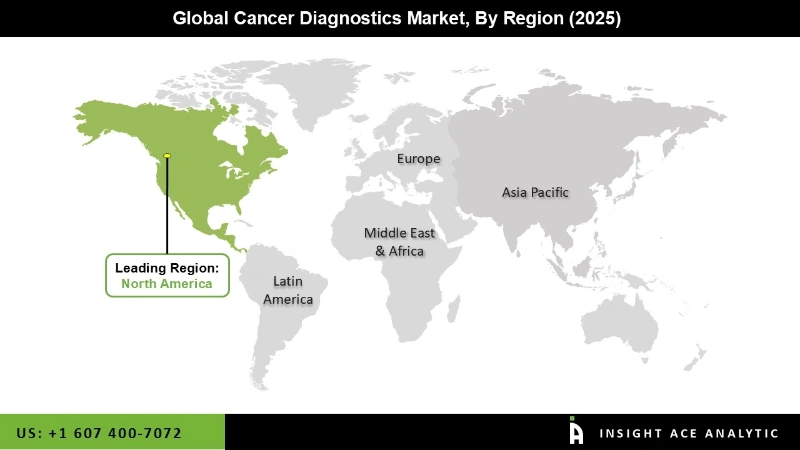
The North America Cancer Diagnostics Market Holds A Significant Revenue Share In The Region
The largest portion was held by North America. The market in this area is being driven by significant companies engaging in more strategic actions. For instance, Resolution Bioscience Inc. was purchased by Agilent in March 2021. The company's capabilities in NGS-based cancer diagnostics are expanded and complemented by the acquisition, which also equips the business with cutting-edge technology to meet the demands of the expanding precision medicine market.
Cancer Diagnostics Market Report Scope:
| Report Attribute | Specifications |
| Market size value in 2025 | USD 117.0 Bn |
| Revenue forecast in 2035 | USD 214.6 Bn |
| Growth rate CAGR | CAGR of 6.3% from 2026 to 2035 |
| Quantitative units | Representation of revenue in US$ Billion, and CAGR from 2026 to 2035 |
| Historic Year | 2022 to 2025 |
| Forecast Year | 2026-2035 |
| Report coverage | The forecast of revenue, the position of the company, the competitive market statistics, growth prospects, and trends |
| Segments covered | Product, Technology, Application, And End-User |
| Regional scope | North America; Europe; Asia Pacific; Latin America; Middle East & Africa |
| Country scope | U.S.; Canada; U.K.; Germany; China; Japan; Brazil; Mexico; France; Italy; Spain; China; India; South Korea; Southeast Asia |
| Competitive Landscape | GE Healthcare, Abbott Laboratories, Hologic Inc., Agilent Technologies Inc., Roche Diagnostics, FUJIFILM Corporation, Danaher Corporation, DiaSorin S.P.A., Myriad Genetics Inc., Siemens AG, BD, Cancer Diagnostics Inc., AMOY Diagnostics Co Ltd., Quidel Corporation, BiocartisNV, Excat Science. |
| Customization scope | Free customization report with the procurement of the report, Modifications to the regional and segment scope. Particular Geographic competitive landscape. |
| Pricing and available payment methods | Explore pricing alternatives that are customized to your particular study requirements. |
Segmentation of Cancer Diagnostics Market -
Cancer Diagnostics Market By Product-
- Consumables
- Antibodies
- Kits & Reagents
- Probes
- Others
- Instruments
- Pathology based Instrument
- Slide Staining Systems
- Tissue Processing Systems
- Cell Processors
- PCR Instruments
- NGS Instruments
- Microarrays
- Other Pathology-based Instruments
- Imaging Instruments
- CT Systems
- Ultrasound Systems
- MRI Systems
- Mammography Systems
- Nuclear Imaging Systems
- Biopsy Instruments
Cancer Diagnostics Market By Technology-
- IVD Testing
- Polymerase Chain Reaction (PCR)
- In Situ Hybridization (ISH)
- Immunohistochemistry (IHC)
- Next-generation Sequencing (NGS)
- Microarrays
- Flow Cytometry
- Immunoassays
- Others
- Imaging
- Magnetic Resonance Imaging (MRI)
- Computed Tomography (CT)
- Positron Emission Tomography (PET)
- Mammography
- Ultrasound
- Biopsy Technique
Cancer Diagnostics Market By Application-
- Breast Cancer
- Lung Cancer
- Colorectal Cancer
- Melanoma
- Others
Cancer Diagnostics Market By End User-
- Hospitals
- Diagnostics Laboratories
Cancer Diagnostics Market By Region-
North America-
- The US
- Canada
- Mexico
Europe-
- Germany
- The UK
- France
- Italy
- Spain
- Rest of Europe
Asia-Pacific-
- China
- Japan
- India
- South Korea
- South East Asia
- Rest of Asia Pacific
Latin America-
- Brazil
- Argentina
- Rest of Latin America
Middle East & Africa-
- GCC Countries
- South Africa
- Rest of Middle East and Africa
Research Design and Approach
This study employed a multi-step, mixed-method research approach that integrates:
- Secondary research
- Primary research
- Data triangulation
- Hybrid top-down and bottom-up modelling
- Forecasting and scenario analysis
This approach ensures a balanced and validated understanding of both macro- and micro-level market factors influencing the market.
Secondary Research
Secondary research for this study involved the collection, review, and analysis of publicly available and paid data sources to build the initial fact base, understand historical market behaviour, identify data gaps, and refine the hypotheses for primary research.
Sources Consulted
Secondary data for the market study was gathered from multiple credible sources, including:
- Government databases, regulatory bodies, and public institutions
- International organizations (WHO, OECD, IMF, World Bank, etc.)
- Commercial and paid databases
- Industry associations, trade publications, and technical journals
- Company annual reports, investor presentations, press releases, and SEC filings
- Academic research papers, patents, and scientific literature
- Previous market research publications and syndicated reports
These sources were used to compile historical data, market volumes/prices, industry trends, technological developments, and competitive insights.

Primary Research
Primary research was conducted to validate secondary data, understand real-time market dynamics, capture price points and adoption trends, and verify the assumptions used in the market modelling.
Stakeholders Interviewed
Primary interviews for this study involved:
- Manufacturers and suppliers in the market value chain
- Distributors, channel partners, and integrators
- End-users / customers (e.g., hospitals, labs, enterprises, consumers, etc., depending on the market)
- Industry experts, technology specialists, consultants, and regulatory professionals
- Senior executives (CEOs, CTOs, VPs, Directors) and product managers
Interview Process
Interviews were conducted via:
- Structured and semi-structured questionnaires
- Telephonic and video interactions
- Email correspondences
- Expert consultation sessions
Primary insights were incorporated into demand modelling, pricing analysis, technology evaluation, and market share estimation.
Data Processing, Normalization, and Validation
All collected data were processed and normalized to ensure consistency and comparability across regions and time frames.
The data validation process included:
- Standardization of units (currency conversions, volume units, inflation adjustments)
- Cross-verification of data points across multiple secondary sources
- Normalization of inconsistent datasets
- Identification and resolution of data gaps
- Outlier detection and removal through algorithmic and manual checks
- Plausibility and coherence checks across segments and geographies
This ensured that the dataset used for modelling was clean, robust, and reliable.
Market Size Estimation and Data Triangulation
Bottom-Up Approach
The bottom-up approach involved aggregating segment-level data, such as:
- Company revenues
- Product-level sales
- Installed base/usage volumes
- Adoption and penetration rates
- Pricing analysis
This method was primarily used when detailed micro-level market data were available.

Top-Down Approach
The top-down approach used macro-level indicators:
- Parent market benchmarks
- Global/regional industry trends
- Economic indicators (GDP, demographics, spending patterns)
- Penetration and usage ratios
This approach was used for segments where granular data were limited or inconsistent.
Hybrid Triangulation Approach
To ensure accuracy, a triangulated hybrid model was used. This included:
- Reconciling top-down and bottom-up estimates
- Cross-checking revenues, volumes, and pricing assumptions
- Incorporating expert insights to validate segment splits and adoption rates
This multi-angle validation yielded the final market size.
Forecasting Framework and Scenario Modelling
Market forecasts were developed using a combination of time-series modelling, adoption curve analysis, and driver-based forecasting tools.
Forecasting Methods
- Time-series modelling
- S-curve and diffusion models (for emerging technologies)
- Driver-based forecasting (GDP, disposable income, adoption rates, regulatory changes)
- Price elasticity models
- Market maturity and lifecycle-based projections
Scenario Analysis
Given inherent uncertainties, three scenarios were constructed:
- Base-Case Scenario: Expected trajectory under current conditions
- Optimistic Scenario: High adoption, favourable regulation, strong economic tailwinds
- Conservative Scenario: Slow adoption, regulatory delays, economic constraints
Sensitivity testing was conducted on key variables, including pricing, demand elasticity, and regional adoption.
Request Customization
Add countries, segments, company profiles, or extend forecast — free 10% customization with purchase.
Customize This Report →Enquire Before Buying
Speak with our analyst team about scope, methodology, pricing, or deliverable formats.
Enquire Now →Frequently Asked Questions
Cancer Diagnostics market Size is valued at 1USD 117.0 billion in 2025 and is predicted to reach USD 214.6 billion by the year 2035.
Cancer Diagnostics Market expected to grow at a 6.3% CAGR during the forecast period for 2026-2035
GE Healthcare, Abbott Laboratories, Hologic Inc., Agilent Technologies Inc., Roche Diagnostics, FUJIFILM Corporation, Danaher Corporation, DiaSorin S.
Cancer Diagnostics market is segmented by product, technology, application, and end-user, consumables, instruments, imaging instruments, and biopsy instruments.
North American region is leading the Cancer Diagnostics Market.