Bivalve Market Size, Share & Trends Analysis Report By Species (Clams, Cockles & Arkshells, Mussels, Oysters, Scallops, Pectens Oral), By Region, And By Segment Forecasts, 2025-2034
Share With :



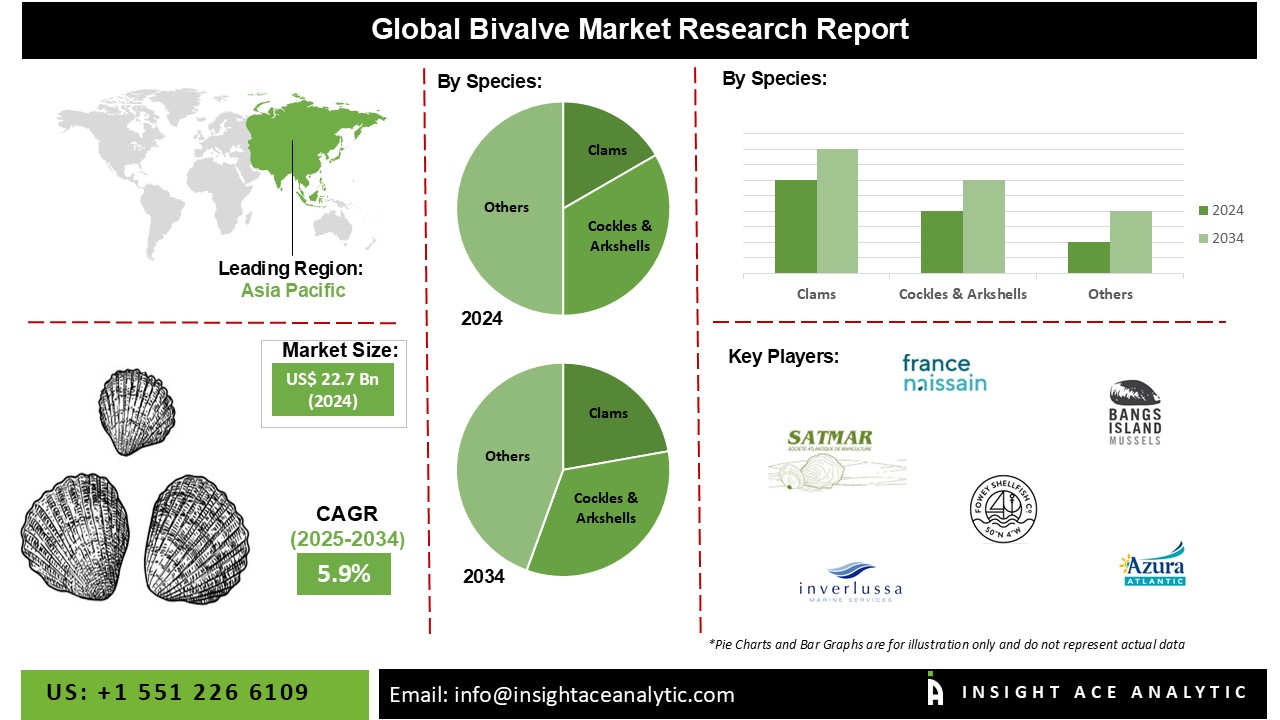
Global Bivalve Market Size is valued at USD 22.7 Billion in 2024 and is predicted to reach USD 39.8 Billion by the year 2034 at a 5.9% CAGR during the forecast period for 2025-2034.
Bivalves represent a taxonomic class within the phylum Mollusca, distinguished by their possession of bivalved shells that are often hinged and exhibit bilateral symmetry. The organisms in question are aquatic invertebrates belonging to the phylum Mollusca, characterized by their filter-feeding behaviour and possessing soft anatomical structures.
Clams, oysters, cockles, mussels, scallops, and many other marine and freshwater families are all included in this class. Most of them rely on filtered food only. Bivalves are characterized by their bilateral symmetry, laterally compressed bodies, flattened feet in the shape of a blade, small or absent heads, and lack of a radula.
The market for bivalves is expanding for many reasons. There has been a rise in the number of people looking for bivalves to satisfy their nutritional needs. More and more people are turning to aquaculture to get their bivalves. Developing economies have a growing appetite for bivalves. Invention of cutting-edge uses for and creations involving bivalves. Omega-3 fatty acids, vital for human health and favourable to cardiovascular health, are abundant in bivalves. Over the projected period, the bivalve market's revenue will rise substantially as market players develop and release new products.
However, low demand in many countries, coastal contamination leading to poor water quality, and expanding limits from ocean acidification are only some challenges that mollusk farming must overcome. Despite efforts to expand mussel farming into the open sea, the industry still has high production costs, little output, and mostly serves niche luxury markets. In addition, the lockdown led to a surge in demand for non-food items, including soap, paper towels, and hand sanitiser.
The demand for bivalvia was high before the spread of COVID-19. Farmers of bivalves kept their stock afloat throughout the COVID-19 pandemic, hoping for a favourable trading climate. Due to a shortage of workers, mass production shutdowns, and supply chain disruptions, many manufacturers halted operations, leading to a corresponding increase in demand for food products such as fish, meat, and many others.
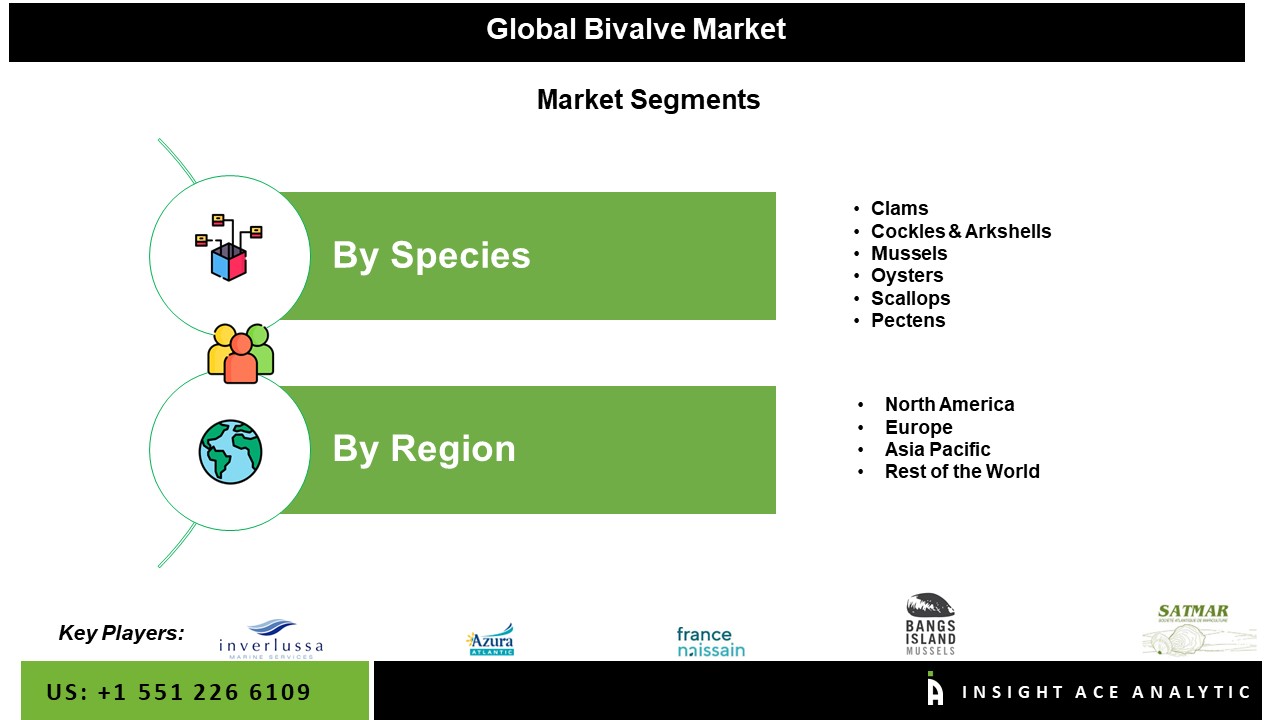
The bivalve market is segmented based on species. According to species, the market is segmented into clams, cockles & ark shells, mussels, oysters, scallops, and pectins.
The oyster bivalve category is expected to hold a major global market share in 2022. Due to the major content of omega-3 fatty acids, vitamin C, minerals, zinc, copper, niacin, and riboflavin, oysters help with muscular building, cardiovascular health, bone strength, immunity, and weight loss. Market expansion is fueled by expanding consumer preferences for bivalves and thick-shelled seafood variation and the increasing prevalence of intercontinental food trends. Oysters come in a wide variety, and the ability to guarantee consistent quality is thought to be a major factor in the industry's projected expansion.
The cockles & ark shells segment is projected to grow rapidly in the global bivalve market. Cockles and ark shells are a great way to get protein, vitamins, minerals, and omega-3 fatty acids. Therefore, they alleviate acid indigestion, heartburn, and abdominal pain and reduce cancer risks, especially in countries like the US, Germany, the UK, China, and India.
The Asia Pacific bivalve market is expected to record the maximum market share in revenue in the near future. It may help to the growing popularity of bivalves as a healthy and sustainable food source, the rising demand for bivalves as a whole food source, the rising popularity of bivalve aquaculture, and the rising need for bivalves in emerging markets all contribute to the high demand for bivalves in the region.
The market's growth is expected to continue during the projected period because of the increased spending on bivalve product initiatives. In addition, Europe is estimated to grow rapidly in the global bivalve market because of increased disposable income, awareness of seafood's health benefits, overall population growth, and rising healthcare expenses.
| Report Attribute | Specifications |
| Market Size Value In 2024 | USD 22.7 Billion |
| Revenue Forecast In 2034 | USD 39.8 Billion |
| Growth Rate CAGR | CAGR of 5.9% from 2025 to 2034 |
| Quantitative Units | Representation of revenue in US$ Bn and CAGR from 2025 to 2034 |
| Historic Year | 2021 to 2024 |
| Forecast Year | 2025-2034 |
| Report Coverage | The forecast of revenue, the position of the company, the competitive market structure, growth prospects, and trends |
| Segments Covered | By Species |
| Regional Scope | North America; Europe; Asia Pacific; Latin America; Middle East & Africa |
| Country Scope | U.S.; Canada; U.K.; Germany; China; India; Japan; Brazil; Mexico; The UK; France; Italy; Spain; China; Japan; India; South Korea; South East Asia; South Korea; South East Asia |
| Competitive Landscape | France Naissain, Satmar, Bang Island Mussels, Fowey Shellfish Company Ltd, Menai Oysters Limited, Inverlussa Marine Services, Azura Atlantic, and Oceano Fresco, S.A., Blue Harvest Fisheries LLC, Camanchaca SA, Dongwon Group, Pacific Seafood Group, FCF Fishery Co. Ltd., Future SeaFoods Inc., Glenmar Shellfish Ltd., Gortons Inc., High Liner Foods Inc., Joe Pattis Seafood Co., Ocean Choice International, PEI Mussel King, Taylor Shellfish Farms Inc., Thai Union Group PCL, The Great Little Harbour Seafood Co. |
| Customization Scope | Free customization report with the procurement of the report, Modifications to the regional and segment scope. Particular Geographic competitive landscape. |
| Pricing And Available Payment Methods | Explore pricing alternatives that are customized to your particular study requirements. |
Bivalve Market By Species -
Bivalve Market By Region-
North America-
Europe-
Asia-Pacific-
Latin America-
Middle East & Africa-
This study employed a multi-step, mixed-method research approach that integrates:
This approach ensures a balanced and validated understanding of both macro- and micro-level market factors influencing the market.
Secondary research for this study involved the collection, review, and analysis of publicly available and paid data sources to build the initial fact base, understand historical market behaviour, identify data gaps, and refine the hypotheses for primary research.
Secondary data for the market study was gathered from multiple credible sources, including:
These sources were used to compile historical data, market volumes/prices, industry trends, technological developments, and competitive insights.

Primary research was conducted to validate secondary data, understand real-time market dynamics, capture price points and adoption trends, and verify the assumptions used in the market modelling.
Primary interviews for this study involved:
Interviews were conducted via:
Primary insights were incorporated into demand modelling, pricing analysis, technology evaluation, and market share estimation.
All collected data were processed and normalized to ensure consistency and comparability across regions and time frames.
The data validation process included:
This ensured that the dataset used for modelling was clean, robust, and reliable.
The bottom-up approach involved aggregating segment-level data, such as:
This method was primarily used when detailed micro-level market data were available.

The top-down approach used macro-level indicators:
This approach was used for segments where granular data were limited or inconsistent.
To ensure accuracy, a triangulated hybrid model was used. This included:
This multi-angle validation yielded the final market size.
Market forecasts were developed using a combination of time-series modelling, adoption curve analysis, and driver-based forecasting tools.
Given inherent uncertainties, three scenarios were constructed:
Sensitivity testing was conducted on key variables, including pricing, demand elasticity, and regional adoption.