



Global Bio-based Pigments and Dyes Market Size is valued at USD 32.7 Bn in 2024 and is predicted to reach USD 48.8 Bn by the year 2034 at a 4.2% CAGR during the forecast period for 2025-2034.
Biologic pigments and dyes are organic colorants derived from plants. People can get them from all renewable resources: plants, fruits, and vegetables. Compared to synthetic pigments and dyes derived from fossil fuels, those derived from bio-based resources are more sustainable and have extended shelf life. Their widespread use is seen in numerous industries, including textiles, printing inks, paints & coatings, and cosmetics. Increased consumer interest in sustainable and environmentally friendly products is fueling the rapid expansion of the bio-based pigments and dyes industry.

The market is defined by the increasing use of bio-based pigments and dyes in a wide range of products, such as textiles, coatings, and printing inks. To satisfy the increasing demand for eco-friendly products, manufacturers emphasize developing novel, high-performance bio-based pigments and dyes. Furthermore, sustainability has become more important as customers become more aware of the need to protect the environment. Plant-based pigments and dyes are gaining popularity in several sectors as a sustainable and less harmful substitute for traditional synthetic colorants.
However, the market growth is hampered by the lack of awareness criteria for the safety and health of the bio-based pigments and dyes market. The product's inability to prevent fog in environments with dramatic temperature fluctuations or high bio-based pigments and dyes is because of the extensive procedures needed for their extraction; pigments and dyes derived from biological sources tend to be more costly than their synthetic equivalents. Their production cost is higher, which makes them less attractive in price-sensitive markets. Due to the COVID-19 pandemic, Producing and distributing bio-based pigments and dyes has been affected by the pandemic's disruption of worldwide supply networks and industrial operations. There have been delays and interruptions in the supply chain due to the difficulties caused by international trade and transportation limitations.
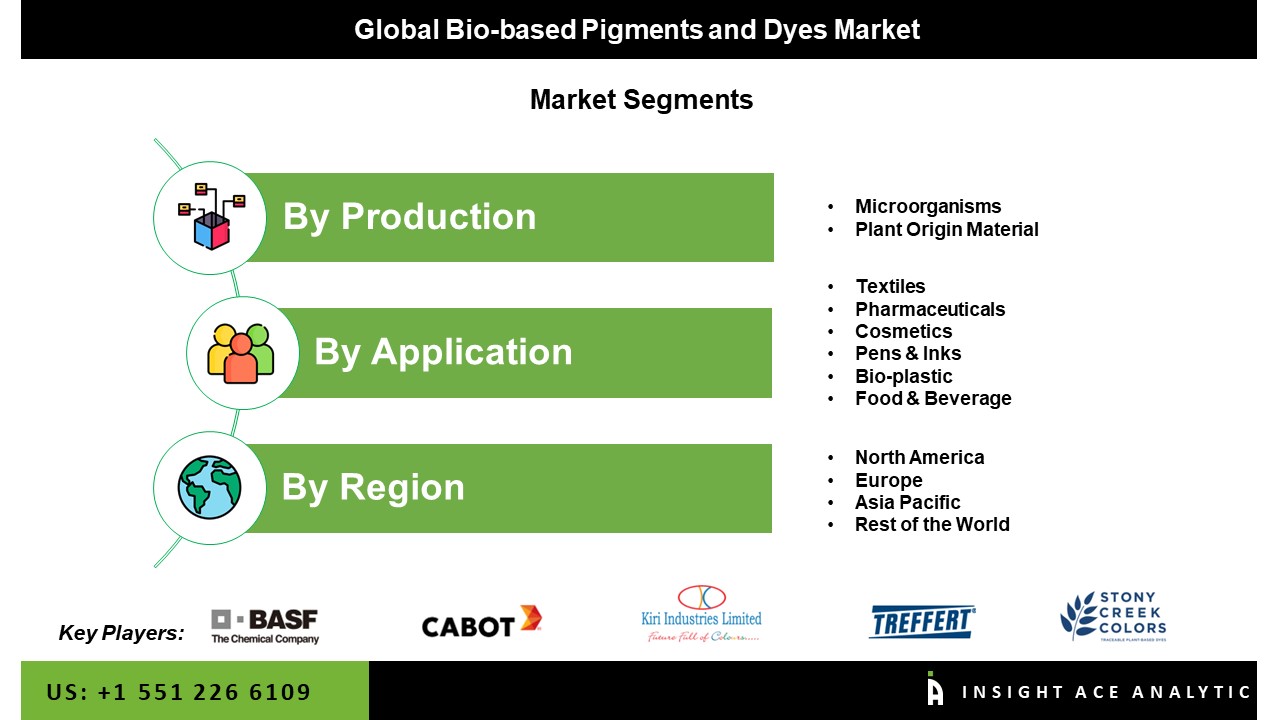
The bio-based pigments and dyes market is segmented based on production and application. Based on production, the market is segmented into microorganisms and plant origin material. Microorganisms segment further sub-segmented into algae, fungi/fungus and bacteria. By application, the market is segmented into textiles, pharmaceuticals, cosmetics, pens & ink, bioplastic, and food & beverage.
Microorganisms' bio-based pigments and dyes market is expected to hold a major global market share in 2022. Microbes produce valuable pigments in the food industry, including carotenoids, melanins, and violaceus, used to color foods. The desire to transition from synthetic to natural food colors drives the demand for microbial pigments. Beverages and foods that undergo fermentation use microorganisms in their manufacturing. There is evidence that microbes and higher creatures engage in symbiotic relationships.
The textile industry makes up the bulk of ester usage because bio-based colorants in textile production have been prompted by the growing demand for organic and environmentally conscious fabrics, especially in countries like the US, Germany, the UK, China, and India.
The North American bio-based pigments and dyes market is expected to register the highest market share in revenue in the near future. It can be attributed to the increased pace of population expansion and the surge in biotechnology research. In addition, Asia Pacific is projected to grow rapidly in the global bio-based pigments and dyes market because of high demand from the region's textile, construction, and automotive sectors. The availability of dyes and pigments has also been boosted by supportive government programs that aim to boost the indigenous chemical sector.
| Report Attribute | Specifications |
| Market Size Value In 2024 | USD 32.7 Bn |
| Revenue Forecast In 2034 | USD 48.8 Bn |
| Growth Rate CAGR | CAGR of 4.2% from 2025 to 2034 |
| Quantitative Units | Representation of revenue in US$ Bn, Volume (KT) and CAGR from 2025 to 2034 |
| Historic Year | 2021 to 2024 |
| Forecast Year | 2025-2034 |
| Report Coverage | The forecast of revenue, the position of the company, the competitive market structure, growth prospects, and trends |
| Segments Covered | By Production, By Application, By Region |
| Regional Scope | North America; Europe; Asia Pacific; Latin America; Middle East & Africa |
| Country Scope | U.S.; Canada; U.K.; Germany; China; India; Japan; Brazil; Mexico; France; Italy; Spain; Southeast Asia; South Korea |
| Competitive Landscape | BASF SE, Cabot Corporation, Clariant, Horizon Research Lab, Huntsman Corporation, Kiri Industries, Kronos Worldwide, Pili, Sea Colors, Stony Creek Colors, Sudarshan Chemical, and Treffert |
| Customization Scope | Free customization report with the procurement of the report and modifications to the regional and segment scope. Particular Geographic competitive landscape. |
| Pricing And Available Payment Methods | Explore pricing alternatives that are customized to your particular study requirements. |
Bio-based Pigments and Dyes Market- By Production
Bio-based Pigments and Dyes Market- By Application
Bio-based Pigments and Dyes Market- By Region
North America-
Europe-
Asia-Pacific-
Latin America-
Middle East & Africa-
This study employed a multi-step, mixed-method research approach that integrates:
This approach ensures a balanced and validated understanding of both macro- and micro-level market factors influencing the market.
Secondary research for this study involved the collection, review, and analysis of publicly available and paid data sources to build the initial fact base, understand historical market behaviour, identify data gaps, and refine the hypotheses for primary research.
Secondary data for the market study was gathered from multiple credible sources, including:
These sources were used to compile historical data, market volumes/prices, industry trends, technological developments, and competitive insights.

Primary research was conducted to validate secondary data, understand real-time market dynamics, capture price points and adoption trends, and verify the assumptions used in the market modelling.
Primary interviews for this study involved:
Interviews were conducted via:
Primary insights were incorporated into demand modelling, pricing analysis, technology evaluation, and market share estimation.
All collected data were processed and normalized to ensure consistency and comparability across regions and time frames.
The data validation process included:
This ensured that the dataset used for modelling was clean, robust, and reliable.
The bottom-up approach involved aggregating segment-level data, such as:
This method was primarily used when detailed micro-level market data were available.

The top-down approach used macro-level indicators:
This approach was used for segments where granular data were limited or inconsistent.
To ensure accuracy, a triangulated hybrid model was used. This included:
This multi-angle validation yielded the final market size.
Market forecasts were developed using a combination of time-series modelling, adoption curve analysis, and driver-based forecasting tools.
Given inherent uncertainties, three scenarios were constructed:
Sensitivity testing was conducted on key variables, including pricing, demand elasticity, and regional adoption.