Beer Processing Market Size, Share, Revenue Report 2026 to 2035
What is Beer Processing Market Size?
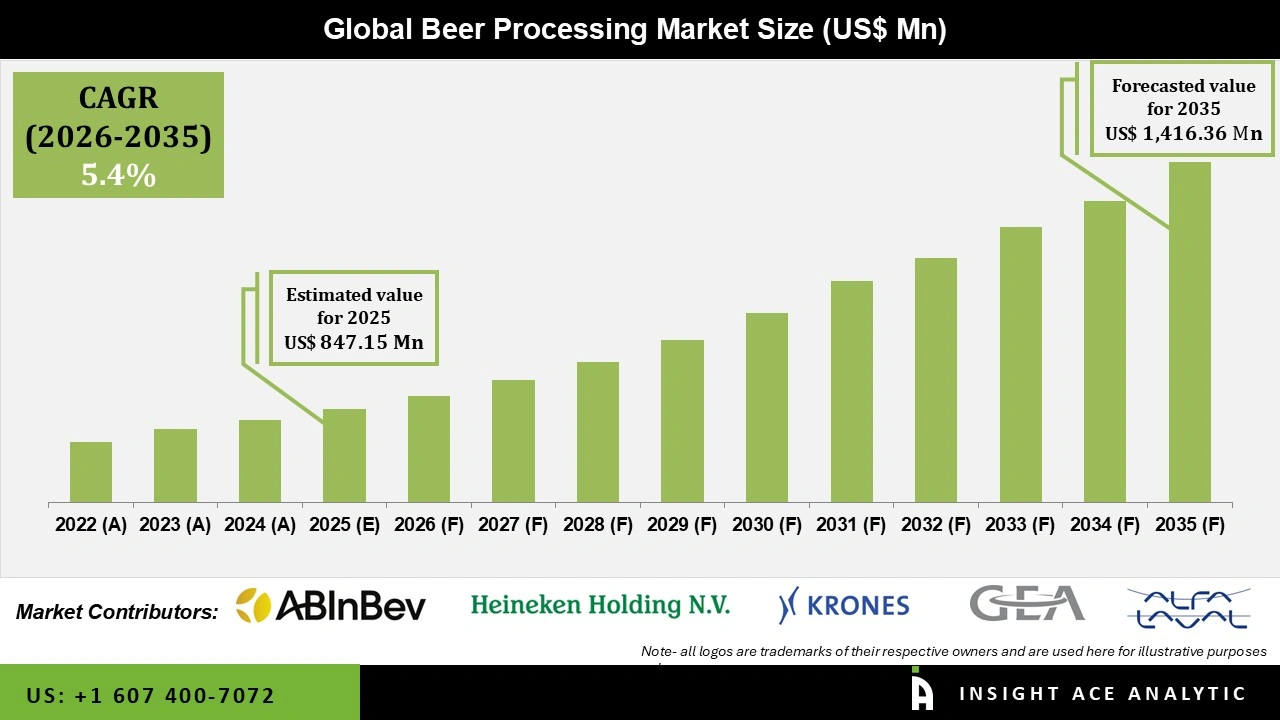
Global Beer Processing Market Size is valued at USD 847.15 Million in 2025 and is predicted to reach USD 1,416.36 Million by the year 2035 at a 5.4% CAGR during the forecast period for 2026 to 2035.
Beer Processing Market Size, Share & Trends Analysis Report By Brewery Type (Macrobrewery, Craft Brewery, Microbrewery, Brewpub), Beer Type (Lager, Ale And Stout, Specialty Beer And Low Alcohol Beer), By Equipment Type, By Price Category, By Distribution Channel, By Region, And Segment Forecasts, 2026 to 2035
Beer Processing Market Key Takeaways:
|
Key Industry Insights & Findings from the Report:
- The major driving factors for the growth of the beer processing industry include an increase in the variety of microbrewers and advancements in the beer processing industry.
- The global beer processing market is segmented into macro brewery equipment and craft brewery equipment. The macro brewery equipment segment is sub-segmented into milling equipment, brew house, cooling equipment, fermentation equipment, filtration and filling equipment, and others.
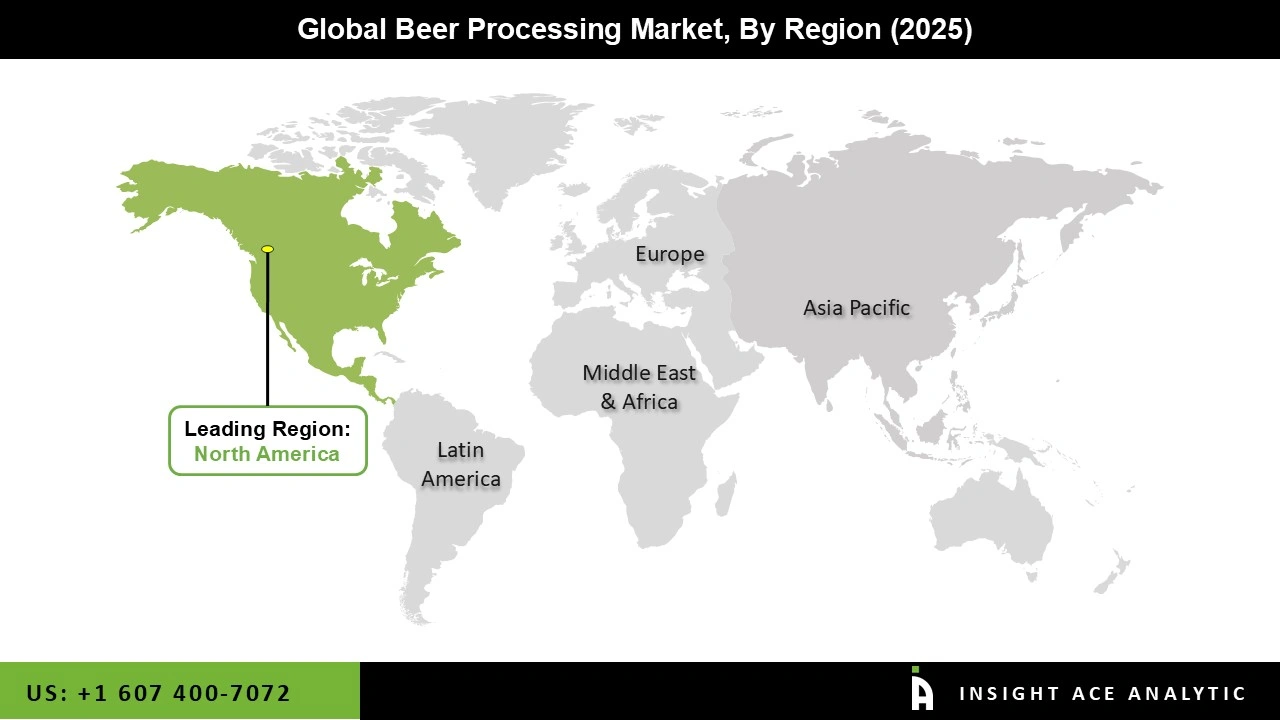
- North America dominated the market and accounted for a revenue share of global revenue in 2025.
- The study has considered the Global Beer Processing Market strategic analysis with respect to individual growth trends and future prospects, along with the contribution of various sub-market stakeholders.
One of the oldest drinks is beer, an alcoholic beverage. Beer is a famous beverage that is produced by fermenting a number of grains, including wheat, rye, and barley, with yeast and water. Increased personal disposable income and the growing popularity of low-alcohol, no-alcohol, and organic beers are the main drivers of the beer processing market's expansion. Other significant factors that influence the growth of the beer processing market are ongoing improvements in brewery equipment and the development and expansion of the beverage sector. Numerous craft brewers, including brewpubs and microbreweries, as well as increasing product innovations by manufacturers, will further foster the market's profitable growth prospects.
A strong marketing strategy and more promotional efforts will both help drive up market value. However, the market's expansion will be significantly hampered by the high energy and maintenance costs involved with beer processing machinery. The development pace of the beer processing market would be further slowed down by high taxes and excise levies. Growing health consciousness will further limit market expansion potential.
Recent Developments:
- In May 2023, Heineken planed to allocate 1.5 billion reais ($300.8 million) in Brazil to expand its premium and single malt beer offerings. According to a statement from the firm, the intended investment is designed to enhance the brewer's manufacturing capabilities for its Amstel, Devassa, and Heineken brands. This investment will be allocated to two facilities located in northeast Brazil.
- In May 2022, Anheuser-Busch InBev released Seven Rivers, a brand-new beer, in the Indian market. The brands Budweiser, Corona Extra, and Hoegaarden are all equivalent to this one.
Competitive Landscape:
Some of the major key players in the Beer Processing Market are:
- Anheuser-Busch InBev
- Heineken N.V.
- United Breweries
- China Resources Snow Breweries Limited
- Alfa Laval
- GEA Group
- Krones
- Ningbo Lehui International Engineering Equipment Co Ltd
- Yanjing Brewery
- The Boston Beer Company, Inc.
- Carlsberg Group
- Dogfish Head Craft Brewery
- Diageo PLC
- Sierra Nevada Brewing Co.
- Squatters Pub
- United Breweries Group
- Praj Industries
- Paul Mueller Company
- LEHUI
- TSINGTAO BEER
- Asahi Group Holdings, Ltd.
- Molson Coors Brewing Company
Market Segmentation:
The Beer Processing Market is segmented on the basis of equipment type, brewery type, beer type, price category and distribution channel. The market is segmented based on equipment type: Macrobrewery equipment (Milling equipment, Brewhouse (Mash kettles, Lauter tun, Wort kettles, Whirlpoolers, Steam generators, Others (hot liquor tanks and cold-water tanks, laboratory equipment, and aeration devices)) Cooling equipment, Fermentation equipment, Filtration & filing equipment, Others (cleaning systems, spent grain silos, generators, bright beer tanks, compressors, and pipes) and Craft brewery equipment (Mashing equipment, Fermentation equipment, Cooling equipment, Storage equipment, Compressors, Others (pumps, filters, and separators)). By brewery type, the market is segmented into Macrobrewery, Craft brewery, Microbrewery, Brewpub and Others (farm breweries and regional breweries). It is further divided into Lager, Ale and Stout, Specialty Beer and Low Alcohol Beer based on beer type. Based on price category, the market is segmented into Mainstream, Discount, Premium and super-premium. Based on the sales channel, the market is segmented into off-trade and on-trade.
Based on beer type, the lager segment is a major contributor to the Beer Processing Market
Beer made with bottom-fermenting yeast is known as lager. More sugar can stay in the mixture. As a result, making the beer smoother and sweeter. To gain more clarity and a better flavor, it also goes through a cold conditioning procedure that other foods do not. This beer is the most popular among customers because it has a more superior sugar content, slower fermentation, and cold treatment, which result in a lighter, clearer appearance, lower alcohol level, and a sweeter, smoother, and crisper flavor.
The Macrobrewery segment witnessed growth at a rapid rate
Large breweries, known as macrobreweries, produce more than 6,000,000 barrels of beer annually. The macrobrewery equipment sector represented a sizeable portion of the worldwide brewery equipment market due to macrobreweries' more enormous capacities and a greater number of facilities. Due to its uniform flavour and quality, beer from major companies continues to be preferred by the majority of customers over artisan beer.
The North America Beer Processing Market holds a significant revenue share in the region.
Over the forecast period, the North American region is expected to develop at the highest CAGR of 7.2%. The expansion results from growing beer producers' investments in nations like Mexico and the United States. Due to the great availability of raw materials and the high demand for various beers, the country of Mexico represents the market with the highest growth potential for beer processing.
The growth is primarily attributable to rising disposable income in the region and the rising popularity of beer in the nations of the Asia Pacific due to an increase in demand from countries like China and India. The number of young people who enjoy beer is growing, which has led to considerable growth in beer consumption in India. The consumption of premium and high-quality beers has also been aided by the significant increase in the region's working-class population and an increase in disposable income.
Beer Processing Market Report Scope :
| Report Attribute | Specifications |
| Market size value in 2025 | USD 847.15 Million |
| Revenue forecast in 2035 | USD 1,416.36 Million |
| Growth rate CAGR | CAGR of 5.4% from 2026 to 2035 |
| Quantitative units | Representation of revenue in US$ Million, and CAGR from 2026 to 2035 |
| Historic Year | 2022 to 2025 |
| Forecast Year | 2026-2035 |
| Report coverage | The forecast of revenue, the position of the company, the competitive market structure, growth prospects, and trends |
| Segments covered | Brewery Type, Equipment Type, Beer Type, Price Category and Distribution Channel |
| Regional scope | North America; Europe; Asia Pacific; Latin America; Middle East & Africa |
| Country scope | U.S.; Canada; U.K.; Germany; China; India; Japan; Brazil; Mexico; The UK; France; Italy; Spain; South Korea; South East Asia |
| Competitive Landscape | Anheuser-Busch InBev (Belgium), Heineken N.V. (Netherlands), United Breweries (India), China Resources Snow Breweries Limited (China), Alfa Laval (Sweden), GEA Group (Germany), Krones (Germany), Ningbo Lehui International Engineering Equipment Co Ltd (China)., Molson Coors Brewing Company, Yanjing Brewery, The Boston Beer Company, Inc., Carlsberg Group, Dogfish Head Craft Brewery, Diageo PLC, Sierra Nevada Brewing Co., LEHUI, Squatters Pub, United Breweries Group, Praj Industries, and Paul Mueller Company |
| Customization scope | Free customization report with the procurement of the report, Modifications to the regional and segment scope. Particular Geographic competitive landscape. |
| Pricing and available payment methods | Explore pricing alternatives that are customized to your particular study requirements. |
Segmentation of Beer Processing Market :
Beer Processsing Market, By Brewery Type-
- Macrobrewery
- Craft brewery
- Microbrewery
- Brewpub
- Others (farm breweries and regional breweries)

Beer Processsing Market, By Equipment Type-
- Macrobrewery equipment
- Milling equipment
- Brewhouse
- Mash kettles
- Lauter tun
- Wort kettles
- Whirlpoolers
- Steam generators
- Others (hot liquor tanks and cold-water tanks, laboratory equipment, and aeration devices)
- Cooling equipment
- Fermentation equipment
- Filtration & filing equipment
- Others (cleaning systems, spent grain silos, generators, bright beer tanks, compressors, and pipes)
- Craft brewery equipment
- Mashing equipment
- Fermentation equipment
- Cooling equipment
- Storage equipment
- Compressors
- Others (pumps, filters, and separators)
Beer Processsing Market, By Beer Type-
- Lager
- Ale and Stout
- Specialty Beer
- Low Alcohol Beer
Beer Processsing Market, By Price Category-
- Mainstream
- Discount
- Premium
- Super-premium
Beer Processsing Market, By Distribution channel-
- Off-trade
- On-trade
Beer Processsing Market, By Region-
- North America-
- The US
- Canada
- Europe-
- Germany
- The UK
- France
- Italy
- Spain
- Rest of Europe
- Asia-Pacific-
- China
- Japan
- India
- South Korea
- South East Asia
- Rest of Asia Pacific
- Latin America-
- Brazil
- Argentina
- Mexico
- Rest of Latin America
- Middle East & Africa-
- GCC Countries
- South Africa
- Rest of Middle East and Africa
Research Design and Approach
This study employed a multi-step, mixed-method research approach that integrates:
- Secondary research
- Primary research
- Data triangulation
- Hybrid top-down and bottom-up modelling
- Forecasting and scenario analysis
This approach ensures a balanced and validated understanding of both macro- and micro-level market factors influencing the market.
Secondary Research
Secondary research for this study involved the collection, review, and analysis of publicly available and paid data sources to build the initial fact base, understand historical market behaviour, identify data gaps, and refine the hypotheses for primary research.
Sources Consulted
Secondary data for the market study was gathered from multiple credible sources, including:
- Government databases, regulatory bodies, and public institutions
- International organizations (WHO, OECD, IMF, World Bank, etc.)
- Commercial and paid databases
- Industry associations, trade publications, and technical journals
- Company annual reports, investor presentations, press releases, and SEC filings
- Academic research papers, patents, and scientific literature
- Previous market research publications and syndicated reports
These sources were used to compile historical data, market volumes/prices, industry trends, technological developments, and competitive insights.

Primary Research
Primary research was conducted to validate secondary data, understand real-time market dynamics, capture price points and adoption trends, and verify the assumptions used in the market modelling.
Stakeholders Interviewed
Primary interviews for this study involved:
- Manufacturers and suppliers in the market value chain
- Distributors, channel partners, and integrators
- End-users / customers (e.g., hospitals, labs, enterprises, consumers, etc., depending on the market)
- Industry experts, technology specialists, consultants, and regulatory professionals
- Senior executives (CEOs, CTOs, VPs, Directors) and product managers
Interview Process
Interviews were conducted via:
- Structured and semi-structured questionnaires
- Telephonic and video interactions
- Email correspondences
- Expert consultation sessions
Primary insights were incorporated into demand modelling, pricing analysis, technology evaluation, and market share estimation.
Data Processing, Normalization, and Validation
All collected data were processed and normalized to ensure consistency and comparability across regions and time frames.
The data validation process included:
- Standardization of units (currency conversions, volume units, inflation adjustments)
- Cross-verification of data points across multiple secondary sources
- Normalization of inconsistent datasets
- Identification and resolution of data gaps
- Outlier detection and removal through algorithmic and manual checks
- Plausibility and coherence checks across segments and geographies
This ensured that the dataset used for modelling was clean, robust, and reliable.
Market Size Estimation and Data Triangulation
Bottom-Up Approach
The bottom-up approach involved aggregating segment-level data, such as:
- Company revenues
- Product-level sales
- Installed base/usage volumes
- Adoption and penetration rates
- Pricing analysis
This method was primarily used when detailed micro-level market data were available.

Top-Down Approach
The top-down approach used macro-level indicators:
- Parent market benchmarks
- Global/regional industry trends
- Economic indicators (GDP, demographics, spending patterns)
- Penetration and usage ratios
This approach was used for segments where granular data were limited or inconsistent.
Hybrid Triangulation Approach
To ensure accuracy, a triangulated hybrid model was used. This included:
- Reconciling top-down and bottom-up estimates
- Cross-checking revenues, volumes, and pricing assumptions
- Incorporating expert insights to validate segment splits and adoption rates
This multi-angle validation yielded the final market size.
Forecasting Framework and Scenario Modelling
Market forecasts were developed using a combination of time-series modelling, adoption curve analysis, and driver-based forecasting tools.
Forecasting Methods
- Time-series modelling
- S-curve and diffusion models (for emerging technologies)
- Driver-based forecasting (GDP, disposable income, adoption rates, regulatory changes)
- Price elasticity models
- Market maturity and lifecycle-based projections
Scenario Analysis
Given inherent uncertainties, three scenarios were constructed:
- Base-Case Scenario: Expected trajectory under current conditions
- Optimistic Scenario: High adoption, favourable regulation, strong economic tailwinds
- Conservative Scenario: Slow adoption, regulatory delays, economic constraints
Sensitivity testing was conducted on key variables, including pricing, demand elasticity, and regional adoption.
Request Customization
Add countries, segments, company profiles, or extend forecast — free 10% customization with purchase.
Customize This Report →Enquire Before Buying
Speak with our analyst team about scope, methodology, pricing, or deliverable formats.
Enquire Now →Frequently Asked Questions
Beer Processing Market Size is valued at USD 847.15 Million in 2025 and is predicted to reach USD 1,416.36 Million by the year 2035
Beer Processing Market expected to grow at a 5.4% CAGR during the forecast period for 2026 to 2035
Anheuser-Busch InBev (Belgium), Heineken N.V. (Netherlands), United Breweries (India), China Resources Snow Breweries Limited (China), Alfa Laval (Sweden), GEA Group (Germany), Krones (Germany), Ningbo Lehui International Engineering Equipment Co Ltd (China)., Molson Coors Brewing Company, Yanjing Brewery, The Boston Beer Company, Inc., Carlsberg Group, Dogfish Head Craft Brewery, Diageo PLC, Sierra Nevada Brewing Co., LEHUI, Squatters Pub, United Breweries Group, Praj Industries, and Paul Mueller Company and Other.
Beer Processing Market is segmented is Brewery Type (Macrobrewery, Craft Brewery, Microbrewery, Brewpub), Beer Type (Lager, Ale And Stout, Specialty Beer And Low Alcohol Beer), Equipment Type, Price Category, Distribution Channel and Other.
North America region is leading the Beer Processing Market.