AI-Powered Enzyme Design Market Size, Share, Trend, Forecast Report 2026 to 2035
What is AI Powered Enzyme Design Market Size?
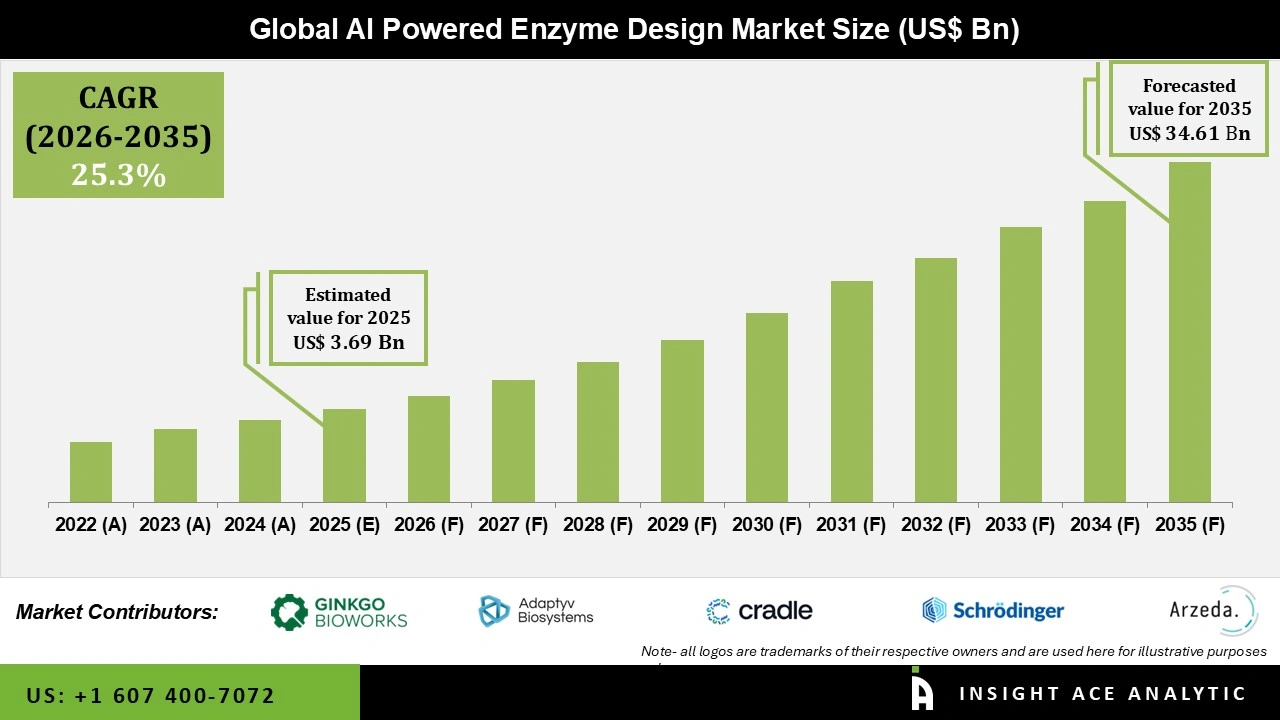
Global AI Powered Enzyme Design Market Size is valued at USD 3.69 Bn in 2025 and is predicted to reach USD 34.61 Bn by the year 2035 at a 25.3% CAGR during the forecast period for 2026 to 2035.
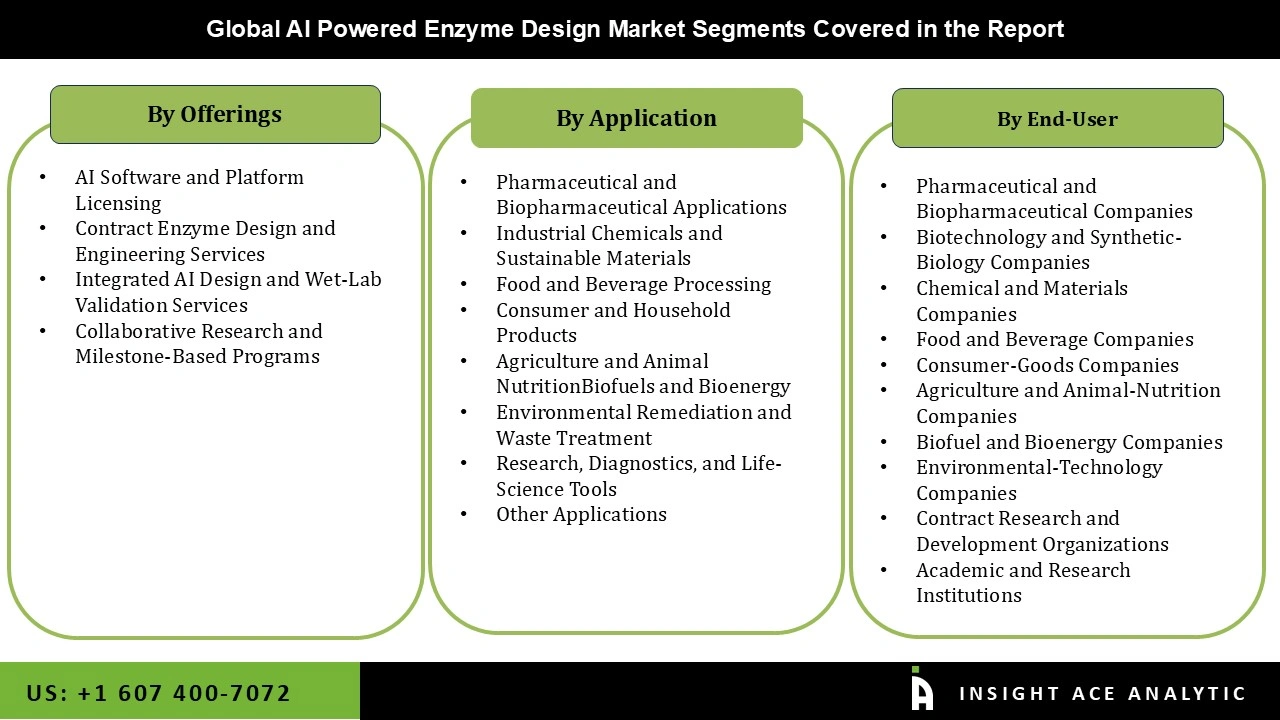
AI-Powered Enzyme Design Market Size, Share & Trends Analysis by Offering (AI Software and Platform Licensing, Contract Enzyme Design and Engineering Services, Integrated AI Design and Wet-Lab Validation Services, and Collaborative Research and Milestone-Based Programs), Application (Pharmaceutical and Biopharmaceutical Applications, Industrial Chemicals and Sustainable Materials, Food and Beverage Processing, Consumer and Household Products, Agriculture and Animal Nutrition, Biofuels and Bioenergy, Environmental Remediation and Waste Treatment, Research, Diagnostics and Life-Science Tools, and Others), End User and Segment Forecasts, 2026 to 2035.
AI-driven enzyme design is the fusion of machine learning, deep learning, and computational biology aimed at facilitating the discovery, engineering, and optimization of enzymes in industry and therapeutics. As opposed to depending exclusively on traditional in-lab techniques to discover and test enzymes, AI algorithms employ massive biological data sets to determine enzyme structures, their catalytic properties, substrate specificity, stability, and mutations without any need for prior experimentation. It greatly minimizes research time, lowers costs, and increases the likelihood of discovering highly effective enzyme candidates. AI-driven enzyme design has grown more significant than ever before in pharmaceutical manufacturing, synthetic biology, industrial biotechnology, food manufacturing, sustainable chemicals, and environmental science sectors since companies are looking for faster and better approaches to develop novel biocatalysts. With the advent of generative AI, protein language models, AlphaFold-based structure prediction, and biological foundation models, computational enzyme design has been revolutionized.
The rising investments in the field of synthetic biology and computational biotechnology will aid the market for AI powered enzyme design to grow. The pharmaceutical industry is increasingly using AI designed enzymes to optimize biocatalytic processes in drug production, whereas the manufacturing sector is using engineered enzymes for boosting efficiency and reducing carbon emissions. Also, the governments of North America, Europe, and Asia-Pacific are investing more in bioeconomy programs, sustainable manufacturing processes, and research involving AI based life sciences.
Moreover, the constant advancement in techniques such as high-throughput sequencing, protein databases, lab automation, robotic techniques, and cloud computing will improve the quality of biological data required for training AI models. With current technology in AI platforms, the predictions regarding enzyme behavior have become more accurate. This will help in reducing the development time and also boost enzyme efficiency, stability, and selectivity. Furthermore, with the increasing use of sustainable manufacturing practices and green chemistry, the use of AI in enzyme design will rise owing to the reduction in energy utilization and harmful chemical use. With further advancement in both AI algorithms and experimental validation techniques, there will be major technological innovations in the market during the forecast period.
Competitive Landscape
Which are the Leading Players in AI Powered Enzyme Design Market?
- Core Enzyme and Protein-Design Companies
- Codexis, Inc.
- Cradle B.V.
- Ginkgo Bioworks Holdings, Inc.
- Arzeda Corporation
- ZYMVOL Biomodeling S.L.
- Profluent Bio, Inc.
- Basecamp Research Ltd.
- Cambrium GmbH
- Adaptyv Bio
- EvolutionaryScale, PBC
- Broader Generative Protein-Design Companies
- Generate Biomedicines, Inc.
- Absci Corporation
- Schrödinger, Inc.
- Enabling AI and Computing Platforms
- NVIDIA Corporation – BioNeMo
- Google DeepMind – AlphaFold
Market Dynamics
Driver
Rising Adoption of AI in Protein Engineering and Synthetic Biology
One of the key growth drivers of the AI powered enzyme design market includes the increasing utilization of artificial intelligence in protein engineering and synthetic biology. Conventional enzyme discovery and optimization techniques may take several years to achieve results, involve a lot of laboratory screening procedures and may be quite expensive. AI-based solutions have brought revolutionary changes to this field as they can quickly predict protein structures, determine useful mutations and even design novel enzymes with enhanced catalytic properties. Computational techniques allow testing millions of enzyme variations online and conducting laboratory tests only after this, which reduces research costs and development timeframes.
Pharmaceutical companies use AI-designed enzymes for biocatalytic drug production, while chemical producers create eco-friendly catalysts as an alternative to traditional chemical reactions. Similarly, food and beverage manufacturers apply engineered enzymes to improve the product quality and production process, while agricultural businesses develop enzymes for increased crop yield. The application of generative AI, protein foundation models, cloud technologies, and automation of laboratory systems helps to accelerate enzyme discovery processes in multiple industries. The rising investments in sustainable biotechnology and precision protein engineering will contribute to further growth of the market during the forecast period.
Restrain/Challenge
Limited Availability of High-Quality Biological Data and Experimental Validation
Despite technological improvements, the AI-based enzyme design market has faced some challenges regarding biological data accuracy and validation of models. AI algorithms need large volumes of quality data such as proteins' sequences, structure, kinetics of enzymes and their function description for making correct predictions. Some enzyme families lack publicly available datasets, which reduces efficiency of the model for specific applications.
Moreover, computer-based predictions have to be validated experimentally before the commercial use of the product. Laboratory work is costly and requires much time and special skills, especially for new types of enzymes that have little experimental basis. Many biotechnology companies have difficulties with integration of AI platforms and laboratory equipment and need investment in special devices and knowledge.
The process of regulation approval of enzymes and biologically created products takes time, and there may be intellectual property disputes about AI-generated biological designs and data bases. Solving these issues through improved biological databases and validation of experiments is vital for future development of the market.
Contract Enzyme Design and Engineering Services Segment Is Expected to Lead the AI-Powered Enzyme Design Market
The contract enzyme design and engineering services segment is expected to account for the largest market share in 2025. This is primarily because most pharmaceutical, biotechnology, chemical, and consumer-product companies prefer to outsource specialized enzyme discovery and optimization activities rather than establish complete internal AI, computational biology, and wet-laboratory infrastructure.
Pharmaceutical and Biopharmaceutical Applications Segment Is Expected to Drive the Market
The pharmaceutical and biopharmaceutical applications segment is expected to dominate the market due to the increasing use of engineered enzymes in active pharmaceutical ingredient synthesis, nucleic-acid manufacturing, molecular diagnostics, therapeutic-enzyme development, and gene-editing technologies.
Pharmaceutical and Biopharmaceutical Companies Segment Is Expected to Hold the Largest End-User Share
Pharmaceutical and biopharmaceutical companies are expected to represent the leading end-user segment because of their high research expenditure, strong demand for improved biocatalysts, and increasing adoption of AI-supported protein-engineering platforms to shorten development timelines and improve manufacturing efficiency.
Why North America Led the AI Powered Enzyme Design Market?
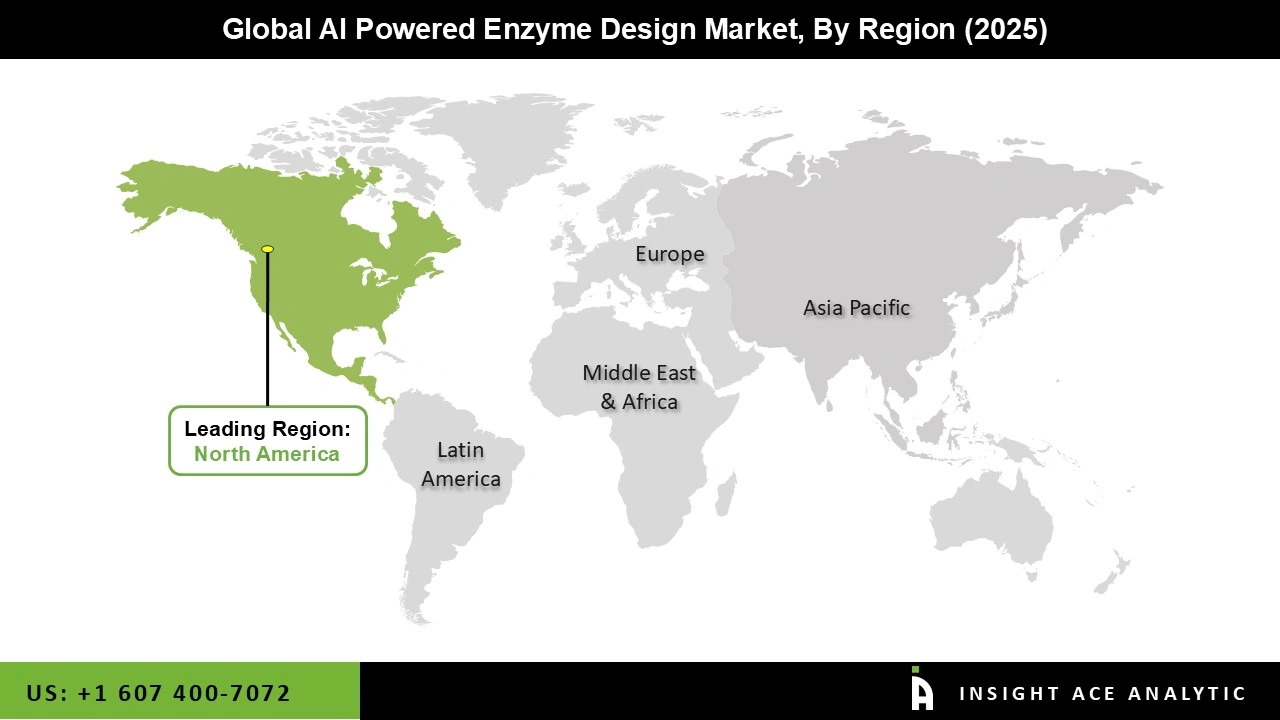
North America emerged as the dominant region in the global market of AI powered enzyme design in 2025 owing to its superior biotechnology infrastructure, high capabilities in artificial intelligence, and high expenditure on life science research. North America is a hub of many biotech companies, pharmaceutical companies, AI software firms, research institutions, and cloud computing providers who actively engage in developing AI-based protein engineering technologies.
Government initiatives towards biotech innovations, increasing investments in synthetic biology research, and venture capital financing are some other important reasons for the rapid commercialization in the region. Besides this, partnerships between pharmaceutical companies and AI start-ups have resulted in rapid development of new enzymes for drugs and industrial biotechnology processes. The region also has advanced research infrastructure, large biological databases, high usage of cloud-based AI systems, and continuous developments in the field of computational biology.
Key Development
• In April 2026, Adaptyv Bio released its API, providing programmatic access to its automated wet-lab infrastructure. The platform allows protein-design teams and AI agents to create experiments, monitor workflow status, obtain cost estimates, and retrieve structured laboratory results, supporting closed-loop AI protein and enzyme engineering.
AI Powered Enzyme Design Market Report Scope:
| Report Attribute | Specifications |
| Market size value in 2025 | USD 3.69 Bn |
| Revenue forecast in 2035 | USD 34.61 Bn |
| Growth Rate CAGR | CAGR of 25.3% from 2026 to 2035 |
| Quantitative Units | Representation of revenue in US$ Bn and CAGR from 2026 to 2035 |
| Historic Year | 2022 to 2025 |
| Forecast Year | 2026-2035 |
| Report Coverage | The forecast of revenue, the position of the company, the competitive market structure, growth prospects, and trends |
| Segments Covered | Offering, Application, End-user, and By Region |
| Regional Scope | North America; Europe; Asia Pacific; Latin America; Middle East & Africa |
| Country Scope | U.S.; Canada; U.K.; Germany; China; India; Japan; Brazil; Mexico; The UK; France; Italy; Spain; China; Japan; India; South Korea; Southeast Asia; South Korea; Southeast Asia |
| Competitive Landscape | Codexis; Cradle; Ginkgo Bioworks; Arzeda; ZYMVOL; Profluent; Basecamp Research; Cambrium; Adaptyv Bio; EvolutionaryScale; Generate Biomedicines; Absci; Schrödinger; NVIDIA BioNeMo; Google DeepMind |
| Customization Scope | Free customization report with the procurement of the report, Modifications to the regional and segment scope. Geographic competitive landscape. |
| Pricing and Available Payment Methods | Explore pricing alternatives that are customized to your particular study requirements. |
Segmentations of AI Powered Enzyme Design Market:
AI Powered Enzyme Design Market by Offerings -
- AI Software and Platform Licensing
- Contract Enzyme Design and Engineering Services
- Integrated AI Design and Wet-Lab Validation Services
- Collaborative Research and Milestone-Based Programs
AI Powered Enzyme Design Market by Application -
- Pharmaceutical and Biopharmaceutical Applications
- Small-Molecule API Biocatalysis
- Therapeutic Enzymes
- Nucleic-Acid Manufacturing Enzymes
- Gene-Editing and Molecular Biology Enzymes
- Industrial Chemicals and Sustainable Materials
- Specialty and Fine Chemicals
- Bio-Based Polymers and Materials
- Green-Chemistry Biocatalysts
- Food and Beverage Processing
- Consumer and Household Products
- Agriculture and Animal Nutrition
- Biofuels and Bioenergy
- Environmental Remediation and Waste Treatment
- Research, Diagnostics, and Life-Science Tools
- Other Applications
- Others
AI Powered Enzyme Design Market by End-user -
- Pharmaceutical and Biopharmaceutical Companies
- Biotechnology and Synthetic-Biology Companies
- Chemical and Materials Companies
- Food and Beverage Companies
- Consumer-Goods Companies
- Agriculture and Animal-Nutrition Companies
- Biofuel and Bioenergy Companies
- Environmental-Technology Companies
- Contract Research and Development Organizations
- Academic and Research Institutions
AI Powered Enzyme Design Market By Region-
- North America-
- The US
- Canada
- Europe-
- Germany
- The UK
- France
- Italy
- Spain
- Rest of Europe
- Asia-Pacific-
- China
- Japan
- India
- South Korea
- South East Asia
- Rest of Asia Pacific
- Latin America-
- Brazil
- Argentina
- Mexico
- Rest of Latin America
- Middle East and Africa-
- GCC Countries
- South Africa
- Rest of Middle East and Africa
Research Design and Approach
This study employed a multi-step, mixed-method research approach that integrates:
- Secondary research
- Primary research
- Data triangulation
- Hybrid top-down and bottom-up modelling
- Forecasting and scenario analysis
This approach ensures a balanced and validated understanding of both macro- and micro-level market factors influencing the market.
Secondary Research
Secondary research for this study involved the collection, review, and analysis of publicly available and paid data sources to build the initial fact base, understand historical market behaviour, identify data gaps, and refine the hypotheses for primary research.
Sources Consulted
Secondary data for the market study was gathered from multiple credible sources, including:
- Government databases, regulatory bodies, and public institutions
- International organizations (WHO, OECD, IMF, World Bank, etc.)
- Commercial and paid databases
- Industry associations, trade publications, and technical journals
- Company annual reports, investor presentations, press releases, and SEC filings
- Academic research papers, patents, and scientific literature
- Previous market research publications and syndicated reports
These sources were used to compile historical data, market volumes/prices, industry trends, technological developments, and competitive insights.

Primary Research
Primary research was conducted to validate secondary data, understand real-time market dynamics, capture price points and adoption trends, and verify the assumptions used in the market modelling.
Stakeholders Interviewed
Primary interviews for this study involved:
- Manufacturers and suppliers in the market value chain
- Distributors, channel partners, and integrators
- End-users / customers (e.g., hospitals, labs, enterprises, consumers, etc., depending on the market)
- Industry experts, technology specialists, consultants, and regulatory professionals
- Senior executives (CEOs, CTOs, VPs, Directors) and product managers
Interview Process
Interviews were conducted via:
- Structured and semi-structured questionnaires
- Telephonic and video interactions
- Email correspondences
- Expert consultation sessions
Primary insights were incorporated into demand modelling, pricing analysis, technology evaluation, and market share estimation.
Data Processing, Normalization, and Validation
All collected data were processed and normalized to ensure consistency and comparability across regions and time frames.
The data validation process included:
- Standardization of units (currency conversions, volume units, inflation adjustments)
- Cross-verification of data points across multiple secondary sources
- Normalization of inconsistent datasets
- Identification and resolution of data gaps
- Outlier detection and removal through algorithmic and manual checks
- Plausibility and coherence checks across segments and geographies
This ensured that the dataset used for modelling was clean, robust, and reliable.
Market Size Estimation and Data Triangulation
Bottom-Up Approach
The bottom-up approach involved aggregating segment-level data, such as:
- Company revenues
- Product-level sales
- Installed base/usage volumes
- Adoption and penetration rates
- Pricing analysis
This method was primarily used when detailed micro-level market data were available.

Top-Down Approach
The top-down approach used macro-level indicators:
- Parent market benchmarks
- Global/regional industry trends
- Economic indicators (GDP, demographics, spending patterns)
- Penetration and usage ratios
This approach was used for segments where granular data were limited or inconsistent.
Hybrid Triangulation Approach
To ensure accuracy, a triangulated hybrid model was used. This included:
- Reconciling top-down and bottom-up estimates
- Cross-checking revenues, volumes, and pricing assumptions
- Incorporating expert insights to validate segment splits and adoption rates
This multi-angle validation yielded the final market size.
Forecasting Framework and Scenario Modelling
Market forecasts were developed using a combination of time-series modelling, adoption curve analysis, and driver-based forecasting tools.
Forecasting Methods
- Time-series modelling
- S-curve and diffusion models (for emerging technologies)
- Driver-based forecasting (GDP, disposable income, adoption rates, regulatory changes)
- Price elasticity models
- Market maturity and lifecycle-based projections
Scenario Analysis
Given inherent uncertainties, three scenarios were constructed:
- Base-Case Scenario: Expected trajectory under current conditions
- Optimistic Scenario: High adoption, favourable regulation, strong economic tailwinds
- Conservative Scenario: Slow adoption, regulatory delays, economic constraints
Sensitivity testing was conducted on key variables, including pricing, demand elasticity, and regional adoption.
Request Customization
Add countries, segments, company profiles, or extend forecast — free 10% customization with purchase.
Customize This Report →Enquire Before Buying
Speak with our analyst team about scope, methodology, pricing, or deliverable formats.
Enquire Now →Frequently Asked Questions
AI Powered Enzyme Design Market Size is valued at USD 3.69 Bn in 2025 and is predicted to reach USD 34.61 Bn by the year 2035
The AI Powered Enzyme Design Market is expected to grow at a 25.3% CAGR during the forecast period for 2026 to 2035
Codexis; Cradle; Ginkgo Bioworks; Arzeda; ZYMVOL; Profluent; Basecamp Research; Cambrium; Adaptyv Bio; EvolutionaryScale; Generate Biomedicines; Absci; Schrödinger; NVIDIA BioNeMo; Google DeepMind and Others.
AI Powered Enzyme Design Market is segmented into Offering, Application, End-user, and Other.
North America region is leading the AI Powered Enzyme Design Market.