AI-Integrated Sustainable and Regenerative Beauty Market Size, Share, Trend, Revenue Report 2026 to 2035
What is AI-Integrated Sustainable and Regenerative Beauty Market Size?
Global AI-Integrated Sustainable and Regenerative Beauty Market Size is predicted to grow at a 23.0% CAGR during the forecast period for 2026 to 2035.
AI-Integrated Sustainable & Regenerative Beauty Market, Share & Trends Analysis Report, By AI Function (AI Formulation & R&D, AI Personalization, Diagnostics & Virtual Try-On, AI-Enabled Smart Devices / Tools, AI Supply Chain & Sustainability Optimization), By Sustainability / Regeneration Modality, Regenerative & Biotech Ingredients, Circular & Low-Carbon Packaging / Materials, Blue/Ocean-Safe & Biodiversity-Positive, Low-Waste, Refillable & Recyclable Systems), By Product Type, By Distribution Channel, By End User, By Region, and Segment Forecasts, 2026 to 2035.
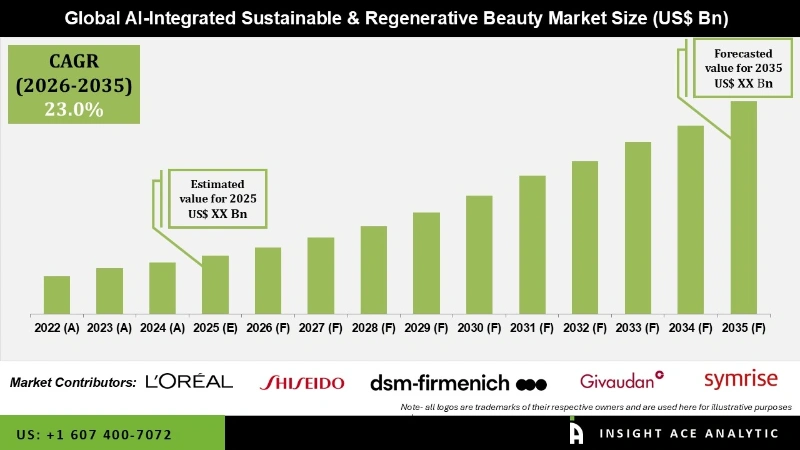
AI-Integrated Sustainable and Regenerative Beauty Market Key Takeaways:
|
An innovative approach called AI-Integrated Sustainable & Regenerative Beauty uses artificial intelligence (AI) to promote regenerative and sustainable practices in the beauty sector. It uses AI with eco-friendly ideas to create products and processes that lower environmental impact, renew resources, and deliver personalized, high-performance solutions. In this context, "sustainable beauty" refers to safe, environmentally friendly products made using eco-friendly materials, packaging, and production techniques that lessen waste, carbon emissions, and resource depletion.
Artificial intelligence (AI) is essential in identifying sustainable, bio-based, or upcycled substitutes for synthetic or ecologically hazardous chemicals by evaluating enormous datasets of ingredients, scientific literature, and biological supplies. Predicting customer demand and optimizing production reduces overproduction and material waste, which further improves manufacturing. Furthermore, by analyzing the environmental impact of ingredients and procedures at each level, AI-powered lifecycle assessments improve supply chain sustainability and ethical sourcing.
In AI-integrated sustainable and regenerative beauty, recent innovations include AI-driven skin and hair diagnostics that allow precise product recommendations, reducing trial-and-error purchases and associated waste; digital platforms that track ingredient origins and carbon footprints; and the adoption of regenerative, bio-based ingredients sourced from renewable or upcycled feedstocks. The industry is driven by rising consumer demand for transparency and personalization, stricter regulations on microplastics and packaging waste, and the industry’s shift toward regenerative, bio-based ingredients.
Emerging trends like hormone-responsive skincare, wearable nanotechnology, gene-informed products, and prejuvenation are driving innovation in the future of beauty, which is developing into a holistic ecosystem that combines health, emotional well-being, and personalization.
Competitive Landscape
Some of the Major Key Players in the AI-Integrated Sustainable & Regenerative Beauty Market are
· L’Oréal
· Shiseido
· DSM-Firmenich
· Symrise
· Givaudan
· Croda
· Evonik
· Arcaea
· LipoTrue
· Perfect Corp
· Revieve
· Proven Skincare
· Dcypher
· IL MAKIAGE
· Function of Beauty
· Curology
· Sephora
· Amorepacific
· Foreo
· Unilever
· P&G Beauty
· Beiersdorf
· Kao
· Coty
· Estée Lauder Companies
· LVMH Beauty
· OneSkin
· Augustinus Bader
· LYMA
· Noble Panacea
Market Segmentation
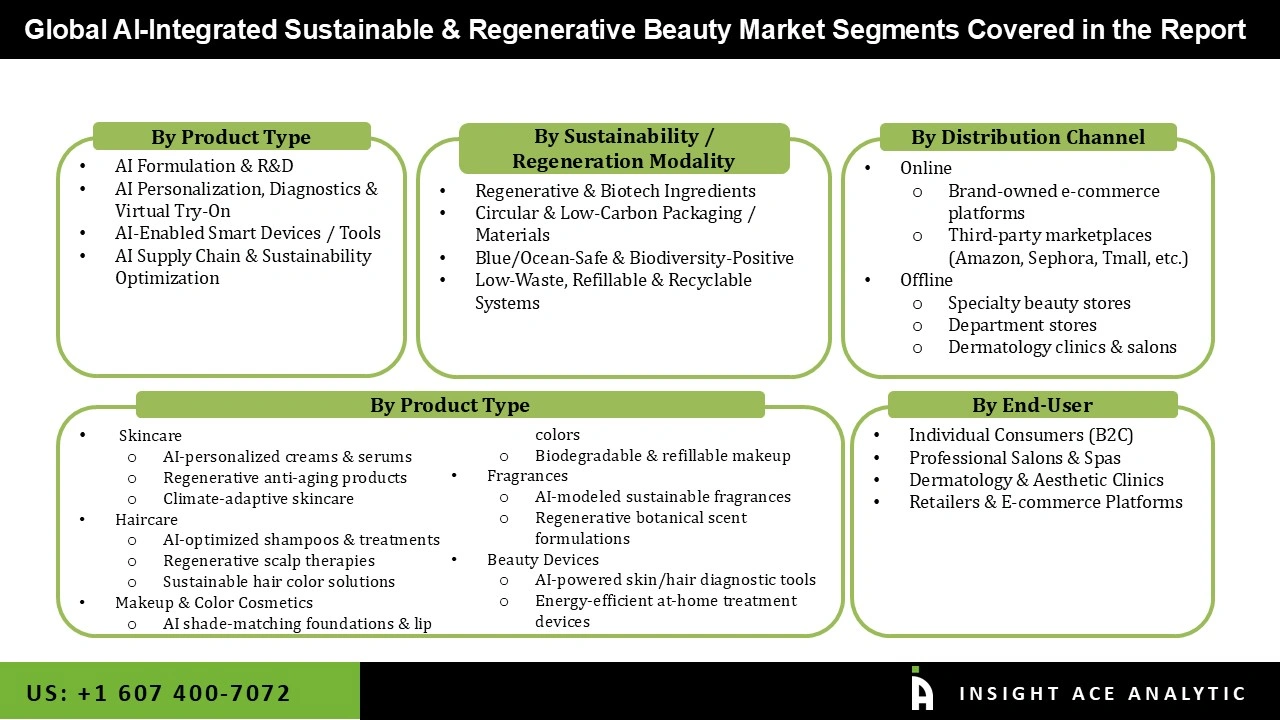
The AI-Integrated Sustainable & Regenerative Beauty Market is segmented into AI function, sustainability/regeneration modality, product type, distribution channel, and end user. Based on the AI function, the market is segmented into AI formulation & R&D, AI personalization, diagnostics & virtual try-on, AI-enabled smart devices/tools, AI supply chain & sustainability optimization. Based on the sustainability/regeneration, the market is divided into modality, regenerative & biotech ingredients, circular & low-carbon packaging/materials, blue/ocean-safe & biodiversity-positive, low-waste, refillable & recyclable systems. Based on the product type, the market is divided into skincare, haircare, makeup & color cosmetics, fragrances, and beauty devices. Based on the distribution channel, the market is divided into online, offline. Based on the End User, the market is divided into individual consumers (B2C), professional salons & spas, dermatology & aesthetic clinics, retailers & e-commerce platforms
The AI Personalization, Diagnostics & Virtual Try-On Segment is Expected to Have the Highest Growth Rate During the Forecast Period
Personalization and virtual try-ons leverage advanced AI technologies such as machine learning, computer vision, and 3D facial mapping to deliver tailored beauty experiences. Personalized products help reduce overconsumption and waste by ensuring consumers purchase only what suits their unique needs, while virtual try-ons, powered by augmented reality (AR) and AI, allow users to digitally test makeup, hair colors, or skincare products, replicating the in-store experience from home. By customizing product recommendations and enabling digital trials, these solutions minimize returns, overproduction, and physical waste, aligning with regenerative beauty’s emphasis on resource conservation. Their ability to satisfy consumer demand for bespoke experiences, lower environmental impact, and drive substantial sales growth has made personalization and virtual try-on technologies the leading segment in the AI-integrated sustainable and regenerative beauty market.
The Skincare Segment Dominates the Market
The skincare industry dominates the AI-integrated sustainable and regenerative beauty market due to its broad customer demand, effectiveness, and strong connection to personalization. Because AI is so good at tailoring skincare ingredients and formulae to each person's unique skin type, its personalization skills are especially important in this market. AI-enhanced diagnostics and formulation greatly increase trust and performance, as consumers place a high value on safe and effective products. The category's potential is further enhanced by its widespread market use, which includes everyday items such as cleansers, moisturizers, serums, and sunscreens. Furthermore, skincare's leading position in the market is strengthened by the constant feedback loop between customers and brands, which is driven by AI analysis and allows for quick innovation and product iteration.
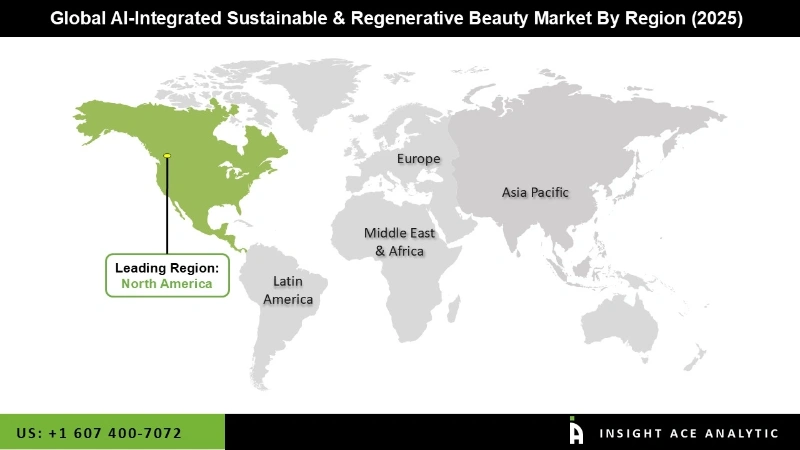
North America Has the Largest Market Share During the Forecast Period.
North America dominates the AI-integrated sustainable and regenerative beauty market, driven by strong regulatory support, including FDA guidelines and Extended Producer Responsibility (EPR) policies that push brands toward eco-friendly practices. The region’s tech-savvy, sustainability-focused consumers are embracing AI-powered personalization tools and virtual try-ons, which reduce product waste and enhance tailored experiences. In addition, leading brands are pioneering circular business models, leveraging AI for demand forecasting and inventory optimisation to minimise overproduction and packaging waste. These technologies deliver strong financial returns, with personalisation and virtual try-ons boosting conversion rates by up to 40% and reducing product returns, which in turn lowers environmental impact and supports sustainability goals.
Recent Developments:
· In March 2025, LipoTrue unveiled a marine ferment that reinterprets the source of hyaluronic acid and a peptide created using artificial intelligence to improve cellular lifetime; both are poised to transform the skincare sector. CellaigieTM, a revolutionary AI-designed peptide from LipoTrue, stimulates autophagy, the skin's natural recycling and rejuvenation mechanism. CellaigieTM uses the same clever process to prolong skin life, drawing inspiration from popular biohacking practices like fasting and high-intensity interval training (HIIT), which maximize energy utilization and cellular efficiency. It encourages deep rejuvenation by removing damaged components from cells, leaving skin smoother, more luminous, and noticeably healthier.
· In May 2024, L’Oréal introduced breakthroughs that provide "Beauty for Each, Powered by Beauty Tech." These include a line of advanced skin and hair diagnostics, a personal beauty assistant driven by GenAI, a GenAI Beauty Content Lab called CREAITECH to enhance creativity, a cutting-edge infrared light-based hair dryer, a micro-resurfacing tool for advanced skincare performance, and the most lifelike, human-like technology platform for product testing and scientific research.
AI-Integrated Sustainable & Regenerative Beauty Market Report Scope
| Report Attribute | Specifications |
| Growth Rate CAGR | CAGR of 23.0% from 2026 to 2035 |
| Quantitative Units | Representation of revenue in US$ Mn and CAGR from 2026 to 2035 |
| Historic Year | 2022 to 2025 |
| Forecast Year | 2026-2035 |
| Report Coverage | The forecast of revenue, the position of the company, the competitive market structure, growth prospects, and trends |
| Segments Covered | By AI Function, Sustainability / Regeneration Modality, Product Type, Distribution Channel, End User |
| Regional Scope | North America; Europe; Asia Pacific; Latin America; Middle East & Africa |
| Country Scope | U.S.; Canada; U.K.; Germany; China; India; Japan; Brazil; Mexico; The UK; France; Italy; Spain; China; Japan; India; South Korea; Southeast Asia; South Korea; South East Asia |
| Competitive Landscape | L’Oréal, Shiseido, DSM-Firmenich, Symrise, Givaudan, Croda, Evonik, Arcaea, LipoTrue, Perfect Corp, Revieve, Proven Skincare, Dcypher, IL MAKIAGE, Function of Beauty, Curology, Sephora, Amorepacific, Foreo, Unilever, P&G Beauty, Beiersdorf, Kao, Coty, Estée Lauder Companies, LVMH Beauty, OneSkin, Augustinus Bader, LYMA, Noble Panacea |
| Customization Scope | Free customization report with the procurement of the report and modifications to the regional and segment scope. Particular Geographic competitive landscape. |
| Pricing and Available Payment Methods | Explore pricing alternatives that are customized to your particular study requirements. |
Segmentation of the AI-Integrated Sustainable & Regenerative Beauty Market-
Global AI-Integrated Sustainable & Regenerative Beauty Market - By AI Function
· AI Formulation & R&D
· AI Personalization, Diagnostics & Virtual Try-On
· AI-Enabled Smart Devices / Tools
· AI Supply Chain & Sustainability Optimization
Global AI-Integrated Sustainable & Regenerative Beauty Market – By Sustainability / Regeneration Modality
· Regenerative & Biotech Ingredients
· Circular & Low-Carbon Packaging / Materials
· Blue/Ocean-Safe & Biodiversity-Positive
· Low-Waste, Refillable & Recyclable Systems
Global AI-Integrated Sustainable & Regenerative Beauty Market – By Product Type
· Skincare
o AI-personalized creams & serums
o Regenerative anti-aging products
o Climate-adaptive skincare
· Haircare
o AI-optimized shampoos & treatments
o Regenerative scalp therapies
o Sustainable hair color solutions
· Makeup & Color Cosmetics
o AI shade-matching foundations & lip colors
o Biodegradable & refillable makeup
· Fragrances
o AI-modeled sustainable fragrances
o Regenerative botanical scent formulations
· Beauty Devices
o AI-powered skin/hair diagnostic tools
o Energy-efficient at-home treatment devices
Global AI-Integrated Sustainable & Regenerative Beauty Market- By Distribution Channel
· Online
o Brand-owned e-commerce platforms
o Third-party marketplaces (Amazon, Sephora, Tmall, etc.)
· Offline
o Specialty beauty stores
o Department stores
o Dermatology clinics & salons
Global AI-Integrated Sustainable & Regenerative Beauty Market – By End User
· Individual Consumers (B2C)
· Professional Salons & Spas
· Dermatology & Aesthetic Clinics
· Retailers & E-commerce Platforms
Global AI-Integrated Sustainable & Regenerative Beauty Market – By Region
North America-
· The US
· Canada
Europe-
· Germany
· The UK
· France
· Italy
· Spain
· Rest of Europe
Asia-Pacific-
· China
· Japan
· India
· South Korea
· Southeast Asia
· Rest of Asia Pacific
Latin America-
· Brazil
· Argentina
· Mexico
· Rest of Latin America
Middle East & Africa-
· GCC Countries
· South Africa
· Rest of the Middle East and Africa
Research Design and Approach
This study employed a multi-step, mixed-method research approach that integrates:
- Secondary research
- Primary research
- Data triangulation
- Hybrid top-down and bottom-up modelling
- Forecasting and scenario analysis
This approach ensures a balanced and validated understanding of both macro- and micro-level market factors influencing the market.
Secondary Research
Secondary research for this study involved the collection, review, and analysis of publicly available and paid data sources to build the initial fact base, understand historical market behaviour, identify data gaps, and refine the hypotheses for primary research.
Sources Consulted
Secondary data for the market study was gathered from multiple credible sources, including:
- Government databases, regulatory bodies, and public institutions
- International organizations (WHO, OECD, IMF, World Bank, etc.)
- Commercial and paid databases
- Industry associations, trade publications, and technical journals
- Company annual reports, investor presentations, press releases, and SEC filings
- Academic research papers, patents, and scientific literature
- Previous market research publications and syndicated reports
These sources were used to compile historical data, market volumes/prices, industry trends, technological developments, and competitive insights.

Primary Research
Primary research was conducted to validate secondary data, understand real-time market dynamics, capture price points and adoption trends, and verify the assumptions used in the market modelling.
Stakeholders Interviewed
Primary interviews for this study involved:
- Manufacturers and suppliers in the market value chain
- Distributors, channel partners, and integrators
- End-users / customers (e.g., hospitals, labs, enterprises, consumers, etc., depending on the market)
- Industry experts, technology specialists, consultants, and regulatory professionals
- Senior executives (CEOs, CTOs, VPs, Directors) and product managers
Interview Process
Interviews were conducted via:
- Structured and semi-structured questionnaires
- Telephonic and video interactions
- Email correspondences
- Expert consultation sessions
Primary insights were incorporated into demand modelling, pricing analysis, technology evaluation, and market share estimation.
Data Processing, Normalization, and Validation
All collected data were processed and normalized to ensure consistency and comparability across regions and time frames.
The data validation process included:
- Standardization of units (currency conversions, volume units, inflation adjustments)
- Cross-verification of data points across multiple secondary sources
- Normalization of inconsistent datasets
- Identification and resolution of data gaps
- Outlier detection and removal through algorithmic and manual checks
- Plausibility and coherence checks across segments and geographies
This ensured that the dataset used for modelling was clean, robust, and reliable.
Market Size Estimation and Data Triangulation
Bottom-Up Approach
The bottom-up approach involved aggregating segment-level data, such as:
- Company revenues
- Product-level sales
- Installed base/usage volumes
- Adoption and penetration rates
- Pricing analysis
This method was primarily used when detailed micro-level market data were available.

Top-Down Approach
The top-down approach used macro-level indicators:
- Parent market benchmarks
- Global/regional industry trends
- Economic indicators (GDP, demographics, spending patterns)
- Penetration and usage ratios
This approach was used for segments where granular data were limited or inconsistent.
Hybrid Triangulation Approach
To ensure accuracy, a triangulated hybrid model was used. This included:
- Reconciling top-down and bottom-up estimates
- Cross-checking revenues, volumes, and pricing assumptions
- Incorporating expert insights to validate segment splits and adoption rates
This multi-angle validation yielded the final market size.
Forecasting Framework and Scenario Modelling
Market forecasts were developed using a combination of time-series modelling, adoption curve analysis, and driver-based forecasting tools.
Forecasting Methods
- Time-series modelling
- S-curve and diffusion models (for emerging technologies)
- Driver-based forecasting (GDP, disposable income, adoption rates, regulatory changes)
- Price elasticity models
- Market maturity and lifecycle-based projections
Scenario Analysis
Given inherent uncertainties, three scenarios were constructed:
- Base-Case Scenario: Expected trajectory under current conditions
- Optimistic Scenario: High adoption, favourable regulation, strong economic tailwinds
- Conservative Scenario: Slow adoption, regulatory delays, economic constraints
Sensitivity testing was conducted on key variables, including pricing, demand elasticity, and regional adoption.
Request Customization
Add countries, segments, company profiles, or extend forecast — free 10% customization with purchase.
Customize This Report →Enquire Before Buying
Speak with our analyst team about scope, methodology, pricing, or deliverable formats.
Enquire Now →Frequently Asked Questions
AI-Integrated Sustainable & Regenerative Beauty Market Size is predicted to grow at a 23.0% CAGR during the forecast period for 2026-2035.
L’Oréal, Shiseido, DSM-Firmenich, Symrise, Givaudan, Croda, Evonik, Arcaea, LipoTrue, Perfect Corp, Revieve, Proven Skincare, Dcypher, IL MAKIAGE, Function of Beauty, Curology, Sephora, Amorepacific, Foreo, Unilever
AI-Integrated Sustainable & Regenerative Beauty Market is segmented into AI function, sustainability/regeneration modality, product type, distribution channel, and end user.
North America region is leading the AI-Integrated Sustainable & Regenerative Beauty Market.